
Two suppliers quote the same description: “EVA puzzle mat, 10 mm, blue.” One price includes a retail set with border strips and printed packaging. The other covers loose tiles in a bulk carton. The lower number tells you little until you know what each supplier has priced.
A useful request for quotation, or RFQ, gives suppliers the same product brief and asks them to return prices on the same basis. It also makes unfinished decisions visible, so suppliers can propose options without quietly changing your requirements.
A foam mat RFQ should identify the intended use, finished construction, dimensions, performance requirements, artwork, packaging, quantities, and delivery basis. Ask suppliers to state their assumptions, deviations, minimum order quantities, and separate development costs alongside the unit price.
You do not need a complete laboratory specification to start. You do need enough information to distinguish a budget estimate from a quotation for a defined product.
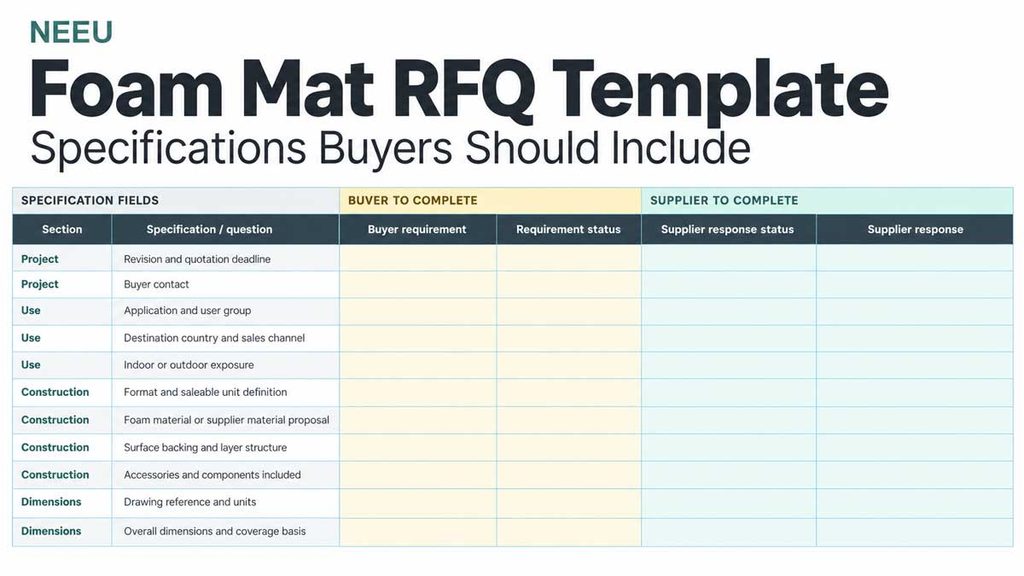
It includes a blank worksheet and a completed buyer example. Use one copy per SKU and mark undecided specifications as “Supplier to propose.”
Start With the Product You Will Sell or Use
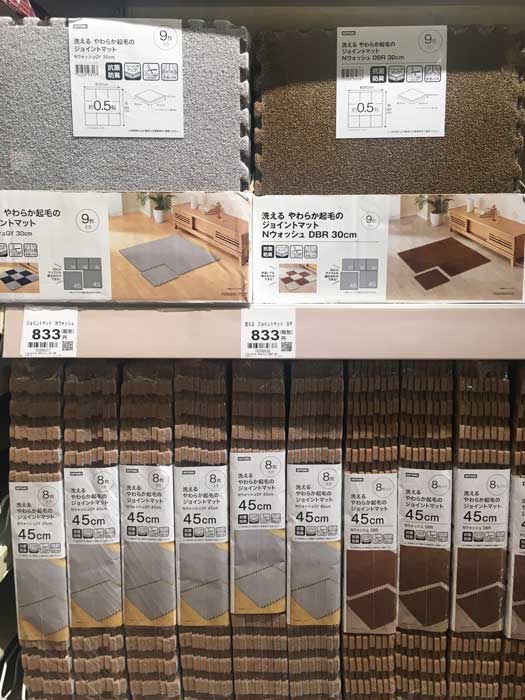
Describe the saleable unit before listing material properties. Is it a single exercise mat, a six-tile retail set, a foldable play mat, or a roll supplied for further cutting?
Include the application, expected user, destination market, and sales channel. A home play-mat program, a studio exercise mat, and a pad under equipment may need different constructions, packaging, and evidence, even when all three start with foam.
Use a project code and revision date on the brief, drawings, and artwork. When several sizes or colors are involved, give each SKU its own quantity and specification row. A folder of unlabelled photographs makes it difficult to tell which version the supplier has quoted.
Mark requirements with one of three statuses:
- Required: quote this specification and flag any inability to meet it.
- Supplier to propose: recommend an option, explain the basis and price it separately.
- Reference only: use the image or sample for direction, not as an exact specification.
For example, a reference tile may show the preferred texture while the color and tooth profile remain open. Say so. Otherwise, one supplier may price a standard tile, and another may allow for new tooling.
NEEU’s design and customization capabilities provide a starting point for discussing material, format, surface, and packaging choices. The RFQ should identify which of those choices belong in the base quotation.
Foam Mat RFQ Template
Copy this table into your sourcing brief. Fill in the decisions already made and use “supplier to propose” where you need advice. Keep one specification sheet per SKU, with a separate summary for the total order.
| RFQ field | Information the buyer should provide | What the supplier should return |
|---|---|---|
| Project identity | Project code, SKU, revision, buyer contact and quotation deadline | Quotation reference and the revision priced |
| Intended use | Application, user group, market, indoor/outdoor conditions and sales channel | Suitability comments and unresolved questions |
| Product format | Tile, roll, foldable mat or single-piece pad; definition of the saleable unit | Proposed format and included components |
| Construction | Foam material or open material brief; surface, backing, layers and accessories | Layer description and any alternatives |
| Dimensions | Drawing, nominal dimensions, thickness basis, tolerances or tolerance proposal request | Offered dimensions, measurement basis and achievable tolerances |
| Assembly | Tooth profile, border count, fold layout or required compatibility | Tooling needs and proposed assembly arrangement |
| Physical properties | Required density/hardness basis and application-specific performance checks | Offered values, methods, units, available reports and tests still needed |
| Surface and artwork | Texture reference, colors, artwork revision, print locations and orientation | Proposed process, artwork limitations and setup costs |
| Care and exposure | Expected spills, cleaning routine, moisture, loads or storage conditions | Recommended cleaning instructions and checks needed |
| Compliance evidence | Destination, product classification, buyer requirements and required documents | Available evidence, coverage gaps and cost of new testing |
| Retail packaging | Pieces per set, borders, accessories, pack type, labels and barcode files | Packing configuration and packaging costs |
| Shipping packaging | Sets per carton, carton/pallet limits and receiving requirements | Estimated packed dimensions, weights and shipment volume |
| Quantity | First order and price-break quantities by SKU/color; forecast marked separately | MOQ by variant and price at each requested quantity |
| Sampling and tooling | Sample purpose, quantity, delivery location and tooling questions | Fees, timing, courier costs and any credit conditions |
| Commercial terms | Currency, price unit, requested delivery rule/place and payment request | Price validity, inclusions, exclusions and payment proposal |
| Schedule | Sample-review date, required ship-ready date and destination arrival target | Milestones, lead-time start conditions and dependencies |
| Exceptions | Fields still open and permission to propose alternatives | Itemized assumptions, deviations and separately priced options |
For a quick first inquiry, start with format, application, size, preferred material and layers, quantity, packaging and destination. A supplier can then identify the decisions needed for a firmer quotation.
A completed buyer example
The following is a hypothetical inquiry for a private-label exercise mat, not a NEEU specification or quotation. The Excel file expands it into all 47 fields. Supplier-response cells remain blank because no supplier has quoted this example.
| Field | Example buyer requirement |
|---|---|
| Project | EXERCISE-01, revision A; one SKU; quotation requested within seven calendar days of receipt |
| Use | Adult indoor home exercise; US direct-to-consumer sales; kneeling and floor exercises, not equipment flooring |
| Saleable unit | One mat, one carry strap and one instruction sheet in a paper sleeve |
| Material and layers | Supplier to propose EVA or TPE construction; identify foam, surface and backing separately |
| Size | Finished mat 1,800 x 600 x 10 mm; thickness includes all layers; supplier to propose tolerances and measurement conditions |
| Feel and performance | Comfortable kneeling and stable floor contact; propose hardness options, scale and method, plus grip, load-recovery and cleaning checks |
| Appearance | Solid blue; supplier to propose color swatches and texture; single-color logo in a 100 x 40 mm print area, centered 50 mm from one short edge |
| Quantity | First order 1,000 units; also quote 2,000 and 5,000; state MOQ for this color and pack; no annual volume commitment |
| Packaging | Rolled mat with strap, instruction sheet and sleeve; propose units per carton; report estimated carton dimensions, weights and total shipment volume |
| Evidence | Identify reports covering the proposed finished construction and gaps against the stated use and market; quote any new testing separately |
| Samples | Three development samples; state sample and courier charges; dispatch address to be confirmed before sending |
| Price and delivery | USD per complete retail unit; propose FCA named handover point, Incoterms 2020; list exclusions and one-time charges |
| Timing | Target ship-ready within 60 calendar days after sample/artwork approval and agreed deposit; confirm feasibility and production start conditions; destination arrival date remains open |
The brief fixes the saleable unit, quantity and intended use while leaving material, tolerances and test methods open for supplier advice. If two constructions are proposed, request a separate price and specification for each.
Specify the Finished Construction, Not Just the Foam Name
“EVA,” “XPE,” or “TPE” identifies a material direction. It does not fully describe the product being priced. Include the exposed surface, backing, and any printing, film, textile, or other attached layer.
For interlocking sets, list the tile count, border pieces, color assortment, and intended layout. If new tiles must fit an existing product, provide a physical reference and identify its revision. Matching nominal size alone is not enough to ensure compatibility.
For foldable mats, include open and folded dimensions, panel arrangement, fold direction, and carrying accessories. For rolls, state width, usable length, thickness, and whether the order is priced per roll or per unit area.
If the material is undecided, explain the priority rather than asking for “the best foam.” For example:
Please propose a construction for an indoor exercise mat, prioritizing stable floor contact, comfortable kneeling and compact rolled packaging. Identify the material, surface and backing in each option, and quote alternatives separately.
Put Numbers, Methods and Open Decisions Together
An RFQ should give measurable requirements where they matter, without filling every blank with an arbitrary target.
Dimensions and thickness
State units and label the dimensions. For puzzle tiles, distinguish the overall size including teeth from the dimension used to calculate installed coverage. For layered mats, say whether thickness includes the finished surface and backing.
Where fit matters, attach a drawing with tooth geometry, border arrangement, hole positions or fold lines. Ask for proposed measurement locations and tolerances if these have not been established. A tolerance request is more useful than discovering after sampling that different suppliers measured different parts of the mat.
Density, hardness and recovery
Specify density units and whether the requirement applies to the core or another defined construction. Hardness needs a named scale or instrument and an agreed method; “hardness 45” leaves too much unresolved.
If the mat will sit under equipment, specify recovery after sustained loading separately from rebound. A foam that performs well in a ball-rebound test may still recover differently after prolonged compression. EVA/nylon-elastomer formulation comparisons show that these properties can change in opposite directions.[1] Ask for the load, duration, and recovery conditions used to evaluate indentation, rather than accepting “high rebound” as the answer.
When the target feel is still open, provide a reference sample and request a small, clearly identified range of options. The hardness and thickness specification guide explains how to frame that decision without using one number to fully describe comfort or support.
Testing and exposure
List the response you need to evaluate: wet grip, repeated folding, tear at a joint, recovery after loading, cleaner compatibility, or another relevant property. Add a method and limit where already agreed; otherwise ask the supplier to identify a suitable evaluation route and its cost.
Water uptake also varies with formulation and cell integrity in EVA-based blends.[2] If water resistance matters, identify whether you need low absorption into the foam, resistance to surface changes after wiping, or reduced leakage through an assembled set. Those requirements need different observations.
Ask suppliers to distinguish existing test evidence from testing proposed for your project. When a report is offered, check the sample description and conditions using the guide to reading a foam mat test report. The RFQ stage identifies the evidence needed; it does not approve a result you have not yet reviewed.
Make Artwork, Packaging and Quantities Quoteable
Artwork and pack-out details can change a quotation’s scope as much as the foam itself.
For printing, provide the artwork revision, location, print area, orientation, and colors. If the final file is not ready, mark the quoted artwork as provisional and ask which changes could affect price or timing. Identify any pattern that must align across panels or tiles.
For retail packaging, define exactly what the customer receives. A “set” might include six tiles, twelve border strips, an instruction sheet, and a carry bag. List those components rather than assuming they are standard inclusions.
Then define the shipping unit: sets per carton, mixed or single-SKU cartons, carton labels, maximum size or weight, and any pallet requirements. GS1’s packaging-level guidance distinguishes consumer units from cases and other packaging levels. Where your trading partner uses these identifiers, provide the correct barcode files and labeling requirements for each relevant level.
Request estimated packed dimensions, gross weight, and total shipment volume with the quote. A preliminary estimate should be identified as such and confirmed after pack-out approval. For bulky mats, a unit-price comparison without packaging data leaves a key part of the shipping calculation incomplete.
Separate these quantities:
- initial order by SKU, color, and pack type;
- quantities at which you want alternative prices;
- repeat-order expectations or an annual forecast;
- minimum quantities the supplier requires for a formulation, color, print run, or packaging item.
A forecast helps explain the program, but it is not the same as a committed first order. Ask whether mixed variants can count toward the stated MOQ and whether any components have separate purchasing minimums.
Request a Price With Clear Inclusions and Timing
Ask suppliers to return a quotation breakdown, not only a total.
Separate the recurring product price from samples, tooling, print setup, testing, and other development costs. If a fee may be credited against an order, request the qualifying quantity, timing, and other conditions in writing. Also ask who owns the paid tooling, where it is stored, and what future maintenance or replacement costs may apply.
State the pricing unit and currency. “USD per tile” and “USD per retail set” are different offers. For roll material, confirm the usable area or length included in that unit.
Delivery terms need a named place
Request the delivery rule, named port/place or point, and edition together, such as FCA [named place], Incoterms 2020. Have the supplier confirm that the proposed rule fits the shipment arrangement.
Incoterms allocate specified delivery obligations, costs and risk; they do not define the product specification, payment terms or ownership transfer. Those matters need separate agreement. The ICC’s explanation of Incoterms clarifies these boundaries.
For delivered-price proposals, ask which freight, insurance, clearance, duty, tax or destination charges are included or excluded under the quoted arrangement. Identify whether freight is fixed for the quotation period or will be reconfirmed at booking. An attractive factory price is not the same calculation as the cost of receiving goods at your warehouse.
Ask what starts the lead-time clock
“Thirty days” is incomplete unless you know the starting event and endpoint. Request separate timing for development samples, tooling, production, inspection, and shipment readiness.
Ask whether production lead time starts after deposit, specification agreement, artwork approval, sample approval, or another defined milestone. Give the required ship-ready date and any destination arrival target separately. Do not hide transit and customs clearance inside a factory production estimate.
Include quotation validity and payment milestones. Before ordering, record the agreed specification revision, price, inclusions, and delivery terms in the purchase order and supplier order confirmation. Resolve any differences between them. The U.S. International Trade Administration’s export-sale guidance explains how quotations and pro forma invoices support this negotiation.
Compare Supplier Responses Before Comparing Prices
The Excel template has a separate Supplier response status column: Meets requirement, Deviation, Supplier proposal, Pending confirmation, or N/A. These describe the supplier’s reply, not the buyer’s requirement status. Ask for an explanation of deviations, proposals, and pending items. Use N/A only when both parties agree the field does not apply.
Start by checking the quoted revision, saleable unit, and quantity. Then compare construction, packaging, evidence, development charges, delivery basis, and timing. Keep optional upgrades outside the base price.
Consider this illustrative comparison:
| Quotation detail | Supplier A | Supplier B | Buyer action |
|---|---|---|---|
| Price unit | Retail set including borders | Loose tile | Request the same complete set from both |
| Surface | Printed film included | Bare foam | Align the finished construction |
| Packaging | Retail bag and export carton | Bulk carton only | Identify packaging additions and revised packed volume |
| Lead time | From sample approval | From deposit, artwork still pending | Agree on equivalent start and end milestones |
| Testing | New project testing separately priced | Existing material report supplied | Confirm sample coverage and price the remaining evidence |
If a supplier proposes a cheaper material or packing configuration, evaluate it as an alternative. Ask for differences in performance, appearance, packaging, and verification rather than letting it silently replace the requested product.
Send the RFQ, Then Move Into Sample Approval
You can use this email with the completed specification sheet:
Subject: Foam mat RFQ - [project/SKU] - [revision]

Please quote the attached specification at the listed order quantities.
Use the stated saleable unit, packaging and delivery basis.

In your reply, please identify:
- the construction and revision priced;
- MOQ by SKU/color and unit prices at each quantity;
- sample, tooling, setup and testing charges;
- estimated packed dimensions, weights and shipment volume;
- sample and production timing, including start conditions;
- quotation validity and payment proposal;
- assumptions, deviations and separately priced alternatives.

Fields marked "supplier to propose" remain open. Please explain your
recommendation. Flag any missing information that prevents a firm quote.

Please respond by [date]. Attach relevant drawings or product information
and identify which test evidence matches the proposed construction.
Complete the blank Excel worksheet for your own SKU, retaining the revision sent to each supplier. The example tab shows how to record open decisions without inventing technical targets or supplier answers.
Once you’ve selected a construction and quotation basis, move the agreed requirements into the foam mat sample approval checklist. That next stage confirms the actual sample, tolerances, evidence, and production-release decision. An RFQ gathers proposals; sample approval establishes the reference for what will be made.
Frequently Asked Questions
Yes. Describe the application, size, load or contact conditions, preferred feel, and reference product. Mark the material properties as supplier proposals. Treat the resulting price as provisional until you agree on the construction and requirements.
It can communicate format or appearance, but it rarely provides all the information needed for a quote. Identify what you want to match and provide dimensions, pack contents, and a physical reference where needed. Confirm that you have permission to use any artwork supplied for reproduction.
Ask for the MOQ per SKU, color, thickness, print design and packaging variant, plus whether variants can be combined. A single minimum order figure may not describe all the choices in your program.
Include the evidence required for the intended product and market. Ask what already exists, what it covers, and what needs new testing. Budget for the gaps rather than ordering an unrelated standard test package by default.
No. It starts the comparison. Carry accepted proposals and resolved exceptions into the controlled specification, order documents, and sample-approval record before releasing production.
Request a Foam Mat Quotation
Send NEEU your completed brief, drawings, reference images, quantity breakdown, and packaging requirements. Identify the decisions still open and the date by which you need the quotation. A clear brief keeps the discussion focused on construction, costs, and your project’s next steps.
Research References
- Huang, G., Gui, Y., Li, Y., et al. (2021). Preparation and Characterization of EVA/Nylon Elastomer Microcellular Foaming Materials. China Plastics, 35(9), 1-7. DOI: 10.19491/j.issn.1001-9278.2021.09.001. The formulation comparisons concern chemically foamed EVA/PEBAX materials developed for footwear; they illustrate differing property responses, not targets for commercial foam mats. ↩︎
- Fu, D., Xu, J., Cai, Q., Li, G., Zhong, J., and Wang, G. (2024). Preparation and properties of radiation-crosslinked EVA/OBC foam materials. China Elastomerics, 34(6), 49-54. DOI: 10.16665/j.cnki.issn1005-3174.2024.06.007. Water-uptake findings concern the tested EVA/OBC blend series, not a universal absorption value for EVA or a NEEU product result. ↩︎