
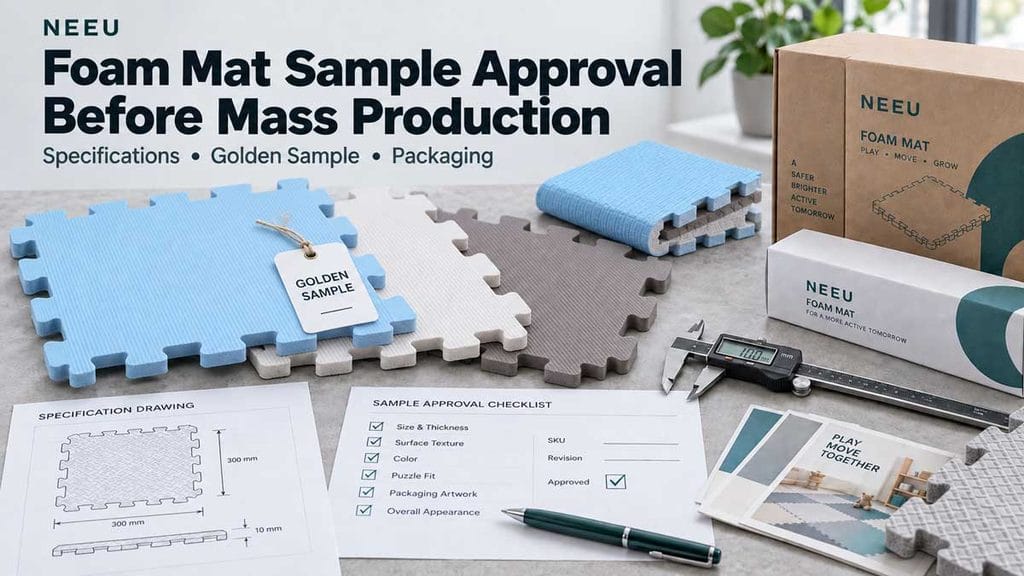
A foam mat sample can look acceptable on a desk and still leave the factory with no usable instructions for mass production. The buyer may have approved the colour but not the lighting condition, the thickness but not the measurement method, or the packaging artwork but not the final packed configuration. When the bulk order arrives, both sides remember the approval differently.
Sample approval turns a development result into a controlled production reference. That requires more than an email saying “sample approved.”
Quick answer: Before releasing a foam mat for mass production, confirm the exact product identity, measurable specifications, appearance, function, artwork, packaging, test evidence, permitted tolerances and approved deviations. Keep an identified reference sample together with the written approval record. The physical sample shows what was accepted; the documents explain how later production will be judged.
Where sample approval fits in the sourcing process
Sample approval sits between product development and production release. Each part of the sourcing process has a different job:
- a customisation page explains which product choices are available;
- a test-report guide explains whether laboratory results are comparable;
- a defect guide helps investigate a problem already found;
- a quality-control page explains how production is inspected;
- the sample approval record defines what the order is supposed to reproduce.
The approval record brings those decisions together at one release point. It is especially useful for private-label, printed, laminated, foldable and interlocking mats, where appearance and assembly details may be difficult to describe with numbers alone.
NEEU’s Design & Customization Capabilities page covers the choices that lead to a custom product. This checklist begins after those choices have been translated into a reviewable sample.
Know which sample you are approving
Suppliers and buyers don’t always use sample names the same way. Define the sample’s purpose in writing, rather than relying on the label alone.
| Sample type | Typical purpose | What it should not be assumed to prove |
|---|---|---|
| Material or colour swatch | Review a material direction, texture or colour range | Finished dimensions, assembly, packaging or full-product performance |
| Development sample | Evaluate an early construction or design option | Repeatability at production scale |
| Laboratory test sample | Generate data under a named test method | Automatic equivalence to the final printed, laminated or packaged SKU |
| Artwork or packaging proof | Review layout, text, barcode and visual presentation | Foam properties or final pack-out performance |
| Pre-production sample | Confirm the intended saleable construction before bulk production | That every later unit or lot will conform |
| Golden sample or approved reference sample | Provide a physical comparison standard for production and inspection | Every measurable tolerance, legal requirement or hidden material property |
| Shipment or production retention sample | Preserve evidence from a specific production lot | Equivalence to the original approval unless identity and revision are traceable |
A handmade development sample may use the correct materials but a different cutting, printing or packing route from bulk production. If the commercial risk depends on production equipment, tooling or pack-out, request a pre-production sample made as close as practical to the intended route.
How to establish a usable golden sample
In buyer-supplier work, “golden sample” usually means the physical sample accepted as the appearance and construction reference. It becomes useful for production only when it is tied to a complete approval record.
A useful golden-sample set contains three connected records:
- The physical product: the approved finished mat, set or packed unit.
- The specification: materials, construction, dimensions, tolerances, performance requirements, artwork and packaging details.
- The approval evidence: photographs, test reports, dated comments, approved deviations and release authorisation.
Where practical, the buyer and supplier should retain matching identified samples. Each sample should carry or reference the project name, SKU, revision, colour, approval date and record number. If a mat is too large to store conveniently, agree on what will be retained: a complete product, representative sections, a colour standard, printed panel, packaging unit and scaled photographs may all be needed.
Do not treat a golden sample as permanent. Foam, inks, adhesives and packaging can change with age, light, heat, compression and storage. Protect the sample from contamination and uncontrolled exposure, record the storage date and condition, and review whether it remains suitable when a repeat order is placed much later.
Start with product identity and revision control
Many approval disputes start as identity problems before they become quality problems. The record should let someone who did not attend the development discussion identify the approved product.
Record at least:
- buyer, brand, project and supplier names;
- product name, SKU and sample ID;
- drawing, specification and artwork revision;
- material or construction description;
- nominal size, thickness, colour and surface;
- product format, such as tile, roll, foldable panel or laminated mat;
- sample production date and, where available, batch or trial reference;
- destination market and intended application;
- packaging version;
- linked test reports and compliance documents;
- approval date, approvers and any conditions attached to approval.
Photographs should show the entire product, both surfaces, edges, markings and packaging. Include a scale and colour reference where they are useful, but do not use photographs as the only dimensional or colour standard.
Confirm material and core specifications
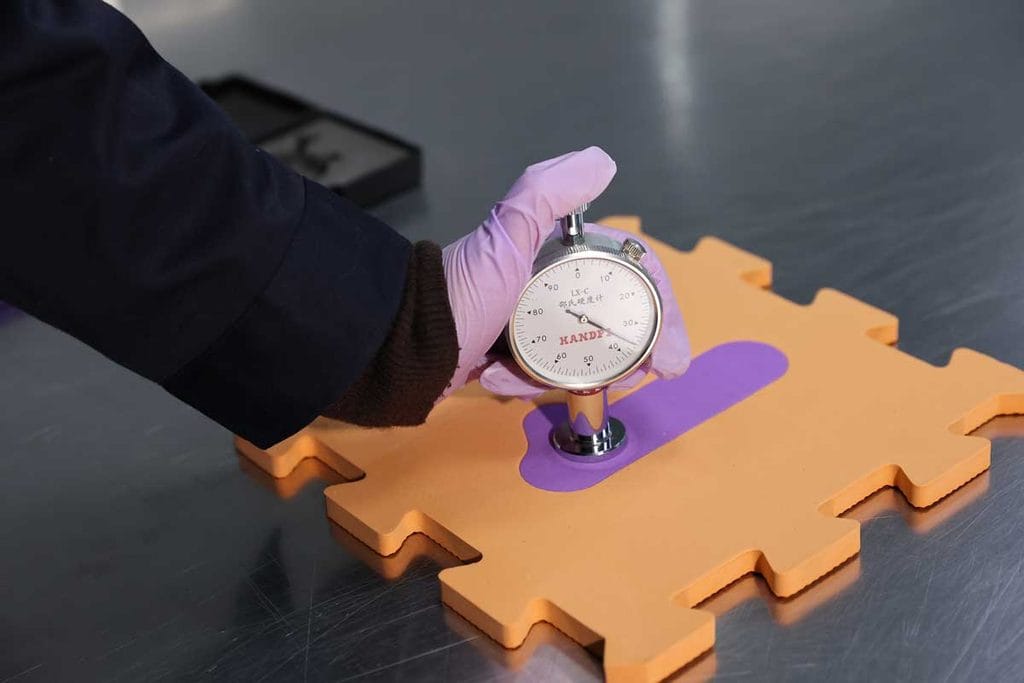
Approval does not require the supplier’s confidential recipe. It does require enough construction detail to prevent an unreviewed material or layer change.
Define the material family or agreed construction, layer sequence, backing, film, textile, coating and adhesive where applicable. State whether a requirement applies to the foam core or the complete finished mat.
Then record the properties that matter to the application. Depending on the product, these may include:
- overall or core density, with units and test basis;
- hardness or indentation response, including instrument scale and specimen conditions;
- nominal thickness and measurement locations;
- unit weight or set weight;
- compression set or recovery under defined conditions;
- tensile, tear, peel or bond performance where relevant;
- water absorption, slip, flammability or chemical testing when required by the product and market.
Density, hardness, and thickness are related design variables, but none can replace the others. The foam mat hardness and thickness guide explains how to separate initial feel, support and profile selection. When a laboratory report is part of the approval package, use the guide to reading a foam mat test report to check specimen identity, method, units and conditions.
Published EVA/nylon-elastomer research illustrates why one property should not stand in for the whole construction. In that experimental footwear-oriented formulation series, changes in blend and blowing-agent content affected cell morphology, density, hardness, rebound, compression recovery and mechanical behaviour together.[1] The study is not a commercial mat specification, but it supports a practical approval rule: select the properties that matter and record them separately.
Check dimensions, fit, flatness and edge finish
Measure the product after an agreed conditioning period and under stated conditions. Record the instrument, locations and whether embossed peaks, skins, laminated layers or folded sections are included.
For every format, check:
- finished length and width;
- thickness at agreed locations;
- squareness or diagonals where geometry matters;
- flatness, curl or bowing after unpacking;
- edge profile, corners, holes and cut quality;
- orientation and alignment of surface patterns;
- compatibility with borders, ramps or accessories.
For interlocking tiles, add an assembled-fit check to the individual measurements. Build a grid from randomly selected pieces, include edge pieces if they are sold with the set, and record gaps, tight joints, corner alignment and damage after disassembly. Foldable mats need panel alignment, fold direction, closed dimensions and repeated opening checks. Roll mats need width, length, winding direction, core or strap configuration and flat-lay behaviour after unrolling.
The foam mat dimensional-stability guide explains why measurement time, conditioning, packaging and multi-tile fit must be defined together. If a concern relates to tooth geometry, burrs or cut profiles, review the Cutting, Shaping & Finishing stage rather than assuming every size difference began at the cutting machine.
An EVA chemical-foaming study found that crosslinking, gas generation, moulding temperature and time interacted with density, surface condition and shrinkage in its specific formulation.[2] Its laboratory conditions should not be transferred to commercial mats, but the result shows why an approved dimension needs a measurement time and product state alongside the number.
ISO 1923:1981 addresses equipment and procedures for determining linear dimensions of cellular plastic and rubber sheets, blocks and specimens.[3] It does not prescribe a universal finished-mat tolerance. The buyer and supplier still need to agree on the product-specific nominal value, tolerance, measurement points, and conditioning state.
Review colour, texture, artwork and surface construction
Visual approval should reflect how the product will be judged in production. Compare samples under agreed lighting, background, orientation and viewing distance. Texture, gloss and viewing angle can change the apparent shade even when the base pigment is similar.
Record:
- approved colour reference or master;
- permitted shade variation, if applicable;
- viewing condition and sample orientation;
- texture pattern, depth and direction;
- front and back surface appearance;
- logo size, position, colour and orientation;
- print or transfer alignment;
- layer registration and border alignment;
- rub, adhesion or flex checks where the decoration requires them;
- acceptable natural variation, such as intentional speckles or marbling.
If instrumental colour difference is used, the approval record should name the colour space, equation, instrument geometry, illuminant, observer condition, measurement locations and tolerance. ASTM D2244-25 notes that purchaser and seller should agree on both the permissible colour tolerance and the calculation procedure, and that gloss, texture and other appearance factors can affect commercial acceptability.[4] A bare “Delta E” limit is therefore incomplete.
For laminated products, identify each visible layer and confirm edges, seams, bubbles, wrinkles and bond appearance. If the sample includes printing, coating, or lamination, approve the finished construction after those operations, not based on an unfinished foam sheet.
Evaluate function in the intended product format
The approval test should resemble the buyer’s intended use without turning an informal trial into an unsupported safety claim.
| Product format | Practical sample checks |
|---|---|
| Interlocking tiles | Grid assembly, tooth fit, border compatibility, repeated connection, loose fragments and disassembly damage |
| Yoga or exercise mats | Flat lay, surface feel, dry or wet grip protocol where defined, edge curl, roll memory, strap or bag fit |
| Foldable mats | Panel alignment, fold direction, crease condition, repeated opening, handle or fastener position and folded pack size |
| Laminated mats | Layer alignment, bubbles, edge lifting, flexing and agreed bond or peel evaluation |
| Printed play mats | Artwork orientation, registration, repeated-panel alignment, surface integrity, warnings and packaging presentation |
| Equipment or protective mats | Contact area, indentation or recovery protocol, edge stability and floor compatibility where specified |
Write down the procedure, number of cycles, environmental conditions, and acceptance rule. “Feels good” may be useful development feedback, but it is not a repeatable production instruction.
Separate appearance approval from compliance evidence
A signed sample does not prove legal compliance. A test report does not automatically apply to every colour, layer or revision of a product.
Before release, confirm:
- product classification and destination market;
- applicable buyer, retailer and legal requirements;
- whether testing covers raw material, foam core or finished product;
- whether the tested sample matches the approved SKU and construction;
- report number, date, laboratory, method and sample description;
- artwork, warning, tracking-label and language requirements;
- which changes would require document review or retesting.
Use the Certifications & Compliance page as a project discussion point, then confirm the actual requirement with the responsible compliance team or qualified laboratory. Do not copy a test list from another foam mat without checking its age grade, intended use, market and construction.
Odour should also remain separate from chemical compliance. Record the unpacking time, packaging state, environment and agreed comparison sample if odour is part of approval. A sensory observation cannot identify a compound or concentration. When appearance or odour differs from the approved reference, the common foam mat quality defects guide provides a neutral way to document the symptom before assigning a cause.
Approve the complete packaging configuration
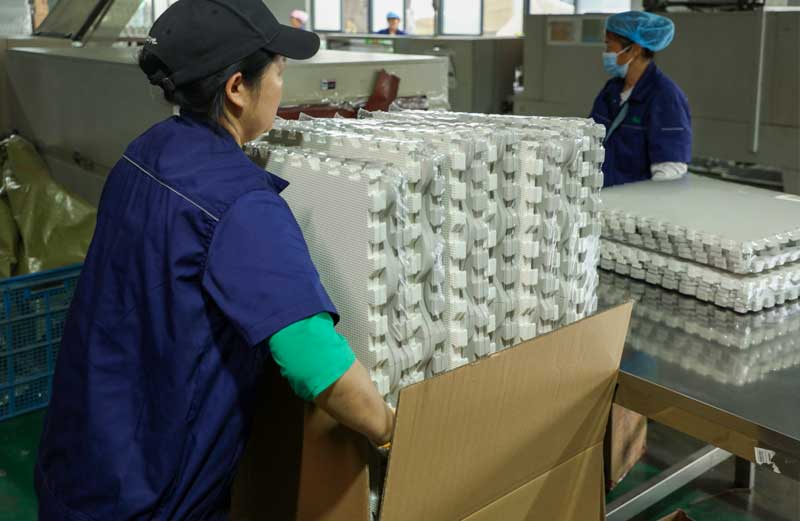
Packaging affects presentation, labelling, product recovery and transport condition. Review it as part of the saleable SKU rather than as an afterthought.
Confirm:
- folding, rolling, stacking or bundling method;
- bag, sleeve, strap, box, insert and protective materials;
- quantity per inner pack and carton;
- product label, barcode and SKU;
- warnings, instructions, languages and country-of-origin marking as applicable;
- carton dimensions, quantity, gross and net weight fields;
- carton marks, assortment and pallet requirements;
- orientation of the product inside the package;
- packed appearance and opening experience;
- any agreed transport or pack-out validation.
Scan the barcode from a production-equivalent print, proofread variable data and confirm that the artwork revision in the approval record matches the production file. The Packaging Preparation & Final Inspection page covers the production stage where labels, inner packing, cartons and shipment readiness are checked.
Record tolerances and approved deviations
“Same as sample” is not enough for characteristics that can be measured or interpreted differently. For each approval item, choose one of four treatments:
- Measured requirement: nominal value, tolerance, method, locations and conditions.
- Visual reference: approved physical sample and viewing rules.
- Functional check: procedure, cycles and acceptance result.
- Document requirement: revision-controlled artwork, test report, certificate or buyer specification.
If the buyer accepts a deviation, record exactly what was accepted and whether it applies only to the sample, the current order or future orders. Do not hide a deviation inside an email thread that production and final inspection may never see.
Approval status should be unambiguous:
- Approved: production may proceed against the listed revision and conditions.
- Approved with conditions: production may proceed only after the stated action or limitation is incorporated.
- Revise and resubmit: changes are required, and a new sample or document must be reviewed.
- Rejected: the sample cannot be used as the production reference.
How the golden sample should control mass production
The golden sample is a comparison tool, not a substitute for an inspection plan. Connect it to production through a defined sequence:
1. Production release
Issue the approved specification, sample ID, artwork files, packaging files, test requirements and deviations together. Withdraw obsolete revisions from the production package.
2. First-off or first-article confirmation
Compare the first production-equivalent units with the approved record before the full run advances. Focus on characteristics that may change when tooling, print setup, lamination or packaging moves from development to production.
3. In-process control
Check selected measurable and visual characteristics at the operations that create them. Waiting until final inspection to discover a repeated cut, colour, or print error can make containment far more expensive.
4. Final and shipment inspection
Use the written tolerances, defect definitions and sampling plan to evaluate the lot. Keep the physical golden sample available for appearance questions, but do not approve measurable failures simply because a unit looks similar.
ISO 2859-1:2026 provides acceptance-sampling schemes indexed by acceptance quality limit for lot-by-lot inspection.[55] That is a production-lot decision tool, not a method for approving one development sample. If an AQL-based plan is used, define lot size, inspection level, defect classes and acceptance rules separately. Safety-critical or regulatory failures may require different treatment rather than being absorbed into a generic AQL.
NEEU’s foam mat Quality Control page shows the wider relationship between incoming materials, in-process checks, finished-product inspection and shipment release.
Define change-control and reapproval triggers
Approval applies to an identified construction and revision. Agree on which changes require notification, document review, a new sample or retesting.
Common triggers include:
- resin grade, blend, additive or raw-material source;
- density, hardness, thickness or layer construction;
- blowing or crosslinking system;
- pigment, ink, coating, adhesive or surface film;
- mould, die, cutting file or tooth geometry;
- artwork, barcode, label, warning or packaging material;
- manufacturing plant or major production route;
- process change that can affect appearance, dimensions or performance;
- a long gap between repeat orders when the retained reference may have aged;
- a new destination market, age grade or retailer requirement.
Not every administrative update needs a complete new qualification. The approval plan should connect the scope of reapproval to the characteristic that changed and the risk it creates.
Download the foam mat sample approval checklist
Use the downloadable worksheet to record requirements, evidence, status and comments for each sample-review item:
The checklist is a starting format, not a universal acceptance standard. Remove irrelevant rows, add product-specific checks and have the responsible buyer, supplier and compliance teams confirm the final approval plan.
At minimum, do not release mass production until the following questions have clear answers:
- Is the exact product revision identified?
- Does the sample represent the finished saleable construction?
- Are measurable requirements paired with methods and tolerances?
- Are visual characteristics tied to a controlled reference?
- Have fit and function been checked in the product’s actual format?
- Do test reports and compliance documents match the approved sample?
- Is packaging approved as a complete packed unit?
- Are deviations and change triggers written down?
- Do the buyer and supplier know which sample and records will be retained?
- Is the approval status signed and dated?
Common sample-approval mistakes
Approving a sample before the specification is complete
This creates a reference without explaining which characteristics matter. Finish the approval record before production release.
Using a laboratory coupon as the finished-product golden sample
A test coupon can support a property result. It may omit printing, lamination, edges, accessories and packaging that belong to the commercial SKU.
Approving colour through phone photographs
Camera processing, screens and lighting alter appearance. Use a physical standard or a defined instrumental and visual procedure when colour is commercially important.
Leaving tolerances until final inspection
Final inspection is too late to decide how much variation is acceptable. The approval stage should define the inspection rule.
Treating one approved sample as proof of batch consistency
The sample proves that the reviewed unit met the approval decision. Production controls and lot inspection are still needed to determine whether later output conforms.
Keeping only one unlabelled reference
An unlabelled sample can be mixed with another revision, damaged or lost. Use durable identification and matching records; retain counterparts where practical.
Frequently asked questions
A pre-production sample describes the sample’s stage and purpose. It becomes the golden or approved reference sample only after the buyer accepts it against an identified specification and records that decision.
Signatures or controlled electronic approval help identify who authorised the reference and when. The sample should also carry a durable ID linked to the specification, revision, photographs and approval record.
There is no universal number for every program. Where practical, buyer and supplier should retain matching identified samples, with additional production or laboratory retention samples based on order risk, product size and contractual needs.
It can provide a visual reference. When colour variation is commercially sensitive, also define lighting, orientation, measurement procedure and permitted difference. Texture and gloss can change visual judgment.
No. Sample approval establishes the reference and acceptance rules. Final inspection applies those rules to a production lot under the agreed sampling and release plan.
Reapproval may be needed after a material, construction, process, tooling, artwork, packaging, factory or market-requirement change. The scope should match the effect of the change rather than automatically repeating every test.
Request a Sample Review
Send NEEU the product brief, drawing, target market, sample photographs, required test reports, artwork and packaging files. Identify the decisions that remain open and the date by which production approval is needed. The review can then focus on missing specifications, comparison methods and records required before mass production.
- Huang, G., Gui, Y., Li, Y., et al. (2021). Preparation and Characterisation of EVA/Nylon Elastomer Microcellular Foaming Materials. China Plastics, 35(9), 1-7. ↩︎
- Feng, S., Liu, Z., Zuo, J., Zeng, J., and Hao, J. (2003). EVA Crosslinking Foaming Technology and Application. Plastics Science and Technology, 2003(2), 9-11. ↩︎
- International Organisation for Standardisation. ISO 1923:1981: Cellular plastics and rubbers – Determination of linear dimensions. ↩︎
- ASTM International. ASTM D2244-25: Standard Practice for Calculation of Color Tolerances and Color Differences from Instrumentally Measured Color Coordinates. ↩︎
- International Organization for Standardization. ISO 2859-1:2026: Sampling procedures for inspection by attributes – Part 1: Sampling schemes indexed by acceptance quality limit (AQL) for lot-by-lot inspection. ↩︎