
Foaming Process in Foam Mat Manufacturing
NEEU controls the foaming stage to convert prepared compounds into foam sheets or molded foam structures with target density, thickness, cushioning, elasticity, and batch stability.
Density
Cushioning and support control
Thickness
Sheet and molded foam stability
Cells
Foam structure consistency
QC
Batch and appearance checks
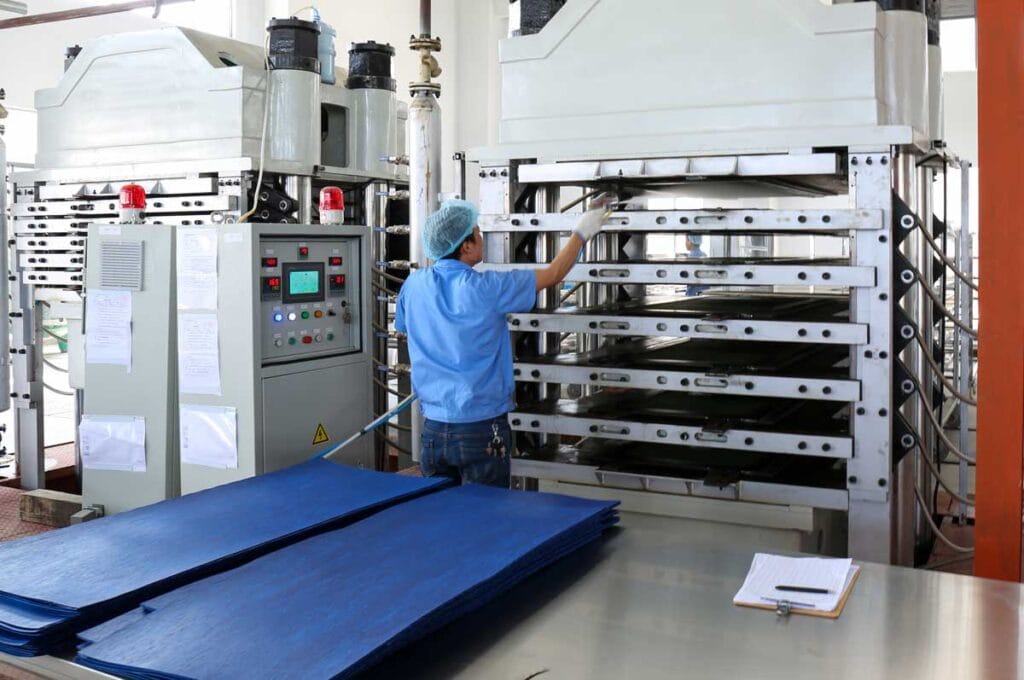
What Is the Foaming Process?
The foaming process is where the compounded raw material expands into a uniform, closed‑cell foam structure – the very foundation of a foam mat‘s cushioning, resilience, and durability. During this stage, heat activates chemical or physical blowing agents inside the compound, generating countless tiny gas bubbles that form a stable cellular network. The resulting closed‑cell structure is waterproof, lightweight, and highly resilient – key properties that distinguish quality foam mats from inferior ones.
Why the Foaming Process Matters – Key Takeaways
The foaming process is not just a manufacturing step – it is the single most influential factor in determining how a foam mat will perform in real-world use. From the bounce under your feet during a workout to the support a baby feels while crawling, every tactile quality traces back to how the foam was expanded, cross‑linked, and cooled. For B2B buyers, understanding this connection helps you specify the right density, thickness, and resilience for your target application – and verify that your supplier can deliver those properties consistently, batch after batch.
- Directly determines mat performance.
Foaming controls density, rebound, thickness uniformity, and long-term compression resistance. Get it wrong, and the mat feels too soft, too hard, or wears out quickly. - Prevents common defects
Proper temperature, pressure, and cooling eliminate surface bubbles, thickness variation, and permanent indentations – saving you from customer complaints and returns. - Ensures chemical safety
Optimized foaming (especially chemical foaming for XPE) guarantees zero formamide, low VOCs, and full compliance with REACH, EN71, and CPSIA. - Delivers batch‑to‑batch consistency
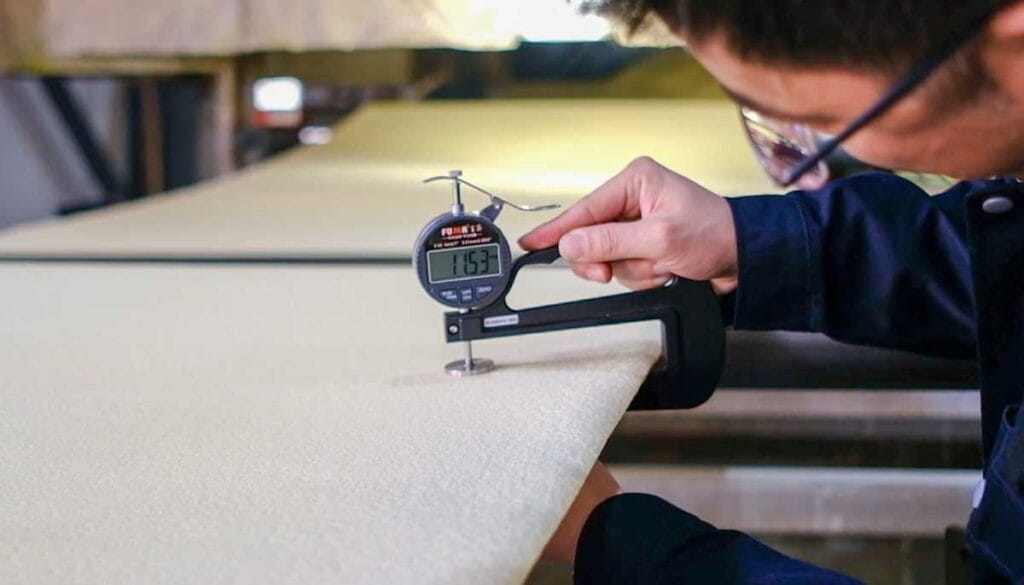
Closed‑loop monitoring of temperature (±2°C) and thickness (±0.3mm) means the first meter of a roll matches the last, and next year’s order matches today’s sample. - Translates into business confidence
With traceable foaming parameters and batch‑specific test reports, you can specify density/hardness targets and trust that your supplier will deliver the same performance order after order.
Need a specific foam density or thickness for your project?
Our engineers can help dial in the perfect foaming parameters.Foaming Processes & Equipment – EVA, XPE, TPE & PVC
Different foam mat applications demand different foaming technologies. EVA interlocking tiles, XPE baby play mats, TPE yoga mats, and PVC rolls each rely on a distinct combination of chemical/physical foaming, cross‑linking methods, and production equipment.
EVA Foaming Process & Equipment – For Interlocking Mats
EVA is an ethylene-vinyl acetate copolymer supplied as a pre-manufactured resin. For a closer look at resin grades, see our guide to EVA copolymer structure and VA content.
In this compression-molding process, EVA resin is compounded with a blowing agent, crosslinking agent, color masterbatch and other formulation additives. The prepared compound is placed in molds and heated under controlled temperature and pressure. During the molding cycle, crosslinking develops while the blowing agent releases gas, expanding the material into a closed-cell foam structure. After cooling and conditioning, the foam is converted into finished interlocking mats.
- Core Equipment: EVA Foaming Machine, Flat-bed Foaming Machine, Molds
- Core Advantage: High Batch Consistency — Fixed Formulation + Molds + Process Parameters → Stable Density, Hardness, and Resilience.
TPE Foaming Process & Equipment – Hydraulic Press Molding for Yoga Mats
NEEU produces TPE yoga mats through a precise hydraulic compression molding and foaming process. The TPE materials are mixed with foaming agents and additives, then shaped into blanks and molded under high temperature and pressure. This method creates mats with a uniform, closed-cell structure, excellent resilience, and eco-friendly properties, while ensuring consistent dimensions and textures.
- Core Equipment: Hydraulic Compression Foaming Machine
- Core Advantage: Equipped with multiple 400T and 1000T hydraulic foaming machines capable of simultaneously producing yoga mats of various specifications.
XPE Foaming Process & Equipment
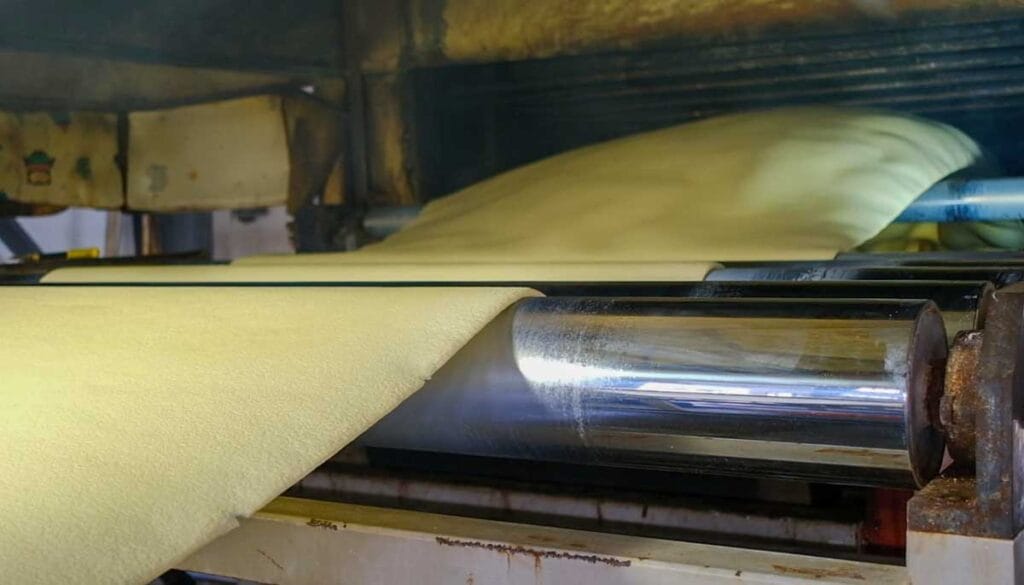
XPE (cross-linked polyethylene) foam for children’s play mats is commonly based on low-density polyethylene (LDPE). Crosslinking builds the polymer network, while a separate blowing mechanism creates the cells. Depending on the grade, production may use chemical or irradiation crosslinking with an appropriate blowing system. The XPE name alone does not indicate whether it is physically foamed or free of chemical blowing agents.
- Core Equipment: Continuous foaming line with sheet-forming and cooling equipment; an irradiation stage is required for irradiation-crosslinked grades.
- Core Advantage: Coordinated control of crosslinking, gas expansion, heating, and cooling helps produce consistent foam sheets and rolls. Matching these conditions to the formulation supports target density, thickness, and cell structure, while dimensional checks after cooling help prepare the foam for cutting, lamination, and foldable mat production.
PVC Foaming Process & Equipment
NEEU’s PVC yoga mats and anti-slip mats are produced using a plastisol coating and thermal foaming process. PVC paste resin is mixed with plasticizers, stabilizers, a chemical blowing agent, pigments and other selected additives to prepare the plastisol. The mixture is coated onto a suitable carrier or backing and passed through a controlled oven, where gelation, fusion, and gas generation are coordinated to form the foam layer. After cooling, the material is wound into rolls or cut to the required dimensions.
- Core Equipment: Plastisol mixing and coating equipment, a continuous heating and foaming oven, cooling units, and winding or cutting equipment.
- Core Advantage: Control of plastisol viscosity, coating thickness, oven temperature, and line speed helps maintain consistent foam production. Finished thickness, cell structure, and surface quality are checked against the approved sample and agreed specification.
Explore More Production Stages
Want to see how this homogeneous compound becomes a finished foam mat?
Compounding and Mixing
Learn how NEEU‘s compounding & mixing process ensures batch‑to‑batch consistency. Automated weighing (±0.1% accuracy), dust‑free environment, and digital recipe management for EVA, TPE, PVC & XPE foams.
Surface Treatment & Lamination
Mats receive functional surface treatments: embossing for anti‑slip texture, heat lamination for multi‑layer composites (e.g., EVA+non‑woven, EVA+cork), and coating for stain resistance. This stage adds both performance and aesthetic value.
Cutting, Shaping & Finishing
Foamed sheets are precision‑cut using CNC slitting and die‑cutting machines to exact dimensions (±0.5mm). Edge trimming, corner rounding, and interlocking teeth forming are completed here, ensuring clean geometry and seamless assembly.
Printing & Packaging Preparation
Custom logos, patterns, or alignment guides are applied via UV printing, heat transfer, or silk screen. Printed mats are then 100% visually inspected, cleaned, and packed into private‑label boxes, poly bags, or shrink wrap – ready for shipment.
Why Global Brands Trust NEEU

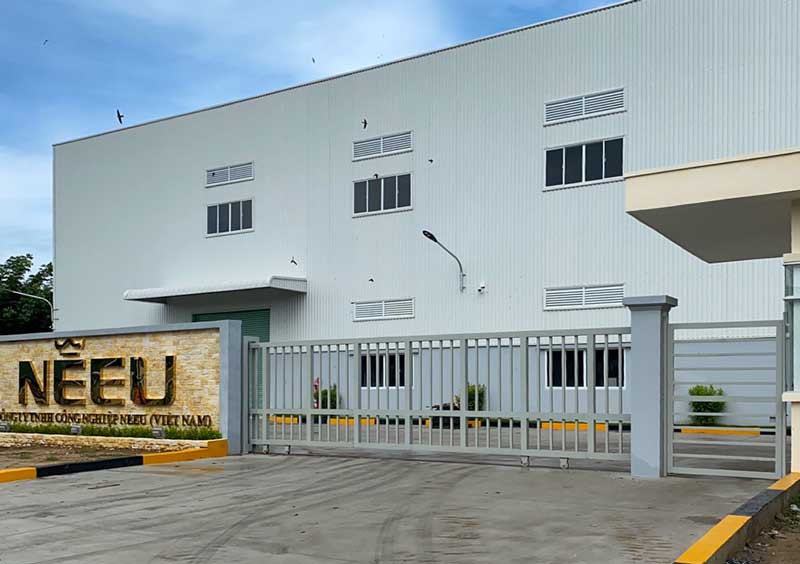

Behind every NEEU Foam mat is a vertically integrated manufacturing operation spanning 75,999㎡ across China and Vietnam – equipped with automated foaming lines, and 620+ skilled technicians. We hold ISO 9001, BSCI, EN71, ASTM F963, CPSIA, REACH, and Walmart/Target/Disney compliance certifications that matter to European and U.S. retailers.
As a professional manufacturer of EVA floor mats, NEEU leverages automated ingredient dosing and ERP-based formula management systems to ensure that key parameters—such as hardness, density, and color—remain precise and consistent across every batch. Equipped with multiple large-scale flatbed and hydraulic foaming presses, we offer flexible production capabilities for a wide range of thicknesses, dimensions, and shapes. By combining high-precision mold technology with 100% inspection, we provide comprehensive support for deep customization of EVA foam products, covering the entire value chain from formula design to final delivery. Want to see our full capabilities?
Frequently Asked Questions About Foaming Process
How is foam density consistency controlled during the foaming process?
A:Our MES system monitors the density of the foamed sheets in real time using inline densimeters. Should any deviation from the set density value be detected, the system automatically adjusts the foaming oven’s temperature profile or the production line speed to achieve closed-loop control. For batch-mode compression foaming (EVA/TPE), density consistency across each mold is ensured through the use of fixed molds, precise control of the weight of each raw material blank, and standardization of process parameters (temperature, pressure, and time). Consequently, the final product’s density tolerance can be maintained within ±2%.
Why is the foaming process important for foam mats?
A: Foaming is important because it directly affects the internal structure of the material. A well-controlled foaming stage helps support consistency in thickness, density, cushioning feel and downstream manufacturing performance.
Does the foaming process affect final product quality?
A: Yes. The foaming process can influence how the material performs in later stages such as shaping, cutting, lamination and finishing. More stable foaming helps support better product uniformity and more consistent production results.
What is the difference between chemical foaming and physical foaming?
A: Chemical foaming generates gas through a chemical reaction. In many thermoplastic foam processes, a blowing agent such as azodicarbonamide decomposes when heated. The choice of agent and processing conditions depends on the polymer and the required foam properties.
Physical foaming uses a blowing medium, such as nitrogen or carbon dioxide, without relying on its chemical decomposition to generate gas. Changes in pressure and temperature allow the medium to expand and form cells.
Crosslinking is a separate part of the process. Electron-beam crosslinking does not establish that a foam is physically blown, and the XPE designation alone does not identify the blowing agent. Neither route automatically guarantees finer cells, zero residues or a safer finished mat.
For a fuller explanation, see our guide to mechanical, physical and chemical foaming.
How Does Foaming Temperature Affect Final Product Quality?
A:
Foaming temperature is a critical parameter that significantly influences both cell structure and material properties.
Temperature Too Low: Incomplete decomposition of the blowing agent results in higher density, poor resilience, and a rough surface finish.
Temperature Too High: The blowing agent decomposes too violently, causing bubbles to coalesce or rupture; this leads to coarse cell structures, degraded mechanical properties, and—in extreme cases—scorching of the material.
Precise Temperature Control: NEEU foaming ovens feature independent PID control for each temperature zone, ensuring ±2 °C temperature accuracy. This ensures a uniform, fine cell structure and stable physical properties.
Are harmful substances (such as formamide) generated during the foaming process? How are they controlled?
A:
Formamide can occur as an unwanted by-product in some azodicarbonamide-based foaming systems. Its presence and level depend on the formulation and processing conditions, not simply on whether the foam is labeled EVA, PVC, TPE or XPE.
Control starts with confirming the blowing-agent system and selecting suitable raw materials and processing conditions. Heating and post-treatment must be validated for the formulation; increasing temperature or processing time is not a universal solution.
For cross-linked PE foam, confirm the actual blowing route rather than assuming that XPE means no azodicarbonamide. Even where a process does not use this agent, that fact alone does not establish the chemical profile of the finished mat.
Formamide claims should be based on a report identifying the tested product, test method, result and reporting limit. “Not detected” means below the stated detection limit, not absolute zero. Where films, inks or adhesives are added, the evidence should cover the construction being supplied.
See our formamide guide for foam mat buyers for the distinction between material claims and test evidence.
How do you ensure consistency in the degree of cross-linking during the foaming process?
A: The degree of cross-linking (gel content) directly impacts the foam’s resilience, compression set, and heat resistance. We ensure consistency through the following measures:
- Formula Standardization: The dosage of cross-linking agents (such as DCP) is fixed, and the ERP formula is locked to prevent unauthorized changes.
- Process Stability: The temperature and duration of the internal mixing, open milling, and foaming stages are strictly controlled.
- In-line Sampling & Testing: Foam samples are collected from each batch to determine gel content (ASTM D2765), ensuring the degree of cross-linking meets the required standard (XPE ≥ 40%).
- Batch Traceability: All cross-linking process parameters (temperature, time, and pressure) for each product batch are fully recorded within the MES system.
Can you customize the foaming process to match the client's required density?
A: Yes, we can. Based on the client’s target specifications—such as density, hardness, and resilience—we can adjust our foaming formulations (including foaming agent and cross-linking agent dosages, as well as filler ratios) and process parameters (temperature, pressure, and duration). We also provide free samples for verification purposes. Once confirmed, we lock in the specific formulation and process to proceed with mass production.