
Foam density is one of the first numbers that appears in a mat inquiry. It affects material consumption, product weight, freight planning, and how consistently a factory can reproduce a construction. It is also easy to overread. A higher number does not automatically mean a better mat, and two mats with the same stated density can still perform differently in use.
For a buyer, density is most useful when treated as part of a finished-product specification. The practical question is not, “What is the best foam density?” It is: which density range, material system, thickness, compression behavior, surface construction, and verification plan fit this particular mat and its intended use?
That distinction matters across all common foam mat categories: EVA interlocking tiles, XPE foldable play mats, TPE or PVC exercise mats, gym equipment mats, and custom multilayer products. This guide explains what density means, how it is measured, what it can indicate, and how to turn the number into a usable B2B requirement.
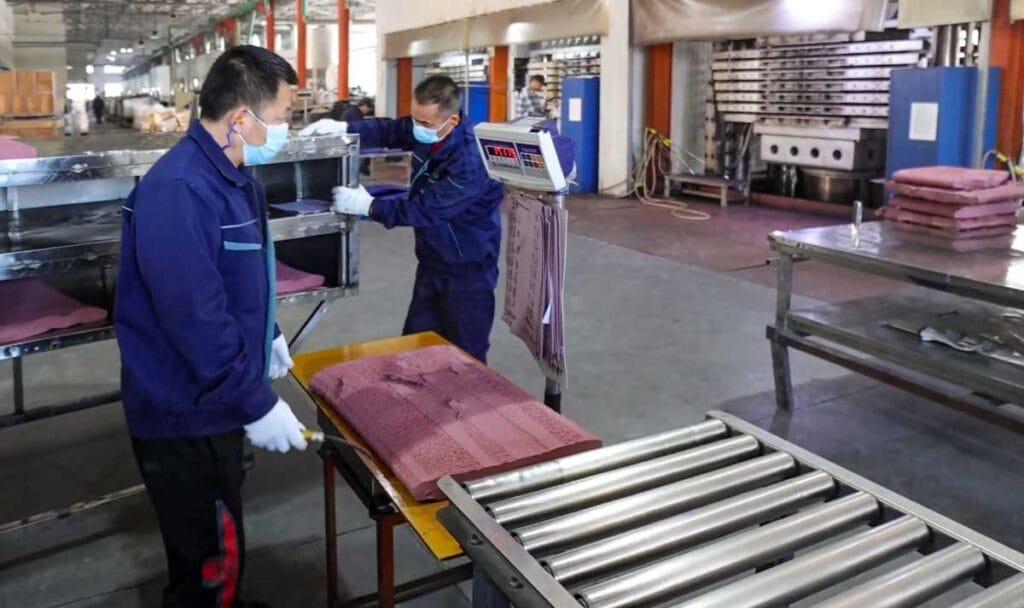
Quick answer: Foam density is mass per unit volume, normally shown as kg/m3 or lb/ft3. It is a valuable process and consistency control, but it is not a stand-alone quality verdict. Specify density with the foam material, thickness, hardness or compression requirement, recovery, dimensions, surface construction/, and relevant performance tests.
What Foam Density Means
Density describes how much mass is contained in a given volume of foam:
Density = mass / volume
For a rectangular sample, the volume is calculated as length × width × thickness. The result is usually expressed as kilograms per cubic meter (kg/m3). North American specifications may use pounds per cubic foot (lb/ft³, often abbreviated as pcf).
| Unit | Where it is commonly used |
|---|---|
| kg/m3 | Metric specifications, factory documents, and most international sourcing projects |
| lb/ft3 (pcf) | U.S. buyer specifications and some foam-industry documents |
| Simple conversion | 1 lb/ft3 is approximately 16.02 kg/m3 |
Density is an average property. It does not show exactly where material is distributed within a foam sheet or finished mat. A product may have a denser surface layer, a less dense center, a backing layer, a film, a textile, a print layer, or a bonded construction. Those details change both the measured result and the in-use experience.
This is why a specification needs to state what is being measured. Is it the complete finished mat? The foam core? One component in a laminated product? Without that definition, two parties can use the same word while reporting different values.
Apparent density, overall density, and core density
The language used in test reports varies. In cellular plastics, the apparent density is generally calculated from the measured mass and external volume of a sample. The ISO 845 standard addresses both apparent overall density and apparent core density, including products with molded or extruded skins.
For a foam mat, the distinction can be commercially important:
- Finished-product or overall density includes the entire item selected for measurement. It may reflect skin layers, film, fabric, coating, adhesive, and the foam body.
- Foam-core density focuses on the cellular foam portion. It can help compare the actual foam construction when surface layers differ.
- Component density may be relevant when a mat uses several materials, such as a closed-cell foam base with a separate anti-slip backing or decorative top layer.
Neither approach is universally better. The buyer and supplier simply need to select the one that supports the decision. If a retailer is buying a finished foldable mat by weight, overall density may be appropriate. If an engineering team is comparing two foam formulations, core density may be more useful.
When reviewing supplier data, confirm whether the reported value represents core density, overall density, or the complete layered construction. The foam mat test report guide explains when different units can be converted and when two density results are not comparable.
What Density Can Tell You, and What It Cannot
Within a comparable material family and product construction, density can be a useful clue about material content. It often affects product weight and can influence compression behavior, support, durability, dimensional stability, and how a foam responds to repeated loading. But it should never be read in isolation.
Consider two EVA tile samples with the same thickness. If one has a materially lower density, it may feel lighter and may compress more easily under the same load. That can be a deliberate choice for a low-load children’s product, or an unwanted result for a gym floor tile. It still does not prove the other sample will be better. The polymer grade, filler package, crosslinking, cell structure, surface pattern, and test method can all change the answer.
Density should therefore be used to ask better questions:
- Is the finished mat weight consistent with the approved sample?
- Is the density result within the agreed tolerance from lot to lot?
- Does the material recover after the compression relevant to its use?
- Does the construction deliver the target hardness, traction, tear resistance, and dimensional stability?
- Are the results based on foam core, complete product, or an undefined sample?
Those questions make density a practical purchasing tool instead of a number copied from a quotation.
Density versus hardness
Density and hardness are related only indirectly. Density describes mass per volume. Hardness describes resistance to indentation under a defined test method. A buyer can encounter a relatively dense foam that feels softer than expected, or a lower-density foam that feels firm because of its formulation, cell structure, skin, or crosslinking.
For mat projects, hardness may be measured using the Shore scale or another agreed-upon method. Compression force, compression deflection, or a product-specific loading test can sometimes be more informative than a single hardness reading. The correct choice depends on the product. A home-gym floor tile, for example, may need a defined compression response under equipment. A yoga mat may need a balance of controlled grip and cushioning, rather than a single hardness target.
Ask the factory which method is used, how samples are conditioned, where readings are taken, and what tolerance applies. A hardness number without that context is difficult to compare between suppliers.
Density versus thickness
Thickness changes the amount of foam available to absorb or distribute a load. Density changes the mass present in that volume. Both matter, but they are not interchangeable.
A thicker, lower-density mat can feel more cushioned in some uses than a thinner, higher-density mat. A thin but dense roll mat may offer a compact, supportive feel but provide limited distance from a hard floor. A thicker construction may improve comfort for kneeling or floor exercise while adding bulk to the packed product. The approved combination should come from the application, not from a single property.
For that reason, a sourcing brief should state nominal thickness and tolerance alongside density. It is also worth measuring thickness after conditioning and at multiple locations, especially on patterned, embossed, folded, or laminated products.
Density versus compression set and recovery
A foam mat is repeatedly loaded, then expected to recover. Density may affect that behavior, but it does not define it. Compression set is a separate property: it describes the permanent deformation remaining after a sample is compressed under controlled conditions. Recovery can also be evaluated through a test designed around the product’s real load and use cycle.
This difference is important in B2B purchasing. A mat can meet a density target and still take a set, show a lasting indentation, or lose its original feel under the actual load. For a gym equipment mat, test the expected point loads or distributed loads from equipment. For a play mat, consider body weight, crawling, dropped toys, folding, and repeated assembly. For exercise mats, include realistic kneeling, balancing, and rolling use.
Density may influence how a mat behaves under load, but it cannot, by itself, predict retained deformation. Learn how to define foam compression set and recovery with controlled loading and recovery conditions.
Why Density Varies in Foam Mat Manufacturing
Foam density is the outcome of materials, expansion, processing, and conversion. It is not normally adjusted through a single factory dial. Understanding the route helps buyers identify where variation can enter the product.
Polymer, formulation, and fillers
EVA, XPE, TPE, PVC, and other foam systems are based on different polymer chemistries and formulation approaches. Resin grade, additives, color concentrates, fillers, recycled-content policy, and compound consistency can all affect mass, processing, feel, and final properties.
This is one reason a density value should always be named with the material system. Comparing the density of an EVA foam directly with that of a PVC or TPE product can be misleading unless the constructions and intended uses are similar. Start with the relevant material family, then compare samples made for the same application.
For background on the different material routes, see Types of Foam Explained. For projects that depend on low water uptake, cushioning, and surface cleanability, the closed-cell foam guide provides useful context for the number.
Foaming and expansion control
Foaming creates cells within the polymer matrix. The amount and uniformity of expansion influence the material’s volume and, therefore, its apparent density. Uneven expansion can produce localized variations in density, thickness, or feel across a sheet.
The details depend on the material and process, but the buyer’s concern remains consistent: a repeatable route should produce repeatable sheet thickness, weight, cell structure, and performance. Information on the foaming process is useful here because it explains why density should be reviewed alongside the production method, rather than treated as an isolated sales specification.
Crosslinking, skins, and conversion
Some foam products are crosslinked to change the material structure and end-use behavior. A surface skin can be formed during processing, and additional steps may emboss, laminate, print, cut, fold, or bond the foam into a finished mat. Each of these steps can change the final dimensions and measured mass.
This is especially relevant for products that look simple in a photo but are technically layered. A foldable children’s mat can combine a foam core, a printed surface, seam construction, and a backing. An exercise mat may use a textured top surface and a separate traction layer. If a buyer asks only for “density,” the supplier may not know whether the number should represent the core sheet or the complete construction.
Material yield and batch consistency
Density is also a useful yield signal. If sheet dimensions remain stable but weight shifts noticeably, the result should prompt a review of formulation, expansion, thickness, and conversion. It belongs in routine quality control alongside dimensional, visual, performance, and packaging checks.
A note on packaging, insulation, and other foam products
Density is discussed across many foam industries, including protective packaging, building insulation, seating, flotation products, and technical components. The principle is familiar: mass per volume helps describe a material, but the end-use property still has to be tested for the application. A packaging insert may be evaluated for cushioning under a defined drop or compression event; an insulation board may be evaluated for thermal performance and moisture behavior; a seating foam may be evaluated for comfort, fatigue, and compression set.
These examples are useful reminders that the word “density” does not have a single, universal meaning in performance. A density target developed for a packaging or insulation product should not be transferred directly to a foam mat. Mats are affected by different combinations of skin contact, surface grip, movement, repeated loading, floor protection, foldability, cleaning, appearance, and packed format.
The comparison does have one practical value for foam mat buyers. In every category, a reliable specification identifies the material system, test basis, sample construction, target value, tolerance, and end-use validation. That same discipline prevents a foam mat project from being decided by an unsupported density claim.
How Density Applies to Common Foam Mat Products
The best density range is application-specific. A supplier should not promise one universal number for all foam mats. The following examples show how a buyer can frame the question more usefully.
EVA interlocking foam mats
Interlocking EVA tiles are used in home gyms, play areas, martial arts spaces, workshops, and general protective flooring. Their puzzle edges, embossed surface, thickness, and tile-to-tile fit all affect the product experience.
Density can help control material weight and support, but tile performance also depends on edge geometry, thickness, hardness or compression response, cell structure, odor control, color stability, and whether the mat is intended for bare feet, shoes, equipment, or children’s use. A high-density tile with poorly controlled interlocking edges can still be a poor flooring product.
When sourcing interlocking foam mats, request an approved physical sample and define the test points. Check tile size, thickness, weight per tile or per square meter, density method, hardness or compression requirement, fit between tiles, surface appearance, and recovery after the expected load. If the mat is for a retailer, include the carton count and packed weight, as density changes can affect freight and handling.
Baby and children’s play mats
For a baby or children’s play mat, density affects the balance among cushioning, product weight, and resistance to everyday handling. It does not replace safety, chemical compliance, seam integrity, surface durability, cleanability, or age-appropriate design.
The buyer should define how the mat will be used: for crawling and floor play, as a nursery surface, as a travel product, as a foldable item, or as a puzzle-tile system. Then specify the construction and relevant testing. A large foldable mat may require uniform thickness across panels and consistent folding behavior. A tile system needs secure interlocking and a surface that remains presentable after repeated cleaning and assembly.
The baby and kids’ play mats category can serve as the commercial destination for this content. From a product-development standpoint, the approval sample should be evaluated as a complete article, including print, surface layers, seams, backing, packaging, and any stated compliance requirements.
XPE foldable mats
XPE is commonly selected for lightweight closed-cell foam constructions, including foldable mats. Buyers often care about packed volume, handling, cushioning, wipe-clean surfaces, fold durability, and how the mat lies flat after storage.
Read density with panel thickness, core structure, cover or film construction, fold geometry, and repeated-fold performance. A single central foam sample may miss variation near fold lines or bonded seams, so test a full-size sample after folding, unfolding, handling, and cleaning cycles that reflect the intended channel. Set the density target only after the desired finished weight, handling feel, compression behavior, dimensions, and packing format are defined.
TPE and PVC yoga or exercise mats
Yoga and exercise mats are judged immediately by hand feel, grip, cushioning, stability, and roll behavior. Density may influence support and product weight, but traction, thickness, texture, formulation, and exercise type are equally visible to the user.
An academic comparison of several 6 mm yoga-mat material constructions found measurable differences in exercise-related biomechanical and plantar-pressure outcomes. However, the study did not isolate density as the cause. The practical lesson is sound: buyers should assess the complete, finished mat rather than assume that a density figure predicts user experience.
For a TPE or PVC project, build sample review around the intended practice: stability under sweaty hands, roll behavior, surface wear, and recovery after kneeling or balance poses. The acceptance sample must demonstrate the actual use case.
Gym equipment and protective flooring mats
Mats placed under treadmills, benches, racks, or other equipment require an application-specific view of load. Consider thickness, density, hardness, compression behavior, surface friction, tear resistance, and floor-contact design together. Equipment feet create concentrated pressure points, while moving equipment adds abrasion and shear forces. Use a relevant physical load test on the finished product instead of a generic “heavy-duty” claim.
Turning Density into a Purchase Specification
The aim is not to create a long document for its own sake. It is to prevent an otherwise avoidable disagreement after production. The following structure works for many custom foam mat projects.
| Specification item | What to define | Why it matters |
|---|---|---|
| Product and use | Mat type, end use, target user, and expected loading | Keeps the density discussion tied to the actual application |
| Material system | EVA, XPE, TPE, PVC, or defined multilayer construction | Prevents cross-material comparisons that do not mean the same thing |
| Measurement basis | Foam core, sheet, component, or finished mat | Makes the stated density comparable |
| Density target | Nominal value, unit, and acceptable tolerance | Creates a measurable production control |
| Sample dimensions | Length, width, thickness, and locations to be sampled | Prevents thickness or location from distorting comparison |
| Conditioning | Time, temperature, and humidity before measurement where relevant | Helps make results repeatable |
| Related properties | Thickness, hardness or compression, recovery, dimensions, weight, surface condition | Covers the product behavior density cannot prove alone |
| Acceptance method | Sample approval, lot sampling plan, test method, and report format | Clarifies how a production lot will be judged |
A practical RFQ wording example
The following is a starting point, not a universal test method:
Supply a finished
using [material/construction]. Report apparent [overall/core] density in kg/m3 from samples conditioned and measured according to the agreed method. Nominal density: [value]; permitted tolerance: [value]. Also report finished thickness, dimensions, unit weight, [hardness or compression requirement], recovery or compression test result, surface condition, and the lot number. The production lot must match the approved golden sample and agreed acceptance criteria.
3D Kids Stickers
$2.29 Select options This product has multiple variants. The options may be chosen on the product page

This wording identifies the product, removes ambiguity about the measured sample, and connects density to the approved article rather than an unverified material claim.
Do not set a tolerance without checking process capability
A very tight density tolerance may look reassuring in an RFQ but can create false failures if it is not grounded in the product route and measurement method. A tolerance should be agreed upon after initial sampling or based on evidence from a stable production process. It should also distinguish normal measurement variation from a real production change.
Before locking the requirement, ask the supplier to explain:
- Which sample is cut or selected, and from where?
- Are surface skins, films, coatings, or backing layers included?
- How is thickness measured, especially on embossed or textured products?
- How many samples are tested from one lot?
- What equipment and calculation method are used?
- What historical variation has been seen on comparable products?
For flexible closed-cell olefin foam materials, ASTM D3575 is a recognized standard that covers physical property testing and its use in research, quality control, and acceptance work. It should not be treated as a substitute for a project-specific agreement. The relevant method, sample preparation, and acceptance rule must still be confirmed by the parties.
Measuring Density: The Simple Calculation and the Common Traps
Measure sample mass, length, width, and thickness; calculate volume; then divide mass by volume. A sample measuring 0.20 m × 0.20 m × 0.01 m has a volume of 0.0004 m³. At 0.12 kg, its calculated density is 300 kg/m3.
The traps are usually in the measurements. Thickness may vary across an embossed mat; an edge sample may not represent the center, and a finished product may include non-foam layers. Conditioning, scales, calipers, measurement pressure, and rounding can also shift the result. Record the sample size, location, conditioning, tools, thickness points, calculation, and whether the result represents core or finished construction.
Density Questions B2B Buyers Should Ask Before Ordering
No. Higher density can increase product weight and may support certain performance goals in a comparable construction, but it can also increase material use and freight costs. The correct density is the one that helps the finished mat meet its intended application, approved sample, and commercial target.
Yes. Hardness, thickness, cell structure, polymer type, crosslinking, surface skin, texture, and layered construction all influence feel and performance. Compare finished samples under a defined evaluation plan.
Use both when practical. Density relates material to volume; finished unit weight helps verify the complete product and supports freight planning. Include thickness and dimensions, because a product can have the correct density but the wrong finished size or weight.
Use the value that answers your question. Core density helps compare the foam itself. Finished-product density may be more relevant for a multilayer item sold as a complete mat. State the basis clearly and do not compare one with the other as if they were identical.
No. Density does not verify chemical compliance, age suitability, flammability, migration, phthalate content, or other regulatory and retailer requirements. Those need their own documentation and testing. For project-specific support, use the relevant certifications and compliance requirements rather than relying on a general material number.
At pre-production, confirm the approved sample, material route, density basis, target, tolerance, thickness, weight, visual standard, and related physical tests. At final inspection, verify the selected lot against that agreement, including dimensions, density or weight checks, appearance, assembly or fold function, packaging, and traceability. The final plan should be adapted to the product rather than copied from a generic checklist.
Use Density as a Decision Tool, Not a Shortcut
Foam density earns its place in a mat specification because it gives buyers and factories a common, measurable reference. Used well, it helps control material use, finished weight, lot consistency, and the development path toward an approved sample. Used alone, it creates an illusion of precision without confirming how the mat will actually perform.
For EVA, XPE, TPE, PVC, and multilayer foam mats, start with the use case. Define the material construction, density basis, thickness, load or comfort requirement, surface needs, regulatory obligations, and the acceptance tests that matter. Then verify the finished product, not just the number on the data sheet.
If you are developing a custom foam mat, begin with the relevant material or application page, share the target use and sample benchmark, and turn density into a requirement the production and quality teams can measure consistently.
Editorial Source Note
This article uses the density terminology reflected in ISO 845 and the flexible closed-cell olefin testing context of ASTM D3575. It also draws a limited practical lesson from Liu Xin et al., A Study on the Effect of Different Materials of Yoga Mats on Key Biomechanical Indexes of Mat Exercise in Women (Zhejiang Sport Science, 2024): finished yoga-mat material constructions can produce different user outcomes, but that study does not isolate density as the cause. Product-specific sampling and testing remain necessary.