
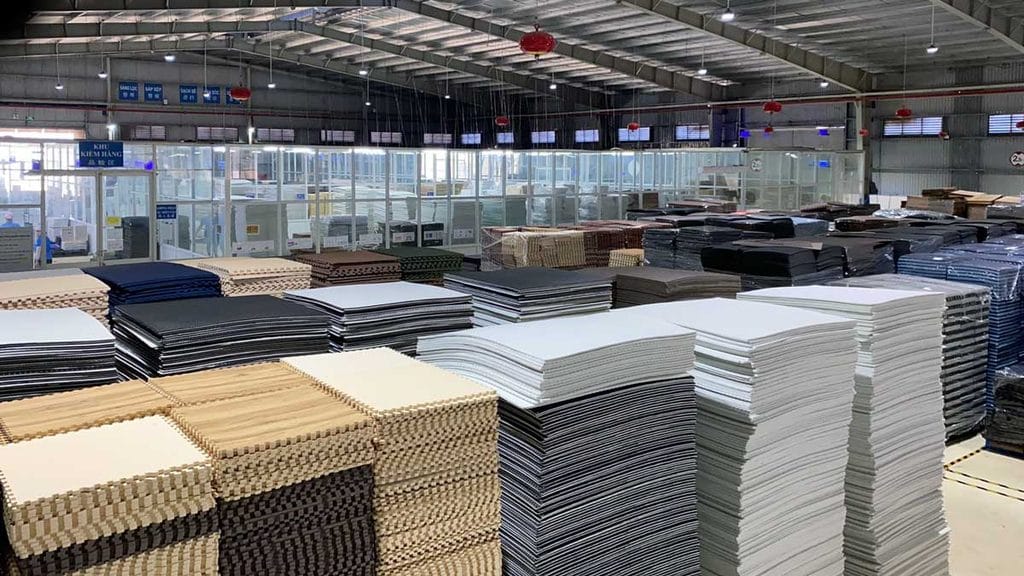
Choosing an EVA foam mat manufacturer is not simply a question of unit price. For an OEM or private-label project, the supplier must be able to convert your application, target market, and product specification into repeatable production. That means controlling the foam formulation, dimensions, surface finish, packaging, and quality checks that affect the finished mat.
This guide explains what B2B buyers should verify before selecting a manufacturer for custom EVA foam mats, including interlocking floor mats, baby play mats, exercise mats, and protective floor mats.
Quick answer: Start with the finished-mat requirement, not a material name alone. Ask each supplier how it will control density, hardness, thickness, dimensions, surface texture, odor, packaging and required testing for your specific product and market.
1. Define the EVA Foam Mat Requirements Before Requesting Quotes
An effective request for quotation gives a factory enough information to recommend a viable construction and provide a consistent quote. Sending only a photo or a target price usually results in quotes that are difficult to compare.
Include the following information where available:
- Applications: baby play area, home gym, fitness studio, martial arts, retail floor protection, or other uses.
- Mat structure: interlocking tile, foldable mat, roll mat, or a custom format.
- Dimensions and tolerance: tile size, finished thickness, edge shape, and packing dimensions.
- Performance priority: cushioning, firmness, grip, cleanability, durability, portability, or appearance.
- Surface and visual requirements: embossing, texture, color, print artwork, logo treatment, or laminated layers.
- Target market and compliance needs: destination country, sales channel, and any required product tests or retailer requirements.
- Commercial requirements: estimated order quantity, repeat-order potential, preferred packaging, and target delivery window.
With this brief, a factory can determine whether EVA is suitable, recommend a density and construction, and provide a quote against a defined packing standard. It also prevents a low quote for a basic mat from being compared with a higher quote for a more demanding specification.
2. Check Whether the Supplier Makes Foam Mats or Only Trades Them
A trading company can be useful for some sourcing projects, but buyers should understand who controls the critical manufacturing steps. For a custom EVA foam mat project, direct production control can shorten problem-solving time and make design changes easier to manage.
Ask practical questions rather than relying only on a website claim:
- Which of the following stages are completed in-house: compounding, foaming, cutting, shaping, surface treatment, printing, lamination, and packaging?
- Can the factory explain how it controls density, thickness, and dimensions from one production run to the next?
- Who reviews artwork, samples, and packaging before mass production?
- Can the supplier provide relevant product specifications, inspection records, or test reports for the proposed construction?
- Who will handle technical questions after the sample has been approved?
Do not stop at a website claim or a factory-tour photo. The supplier should be able to show where the approved specification is checked, who signs off the sample, and how a production issue is traced back to the relevant stage.
3. Evaluate the Specifications That Affect Finished-Mat Performance
EVA is a closed-cell foam material widely used where a product needs cushioning, low moisture uptake and practical cleaning. Its finished performance varies substantially with formulation, density, thickness, structure and surface design.
Density and firmness
Density and hardness influence how a mat feels underfoot, how it supports load and how it recovers after use. A softer construction may suit comfort-focused use, while a firmer construction may be more appropriate where stability or higher load resistance is required. Do not treat density as the only quality indicator; compare it together with hardness, compression behavior, and the actual finished construction.
Thickness and dimensions
Thickness affects cushioning, shipping volume, and how a mat works with adjacent flooring or equipment. Buyers should agree on the finished thickness and permitted tolerance, particularly for interlocking tiles where uneven edges or inconsistent thickness can affect installation.
Surface and edge design
Texture, embossing, lamination and edge treatment affect grip, appearance and routine cleaning. For puzzle mats, ask to assemble a sample set and inspect the joint fit, edge alignment and color consistency under normal lighting.
Color, printing and packaging
Custom color and artwork should be approved against a physical sample whenever possible. The purchase specification should also define packaging materials, insert cards, barcode placement, carton marks and protection needed for transport. Packaging is part of the product experience and should be checked before shipment, not treated as an afterthought.
4. Review the Manufacturing and Quality-Control Process
Foam mats may seem simple, yet variation can arise at several points: formulation, foaming, cutting, surface finishing, printing, and packing. Buyers do not need to become process engineers, but they should know which stages affect the specification they are buying.
A typical EVA foam mat workflow may include:
- Compounding and mixing of resin and approved formulation ingredients.
- Foaming and cooling to create the required foam structure.
- Cutting, shaping, and finishing to achieve the specified size, thickness, and edge profile.
- Surface treatment or lamination where the product design requires it.
- Printing and packaging preparation, followed by final inspection and packing.
During supplier evaluation, ask which measurements are checked at each stage, who records them, and what happens if any fall outside the approved specifications. Request the inspection points for incoming materials, in-process production, finished mats, and finished cartons.
For NEEU projects, buyers can review the related manufacturing process pages before sampling. The factory should recommend the process based on the finished mat requirement, rather than fitting the product to a process name chosen at the start of the discussion.
5. Confirm Compliance for the Specific Product and Destination Market
Compliance is product-specific. A certificate or test report for one mat construction does not automatically apply to every material, thickness, color, print, or target market.
Before placing an order, confirm:
- The destination market and applicable customer, retailer, or product requirements.
- The exact material construction and product version to be tested.
- Which documents are available for review and whether additional testing is required.
- The laboratory, test method, report date, and report scope.
- The approval process for any material, print, packaging, or formulation change.
For products intended for children or other regulated uses, include testing time and cost in the development schedule. The factory can provide material details, product samples, and available documents. The importer should confirm the final legal and market-entry requirements for the exact product it intends to sell. NEEU’s Certifications & Compliance page is a useful starting point for identifying the documents that may be relevant to an EVA foam mat project.
6. How to Assess EVA Foam Mat Suppliers in China and Vietnam
China and Vietnam can both be relevant manufacturing locations for foam mat buyers. Rather than treating location as a shortcut for quality, evaluate the individual factory, the product route, and the supply arrangement.
Use this comparison framework during supplier discussions:
| Evaluation point | Questions for the supplier |
|---|---|
| Product fit | Which mat types and material constructions are routinely produced at this site? |
| Process control | Which production and finishing stages are handled in-house? |
| Sampling | Who approves the material, artwork, dimensions, and packaging before mass production? |
| Quality assurance | What is inspected during production and before shipment? Can the agreed checks be written into the order? |
| Compliance support | Can the supplier provide project-relevant documentation and coordinate samples for required testing? |
| Capacity and delivery | What is the realistic lead time for development, production, and packing at the expected order quantity? |
| Communication | Who owns technical questions, order updates, and corrective actions? |
NEEU operates manufacturing facilities in China and Vietnam, with 50,999 square meters in China and 25,000 in Vietnam. Send the same product brief to the project team and ask which facility will make the product, which process it proposes, and what sample and production plan it recommends. This gives you a basis for comparison before you discuss commercial terms.
7. Use Sampling to Validate the Supplier, Not Just the Product
Samples are the bridge between a quotation and a repeatable production order. A visually attractive sample is not enough if the factory cannot consistently reproduce the approved construction.
Before approving mass production, check:
- Overall dimensions, thickness, and edge fit.
- Density or firmness against the agreed target where applicable.
- Surface feel, texture, color and print quality.
- Assembly performance for interlocking formats.
- Odor, cleanliness and visible foreign matter.
- Carton condition, inner protection, labels and packing quantity.
- Required product testing and approval records.
For a substantial or recurring order, ask how the factory stores the approved sample, specification sheet, and packaging standard with the production order. Those references should be available during pre-production confirmation and final inspection, especially when the order is repeated months later. See NEEU’s foam mat quality-control process for the inspection stages used from incoming materials through packing release.
8. What to Include in the Purchase Specification
The final purchase order should document more than price and quantity. A clear written specification reduces avoidable disagreement later.
At minimum, record:
- Product name, application and approved sample reference.
- Material construction, dimensions, thickness and agreed tolerances.
- Color standard, artwork version and surface requirements.
- Packaging configuration, carton marks, barcode details and labeling.
- Required testing, inspection points and acceptance criteria.
- Production lead time, shipping terms and delivery requirements.
- Process for approving substitutions or changes.
If a requirement is critical to the product launch, include it in the approved specification or purchase documentation. Do not rely on an informal message thread alone.
9. Start an EVA Foam Mat OEM Project With NEEU
NEEU works with B2B buyers on custom EVA foam mat development and export-oriented production. Begin with the intended use, mat structure, dimensions, target thickness, target market, artwork or packaging needs, and estimated volume. A photo or existing sample is helpful, but it should be accompanied by written requirements the factory can use for quoting and sampling.
The project discussion can then cover the proposed mat construction, sample route, inspection requirements, and packing standard before mass production. That sequence helps prevent a late change to the material, artwork, or carton after the price and lead time have already been agreed upon.
Ready to discuss a custom EVA foam mat project? Contact NEEU with your product brief or request a sample discussion.
Frequently Asked Questions
No. Higher density can provide a firmer feel and may suit some load-bearing applications, but the best choice depends on the finished product’s comfort, stability, thickness, structure, and use conditions. Evaluate the complete specification and a physical sample.
Send the application, mat type, dimensions, target thickness, color or artwork, packaging requirement, destination market, estimated order volume, and target delivery date. Photos or drawings are useful, but a written specification is stronger.
Not necessarily. Changes to material construction, color, print, thickness, intended use or destination market can affect what documentation is relevant. Confirm the scope of each report for the exact product version.
No. Compare the quoted construction, tolerances, packaging, inspection plan, testing scope, development support, minimum order quantity and delivery terms. A lower quote may not represent the same finished product or quality controls.