
Foam Mat Certifications Explained: The 2026 Compliance Guide for B2B Buyers
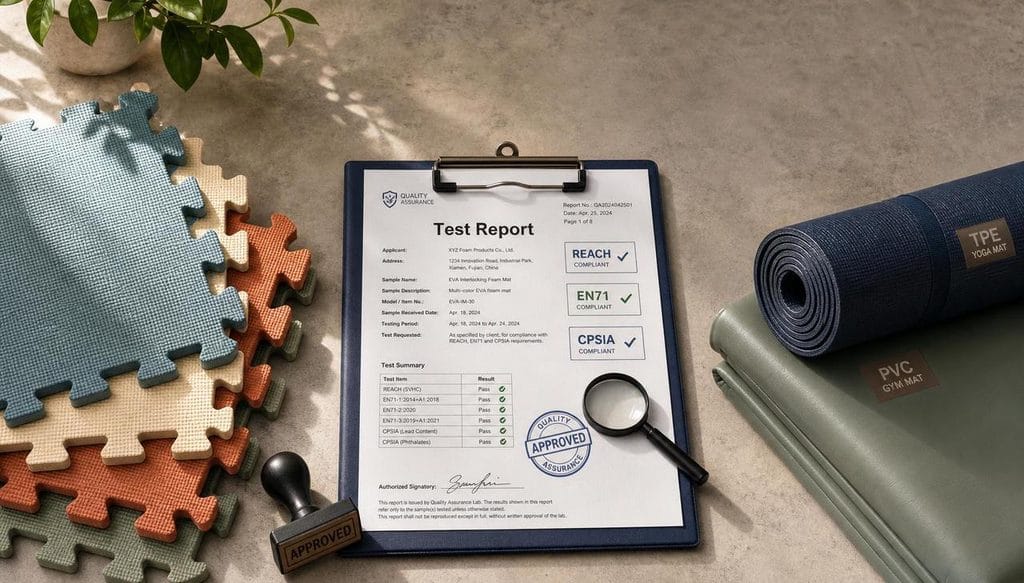
When sourcing foam mats for Europe, the United Kingdom or the United States, the question is rarely simply, “Which certificate do you have?” A more useful question is: which legal and buyer requirements apply to this exact product, and what current documents prove that the supplied SKU meets them?
That distinction matters because a children’s puzzle mat, a yoga mat for adults, a gym floor tile and a home floor covering may be made from similar EVA, TPE, PVC or XPE foam, yet face different requirements. The intended age group, product claims, packaging, destination market, retailer rules, and the final product configuration can all affect the compliance route.
This guide helps importers, retailers, distributors and private-label teams request and evaluate the right evidence. It is an operational sourcing guide, not legal advice. Before placing an order, confirm the final product classification and current requirements with your importer of record, retailer and qualified compliance adviser or accredited laboratory.
A practical rule: Do not approve a foam mat based on a logo sheet or a generic certificate. Match every document to the exact material, construction, colour, intended use, destination market and production version you plan to buy.
Start with product classification, destination and intended user
Compliance planning begins before a supplier selects a test package. Give the supplier and laboratory a concise product brief covering:
- Product format: interlocking tile, roll mat, foldable mat, yoga mat, gym mat, play mat or floor covering.
- Material construction: EVA, TPE, PVC, XPE, rubber, laminated layers, inks, coatings and accessories.
- Target user and age grading: adult fitness user, family household, children under 12, or a product marketed as a toy or play item.
- Claims and presentation: educational letters or numbers, toy language, anti-slip claim, fitness claim, packaging artwork and online listing copy.
- Destination: EU/EEA country, Great Britain, Northern Ireland, the United States generally, California, or a retailer-specific programme.
- Product dimensions and intended installation: particularly relevant when the product may be presented as a carpet, rug or floor covering.
For example, a plain adult yoga mat should not automatically be tested and certified as a children’s toy. Conversely, a foam tile marketed for young children with play, learning or toy features should not be handled as an ordinary adult exercise mat merely because its base material is EVA. Classification follows the finished product and its intended use, not material alone.
For product routes by use case, see NEEU’s Yoga Mats and TPE Foam Material pages. The purpose here is different: to help buyers decide what evidence belongs in the product file.
Do not treat every document as a “certificate”
the word certification is widely used in sales conversations, but it can describe several very different documents. Keeping them separate makes RFQs, supplier reviews and retailer submissions much clearer.
| Document type | What it does | What it does not prove on its own |
|---|---|---|
| Regulation or legal requirement | Sets an obligation for a defined market and product scope. | That your specific mat has been tested or is compliant. |
| Standard or test method | Defines how a characteristic is evaluated. | That the standard applies to every foam mat or destination. |
| Laboratory test report | Records results for identified samples, methods and dates. | That a different colour, formula, thickness or later production run is covered. |
| Declaration of Conformity / certificate of conformity | Identifies the responsible economic operator and applicable rules. | That a declaration replaces underlying testing or technical documentation. |
| CE marking | A marking used only where EU harmonised legislation requires it and the product falls within scope. | A general quality badge for all foam mats. |
| ISO 9001 certificate | Indicates that a factory’s quality-management system has been audited to ISO 9001. | Product safety, chemical compliance or approval of every SKU. |
| Social audit, such as amfori BSCI | Assesses defined social-responsibility management conditions. | Chemical, toy-safety or product-performance compliance. |
Ask a supplier to label files accurately. A test report should be supplied as a report. An ISO 9001 document should be supplied as a management system certificate. Treating them as interchangeable can leave gaps in a retailer’s compliance file.
EU and EEA: build the chemical and product-safety file around the finished mat
REACH: check substances, scope and the current production match
For many foam-mat programmes entering the EU/EEA, REACH is a core chemical-compliance consideration. The European Chemicals Agency maintains the Candidate List of substances of very high concern (SVHCs), which changes over time. As of February 2026, the Candidate List contains 253 entries, but buyers should always verify the current list when finalising the product file.
For articles containing an SVHC above 0.1% by weight, information duties may apply; EU supply-chain and SCIP obligations can also be relevant depending on the role of the economic operator and the product placed on the EU market. This is not a reason to request a vague “REACH certificate.” It is a reason to request a report or declaration that identifies:
- the exact sample and SKU;
- the laboratory and test method;
- the date of issue;
- the substances or restrictions addressed; and
- how the report relates to the final formulation, pigments, coatings, printing and accessories.
REACH assessments should not be copied blindly from one foam material to an unrelated finished mat. A new colour masterbatch, printed surface, laminated layer, adhesive, anti-slip backing, or carry strap may change the evidence needed.
CE marking and toy safety: use only when the product is in scope
CE marking is not a universal requirement for all foam mats. It becomes relevant only if the finished product falls under EU legislation that requires it. A foam mat marketed as a toy or with an in-scope toy function may require a toy-safety conformity route; an adult yoga mat does not become a toy simply because it has a colourful surface.
For a children’s product that is genuinely a toy, the responsible economic operator should establish the correct classification, safety assessment, technical documentation, applicable requirements, and conformity process before using the CE mark. The EU’s new Toy Safety Regulation, Regulation (EU) 2025/2509, entered into force on 1 January 2026 but is scheduled to apply from 1 August 2030. Do not use a future transition date as a shortcut around requirements already applicable to the product today.
The practical buyer task is to ask: Is the product being supplied and marketed as a toy in this market? If yes, which current toy-safety requirements, documents and markings apply to this exact item?
Great Britain and Northern Ireland: confirm the route separately
Do not write “EU/UK compliant” in an RFQ as though it were one uncomplicated market. Great Britain and Northern Ireland have different regulatory arrangements. For toys sold in Great Britain, the Toys (Safety) Regulations 2011 remain central, and the acceptability of CE marking depends on the applicable conditions. Northern Ireland follows a different framework connected to EU rules.
Ask the importer, retailer or appointed compliance adviser to confirm:
- the destination: England, Scotland, Wales or Northern Ireland;
- product classification and intended user;
- marking and documentation route currently required;
- whether retailer protocols go beyond the statutory minimum; and
- who is the responsible importer or economic operator?
This separate check is especially important for children’s foam play products, because marketing language, age grading and toy features may alter the route.
United States: separate children’s products, general-use products and floor-covering scope
Children’s products and toys
In the United States, the Consumer Product Safety Commission (CPSC) distinguishes children’s products from general-use products. When a foam mat is a children’s product subject to applicable children’s product safety rules, the domestic manufacturer or importer has responsibilities that can include third-party testing by a CPSC-accepted laboratory and a Children’s Product Certificate (CPC). If a product is a toy, the applicable toy-safety route and current ASTM F963 requirements should be confirmed for that exact product.
The important word is applicable. Do not apply every children’s product test to an adult yoga mat simply because it is foam. Equally, do not assume that a children’s play mat avoids children’s-product obligations because the supplier calls it an exercise mat.
General-use products and the GCC
For non-children’s products, a General Certificate of Conformity (GCC) is required only when the product is subject to an applicable CPSC-enforced rule, standard, ban, or regulation. The GCC is issued by the U.S. manufacturer or importer, even if a factory or laboratory assists in preparing the information. It must be supported by product testing or a reasonable testing program.
That means a GCC is not a generic attachment for every adult foam mat. First, identify which rule applies. Then ensure that the product description, cited rule, responsible importer, and supporting evidence actually match the shipment.
Floor coverings, carpets and rugs
U.S. surface-flammability rules for carpets and rugs may apply when a product falls within that scope. The CPSC identifies 16 CFR Part 1630 for large carpets and rugs and 16 CFR Part 1631 for small carpets and rugs. Whether a foam mat is covered requires a classification review based on the finished product, intended use, dimensions, and product presentation. A factory should not promise a blanket “U.S. flammability compliant” claim without that review and suitable evidence.
For flooring-oriented products, include the intended installation and end-use description in your RFQ. This allows the laboratory and importer to determine whether a flammability route, a retailer requirement, or no such requirement is applicable.
California Proposition 65
California Proposition 65 is often requested by U.S. retailers, but it is not a product certificate or a substitute for federal compliance. It concerns listed chemicals and exposure/warning obligations. A buyer should evaluate the intended California distribution, relevant chemicals, exposure pathway, product composition, and warning strategy with qualified advice. Avoid unqualified claims such as “Prop 65 certified.”
Formamide testing: ask the precise question
Formamide is a chemical of concern often raised in relation to EVA foam products, especially children’s foam mats. It should not be confused with DMF, which means dimethylformamide and is a different substance. Nor is there a universal document called a “low-formamide certificate” that makes every EVA mat acceptable in every market.
The defensible sourcing approach is to request product-specific test evidence when formamide is relevant to your product or market brief. State the following in the RFQ:
- the exact EVA foam product and final dimensions;
- front and back surface construction;
- color, printed layer, coating and laminated components;
- destination and customer program;
- requested substance, method, reporting units and any limit supplied by the buyer, retailer or applicable rule; and
- whether the laboratory must be accredited for the requested test.
Then review the report against the actual production specification. A historical report from another thickness, another color or a different molded tile may be useful background evidence, but it should not be represented as proof for your current SKU without a defensible coverage assessment.
For material and construction decisions that can affect the finished surface, see NEEU’s Surface Treatment & Lamination overview. Chemical claims should still be verified through product-specific documentation rather than inferred from a process description.
Adult yoga and exercise mats: do not import toy requirements by default
Adult yoga and exercise mats can be subject to chemical, consumer-safety, labeling, retailer and local-market expectations, but they are not automatically governed by children’s toy rules. Their compliance plan should begin with the actual product:
- Is it designed, marketed or age-graded for children?
- Is it a stand-alone exercise product, a household mat or a floor covering?
- Does it make health, performance, anti-slip, recycled-content, or chemical-free claims that require substantiation?
- Does the retailer require testing for restricted substances, odor, migration, phthalates, grip, dimensions, or packaging?
- Does the product include accessories, electronics, printed graphics or materials that create a separate requirement?
This approach prevents both under-testing and unnecessary testing. It also helps a buyer compare EVA, TPE, PVC, rubber, and layered constructions on a fair technical basis. See how to Customize Yoga Mats for the commercial specification choices that should be settled before testing is booked.
How to review a supplier’s compliance report in five checks
A report is useful only if it can be connected to the goods you will receive. Before approving a document, make these five checks.
1. Does the sample clearly identify the product?
The report should identify the relevant product name or code, material, color where relevant, thickness, construction, and sample description. A report called simply “EVA foam mat” may be too broad when you are buying a printed, laminated, multi-layer product.
2. Is the test method relevant to the buyer brief?
Check the named regulation, standard or method against the market and product classification. A recognized laboratory logo does not cure an irrelevant test method.
3. Is the report current enough and tied to production?
There is no universal expiry date for every test report. However, a report should be reassessed after formula changes, pigment or ink changes, supplier changes, new laminations, revised tooling, changes to packaging contact materials, or any material modification. Retailer programs may specify their own recency rules.
4. Does the tested sample cover the final product?
Ask how the tested sample represents the actual SKU. For a multi-layer mat, a component report may not cover the assembled item. For a collection with many colors, confirm whether the selected worst-case color, ink or additive package is genuinely representative.
5. Who will issue the final market document?
Laboratories test. Factories provide technical evidence. The importer or other responsible economic operator may be responsible for declarations, certificates and placing the product on the market. Clarify ownership of each document before shipment, not after a retailer asks for it.
NEEU’s Quality Control and Packaging Preparation & Final Inspection pages explain the production-side checks that can support consistency between approved samples and export-ready goods. They do not replace destination-market compliance review.
Chemical compliance documents and physical performance reports answer different questions. For density, hardness, compression, and tear data, use this guide to read and compare foam mat test reports.
What to request in a foam mat compliance RFQ
Use this short request as a starting point when sending a buyer brief:
Product:product name and SKU
Construction: [material, layers, coating, printing, colour, thickness and accessories]
Intended user and claims: [adult / child age grade / toy or non-toy / marketing claims]
Destination: [country or region, including GB or NI where relevant]
Retailer or customer programme: [name and manual version, if applicable]
Required evidence: Please confirm the applicable route and provide current, product-specific test reports, declarations and factory documents. Identify report number, laboratory, sample description, test method, date, coverage rationale and any limitations.
Change-control requirement: Notify us before changing formulation, pigment, ink, coating, laminate, accessory, material supplier or production site after approval.
This wording encourages the supplier to identify gaps early. It is much stronger than asking for “all certificates” because it makes the buyer’s intended product and market explicit.
How NEEU supports a documented compliance workflow
NEEU can review a buyer’s product brief and align materials, surface options, printing, packaging and production controls with the requested documentation plan. Where testing is needed, the scope should be confirmed for the agreed SKU, construction, destination, and retailer program before production release.
The availability and applicability of any report, declaration, or factory certificate must be confirmed against the final product specification. This is especially important when an EVA, TPE, or PVC mat has a custom color, printed graphics, coatings, laminated surfaces, or accessories.
Explore NEEU’s Certifications & Compliance capability overview, or contact the team with your target market, product drawing and retailer requirements to begin the document review.
Frequently asked questions
No. CE marking is not a generic certificate for foam mats. It applies only where the finished product falls under EU legislation requiring CE marking. Product classification and intended use must be confirmed first.
No. A REACH-related report can be important chemical evidence, but it covers only the samples, substances, methods and scope stated in the report. Buyers must also consider the final product, current Candidate List and restriction requirements, supply-chain duties and applicable product rules.
No. It is a product-specific chemical claim that needs a defined substance, test method, unit, sample and applicable target. Do not confuse formamide with DMF, and do not rely on a generic claim without supporting evidence for the final SKU.
No. An adult yoga mat is not automatically a toy or a children’s product. Requirements depend on the finished product, age grading, intended use, claims, and destination-market rules.
The correct answer depends on the report type, customer program and whether the product has changed. Treat a change in formula, pigments, printed layers, laminate, accessories or production site as a reason to reassess coverage. Ask retailers and qualified laboratories for the applicable recency or retest expectation.
Fake and expired certificates are a real problem in low-cost sourcing, so verification is a core skill for buyers. Start by checking three things on every document: the date (is it current, especially for REACH given the twice-yearly SVHC updates?), the scope (does it name the specific material, product, and even color you are buying, or is it a generic company statement?), and the issuing body (is it an accredited lab such as SGS, Intertek, TÜV or Bureau Veritas?).
Next, cross-check independently. Reputable test labs issue reports with a unique report number that you can often verify on the lab’s website or by contacting the lab directly. For CE, ask for the Declaration of Conformity and the technical file references, not just the logo. For social and quality schemes, BSCI/amfori audits and ISO 9001 certificates are registered and can be validated with the certifying auditor. A supplier that resists these requests is a red flag in itself.
Final buyer checklist
Before approving a foam mat for shipment, confirm that you have:
- classified the finished product and its intended user;
- identified the destination market, including GB versus NI where relevant;
- separated legal requirements, test methods, reports, declarations and factory-system documents;
- matched every report to the final SKU and current production version;
- assigned responsibility for CPC, GCC, declarations and retailer submissions;
- documented material and production change controls; and
- retained a clear evidence file for the importer, retailer and future replenishment orders.
The strongest compliance programme is not the largest collection of logos. It is a documented chain from product brief to tested sample, controlled production, final inspection and market-specific paperwork.
Official sources and further reading
- European Chemicals Agency: Candidate List of substances of very high concern
- European Chemicals Agency: SCIP database obligations for suppliers of articles
- European Commission: Toy safety
- UK Government: Toys (Safety) Regulations 2011 guidance for Great Britain
- U.S. CPSC: Testing and certification
- U.S. CPSC: General Certificate of Conformity guidance
- U.S. CPSC: Carpet and rug flammability guidance
- California Proposition 65: warning guidance
Last reviewed: 30 August 2026. Regulations, official lists, retailer manuals and product classifications can change. Confirm the current requirements for the final product and destination market before shipment.