
A supplier sends a foam mat test report with four results: density, hardness, compression set, and tear strength. Each result is marked “Pass.” Before approving the sample, you still need to know whether those results apply to the mat in your quotation.
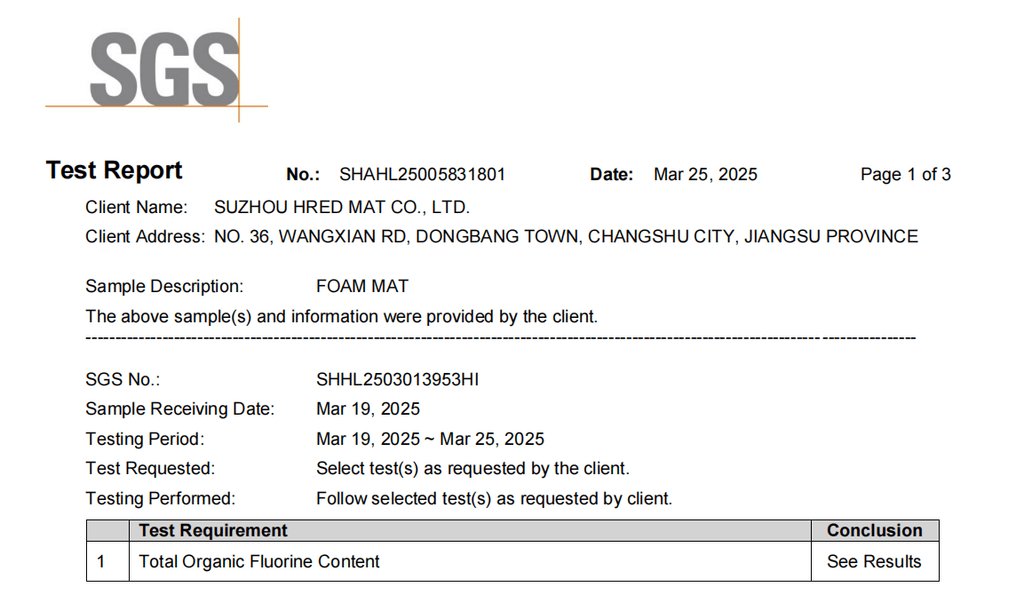
A plain foam sheet and a laminated retail mat are different test samples. Hardness readings from different instruments may not be comparable, and two compression percentages may describe entirely different properties.
To read a foam mat test report, check the sample identity, test method, specimen preparation, conditions, units, and acceptance limit before comparing the results. If a detail is missing, ask for clarification rather than assuming it matches your specification.
For tile, play-mat, and exercise-mat orders, the report should support two decisions: whether the tested sample meets your requirements, and what needs to be checked in production.
Start with the sample, not the results table
Check the product code against the quotation, sample label, and drawing. A description such as “EVA foam, blue” is not enough to distinguish several thicknesses, formulations, or surface constructions. For an EVA foam mat, identify whether the laboratory received a plain sheet, a finished tile, or a coupon cut from a specific area of the finished product.
The distinction matters when the mat has a molded skin, an embossed surface, a printed film, a textile cover, a coating, an adhesive, or a backing. A foam-core result and a finished-construction result can both be useful, but they answer different questions.
| Report detail | What a buyer should establish |
|---|---|
| Sample description and photographs | Do they match the approved material, surface, thickness, and construction? |
| Sample or batch identifier | Can the tested item be traced to the proposed product and production lot? |
| Sampling responsibility | Did the client submit selected samples, or was sampling performed or witnessed independently? |
| Receipt and test dates | Which sample revision was available at the time of testing? |
| Test locations | Were specimens cut from the center, edge, surface layer, or another defined area? |
| Report number and revision | Is this the complete, final report, including amendments and relevant annexes? |
A genuine laboratory report may describe a sample selected and submitted by the supplier. That can support sample approval, but it does not establish that the sample represents an entire shipment. For production acceptance, the sampling agreement should identify who selects the items, which cartons or sheet positions are covered, and how the samples remain traceable. A retained reference sample can help resolve later differences.
If authenticity is uncertain, use the laboratory’s own verification channel. Obtain its contact details independently rather than relying solely on a phone number included in a forwarded PDF. A report image or a single cropped results page may omit conditions that change the interpretation.
Density: check the measurement basis and units
Density is mass divided by volume. In a report, the useful details are the method and the part of the construction measured.
ISO 845 distinguishes apparent overall density from apparent core density and addresses molded or extruded skins. That distinction helps explain why sample preparation matters when comparing cellular materials. ISO 845:2006
The specimen description should state whether the skin or attached layers were included. “Overall density” under a particular standard does not automatically mean every layer of a finished multilayer mat was tested together. If one sample includes a backing and the other is bare foam, their density values reflect different constructions.
Also distinguish foam density from solid resin density. The resin value does not include the cellular volume created during foaming and cannot substitute for a finished-foam measurement.
Different units can be comparable
These illustrative values express the same density:
- 0.10 g/cm3;
- 100 kg/m3;
- approximately 6.24 lb/ft3.
These are unit conversions, not recommended mat specifications. They allow a numerical comparison when the methods and measurement basis align; they cannot resolve a core-versus-layered-sample mismatch.
Specimen dimensions and conditioning matter too. On thin or textured foam, a small difference in thickness measurement changes the calculated volume. The results table should also distinguish a measured mean from a single reading or a nominal data-sheet value.
The foam density specification guide covers the selection of targets and tolerances. When reviewing the report, first establish that the value represents the agreed sample. A higher density is not an automatic quality ranking.
Hardness: a number without a scale is incomplete
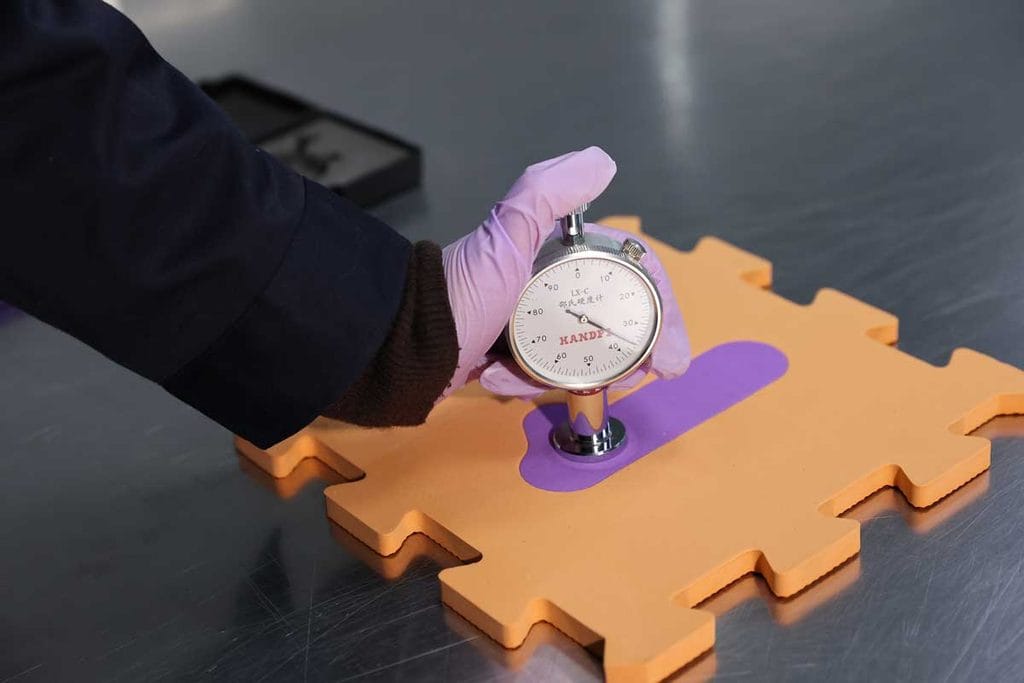
“Hardness: 45” cannot be interpreted reliably. The report needs the instrument type or scale, the test method, and the relevant test conditions.
ASTM D2240 explains that different durometer types use different indenter geometries and forces; readings from different types are not simply or directly comparable. Do not convert one scale into another using an unvalidated chart. ASTM D2240
Shore A, Shore C, Shore OO and Asker C should therefore not be treated as interchangeable labels. Even a letter such as “C” needs to be read together with the named instrument and method.
Before accepting a hardness result, check:
- whether the specified scale was used;
- specimen thickness and whether stacking was permitted and used;
- whether the reading was taken on the core or the finished surface;
- the reading time after contact and the measurement arrangement;
- measurement locations, number of readings and the reported summary.
If the mat is too thin for the selected procedure, ask the laboratory how it prepared the specimen and whether any deviation was recorded. A reading affected by the support beneath the sample is not necessarily comparable with a reading from a properly prepared thicker specimen.
Surface texture also deserves attention. An embossed peak, a recessed area, and a smooth core section may not give the same contact condition. Agree on positions that can be reproduced during future inspections.
A hardness result can support production control when the scale, specimen preparation, and measurement positions match the purchasing requirement. It does not describe the complete underfoot feel. For that specification decision, consider foam mat hardness and thickness together.
Compression: identify which property the percentage describes
A compression result can describe resistance under load, residual deformation after release, or thickness recovery. The heading and units should identify which property was measured.
| Report term | What is being evaluated | What to check |
|---|---|---|
| Compression stress or compression deflection | Resistance while the specimen is compressed | Deflection, loading rate, specimen dimensions and force or stress units |
| Compression set | Deformation remaining after release and a defined recovery period | Compression level, duration, temperature, recovery conditions and calculation |
| Thickness recovery | Thickness regained after unloading | Formula, measurement time and reference thickness |
| Rebound resilience | Response to a specified short-duration impact | Impact method and result definition |
A percentage alone does not identify the property. “Compression: 25%” might describe the imposed deflection rather than the test result.
Read the loading and recovery conditions together
For compression set, read the loading conditions alongside the recovery conditions: initial thickness, imposed deflection or loading arrangement, duration, temperature, recovery interval, and final-thickness measurement procedure.
A result obtained after room-temperature loading cannot be directly compared with one obtained under a heated protocol. Likewise, a specimen measured shortly after release may not have recovered as much as one measured several hours later. Those are different test conditions, not necessarily different supplier quality levels.
A result from one controlled exposure is not a lifetime forecast. Equipment feet, rolled storage, and repeated loading can create conditions outside the report’s protocol.
Recovery is not automatically 100 minus compression set
Consider a purely illustrative specimen with an original thickness of 10 mm, a compressed thickness of 5 mm, and a recovered thickness of 9 mm.
Using the recovered thickness divided by the original thickness yields a 90% thickness recovery. Using residual thickness loss divided by imposed deflection gives 20% compression set:
Thickness recovery = 9 / 10 x 100 = 90%
Compression set = (10 – 9) / (10 – 5) x 100 = 20%
The denominators differ, so the percentages are not complements. Another protocol may define recovery differently; the report’s formula determines how its result should be read.
A published EVA/nylon-elastomer study measured ball rebound and long-duration compression recovery as separate properties, defining recovery as the difference between recovered and original thickness. This distinction is useful when reading reports, although the footwear-oriented experimental blends provide no acceptance limits for commercial mats. Huang et al., 2021
Force and stress are not the same result
A force in newtons depends on the loaded area and the construction. Stress expresses force per area and is often reported in kPa. Two force values from different specimen areas cannot be ranked directly.
Area normalization may help if the method permits it, but converting force to stress does not resolve differences in thickness, loading rate, preconditioning, or test arrangement. The laboratory can establish whether the comparison is valid.
For an equipment mat, supplement the agreed material test with a defined finished-product loading check where needed. Record the contact footprint, load, exposure time, and recovery interval. That check addresses the intended use; it should not be presented as a standardized laboratory result unless it actually follows the named procedure.
Tear strength: read the specimen shape before the value
Tear testing evaluates resistance to tearing under a defined specimen geometry and loading procedure. It is different from tensile strength, which evaluates a specimen pulled in tension.
Reports may identify trouser, angle, or other specimen designs, with different cutting and notch arrangements. Check the actual method rather than assuming that all results headed “tear strength” are equivalent.
For example, a trouser-tear result should be read with its specimen preparation, thickness measurement, test speed, and number of specimens. Those details are documented in Huang et al.’s testing methods; the same information helps you identify what a supplier’s result actually represents.
Separate tear force from thickness-normalized strength
Newtons measure force. N/mm and kN/m can express force normalized by specimen thickness; 1 N/mm equals 1 kN/m. A value in newtons is not directly comparable with a thickness-normalized value without the relevant dimensions and the method’s calculation rule.
Tensile strength, measured in MPa, is a different property, not an alternative unit for tear strength.
Specimen orientation can also affect the comparison. Where directional performance matters, the specification should identify the sheet directions to be tested and how each is evaluated.
A foam coupon does not prove puzzle-edge durability
A satisfactory material tear result does not automatically confirm that a narrow puzzle tooth will withstand repeated assembly. Tooth width, root shape, die-cut condition, thickness, and handling loads can affect the finished feature.
For interlocking tiles, include an agreed assembly and edge-condition check. For foldable mats, examine the fold area and any bonded or covered construction. If the concern is layer separation, a suitable bond or peel evaluation may be more relevant than a core tear test.
Can you compare two suppliers’ test reports?
Use a side-by-side comparison sheet before ranking suppliers. A blank field is a request for clarification, not permission to assume the conditions match.
| Comparison field | What needs to align |
|---|---|
| Sample | Material system, construction, thickness, and specimen source |
| Method | Standard, edition, specific procedure and any deviations |
| Preparation | Specimen shape, dimensions, skin or layer removal, orientation and stacking |
| Conditions | Conditioning, temperature, rate, duration, deflection and recovery period as applicable |
| Result | Property definition, units, formula, specimen count and statistics |
| Judgment | Acceptance limit and decision rule, if a conformity statement is requested |
The following examples are hypothetical, not NEEU or supplier test data:
| Report A | Report B | Comparison decision |
|---|---|---|
| Core density: 100 kg/m3 | Core density: 0.10 g/cm3 | Numerically equivalent after conversion; verify method and preparation |
| Hardness: 45 Shore C | Hardness: 45 Asker C | Do not assume equal hardness |
| Compression set: 12%, one recovery interval | Compression set: 8%, a longer recovery interval | Do not rank recovery performance without aligned conditions |
| Tear force: 30 N | Tear strength: 3 kN/m | Different quantities as stated; request geometry, thickness, and calculation |
When a difference in method could change the decision, matched retesting is more useful than ranking incompatible numbers. Test the approved reference sample and candidate samples under the same agreed protocol.
Even with matching methods, a small numerical difference may not justify a ranking. Consider specimen variation, measurement uncertainty where relevant, and the method’s precision. An average without individual results can conceal a wider spread. Request individual values or a summary of variations when that information is available and important to the order.
What does “Pass” actually mean?
A pass statement needs a requirement. Find the limit, its source, and the results to which it applies. The requirement may come from a buyer specification, a retailer protocol, a product standard, or another defined agreement.
A test-method designation is not, by itself, a universal quality threshold. ASTM D3575, for example, describes procedures for flexible closed-cell olefin-based materials and distinguishes those procedures from product requirements. It also limits interpretation to the particular test conditions. ASTM D3575-20
Method selection belongs with a qualified laboratory. A procedure used for one cellular material may not apply to every EVA, XPE, TPE, or covered construction.
Near a limit, ask about the decision rule
For a result close to an acceptance boundary, the decision rule becomes important: how did the laboratory judge conformity, and how was measurement uncertainty handled where applicable? ILAC G8 addresses conformity decision rules, while G17 addresses uncertainty in testing. ILAC guidance documents
The rule should be agreed with the laboratory and the party setting the requirement, rather than improvised by adding or subtracting uncertainty afterward. A report without a printed uncertainty value is not automatically invalid; reporting needs depend on the test and its use. Clarification matters when uncertainty could change acceptance.
Check accreditation scope, not only the logo
Where accredited testing is required, verify the laboratory’s current scope of accreditation with its accrediting body. Confirm that the relevant activity or method falls within that scope and check how the report distinguishes any non-accredited results. Accreditation should not be interpreted as certification of the mat itself. ILAC publishes guidance on describing accreditation scopes. ILAC G18 and related guidance
A physical test report also does not establish chemical compliance, child-product suitability, flammability performance, or compliance with all destination-market requirements. Those need their own applicable assessments and documentation. Avoid turning “passed four mechanical tests” into a broad safety claim.
Turn the report into a purchase and inspection requirement
The sample approval record should carry forward the report’s relevant conditions. Otherwise, a later production lot may be judged against a number whose measurement basis has been forgotten.
For each required property, retain the method and edition, preparation, conditions, target or limit, sampling plan and reporting basis. Specify whether acceptance applies to individual specimens, an average, or another statistic. A sample’s measured result is evidence for approval, not automatically a realistic production target or tolerance.
Connect the laboratory requirements to the foam mat quality-control plan. Incoming or in-process checks, finished-product sampling and laboratory testing serve different roles. A report should supplement dimensional, visual, assembly and packaging checks rather than replace them.
A physical report’s continued relevance depends on product changes, customer requirements, and sampling history, not on a universal expiry period. Changes to formulation, thickness, surface layers, tooling or manufacturing route may require new evidence. A recent report for the wrong construction is less useful than an older report whose relevance has been established, but neither date nor description alone proves production consistency.
A clarification request you can send to a supplier
Please confirm which product code, revision and batch this report represents, and who selected the samples. We also need the method and edition, specimen preparation, test conditions, units, calculation and specimen count for each result. For any pass statement, please identify the acceptance requirement and decision rule. Where accredited testing is required, flag any results outside that scope, along with any method deviations.
Keep the response with the report and sample approval record. If clarification reveals a material mismatch, resolve it before using the results to approve production.
Frequently asked questions
No. A data sheet may state typical or nominal properties without identifying a tested lot. A laboratory report should identify the sample and the reported testing. Both can support sourcing, but typical values should not be treated as evidence of shipment-specific acceptance.
Sometimes, but equivalence needs to be established rather than assumed. Compare scope, specimen preparation, conditions, calculation, and precision with a qualified laboratory. If equivalence remains uncertain, use matched testing for the purchasing decision.
It may support a particular durability requirement when the methods and constructions are comparable. It does not address grip, comfort, recovery, interlock fit, or compliance. Set a target requirement based on the actual risk rather than buying the largest reported number.
It may provide background, but do not assume automatic coverage. Ask whether the formulation, surface construction, or processing changed and which tests need to be repeated. The relevant customer or laboratory should confirm the required scope.
Not necessarily. Test frequency should be based on risk, production history, change controls, and customer requirements. Agree on routine checks and periodic or change-triggered laboratory testing. Retain enough traceability to connect the evidence to the product being released.
Preparing a foam mat sourcing brief?
Send NEEU your intended use, mat construction, dimensions, and the test requirements your purchasing team or retailer expects. Include the method and conditions behind any target values so the sample request is clear from the start.
References
- Huang, G., Gui, Y., Li, Y., et al. (2021). Preparation and Characterization of EVA/Nylon Elastomer Microcellular Foaming Materials. China Plastics, 35(9), 1-7. DOI: 10.19491/j.issn.1001-9278.2021.09.001.
- ISO 845:2006: Determination of apparent density.
- ASTM D2240: Durometer hardness.
- ASTM D3575-20: Flexible cellular materials made from olefin polymers.
- ILAC guidance series: G8, G17, and G18, covering conformity decisions, measurement uncertainty, and accreditation scopes.