
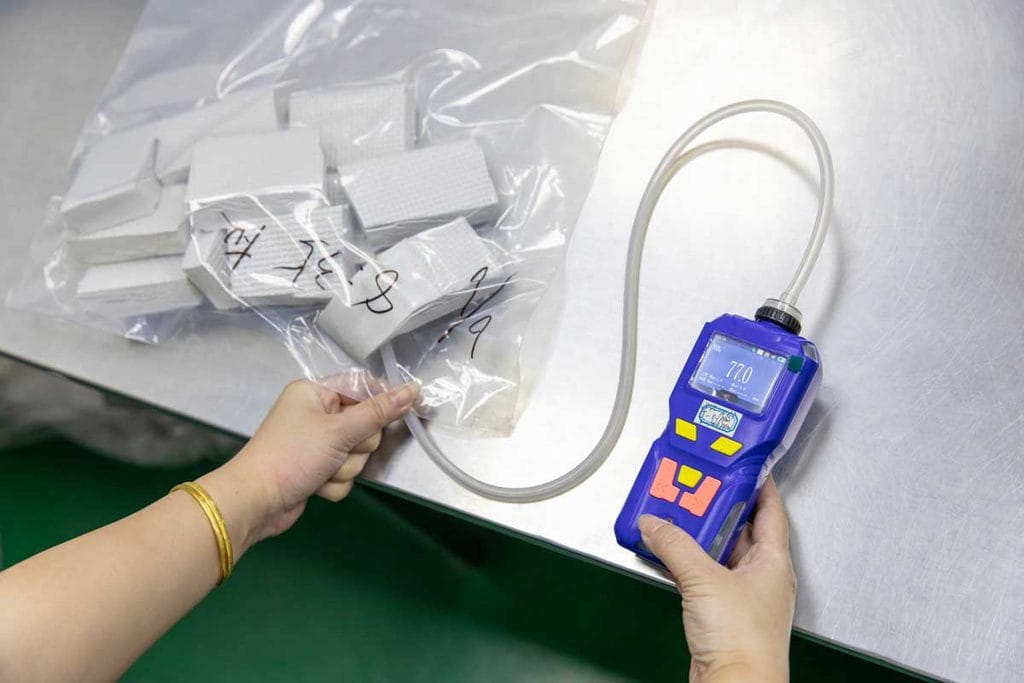
Two foam mat VOC reports can both be genuine and still be impossible to compare. One may test a bare foam sheet in a heated gas bag for two hours. Another may place a finished printed mat in an environmental chamber and report results after several days. Their compound lists, exposed areas, temperatures, and units may all differ.
For a B2B buyer, the first question is therefore not simply, “Does this mat contain VOCs?” It is: What product was tested, which emissions were measured, under what conditions, and against which requirement?
This guide explains how volatile organic compound testing applies to EVA, XPE, PE, TPE, PVC, and multilayer foam mats. It also shows how to separate odor observations from chemical evidence, read a chamber or bag report, and write a purchasing specification that can be repeated for production.
Quick answer: A VOC result is meaningful only when it identifies the tested product, method, conditions, analytes, units and acceptance criteria. Odor, TVOC and a generic “Pass” statement do not answer the same question.
What does “VOC” mean in a foam mat report?
VOC stands for volatile organic compound. It describes a broad class of compounds rather than one substance. The term alone says nothing about hazard or exposure, and the boundary between very volatile, volatile, and semivolatile compounds depends on the convention and analytical method being used.[1]
A report may use several related terms:
| Report term | What it usually tells the buyer | What it does not tell the buyer by itself |
|---|---|---|
| Individual VOC | The reported result for a named compound, such as toluene or styrene | Whether unlisted compounds were measured |
| Target VOC panel | Results for a defined list of compounds | The complete emissions profile of the product |
| Non-target or scan result | Compounds tentatively identified outside a fixed target list | A validated concentration for every detected peak |
| TVOC | A sum calculated over a stated analytical range and according to a stated procedure | The toxicity, odor or compliance of every compound in the sum |
| Chamber concentration | The amount measured in chamber air at a stated time, often in micrograms per cubic metre | The expected concentration in every real room |
| Emission rate | Release normalized by area, mass or product under defined conditions | A universal pass limit or lifetime exposure result |
The US Environmental Protection Agency notes that definitions used for VOC regulation and indoor-air evaluation can differ, and that a label or VOC program may not cover every compound relevant to indoor air.[1] This is one reason a bare statement such as “VOC tested” is incomplete.
Where can emissions come from in a finished foam mat?
A finished mat is often more than a foam core. Depending on its construction, potential emission sources may include:
- the polymer compound and processing aids;
- residual or decomposition-related substances associated with a particular foaming system;
- pigments, inks and print treatments;
- adhesives used for lamination or assembly;
- films, textiles, coatings or backings;
- cleaning agents and maintenance products;
- bags, inserts, cartons, pallets and storage contamination.
Test the construction being purchased. For a printed or laminated retail mat, that normally means the complete product rather than a plain foam coupon. Finished-product testing, however, may not reveal which layer contributed a reported compound; investigating an unexpected result may require separate testing of the core, ink, adhesive, or surface layer.
Material acronyms are not substitutes for product data. EVA, XPE, TPE, and PVC identify material families or constructions, while formulation, processing, surface layers, product age, and handling shape the measured profile. Buyers reviewing EVA foam mats should link emissions requirements to the exact SKU, color, and construction.
Odor and VOC emissions answer different questions
Odor is useful quality information. An unusual smell can trigger lot isolation, comparison with the approved sample, and further testing. It cannot identify a compound or establish its concentration.
People also differ in odor perception, and different compounds can be noticeable at very different concentrations. Packaging may concentrate an initial smell, while airing can change the sensory impression without showing which compounds remain or whether a contractual limit is met.
Keep three questions separate:
- Sensory question: Does the finished mat have an odor that differs from the approved sample or agreed rating?
- Analytical question: Which target compounds or summed emissions are reported under the selected method?
- Compliance question: Does the identified product meet the applicable legal, retailer, or buyer requirement?
Sensory inspection and chemical testing should therefore remain separate records. A mat with little noticeable odor may still require analytical testing, while a strong odor cannot identify formamide, solvent residue, or a specific blowing-agent by-product. The foam mat quality defects guide explains how to document an odor complaint without guessing its chemical cause.
Content, headspace, bag, and chamber tests are not interchangeable
The phrase “VOC test” can refer to different measurement designs. Before comparing numbers, identify what was measured.
Material content or extraction testing
An extraction test measures substances removed from a known mass of material under a defined solvent and preparation procedure. Results are commonly reported as mass per mass, such as milligrams per kilogram.
This can answer a restricted-substance or formulation question when the method and requirement match. It does not directly show how much enters room air during use.
Static headspace testing
Headspace analysis measures compounds in the gas above a sample after controlled equilibration or heating. It can be useful for screening and method development. The headspace conditions must be known because the temperature, sample mass, container volume, and equilibrium time affect the result.
Gas-bag testing
In a bag method, a cut sample is enclosed with a defined gas volume and held under stated conditions before the gas is collected for analysis. This can provide controlled comparative data and may accelerate release by using an elevated temperature.
Cui and colleagues developed a TD-GC-MS method for 35 target VOCs in children’s interlocking mats. Their samples were cut, placed in 10 L Tedlar bags with 5 L of nitrogen, and held at 60 degrees C for two hours before sampling.[5] Those conditions make the paper useful for understanding an accelerated target-panel method. Its results should not be read as ordinary room-air concentrations, and its 35-compound list does not represent every possible volatile substance.
Environmental chamber testing
An emission chamber controls the environment around a sample and measures compounds released into the air over time. ISO 16000-9:2024 describes a chamber method for determining area-specific VOC emission rates from building-product and furnishing samples under defined climate conditions.[2] ISO 16000-6:2021 covers active sampling on sorbent tubes followed by thermal desorption and gas chromatography with MS or MS-FID for compounds in indoor and chamber air.[3]
ASTM D5116-25 is a guide for small-scale chamber determinations of organic emissions from indoor materials and products. ASTM explicitly describes it as a guide rather than a pass/fail test method and notes that chamber concentrations should not simply be substituted for full-scale room concentrations.[4]
These standards are important technical references. They are not proof that every foam mat must be assessed under the same protocol. The laboratory, buyer, and applicable program must agree on the method and acceptance basis for the actual product.
Why chamber conditions change the result
Emission testing is controlled because release depends on both the material and its environment. The report should identify at least the following conditions.
Temperature and relative humidity
Temperature can affect vapor pressure, diffusion, and desorption. ASTM D5116-25 identifies temperature as a critical variable in chamber emissions, while a recent chamber study of selected EVA, PE, and XPE children’s mats found higher measured VOC release from its EVA sample as test temperature increased.[4,6]
That finding does not provide a universal correction factor for every mat. It shows why two tests at different temperatures should not be ranked as if their conditions matched.
Air change rate and air speed
Fresh-air supply dilutes chamber concentration and changes the concentration gradient above the material. Surface air speed can also affect mass transfer. A report that states only chamber volume but omits air change and air speed leaves important context missing.[4]
Product loading factor
Loading factor relates the exposed sample area to chamber volume. More exposed surface per unit of air can increase chamber concentration. The selected area should represent the test plan, and the report should state whether cut edges were exposed or sealed.
Product age, packaging and conditioning
Record manufacturing date, packaging date, laboratory receipt, unpacking time, and start of conditioning. A newly opened, tightly bagged product and a sample stored unwrapped for weeks do not have the same history.
Sampling time
Many emissions change over time. A result after several hours and one after several days answer different questions. The selected time point must match the requirement rather than being chosen after the result is known.
Research on partition coefficients and emission modelling for seven inhalable chemicals in children’s play mats also found that release behavior depended on the compound, material, temperature, and adsorption within the mat structure.[5] The study supports tracking time and material conditions; it does not establish one airing period that makes every mat acceptable.
What published play-mat research can and cannot tell buyers
A 2026 study used a climate chamber and TD-GC-MS to examine selected market-purchased EVA, PE and XPE children’s mats. It also varied temperature, air exchange, loading factor, and release time for the selected EVA sample. The measured profile changed with those conditions.[6]
The study does not establish a general ranking of EVA, PE and XPE. It covered selected market samples rather than every formulation, color, print, adhesive or production route. For procurement, it supports four narrower conclusions:
- chamber conditions must accompany the result;
- a material comparison is valid only for the products actually tested;
- individual compounds and the summed value should be reviewed together;
- results from one sample should not be transferred to an untested SKU.
The earlier gas-bag study reached a related methodological finding through a different test design: heating conditions, target list, and sorbent choice shape what is measured.[7] A chamber report and an accelerated bag report can each inform a purchasing decision, but a direct numerical ranking requires comparable methods and specimens.
How to read a foam mat VOC report
Start with the report identity, not the lowest number on the results page.
| Report field | What the buyer should confirm |
|---|---|
| Product identity | SKU, material, thickness, color, print, layers, adhesive, and packaging match the proposed order |
| Sample stage | Raw material, foam core, unfinished sheet, or complete retail product is clearly identified |
| Sampling responsibility | Who selected and submitted the sample, and whether it can be traced to a batch |
| Method and version | Named procedure, laboratory SOP, or buyer protocol is stated, with any deviations |
| Sample preparation | Dimensions, mass, exposed area, edge sealing, preconditioning and unpacking history are recorded |
| Test environment | Chamber or bag volume, temperature, humidity, air change, gas volume, and loading factor are stated as applicable |
| Analytical scope | Target compounds, scan range, TVOC definition and compounds excluded from the method are clear |
| Time point | Conditioning, exposure and sampling times match the requirement |
| Units | Content, concentration and emission-rate units are not mixed |
| Reporting limits | Limit of detection or quantification is available for the relevant compounds |
| Acceptance basis | The report identifies the legal, retailer or buyer limit used for its conclusion |
| Laboratory status | Laboratory identity, scope of accreditation and report authenticity can be checked where required |
A report may be technically valid but still fail to answer the purchasing question. For example, a broad TVOC result does not necessarily include a substance that needs a different analytical route. The formamide in foam mats guide explains why a VOC panel, a formamide content result and a formamide emission result must be distinguished.
For a broader approach to sample identity, units, and method comparison, use the guide to reading a foam mat test report.
Can two suppliers’ VOC reports be compared?
Use the following decision sequence.
- Confirm product equivalence. If one report covers bare foam and the other covers a printed, laminated mat, stop the numerical comparison.
- Check the analytical scope. Confirm that the same compounds or the same TVOC calculation are being reported.
- Compare test conditions. Review sample preparation, temperature, loading factor, air exchange, duration, and sampling method.
- Reconcile the units. Results in mg/kg, micrograms per cubic metre and micrograms per square metre per hour describe different quantities.
- Use the same time point. A day-one result and a later result should not be presented as equivalent.
- Identify the pass/fail basis. “Pass” has meaning only when the applicable limit and product scope are identified.
If any of these fields differ, the reports may still support separate decisions. They do not support a simple supplier ranking.
How buyers should specify VOC testing in an RFQ or purchase order
A usable RFQ identifies the finished product, destination market, and exact testing question. A generic request for a “VOC certificate” leaves all three open to interpretation.
1. Define the finished product
Identify the material, dimensions, thickness, color, surface treatment, printed layer, adhesive, backing, and retail packaging. State whether testing applies to the foam core or the finished construction.
2. Define the market and product classification
A baby play mat, yoga mat, exercise mat, and industrial floor-protection tile may fall under different legal or retailer programs. Confirm classification with the responsible compliance team or qualified laboratory before selecting the test plan. There is no single universal VOC limit for every foam mat.
3. Name the test question
Decide whether the requirement concerns:
- a target list of individual VOCs;
- a TVOC value under a named method;
- one substance requiring a dedicated test;
- an odor rating;
- an emission profile over time; or
- a retailer or voluntary low-emission program.
Do not assume one result answers all six questions.
4. State the protocol and result format
Record the method, laboratory, sample preparation, conditioning, chamber or bag conditions, sampling time, units, and acceptance criteria. When a buyer protocol modifies a standard, the report should identify the modification.
5. Control the sample
Connect the laboratory sample to the approved construction and revision. Retain an identified comparison sample. For production verification, agree who selects units, which lots and colors are covered, and whether testing occurs before or after final packaging.
6. Define what triggers retesting
Retesting may be appropriate after a change in foam formulation, raw-material source, blowing system, pigment, ink, adhesive, surface layer, curing condition, or packaging. The trigger should reflect the risk and buyer program rather than requiring a full panel after every minor administrative change.
Production controls behind a repeatable result
Laboratory testing is a snapshot. Repeatable production also depends on controlled inputs and documented change management.
Relevant controls may include approved raw-material and additive specifications, batch identification, formulation revision, processing records, conditioning time, ink and adhesive approval, cleaning controls, packaging material approval and retained samples. None of these replaces finished-product testing when a test is required. Together, they help explain why one tested result can or cannot represent later production.
The foam blowing-agent guide explains why a blowing-agent name alone cannot predict odor, residues or finished-mat compliance. The foaming process page shows where compound preparation and process control connect to the finished foam structure. Final release should then follow an agreed inspection and documentation plan within the broader foam mat quality-control process.
Use low-VOC and odor claims carefully
Terms such as “low VOC,” “VOC-free,” “zero emissions,” “odorless,” and “non-toxic” need a defined basis.
- Low VOC should name the method, analytes or program, sample, and result criteria.
- Not detected means the result was below the method’s stated reporting threshold for the tested sample. It does not mean absolute zero.
- Odorless is a sensory claim and needs an agreed assessment condition if it is used commercially.
- VOC-free is usually too broad unless its scope is narrowly and defensibly defined.
- Non-toxic is not established by a TVOC number because individual compounds differ and exposure assessment is a separate task.
A more defensible statement identifies the tested product and evidence:
The identified finished sample was tested for the listed VOCs under [method and conditions]. Results are reported in [report number and date]. This statement applies to the tested SKU and construction.
Frequently asked questions
Many polymer products can release measurable organic compounds, especially under sensitive analytical methods. The relevant question is which compounds were measured, at what level, under which conditions, and against what requirement.
Not necessarily. Odor perception and analytical sums answer different questions. Record the odor under a defined condition and use a suitable chemical test when identification or compliance matters.
No universal conclusion follows from the material names. Individual studies can compare the samples they tested, but commercial formulations, layers, processing and handling vary. Verify the finished SKU.
They serve different purposes. A chamber method can characterize emissions under controlled climate conditions and over time. A heated bag method can provide targeted or accelerated screening. The better choice is the method that matches the buyer’s requirements.
No. TVOC is a method-dependent sum. It does not replace review of individual substances, applicable product requirements or exposure assessment.
Core testing can help investigate material or process control. Finished-product testing is needed when the commercial claim or requirement applies to the complete mat, including printing, lamination, adhesive and other layers.
Build the test plan before sample approval
Define the selling market, product classification, finished construction, compounds or program of interest, test conditions, units, and acceptance rule before the sample reaches the laboratory. This allows the report to answer the purchasing question instead of merely adding another certificate to the file.
Share the intended market, finished-mat construction, required test method, and retailer protocol with NEEU. These details can be used to identify the sample configuration and production records that should accompany testing by a qualified laboratory.
References
- US Environmental Protection Agency. Technical Overview of Volatile Organic Compounds. ↩︎
- International Organization for Standardization. ISO 16000-9:2024: Indoor air – Part 9: Determination of the emission of volatile organic compounds from samples of building products and furnishing – Emission test chamber method. ↩︎
- International Organization for Standardization. ISO 16000-6:2021: Indoor air – Part 6: Determination of organic compounds in indoor and test chamber air by active sampling on sorbent tubes, thermal desorption and gas chromatography. ↩︎
- ASTM International. ASTM D5116-25: Standard Guide for Small-Scale Environmental Chamber Determinations of Organic Emissions from Indoor Materials/Products. ↩︎
- Yu, L., He, X., Gao, C., Li, G., Wang, Y., and Wang, Y. (2024). An emission model for inhalable chemicals from children’s play mats based on partition coefficients. Journal of Chromatography A, 1721, 464855. https://doi.org/10.1016/j.chroma.2024.464855. ↩︎
- Cui, J., Liu, C., Chen, S., and Cui, L. (2020). Determination of 35 Volatile Organic Compounds in Children’s Play Mats by Bag Sampling/Thermal Desorption-Gas Chromatography-Mass Spectrometry. Chinese Journal of Analysis Laboratory, 39(6), 700-705. ↩︎
- Zeng, A., Wu, P., Luo, X., Wang, Y., and Wang, D. (2026). Volatile organic compound emission characteristics of children’s mats made from different materials and the factors affecting their release. Laboratory Testing, 4(10), 19-23. ↩︎