
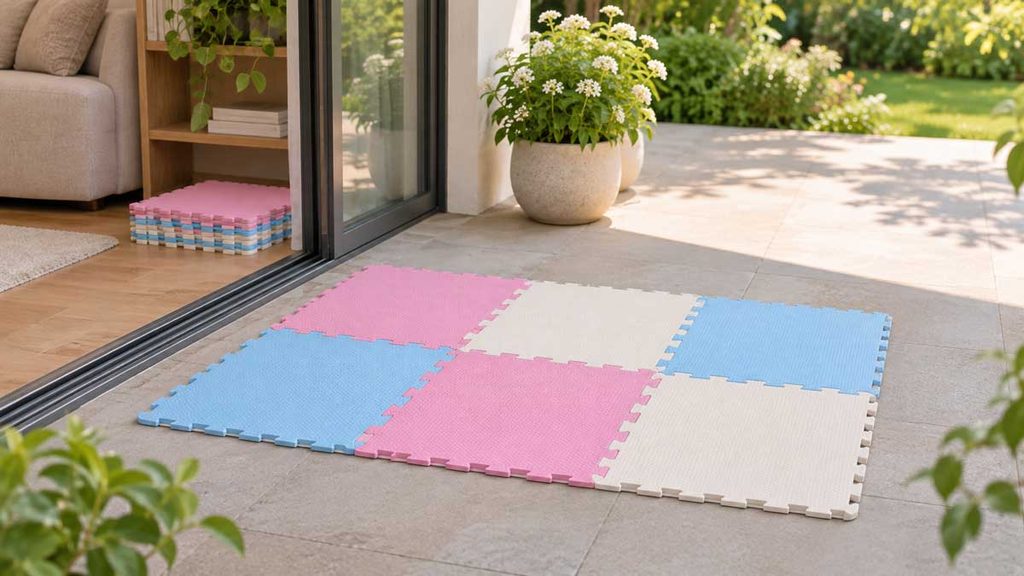
Yes, some foam mats are suitable for outdoor use. The deciding factors are the product’s intended use, weather exposure, and the ground beneath it—not water resistance alone. Keep a mat labelled for indoor use indoors. For other products, confirm whether outdoor use means bringing the mat out for a session or leaving it installed through changing weather.
For a patio, lawn or campsite, plan for sunlight, moisture, stable footing and drying after use. A short session reduces exposure time, but does not make an unsuitable mat or uneven base suitable.
This guide focuses on portable foam mats and interlocking foam floor tiles. Permanent playground surfacing, pool surrounds and other specialist outdoor installations need products designed for those uses.
Start with the Product Label and the Place You Will Use It
Look for an instruction that applies to your exact model. “Waterproof,” “closed-cell,” and “easy to clean” don’t tell you whether the finished mat is meant to stay outdoors.
Read the limits alongside any outdoor-use claim: temporary or permanent placement, direct sun or shelter, approved ground surfaces, and drying or storage requirements. If the listing is silent—or its outdoor claim conflicts with an indoor-only care label—ask for written clarification for that model before setting it up outside.
Material alone is not enough to make this decision. EVA, XPE and TPE identify material types or families; they do not specify the outdoor performance of the printed surface, backing, joints or bonded layers. For an interlocking foam mat, the completed layout must also remain flat and connected on the chosen base.
Match the Instructions to Your Outdoor Setting
Use your setting to identify the conditions the product instructions need to cover.
| Where you want to use the mat | What changes outdoors | What to establish before use |
|---|---|---|
| Sheltered patio or covered balcony | Sideways rain, moving sunlight and a damp floor can still reach the mat | The model permits that exposure; the base is compatible, dry and adequately drained |
| Open patio for an exercise session | Direct sun, surface heat, wind and rough paving | Outdoor exercise is permitted; the mat lies securely, and the surface remains suitable for skin contact |
| Lawn or garden play area | Uneven ground, stones, wet grass and unsupported joints | The product allows that base; the area can be cleared, and the mat remains stable without bridging hollows |
| Inside a camping tent | Ground irregularities, tracked-in dirt and condensation | The mat suits the planned use and can be lifted and dried; it does not replace the tent’s waterproof floor |
| Uncovered balcony left laid out | Repeated wetting, daily temperature changes and seasonal exposure | Explicit suitability for continuous outdoor installation, including drainage and climate limits |
| Under play equipment or beside a pool | Fall protection or persistent wet-foot traffic becomes a primary requirement | A purpose-designed surface and installation for that activity, rather than an ordinary indoor puzzle mat |
A roof changes exposure, but does not make an outdoor space equivalent to an indoor room. Check where rain reaches and where the sun falls when you intend to use the mat.
Sunlight Raises Two Different Questions
Will the Surface Become Too Hot to Use?
An outdoor surface can be much hotter than the surrounding air. Shade can substantially reduce summer heating of rubber and synthetic-turf playground surfaces, but those findings do not establish a safe temperature for an EVA play mat. Surface-temperature evidence
Check the actual mat, including shaded areas, before anyone sits, kneels or plays on it. Check again if sunlight moves across the area. Do not judge it only by the weather forecast or by its color. A light-colored mat still needs inspection.
Plastic and rubber surfaces can cause contact burns, even when the weather doesn’t feel particularly hot. A quick touch may also miss heat because materials transfer it at different rates. Keep children off a hot surface and move the activity until conditions are suitable. The CPSC’s surface-heat guidance explains why air temperature alone is an unreliable check.
Will Repeated Exposure Change the Mat?
Sunlight, heat and moisture can act together during weathering. Depending on the construction and exposure, changes may include fading, cracking, reduced flexibility, distortion or separation between layers. The type and rate of change vary between products. Weathering mechanisms
Inspect printed faces and laminated edges as well as the foam underneath. A surface that still looks bright does not establish that its joints or bonded layers are unchanged. Conversely, fading alone does not tell you how much cushioning remains.
When the product requires indoor storage between uses, bring it in rather than leaving it out as a trial. Do not try to correct distorted tiles by heating them or stretching the joints. Persistent changes in fit need a separate dimensional-stability check.
Rain Can Leave Water Where You Cannot See It
Consider three places: the foam itself, any attached surface or backing, and the space underneath the mat.
Not all EVA foams absorb the same amount of water. In a tested series of radiation-crosslinked EVA/OBC blends, water uptake varied with formulation and cell structure.[1] That result does not establish rain resistance for a finished, layered mat.
Even where the foam absorbs little water, rain can pass through puzzle joints and around the perimeter. A dry-looking top is not proof that the floor below is dry. Our guide to foam mat water resistance, seams and drying explains those separate water paths.
For a removable mat that gets caught in rain:
- Stop using the area if it is slippery, waterlogged or unstable.
- Lift the mat or separate removable tiles as their instructions allow. Inspect the underside and the ground below.
- Remove dirt using the permitted cleaning method. Do not assume immersion, pressure washing or a stronger cleaner is acceptable.
- Dry both faces, joints and any attached layers before reassembly or storage. Keep the supporting floor dry too.
- Before reuse, check for peeling, curled edges, damaged connections, or a persistent musty smell. Set affected pieces aside for further assessment.
Do not cover a wet assembled mat with a tarpaulin and treat it as stored. Covering it does not remove moisture already trapped underneath. Equally, do not leave a mat in strong sun to speed drying when its care instructions require shade.
Dry Grip Does Not Establish Wet Grip
Rainwater, soil and cleaning residue can change the surface underfoot. Do not assume that a mat described as “non-slip” indoors will provide the same grip when wet. Remove contamination using the permitted care method, and keep the area out of use while it remains slippery. Contamination and slip prevention
Check two separate contacts: feet or hands against the top, and the underside against the ground. A mat can stay connected while sliding as a whole. Visible texture alone cannot verify wet-use performance. For an area expected to stay wet, request evidence for the relevant surface, wet conditions and barefoot or footwear use. A home inspection does not replace a suitable wet-use performance test. Interpreting slip-resistance test conditions
The Ground Matters as Much as the Weather
Portable foam tiles need support beneath them; don’t use them to bridge hollows or level uneven ground. Before use, remove stones, twigs, and other debris, and check for raised paving joints, loose decking boards, or soft patches.
On grass, check for uneven support and moisture beneath the surface. If joints open or the mat rocks when used, stop and change the setup. Adding more tiles won’t fix an unsuitable base.
On a patio or balcony, keep drainage routes clear and check exposed edges where people step onto the mat. Use only the attachment or edge treatment approved for the mat and the underlying surface. Don’t improvise with loose weights that create obstacles or tape the floor, which the manufacturer prohibits. If wind lifts the mat or moves the layout, pack it away.
If the tiles remain connected but the whole mat slides, the problem is different from teeth pulling apart. Our guide to keeping interlocking foam mats together explains how to distinguish those symptoms for indoor layouts. Outdoor attachments and installation still need the product’s own instructions.
Store It Dry and in Its Intended Shape
For mats approved for occasional outdoor use, packing up is part of the routine. Remove debris before carrying the mat indoors, clean it as directed, and let all surfaces dry before putting them together.
Store tiles flat where their instructions call for flat stacking. Fold panel mats along their intended hinges and roll rollable mats in the specified direction. Avoid forcing a format into a smaller space by sharply folding it or loading heavy items on top.
Choose a clean, dry storage location within the product’s stated conditions. An outdoor box may keep it off rain while still trapping moisture. Before the next use, check the underside, edges and connections as well as the visible face.
No general winter-storage temperature applies to all foam mats. If exposure to freezing conditions is not covered by the instructions, bring portable mats into an appropriate indoor storage space before those conditions arrive. Do not force a frozen or unusually stiff mat to fold.
Which Changes Mean You Should Stop Using It?
Inspect a clean, dry mat on a suitable base before using it again. These observations help decide the next action; they do not identify the cause of damage or certify the mat as safe.
| What you find | What to do next |
|---|---|
| Fading without visible damage | Check the face, underside and joints. Colour change alone does not measure remaining cushioning or grip. |
| Grit, moisture or residue | Clean and dry as directed, then reassess. If slipping continues, stop using that setup. |
| Raised edges, buckling or joints that will not stay closed | Remove the affected area from use. Check the base and assembly instructions; replace damaged or persistently distorted pieces. |
| Cracks, crumbling foam or peeling layers | Set the affected mat aside and seek replacement or the supplier’s assessment. Covering damage with tape does not restore its performance. |
| Suspected mould or a persistent musty smell | Keep it out of use while investigating the moisture source and a suitable cleaning or replacement route. Smell alone does not identify mould. |
When to Choose a Different Outdoor Surface
If you plan to leave flooring outside all season, choose a system whose documentation covers continuous outdoor exposure and your installation. Confirm the base, drainage, edge treatment, intended loads and maintenance requirements. A material name such as rubber or PVC is not sufficient approval by itself.
Do not substitute ordinary play mats for protective surfacing beneath swings, slides, or climbing equipment. That surface needs evidence appropriate to the equipment and installation. The CPSC playground checklist identifies safety-tested protective surfacing as a separate requirement; local requirements should guide the actual project.
Likewise, a pool surround needs a product intended for repeated wet traffic and the proposed drainage arrangement. A portable foam mat that wipes clean indoors does not prove it’s suitable for that job. Buoyancy also doesn’t permit using a floor mat as a flotation device.
What to Ask Before Buying or Specifying an Outdoor Mat
Give the seller a description of the setting, rather than asking only whether the foam is waterproof:
I need a removable mat for exercise on a paved patio. It will be exposed to direct sun during use and stored indoors afterward. Is this exact model suitable? Please confirm the ground preparation, exposure limits, cleaning and drying instructions, and any warranty exclusions.
For a permanent installation, describe the actual year-round conditions. Ask which written instructions and test results apply to the proposed finished construction.
Treat “UV-resistant” as a claim to clarify. Ask whether the supporting result concerns color retention, the foam, a surface film or the complete mat. Resistance to light alone does not establish resistance to repeated wetting or to outdoor installation conditions. The distinction between light exposure and combined weathering is explained in the weathering guidance above. A warranty is also worth reading for exclusions, but it is not a substitute for relevant performance evidence.
Brands and wholesale buyers should also agree on what to check after exposure: appearance, layer adhesion, dimensions, joint fit, and relevant surface performance. A report should identify the specimen and exposure conditions. You cannot convert hours in a weathering chamber into outdoor years using a universal multiplier. Q-Lab’s explanation of test correlation
For a NEEU project, put the intended setting and proposed outdoor-use wording into the foam mat RFQ before sample approval. Ask what supporting evidence exists and what still needs evaluation. This lets the product specification and care instructions address the same use.
Frequently Asked Questions
Some finished products permit outdoor use; others are sold for indoor use only. Check the exact model, including its surface layers and installation instructions. EVA’s material properties don’t make every EVA mat equally suitable for outdoor use.
Only if the product’s instructions cover that exposure. A rain-free forecast does not rule out dew or condensation. If the mat is meant to be brought indoors after use, dry it and store it rather than leaving it out overnight.
Only where the product allows it and the ground provides suitable support. Check for stones, hollows and wet areas. If the layout shifts, joints open, or the surface becomes uneven during use, remove it and choose a suitable base or another product.
No. A cover doesn’t protect against outdoor heat or temperature changes, and water already underneath may remain trapped. It also does not change the mat’s intended-use instructions.
Don’t assume a water-resistant foam mat will keep the area underneath free of mould. Moisture and accumulated dirt can remain underneath; mould can grow on dirty plastic surfaces and on absorbent materials. Lift removable mats, address trapped moisture and follow compatible cleaning instructions. If growth persists or you can’t clean and dry the affected backing, seek advice on replacement. Cleaning without addressing the moisture source can cause the problem to recur. Moisture control and mold cleanup
No reliable lifespan exists based on foam name alone. Construction, sunlight, climate, activity, and storage all matter. Use product-specific guidance and inspect condition; don’t use a fixed replacement interval to justify continued use of a mat with broken joints, peeling layers, or persistent deformation.
Research Reference
- Fu, D., Xu, J., Cai, Q., Li, G., Zhong, J., and Wang, G. (2024). Preparation and properties of radiation-crosslinked EVA/OBC foam materials. China Elastomerics, 34(6), 49–54. DOI: 10.16665/j.cnki.issn1005-3174.2024.06.007. The cited finding concerns formulation and water uptake in the tested foam series; it is not an outdoor-exposure test of finished NEEU mats. ↩︎