
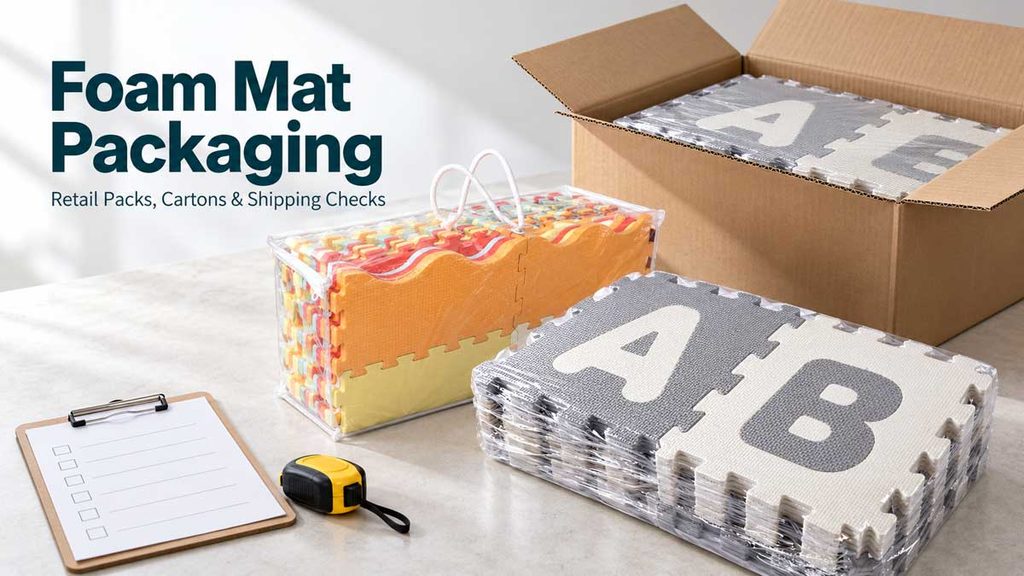
A mat can match the approved sample and still arrive with bent puzzle teeth, strap marks or the wrong number of border pieces. A retail box may look right on a screen but become difficult to scan once it is wrapped. These problems need decisions before the packing line starts.
A foam mat packaging specification should define the saleable unit, protective materials, packing arrangement, labels, finished carton dimensions and weights, transport conditions, and the condition required after unpacking. Approve those details together on a production-representative packed sample.
Keep the agreed specification, packing photographs, label files and approval record under the same revision. That gives the supplier a packing reference and the receiving warehouse something concrete to check. Start with what the customer buys, then work outward to the shipping carton and pallet.
Define What One Unit Contains
Use separate names for a tile, a mat, a retail set and a shipping carton. An order for 1,000 “pieces” could mean 1,000 individual tiles or 1,000 complete sets. Resolve that difference before calculating packaging quantities.
Write a bill of materials for each retail SKU. For an interlocking set, record tile count, colors, border pieces and instructions. For a folding or rolled mat, list the mat, strap or bag, inserts and any other accessories. State which items are included and which are optional.
There are usually three packaging levels:
- Retail pack: the unit sold to the customer, such as a wrapped tile set or one boxed yoga mat.
- Shipping carton: one or more retail packs protected for the planned distribution route.
- Pallet or transport unit: cartons arranged and secured for handling, storage and shipment.
A retail pack may also be the shipping package when it has been designed and validated for that route. Do not assume a display sleeve or thin printed box can travel alone through a parcel network.
For puzzle sets, verify the coverage printed on the pack against the assembled layout, including border treatment. Our guide to tile counts, borders and finished coverage explains that calculation. Packaging dimensions describe the packed product; they are not its usable floor area.
Choose the Pack for the Sales Route
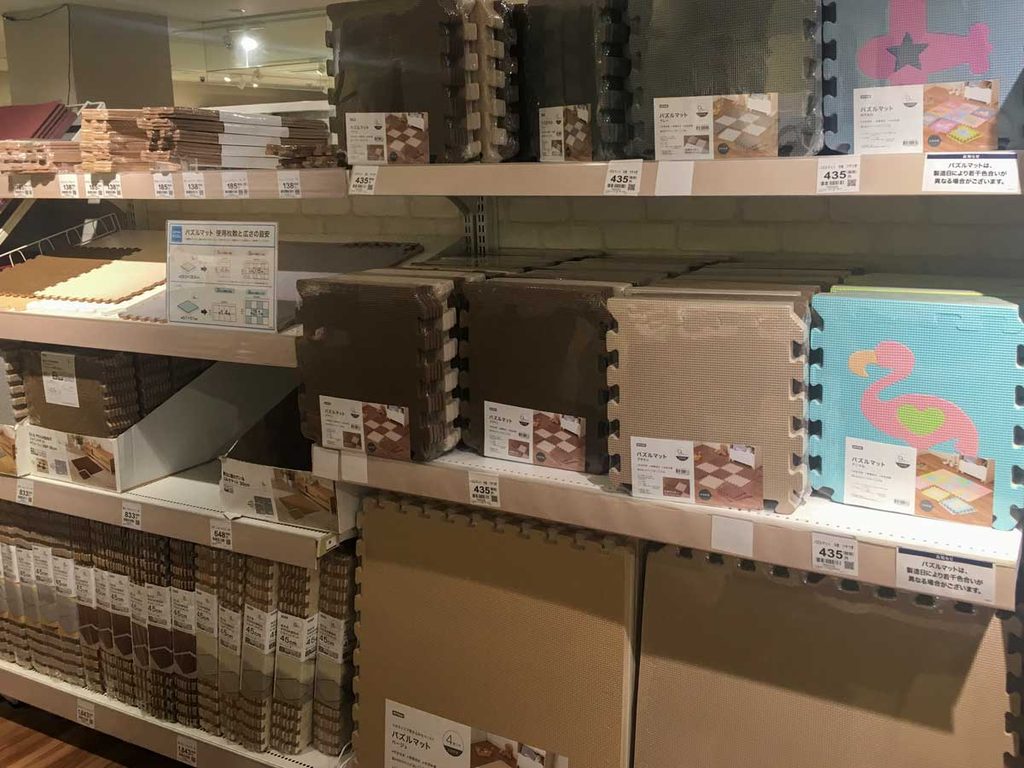
A store display and a parcel shipment expose the package to different handling. Tell the supplier whether the product moves as palletised wholesale stock, individual parcels, or both. Include any repacking at a distributor or fulfillment center.
| Pack format | Useful role | Detail to resolve before approval |
|---|---|---|
| Bag or shrink film with an insert | Keeps a set together and provides a surface for identification | Film specification, closure, sharp-edge protection, print contact and applicable bag warnings |
| Paper band or sleeve | Identifies a rolled or folded product while leaving part of it visible | Retention, label placement and protection for exposed surfaces during shipment |
| Printed retail box | Contains accessories and provides room for product information | Internal fit, opening method, artwork, barcode placement and whether an outer shipper is needed |
| Bulk carton | Supplies loose mats or sets for later packing | Exact contents, separators, SKU segregation and who completes the retail pack |
The receiving warehouse’s limits help narrow the choice. If the finished pack exceeds its permitted size or weight, compare a smaller carton quantity or a different pack before approving the artwork. The selected film needs material, thickness, and closure specifications; the selected box needs a drawing and material specifications.
Test the opening experience and the closed pack. The buyer should be able to remove the mat without cutting its surface, tearing a hinge or losing loose accessories. Any reusable bag or strap needs its own agreed dimensions and closure details.
Protect Tiles, Folds and Rolls Differently
Interlocking tile sets
Record the stacking orientation and border-strip placement. Keep loose parts with their set, and don’t press narrow edges into a visible mat face. Keep puzzle teeth supported and avoid concentrating restraint pressure on corners.
Count the set after packing and reopening. Check that the approved color assortment and edge pieces survived the packing sequence. A photograph of the top tile cannot confirm everything underneath it.
Folding mats
Specify the folding sequence and which face points outward. Include the folded length, width and height with the actual bag, sleeve or box fitted. The location of a strap or accessory should be part of the packing drawing so that it does not press into a fold or printed surface.
Open the sample using the intended instructions. Check panel alignment, hinge condition and surface contact marks. A fold line designed into the product is different from a new crease caused by forcing it into an undersized package.
Rolled yoga and exercise mats
Record winding direction, roll diameter, any core, restraint position and protection at both ends. Confirm that the outer face can tolerate contact with the sleeve or film. A tighter roll may reduce package size but still be unsuitable if it causes unacceptable curl, surface marking or layer separation.
The packing trial should document how the finished mat looks and fits after opening. Use consistent dimensional stability and assembled-fit checks when dimensions or puzzle fit are part of approval.
Check the surfaces that touch the packaging
Use the intended film, sleeve, separators and restraints in the packing trial. A substitute bag or an omitted strap leaves part of the proposed configuration unchecked. Photograph the contact areas before packing and after the agreed storage or transport exposure.
| Contact area | What to inspect after opening | What to record in the specification |
|---|---|---|
| Printed mat face against film, a sleeve or another mat | Visible transfer, sticking or a changed surface finish | Which face points outward; approved contact material; any separator |
| Strap, band or closure against the mat | Local indentation, rubbing or damage at the restraint position | Restraint type, position and agreed application method |
| Puzzle teeth and corners against the box or loose accessories | Bent edges, crushed corners or contact marks | Orientation, edge support and accessory position |
| Fold or bonded-layer edge against the package | New creases, split hinges or lifted edges | Folding sequence, folded dimensions and clearance |
These are inspection points for the actual pack. They do not establish that a particular film or adhesive is compatible with every EVA, XPE, TPE or PVC mat.
Write a Carton Specification That Can Be Checked
“Strong export carton” leaves too much open. Record the box style, board construction, dimensions, closure and loading arrangement, then agree how the filled package will be evaluated.
Internal dimensions establish fit; external dimensions establish shipping space. Identify which measurement a drawing uses. For shipping estimates, measure the completed, closed carton, including bulging where relevant, using the carrier’s measurement rules.
State units per carton, orientation, separators and accessories. Distinguish product net weight from carton gross weight, and define whether accessory weight is included in the net figure. Gross weight must include all packaging in the shipping unit.
Board thickness or ply count alone does not describe the whole box. Where relevant, specify a board-strength measure such as edge crush strength, and agree filled-carton compression or stacking evaluation with the packaging supplier. Board tests and finished-box tests answer different questions.
A stacking requirement needs an environment, a duration, and a load. In corrugated food-carton systems, compression performance under changing temperature and humidity depended on the board and internal packing configuration. Those results support checking the complete packing arrangement under relevant conditions; they do not supply a load rating for a foam-mat carton. Include the expected storage conditions, stack arrangement and duration in the carton brief.
Include the tape or other closure specification and application pattern. If straps are used, record their location and any edge protection. Check both carton damage and pressure marks on the mats inside.
Three Illustrative Pack-Out Calculations
The following figures are hypothetical arithmetic examples, not NEEU standard carton sizes, measured products or approved packing configurations. Physical fit, strength and product recovery would need confirmation on packed samples.
| Example | One saleable unit | Units per carton | Assumed external carton size, cm | Volume per carton, m³ | Volume per saleable unit, m³ |
|---|---|---|---|---|---|
| Interlocking tile set | 6 tiles, 12 border strips and 1 insert | 4 sets | 65 × 65 × 30 | 0.12675 | 0.0316875 |
| Folding play mat | 1 mat, 1 bag and 1 insert | 4 mats | 92 × 42 × 52 | 0.200928 | 0.050232 |
| Rolled yoga mat | 1 mat, 1 strap and 1 sleeve | 6 mats | 65 × 45 × 32 | 0.0936 | 0.0156 |
With dimensions in centimetres:
Carton volume (m³) = length × width × height ÷ 1,000,000.
For the tile example, an order of 1,000 sets requires 250 full cartons. That is 6,000 tiles, 12,000 border strips and 1,000 inserts. The carton-volume total is 250 × 0.12675 = 31.6875 m³, before pallets or other shipment-level materials. For an order that does not divide evenly, define and label the partial carton separately.
That total is a volume estimate, not a guaranteed container loading quantity. Pallet dimensions, container door clearance, usable space, load distribution, securing and weight limits still affect the loading plan. Also, don’t treat these three example volumes as a cost comparison: the products and their usable areas differ.
Check the packing arrangement before using the volume
For the rolled-mat example, suppose each finished retail pack has a bounding size of 62 × 14 × 14 cm, including the mat, strap and sleeve. This is an assumed pack size, not a product specification.
Place all six packs with their 62 cm length running along the carton length: three side by side and two layers high. The rectangular space occupied is:
- Length: 62 cm.
- Width: 3 × 14 = 42 cm.
- Height: 2 × 14 = 28 cm.
An assumed internal carton size of 63 × 43 × 30 cm leaves total clearances of 1, 1 and 2 cm, respectively. Any separators or end protection must fit within that allowance. The example pairs this with an assumed external size of 65 × 45 × 32 cm; the box supplier must confirm the actual relationship between internal and external dimensions on the drawing. Adding a fixed allowance is not a general box-design rule.
The layout explains the six-unit count, but trial packing still needs to confirm closure without forcing the mats, excessive empty space or unacceptable movement. Measure the closed sample before using its dimensions in the freight calculation.
Dimensional weight needs the actual shipping service
Light mats can occupy considerable parcel space. Carriers may calculate a dimensional weight and compare it with actual weight when determining the charge. FedEx explains the distinction; the applicable divisor, rounding, and surcharges depend on the service and account used.
For illustration only, using a divisor of 5,000 cm³/kg, the rolled-mat carton above gives 65 × 45 × 32 ÷ 5,000 = 18.72 kg dimensional weight. If its assumed actual gross weight were 10 kg, dimensional weight would be the larger figure, before applicable rounding or other charges. Do not use that divisor as a universal rule for European, US or ocean-freight shipments.
Approve Labels on the Finished Pack
Create an artwork register with a revision number for the retail label, insert, carton mark and any pallet label. Assign responsibility for approving text, translations and barcode data before printing.
Match identification to the packaging level and receiving system. A retail identifier, an internal SKU, a carton identifier and a logistics-unit identifier serve different purposes. Confirm the required format with the trading partner instead of copying the retail barcode onto every level by default.

Check the barcode on the actual printed and assembled pack. GS1’s placement guidance addresses sizing, contrast and clear areas around the symbol. Folds, seams, reflective wrapping and overlabels can interfere with readability. A successful phone scan is useful for a basic check but does not replace formal barcode verification when the customer requires it.
The carton mark should identify the contents and receiving references: SKU, quantity and unit, order reference, carton number, batch or lot reference, and agreed weights or dimensions. Keep mixed-SKU and partial cartons unmistakable.
Approve market-specific product identification, responsible-business details, instructions, warnings, languages and origin statements with the party responsible for compliance. Children’s mat labels and packaging-bag warnings require attention to the particular product and market. A barcode or a chemical test report does not settle those requirements.
For environmental wording, distinguish claims about the paper box, plastic film and mat itself. Record the evidence for recycled-content or disposal statements and the destination’s applicable labelling rules. Avoid a single “recyclable” claim that leaves readers unsure which component it describes.
Match Shipping Checks to the Distribution Route
Send the test laboratory a route description, finished package dimensions and weight, product photographs, packing drawing and buyer requirements. A palletised export carton that will later be split into individual parcel orders has two stages to consider.
ISTA’s procedure descriptions identify different distribution environments. For example, Procedure 3A addresses individual packaged products in parcel delivery within its stated weight scope. It is not automatically the correct procedure for every mat, wholesale pallet or retailer program. Ask the laboratory and receiving customer to confirm the current procedure, version and package classification.
Agree product and package acceptance criteria before testing. A crushed retail box, unreadable label, missing border strip and permanently curled mat are different failure modes. Decide which are unacceptable and how to record them. The chosen program may involve conditioning, compression, vibration and impact exposures. Record the procedure version, required sequence and acceptance criteria in the test request.
Test the complete production-representative pack, including the actual inserts, closures and accessory positions. Follow the test procedure’s rules on intermediate inspection. Keep the tested configuration and report connected to the approved packing revision.
Pallets, containers and moisture
Confirm pallet footprint, entry requirements, cartons per layer, layer count, total height and gross weight. Include pallet weight and height, support beneath the boxes, restraint and handling clearances. Avoid unapproved carton overhang and check that restraint does not crush the load.
For containerised shipments, use the IMO/ILO/UNECE CTU Code as a planning reference for container suitability, packing and securing. This non-mandatory global code provides guidance for planning and checking the load. Check for water entry, unsuitable moisture conditions and damp packaging or dunnage. Any liner or desiccant arrangement should suit the route and packing system; adding a sachet does not resolve wet cargo.
When using solid-wood pallets or dunnage internationally, confirm the destination’s requirements and applicable ISPM 15 treatment and marking provisions. Processed-wood exemptions depend on the construction; a pallet with a plywood deck can still contain regulated solid-wood components.
Unpack the Sample Before Signing Off
Retain a baseline record of the mat before packing. After the agreed storage or transport exposure, photograph the unopened carton, labels, closure and any visible damage. Record the sample identity and exposure history before opening it.
The timing matters for foam measurements. For cross-linked PE foam specimens held under compression, thickness recovery continues after the load is removed, so immediate and later readings describe different states. This supports recording the observation time. It does not establish how quickly a rolled mat will flatten, or a universal recovery period for EVA, TPE, PVC or laminated products.
Check the contents in the order a receiver would encounter them:
- Count and identify: verify SKU, color mix, retail units, borders, accessories and inserts.
- Inspect the presentation: check the retail box, bag, printing and readable labels.
- Open and lay out the mat: inspect pressure marks, surface transfer, torn teeth, split hinges and lifted layers.
- Measure at agreed times: record dimensions, thickness or flatness using the defined method immediately after opening and after the specified recovery period.
- Check normal assembly: connect a tile set, open the folding panels or unroll the mat as instructed. Record whether it meets the approved functional criteria.
For every defect limit, specify the location, method and timing. “No unacceptable curl” is incomplete without an agreed measurement and limit. A cosmetic reference sample can help assess appearance, but dimensional requirements need a written tolerance.
Put unresolved results on hold rather than extending the recovery time until a sample passes. Include repacking, warming, or reverse rolling in approval only if they are in the agreed customer instructions. Connect the outcome to the broader finished-mat sample approval record.
A Worked Packing Record
The following teaching example brings the rolled-mat assumptions together. The names and document references are fictional; this is not a NEEU SKU, test report or approved shipment. The record shows how to organise an approval file, including the evidence still required before release.
| Field | Example entry |
|---|---|
| Identification | Example SKU ROLL-01; packaging revision P01 |
| Retail unit | 1 rolled mat, 1 strap and 1 sleeve; 62 × 14 × 14 cm assumed finished bounding size |
| Distribution | Six retail units in one outer carton, shipped as an individual parcel to a distributor; no pallet leg in this example |
| Arrangement | Lengthwise rolls; three across, two layers; strap on each roll beneath its sleeve; layout drawing PACK-01 |
| Carton | Assumed internal 63 × 43 × 30 cm; external 65 × 45 × 32 cm; box style, board and closure to be approved against the supplier drawing before release |
| Quantity and weight | 6 saleable units per full carton; assumed net weight 8.4 kg for six mats plus straps; assumed gross weight 10 kg including sleeves and all shipping packaging |
| Identification files | Sleeve artwork ART-01; carton mark MARK-01; actual SKU, order, lot and carton sequence to match the packing list |
| Unpacking checks | All six units and straps present; correct sleeve version; readable labels; no new visible transfer, torn surfaces or lifted layers compared with the approved baseline |
| Measurement timing | Record on opening and after an assumed 24-hour observation period, without warming or reverse rolling; this timing is for the example, not a recommended universal recovery period |
| Release gate | Buyer approves the supplier drawing, closure, dimensional limits and route-specific test plan; the tested sample and report must meet those agreed criteria before release |
You can complete the calculation before these approvals, but you cannot describe the shipment as validated on that basis. Replace the assumed dimensions, weights and observation period with the selected product’s measured and agreed values.
Carry the Approved Pack Into Production
A successful sample establishes a reference. Bulk packing still needs checks against that reference, especially when artwork, carton stock or packing staff change.
Before the run, the packing team should have the current specification, layout photographs and approved artwork. Remove superseded versions from the work area. Check a packed unit from the run against the reference for contents, orientation, restraints, closure, and label data, then repeat checks at the order-agreed frequency and after relevant changes.
Define the batch and sampling plan in the inspection instructions. The order’s agreed inspection plan should define the number of cartons opened and the acceptance rules; a transport-test sample count does not automatically become a production sampling plan.
For dispatch, reconcile cartons and retail-unit quantities with the packing list. A partial carton needs its actual quantity; a mixed-SKU carton needs an identifiable breakdown. Keep lot references linked to the inspected cartons so you can trace a discrepancy to the affected stock.
If the carton, label or packing arrangement differs from the approved version, isolate the affected stock and record who decides on correction, reinspection or reapproval. Retain the inspection results and packing photographs with the shipment record. Detailed approval responsibilities can remain in the broader sample-approval system; the packing record should identify which version was actually shipped.
A Packaging Approval Sheet to Use With Your Supplier
Copy this table for each SKU and destination configuration. Complete open items before release; record any conditional approval with its owner and deadline.
| Approval field | Record for this order |
|---|---|
| Product and revision | SKU; construction; size; color; approved sample ID; packing revision |
| Route and receiver | Destination; retail/parcel/wholesale route; warehouse preparation requirements |
| Retail contents | Mats or tiles per set; borders; accessories; instructions; quantities |
| Inner packaging | Material; thickness or grade; dimensions; closure; component positions |
| Packing arrangement | Stack/fold/roll drawing; orientation; restraints; separators; packing photos |
| Shipping carton | Box style; board specification; internal and external dimensions; tolerances; closure |
| Quantity and weight | Units per carton; net-weight definition; gross weight; partial-carton rules |
| Artwork and identification | File revisions; barcode data and verification; languages; carton marks; lot coding |
| Pallet/load plan | Footprint; layer arrangement; height; gross weight; restraint; wood requirements |
| Validation | Procedure/version; sample quantity; conditioning and exposure; acceptance limits |
| Unpacking | Inspection method; recovery period; assembly and appearance criteria |
| Production and dispatch | Approved packing reference; batch and sampling plan; quantity reconciliation; discrepancy handling; shipment records |
| Release and changes | Test/report IDs; signatories; approval date; retained samples; reapproval triggers |
Review changes to board grade, film, carton size, units per carton, winding, folding, restraint, accessories or distribution route before production. A previous result applies to its tested configuration. ISTA’s design and testing guidance treats product and package changes as potential reasons to reassess testing.
Frequently Asked Questions
It can hold a set together, but it does not protect against parcel handling or stacking. Assess exposed edges, surfaces, labels and the planned route. A wrapped retail set may still need an outer carton.
Use vacuum compression only after validating the exact construction and packing conditions. Compare the unpacked mat with the approved baseline for recovery, dimensions, joints, surface marks and bonded layers. A successful trial on one foam or thickness does not approve every mat in the range.
Choose the quantity based on physical fit, protection, gross weight, receiving limits, and route cost. Trial-pack the complete retail units. Adding more mats can increase compression or make a carton unsuitable for handling, even if the volume calculation looks attractive.
No. Procedure selection depends on the distribution system and customer requirements. Confirm the applicable program for the complete packaged product, including any retailer-specific requirements, with the customer and test laboratory.
The physical pack may be reusable across markets if it meets the requirements of both routes. Confirm the product information, language, responsible-business details, warnings, recycling information, barcode system and warehouse rules for each destination. Keep separate artwork revisions where needed.
Prepare the Packing Brief for Your Next Order
Send NEEU the SKU list, retail contents, destination and sales route, artwork files, warehouse limits and required unpacking condition. Include any unresolved choices, such as box versus sleeve or units per carton, so alternatives can be quoted separately.
Use the foam mat RFQ template to keep the quotation consistent with the packing brief. Our packaging preparation and final inspection page explains the production workflow that follows those approved requirements.