
A mat that feels supportive in a showroom can become uncomfortable after repeated use. Its surface may still look intact while the foam underneath has lost thickness or changed its response to loading. Elsewhere, the first problem may be a torn puzzle edge or a worn printed layer.
These are different durability problems. Before asking a supplier how long a mat will last, identify what must remain acceptable through use: thickness, support, edge integrity, surface appearance, grip, or the bond between layers.
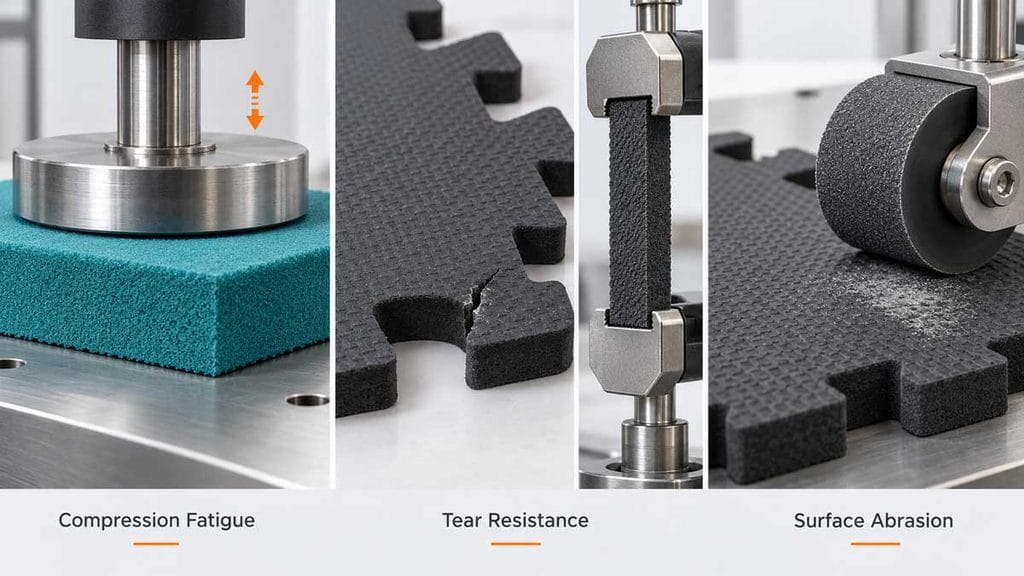
Foam mat durability testing evaluates how a defined material or finished construction withstands specified loading, tearing, or rubbing conditions. Compression fatigue addresses repeated loading; tear testing examines resistance to tearing under a defined procedure; abrasion testing evaluates wear from rubbing. None provides a universal conversion from a laboratory result to years of service.
Before approving a bulk order, decide which changes would make the product unacceptable. The test plan should then reproduce the relevant loading or wear and measure those changes.
Start with the failure buyers need to prevent
The word “durable” is too broad to use as an acceptance criterion. A retailer concerned about printed play-mat wear needs different evidence from a gym buyer concerned about equipment feet leaving permanent dents.
| Buyer concern | Relevant evaluation | What else needs checking |
|---|---|---|
| The mat loses support after repeated use | Cyclic compression or an agreed loading simulation | Thickness and load response after a defined recovery period |
| Equipment leaves a lasting dent | Sustained-load compression and recovery | Contact footprint, temperature and time under load |
| Puzzle teeth split during installation | Material tear testing plus repeated assembly | Tooth geometry, cutting condition and damage at the tooth root |
| The surface becomes scuffed or sheds material | Abrasion evaluation on the relevant surface | Texture, layer breakthrough, debris and functional change |
| Printing disappears while the core remains intact | Decoration-specific rub or wear evaluation | Artwork visibility, adhesion and any subsequent grip assessment |
| A fold cracks or a laminate lifts | Repeated folding or flexing and an appropriate bond evaluation | Fold radius, layer construction and failure location |
Choose the dominant risks first. Adding a long list of unrelated tests can increase cost without clarifying the purchasing decision.
Decide what counts as failure
Durability has both functional and visual endpoints. A decorative retail mat may become unacceptable when its pattern wears through, even though the core still supports a user. An equipment pad may tolerate a minor scuff but fail its purpose when a concentrated load leaves excessive retained deformation.
Separate acceptable cosmetic change from damage that affects use. Record whether discoloration, texture smoothing, detached fragments, cracks, gaps, or layer lifting are allowed, and how each will be judged. For performance requirements, pair that inspection with a measurable limit such as retained thickness loss or a change in load response.
Use photographs of acceptable and unacceptable conditions where they help inspection. They supplement measurements and a controlled reference sample; they do not establish the cause of damage.
Compression fatigue: what changes after repeated loading?
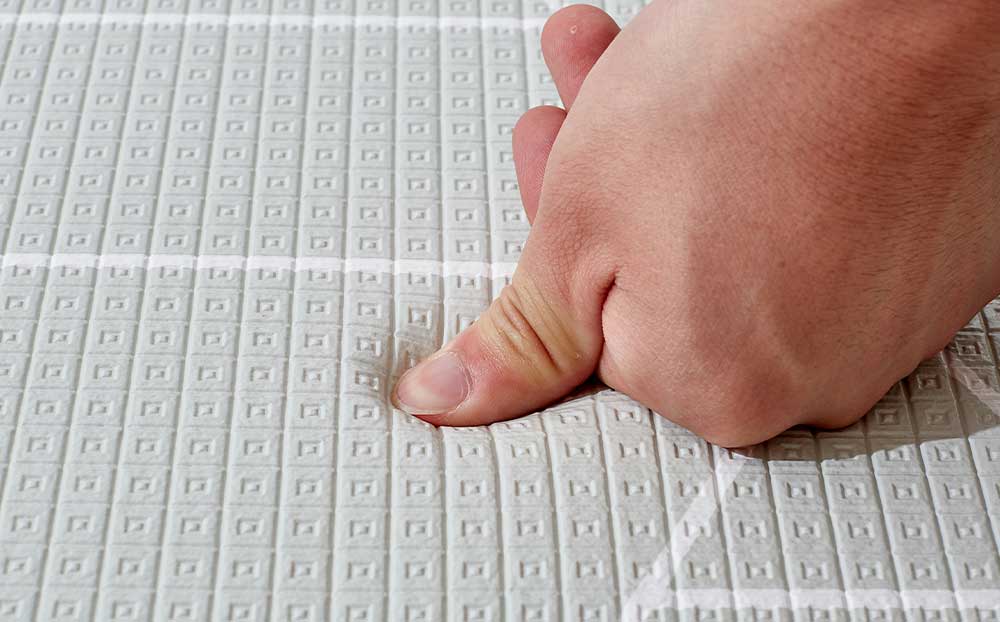
Compression fatigue evaluates changes through repeated loading and unloading. A specimen that initially provides the desired support may lose thickness, change its resistance to compression, or develop localized damage after cycling.
This differs from keeping a specimen compressed for one long period. If you’re concerned about a dent after storage or a sustained equipment load, the compression set and recovery guide covers that separate question. A strong result in either test does not establish performance in the other.
For fatigue evaluation, measure the sample before cycling and again afterward using a consistent measurement procedure. Depending on the application, record:
- thickness at identified locations;
- force at a specified deflection, or deformation under a specified load;
- surface or edge damage;
- recovery after an agreed rest period;
- flatness and the condition of attached layers.
A mat can lose support even when the surface still looks intact. Compare its thickness and response under the same load before and after cycling, then inspect for cracks, loose fragments and loss of fit.
Define the load and contact area together
An equipment foot, a knee, and a broad loading plate create different contact conditions. State the load, footprint, support beneath the mat, and loading location. Keep the finished thickness and construction consistent across candidate samples.
Also define whether the test controls force or displacement. Under a fixed force, a softer sample may compress farther. Under a fixed displacement, different samples may require different forces. Reports from those two arrangements cannot be treated as the same comparison.
The test brief should include the loading rate, dwell time, unloading interval, and temperature. Rapid cycling can create a different response from intermittent use with long rest periods. If heating could affect the result, ask the laboratory to monitor or control it rather than assume faster testing merely saves time.
Measure after a stated recovery period
Some deformation recovers after unloading. An immediate reading and a reading after a longer rest can therefore answer different questions. Use the same recovery interval when comparing samples, and take additional readings to distinguish short-term change from retained deformation.
A practical comparison can track thickness loss and the change in load response. If a percentage change is reported, identify the baseline, formula, and sign convention. Do not describe every post-test thickness loss as “compression set” unless it was determined by the named compression-set procedure.
Thickness loss and hardness changes are established ways to assess fatigue in load-bearing flexible cellular materials. ISO 3385 uses these outcomes in constant-load pounding for applications such as upholstery. For a thin, closed-cell or laminated mat, ask the laboratory to confirm the specimen is suitable before selecting or adapting the procedure. ISO 3385 scope
Keep thickness loss and softening separate
A thinner sample and a softer sample are not necessarily the same finding. Measure both where support matters. Use the same contact pressure and positions for post-test thickness measurements as for the baseline; pressing a measuring tool harder into soft foam can create an apparent change unrelated to the fatigue exposure.
For a simple thickness comparison, percentage loss can be reported as:
Thickness loss (%) = (initial thickness – thickness after cycling and recovery) / initial thickness x 100.
This describes change under the stated measurement conditions. It is not a substitute for a standard’s own calculation. When reporting load-response change, identify whether the same absolute displacement or the same percentage of specimen thickness was used: if the sample became thinner, those arrangements may impose different conditions.
Tear resistance: test the material and the vulnerable feature
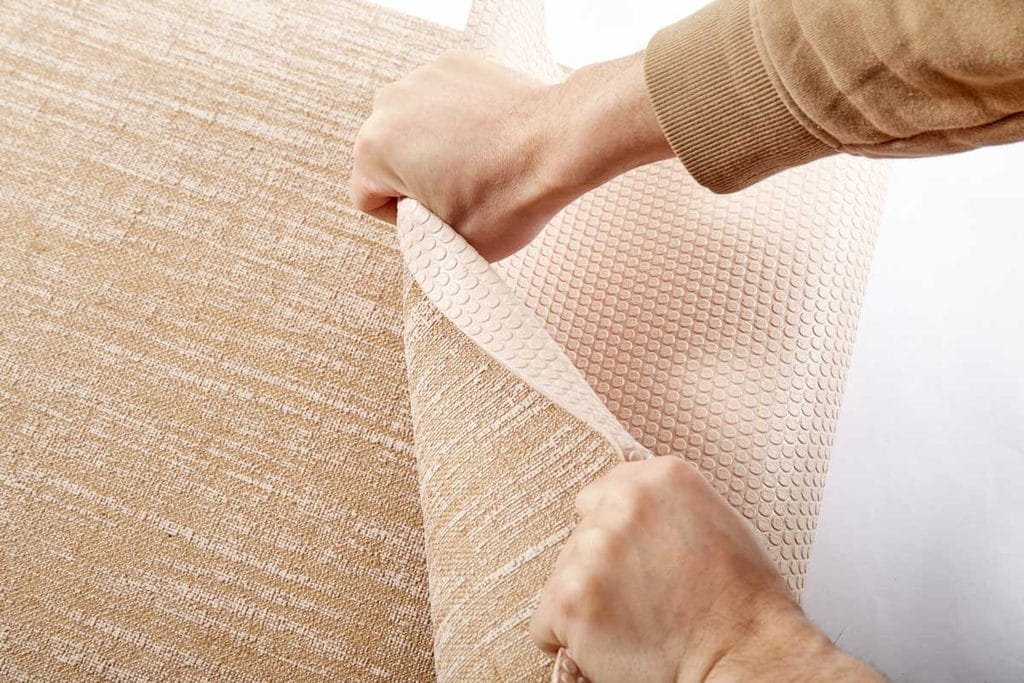
Tear testing measures resistance under a specified specimen geometry and loading procedure. The reported value depends on details such as the shape, notch preparation, thickness, direction, and test speed. Tensile strength describes a different loading arrangement and cannot substitute for tear strength.
Separate results are needed for tearing, rebound, and recovery after sustained compression because each test applies a different load and measures a different response. In EVA-blend testing, these properties are evaluated using their own procedures; a favorable result in one does not replace evidence for the others. Read the tear value with its specimen preparation and loading conditions. 1
A tear coupon does not reproduce a puzzle tooth
For interlocking foam mats, a narrow tooth root, a sharp cut, or a local surface defect may become the weak point during installation. Pair the material test with a finished-tile assembly check when repeated connection is part of the intended use.
Define how pieces are connected and separated, the number of repetitions, the operator or fixture arrangement, and the damage to be recorded. Inspect tooth roots and borders, then check whether the tiles still connect and lie acceptably flat. A demonstration without recorded conditions is development feedback, not a repeatable production requirement.
For directional sheets or layered products, identify where specimens come from and which orientations are tested. If layers separate before the core tears, record that failure mode. A core tear number does not answer an adhesive-bond question.
Tear force (N) and thickness-normalized strength (N/mm) describe different quantities. If two reports use different units or specimen designs, request the method and calculation before ranking their values. The foam mat test-report guide explains these comparison issues in more detail.
Abrasion: identify which surface is wearing
Abrasion concerns material loss or surface change caused by rubbing. A mat can have a bare foam skin, embossing, printing, a coating, a textile face, or a laminated film. Test the surface that the user will actually contact, and document how it is supported during testing.
Before selecting a method, agree on the failure endpoint. Depending on the construction, it may be material loss, visible damage, removal of a decorative layer, exposure of the core, or unacceptable debris. These outcomes are not interchangeable.
| Construction | Useful observations after wear | Interpretation limit |
|---|---|---|
| Bare or embossed foam | Wear depth, debris, texture change and local damage | A surviving appearance alone does not prove retained grip |
| Printed or coated foam | Pattern loss, transfer, cracking and layer breakthrough | Rub resistance and abrasion resistance may use different procedures |
| Film-laminated foam | Film damage, exposed core, and edge lifting | Film wear does not quantify the bond between film and foam |
| Textile-faced mat | Surface wear, loose fibers, and attachment condition | Textile and foam-core results describe different components |
Match the abrasion method to the surface
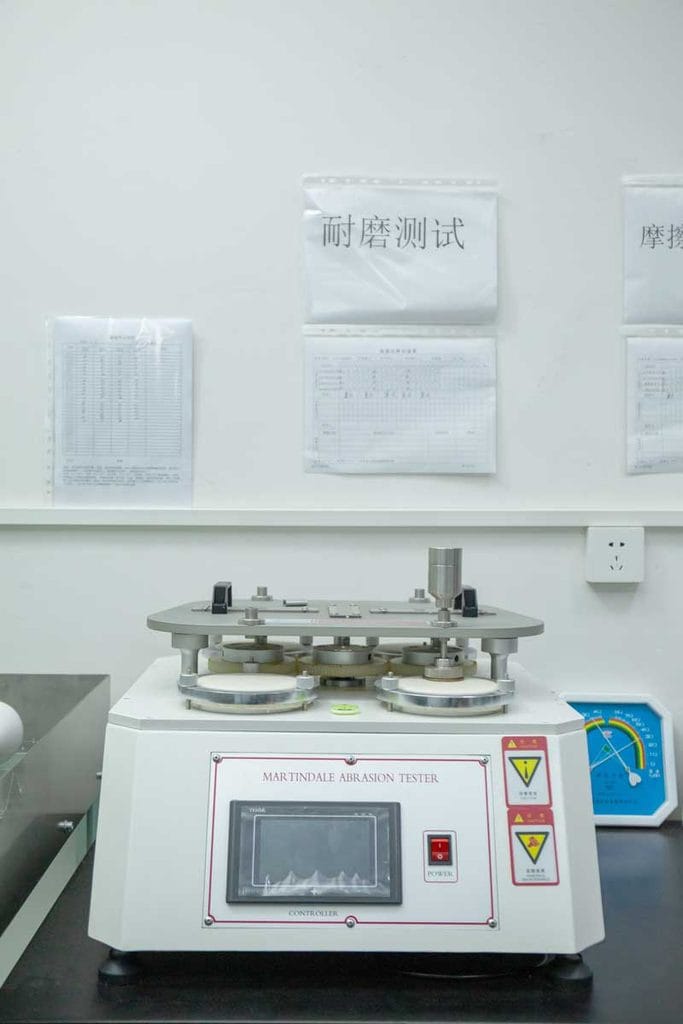
For a suitable rubber specimen, rotating-drum abrasion can compare volume loss under controlled rubbing conditions. ISO 4649 describes this type of evaluation. Its results support comparison within the method, but the standard does not establish a close relationship to service performance. Confirm that the proposed foam or surface material falls within the selected procedure’s scope. ISO 4649:2024
For a coated mat, ask whether the abrasion test represents the finished surface and how the soft foam was supported. ASTM D4060 evaluates organic coatings on a rigid, flat substrate. Testing a coating on flexible foam may require a different setup, and the report should identify any modifications. ASTM D4060 scope
For a wear comparison, retain the abrasive type, load, cycle count or distance, specimen mounting, conditioning, and endpoint. Do not compare mass loss and volume loss as if they were the same result. When converting between them is justified, the density basis must also suit the worn material; the nominal density of the whole laminated mat may not represent its surface layer.
A small wear loss does not automatically mean better user performance. If texture or surface finish is important to grip, assess that function after wear with a suitable agreed method. An abrasion result alone cannot support a non-slip claim.
Distinguish abrasion from rubbing, scratching and peeling
Buyers sometimes receive a “surface durability” report that evaluates a different concern from the one in their brief. A color-transfer rub check examines whether color transfers under its stated conditions. A scratch evaluation uses a different contact from repeated broad-area rubbing. A peel evaluation addresses layer attachment. None should be relabeled as proof of all surface durability.
For a printed or laminated mat, identify the claim being supported: pattern retention, resistance to transfer, wear-through, or bond integrity. Select the corresponding evidence and inspect the actual failure location. When a film lifts, record whether the separation occurred at an interface or within the foam; a torn core and a failed bond call for different investigations.
Include finished-product use checks where they matter
The laboratory specimen is useful because its conditions are controlled. The finished mat adds geometry, joints, layers, and packaging history that a small coupon may omit.
| Product | Finished-product priority | Recheck after exposure |
|---|---|---|
| Interlocking tile | Repeated connection and local loading | Tooth roots, fit, gaps, flatness and loose fragments |
| Yoga or exercise mat | Repeated body loading and rolling | Support, thickness, surface condition and flat lay |
| Foldable play mat | Folding at the intended crease | Cracks, layer lifting, alignment and folded condition |
| Printed or laminated mat | Surface wear and flexing of the finished layers | Artwork, breakthrough and bond condition |
| Equipment pad | Sustained contact load and relevant repeated loading | Retained indentation, support and floor-contact condition |
Select the rows relevant to the product rather than applying the entire table to every order.
For a roll mat, consider repeated rolling, unrolling, and flat lay. For a foldable panel, define the fold direction and radius, then examine the crease and any film or textile crossing it. For a printed play mat, inspect the pattern and surface after the selected wear exposure. For an equipment mat, evaluate sustained contact loads separately from repeated loading.
Cleaning can also change the exposure. Where routine cleaning is part of the intended use, agree on the cleaner, dilution, application, drying, and number of cleaning cycles before adding it to the evaluation. Do not assume a dry abrasion test also establishes resistance to every disinfectant or cleaning product.
If environmental aging or cleaning precedes mechanical testing, identify the sequence. Testing an aged sample can answer a useful question, but its result is not directly interchangeable with an unaged result. Keep such combinations tied to the intended application rather than adding severe exposures without a reason.
Compare candidates under one test plan
Keep the product revision, specimen source, method, exposure, and measurement timing aligned. If thickness or construction differs because the buyer is comparing alternative designs, preserve those differences in the record. The results then compare those finished designs; they cannot isolate formulation quality alone.
Record individual results as well as any average needed by the protocol. One damaged specimen can be important even when the average numerical change looks acceptable. Establish how you will handle individual failures, invalid tests, and retesting before seeing the results.
Use an unexposed reference from the same construction where it helps separate test-induced change from storage or conditioning effects. For destructive tests such as tear, before-and-after comparisons require suitably matched specimens; the same specimen cannot supply both results. Record the number tested and how they were selected.
If a candidate performs worse, first check whether the reports used the same conditions. A different recovery interval, abrasive, specimen direction, or contact footprint can change the comparison. Request matched testing when the mismatch could affect acceptance.
Can test cycles tell you how many years a mat will last?
No general formula turns compression cycles, assembly repetitions, or abrasion revolutions into years of use. A laboratory cycle may have a different load, speed, and contact pattern from a real activity. Users also vary in footwear, cleaning, storage, floor condition, and frequency of use.
Accelerated testing can help compare products or investigate a failure. Predicting service life requires evidence that the accelerated exposure represents the relevant failure mechanism, supported by appropriate field observations or another validated relationship.
Without that relationship, report the actual test outcome: the identified sample completed the stated exposure and met the stated criteria. Avoid translating it into a multi-year lifespan, an unlimited-use promise, or a broad safety claim.
Material names, density, and hardness also cannot provide a universal lifespan. When sourcing EVA foam mats, compare the proposed finished construction under matched conditions rather than assuming that every EVA product belongs to one durability grade.
Write a durability test brief before comparing suppliers
The following table is a purchasing template, not a universal test specification. Select the relevant fields with the supplier and laboratory.
| Field | What to agree |
|---|---|
| Product identity | SKU, revision, material, layers, finished thickness and production reference |
| Use and failure concern | Repeated body loading, equipment indentation, edge tearing or surface wear |
| Specimen | Location, direction, dimensions, skin or layers retained, and mounting |
| Method | Standard and edition, procedure, or fully described agreed simulation |
| Exposure | Load or deflection, contact area, rate, cycles or duration, and environment |
| Recovery | Rest period and measurement conditions after loading |
| Results | Initial and final values, calculations, photographs, and failure observations |
| Acceptance | Limits for change and specific unacceptable damage |
| Sampling | Number of specimens, product locations and lots represented |
| Change control | Changes requiring review, matched retesting or new sample approval |
Use a suitable incumbent product or approved candidate to help develop practical criteria. The observed result is a comparison point; it does not automatically justify a production tolerance. Consider test variation, individual failures and the functional consequence of the proposed limit.
For example, an agreed assembly check might require no detached teeth or unacceptable gaps after the defined repetitions. A loading requirement might combine maximum retained thickness loss with an acceptable change in force at a specified deflection. The actual numbers should come from product development and the buyer’s requirements, not an unrelated competitor report.
Keep these requirements with the sample approval record. An approved sample establishes the reference; the written method enables consistent evaluation of later production.
Carry the approved result into production control
A development result applies to the tested construction. Formula, thickness, skin, printing, adhesive, tooling or processing changes may alter durability and should trigger a review of the affected evidence.
Connect the test plan to batch identification and the agreed quality-control requirements. Routine inspections and periodic or change-triggered laboratory testing serve different roles. A visual shipment inspection cannot establish compression-fatigue performance, while a fatigue report cannot replace checks of dimensions, fit, appearance, and packaging.
If a production sample fails, document the symptom and conditions before assigning a cause. Softening, tearing, or surface loss can involve several interacting factors; appearance alone does not establish a particular formulation or process error.
Frequently asked questions
No. Fatigue examines change through repeated loading. Compression set examines retained deformation after a specified compression exposure and recovery period. Choose the evaluation that represents the concern, and use both when repeated use and sustained loading matter.
It can support a defined tear requirement when methods and constructions match. It does not establish resistance to surface wear, repeated compression, layer separation, or damage to a particular puzzle tooth.
Only after aligning the method, abrasive, load, exposure, specimen construction, mounting, and result definition. The same cycle count alone does not make tests comparable.
The frequency should reflect product risk, customer requirements, production history, and changes. Agree on routine checks, periodic verification, and triggers for retesting before production. Do not assume that a prototype report represents every later lot.
Ask what product construction was evaluated, what use and maintenance conditions the claim assumes, what counts as failure, and how the test results relate to field performance. A warranty period is also a commercial commitment with its own terms; it is not interchangeable with a laboratory prediction of service life.
Request a Durability Test Review
Preparing a new mat program or investigating wear in an existing product?
Include the product format, intended use, finished dimensions, construction, loading or cleaning conditions, and the failure you need to prevent. Where available, add an incumbent sample and existing reports so the discussion can focus on a comparable evaluation and clear acceptance criteria.
Technical references
- Huang, G., Gui, Y., Li, Y., et al. (2021). Preparation and Characterization of EVA/Nylon Elastomer Microcellular Foaming Materials. China Plastics, 35(9), 1-7. DOI.
- International Organization for Standardization. ISO 3385:2014: Flexible cellular polymeric materials – Determination of fatigue by constant-load pounding.
- International Organization for Standardization. ISO 4649:2024: Rubber, vulcanized or thermoplastic – Determination of abrasion resistance using a rotating cylindrical drum device.
- ASTM International. ASTM D4060: Abrasion Resistance of Organic Coatings by the Taber Abraser.