
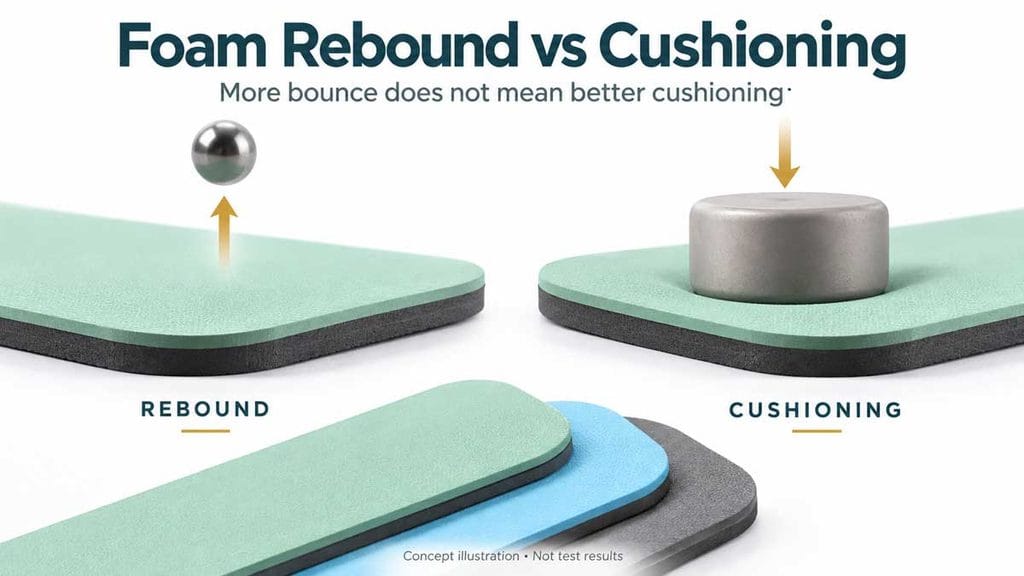
A foam mat that springs back quickly can feel responsive. But watching it recover after a hand press does not tell you how much force it transmits during an impact.
Rebound, thickness recovery, and impact cushioning answer different questions. When comparing samples, look at what happens during compression, not just how it looks afterwards. How far does it compress under the intended load? What force is transmitted? Does it approach its compression limit?
For buyers, a high rebound result is one piece of information, not a reason to approve a mat on its own.
Why a springy mat does not necessarily cushion better
Returning energy and limiting impact force are different jobs
When foam is compressed, mechanical work is done on it. As it expands again, some of that work is returned. In a controlled compression cycle, the difference between the work put in and returned is the energy not returned during that cycle.
A high energy-return result does not tell you the peak impact force. To evaluate impact cushioning, you need to measure the impact response itself. A lower energy-return result is not enough either: the foam must still accommodate the load within its useful compression range. [1]
This is why a supplier’s “rebound percentage” needs a method behind it. A ball-rebound result and energy return calculated from a compression cycle are different measurements. Subtracting an unspecified rebound percentage from 100 does not give a reliable “shock absorption” rating.
More energy dissipation is not the whole answer
Replacing “more rebound is better” with “more energy dissipation is better” creates another incomplete purchasing rule. A cushioning requirement must include the force experienced during loading and the available compression distance, not just the energy balance afterwards.
Consider two questions: How much work was done during the compression stroke? What was the highest force along the way? They are not the same mathematical quantity. A total accumulated over a distance cannot, by itself, tell you the highest point on a curve.
For a buyer, the useful request is therefore a combination: the relevant force or acceleration result, the compression reached, and any energy measure needed for the application. Ask how each was calculated. In particular, “energy absorbed” may refer to loading work in one report and the loading-unloading difference in another.
A soft hand feel can hide insufficient support
Pressing a sample with your thumb is a useful first check. It is not a controlled comparison: the force, contact area, speed, and depth change each time.
For a kneeling mat, a more useful sample review includes a defined load and contact area, as well as a practical kneeling trial. Record the compression depth and whether the user can feel the hard floor underneath. For standing exercises, check for excessive sinking, balance, and comfort.
Keep hardness in the specification, but give it a separate role. The guide to foam mat hardness and thickness explains how to compare those specifications without treating them as a complete performance rating.
The mat needs enough room to compress
Foam has a limited useful compression range. At high compression, its cells become crowded together, and resistance can rise sharply. This densification is associated with the risk of bottoming out: a sample that feels compliant under light pressure may behave very differently near its compression limit. [1]
Test the thickness you intend to purchase. Do not use results from a thicker sample to approve a thinner production mat. Include the intended surface layers and backing, and record the supporting floor or test surface.
Density belongs in that sample record too, but it is not a cushioning score. Controlled polypropylene foam experiments measured contact force and deformation separately as density changed; they do not provide a universal density ranking for other foams or finished mats. [2]
What do rebound, recovery and cushioning actually measure?

Before comparing supplier data, check which property the result describes.
| Property | What you are checking | What it does not tell you on its own |
|---|---|---|
| Ball-rebound resilience | How high a test ball rebounds under a specified procedure | The force transmitted during the mat’s intended use |
| Energy return | The share of mechanical work returned during a defined loading and unloading cycle | Comfort or suitability for every impact |
| Thickness recovery | How much thickness returns after compression, measured at a stated time | Ball rebound or impact attenuation |
| Support under load | How far the mat compresses beneath a defined load and contact area | Its response to a faster impact |
| Impact cushioning | Force or acceleration during a specified impact, together with compression information where available | Performance under a different test setup |
Ball rebound and recovery after prolonged compression are separate tests, including in EVA foam research. [3] If the concern is a dent left by storage, equipment, or sustained loading, use the compression set and recovery guide. If the concern is impact, request the relevant impact evidence.
Choose a test that matches the requirement
Read the curve, not just the percentage
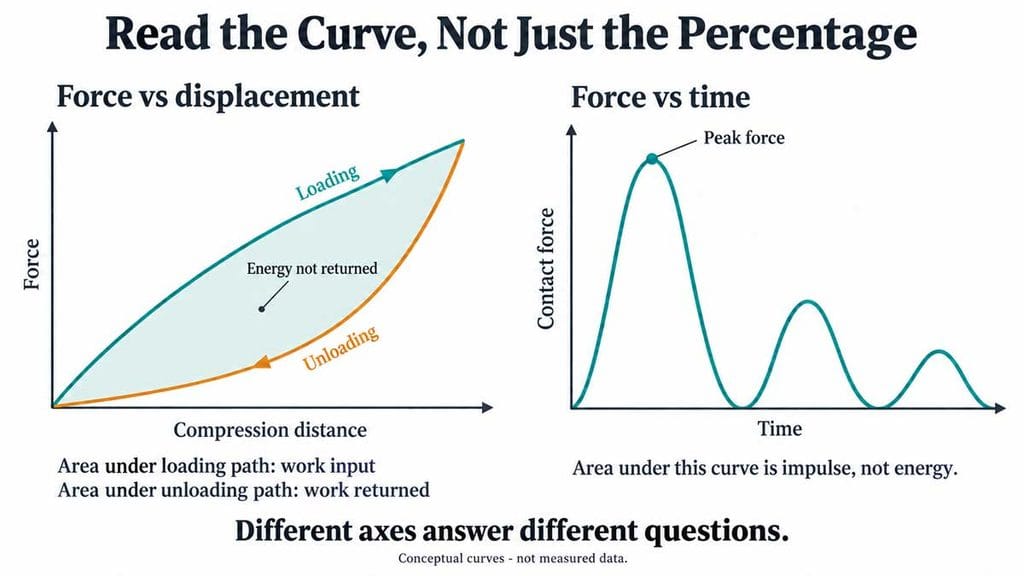
A force-displacement plot can help explain the measurements. Force is on the vertical axis; compression distance is on the horizontal axis. Read it in this order:
- Loading: Follow the curve as the sample is compressed. The area under this path represents work put into the sample during that loading stroke.
- Unloading: Follow the return path as the force is released. The area under that path represents work returned over the measured unloading stroke.
- The loop: For a defined complete cycle, the difference between those areas is the work not returned in that cycle, commonly described as hysteresis loss. It is not a measurement of recovery speed. [6]
These are quantities to identify on an actual report, not a prescribed curve shape or pass/fail limit. A stress-strain plot uses different axes and expresses work per unit volume rather than total work.
For peak force, look at the highest force reached in the relevant test, not the area enclosed by the curve. Also check whether the plot came from slow compression or an impact. A clear-looking curve from the wrong loading conditions still answers the wrong question.
Check the method and specimen
For a rebound specification, ask for a named method and the specimen details. ISO 8307, for example, covers ball-rebound resilience of flexible cellular polymeric materials. It does not measure how quickly a mat regains its thickness. [4]
For support, discuss force-versus-compression measurements with the laboratory. For impact cushioning, agree on an appropriate instrumented test and the result to be assessed, such as peak force or acceleration. A slow compression result should not be presented as a measured impact result.
Check the method’s scope as well as its name. ASTM D1596 addresses packaging materials, not general floor-mat approval. Its guidance also warns that material results do not necessarily describe the complete package. [5] A familiar ASTM or ISO reference is useful only when the method fits the question and the sample.
Thin mats need particular care with specimen preparation. Ask whether the selected method permits the proposed thickness or any stacking. A stack of layers should not be treated as evidence for a single-layer product without explaining the preparation and its relevance.
Compare samples on the same basis
Request the following information with the results. It makes it easier to investigate differences between quotations before sample approval.
| Record | Details to confirm |
|---|---|
| Sample identity | SKU, revision, material, density and measured thickness |
| Finished construction | Bare foam or finished mat; surface layers, adhesive, texture and backing |
| Test setup | Supporting surface, contact shape and area, load, and loading speed or impact conditions |
| Conditioning | Temperature, humidity where relevant, and time before testing |
| Previous loading | Fresh or previously tested specimen, number of cycles and rest intervals |
| Results and acceptance | Number of specimens, individual results, variation and agreed limits |
Two percentages are not necessarily comparable just because they appear in the same column of a quotation. If the methods or specimen preparations differ, resolve that difference first. For help checking the report, see how to read a foam mat test report.
Example: two reports that do not yet identify a winner
Consider this hypothetical purchasing situation, not a comparison of NEEU products:
Supplier A provides a higher ball-rebound result measured on a thick foam specimen. The quotation is for a thinner finished mat, and the report contains no impact-force measurement.
Supplier B provides a lower ball-rebound result plus an impact report for a finished mat. However, the backing and supporting surface differ from your proposed installation.
Neither report establishes which product cushions better in your application. A’s higher rebound does not fill in the missing impact result. B’s additional report is useful, but the construction and setup need to be checked before applying it to your order.
The next step is to request samples in the proposed finished constructions and compare them under an agreed, relevant setup. Keep the test conditions matched; document any product differences you intentionally want to compare. Ask for individual results and compression information, not just the best specimen or a marketing percentage.
If one sample then records a lower peak force under that setup, the supported conclusion is specific: it produced a lower peak force in that test. Grip, balance, recovery, and performance after repeated loading remain separate approval questions.
What happens on the next compression?
A mat used repeatedly needs more than a first-cycle result. In EVA footwear research, changing the loading pattern to include a recovery interval changed the measured ageing response; specimen geometry also mattered. This supports checking the loading sequence, not transferring a footwear result or service-life estimate to a floor mat. [66]
For your sample program, distinguish three observations: the response before repeated loading, the response during the agreed sequence, and the response after a stated rest period. A measurement taken after a long rest does not describe what happened between closely spaced loads.
Ask the laboratory to record the cycle count, loading rate, load or compression target, and recovery interval. Also specify whether the machine controls force or displacement. Holding force constant asks how deformation changes; holding compression constant asks how the required force changes.
Choose those conditions around the use you are investigating. Holding a kneeling position, stepping repeatedly, and dropping an object are different loading scenarios. There is no single rest interval or cycle count in this article that applies to all three.
Keep the acceptance decision equally specific. For example, you may need to review support during repeated loading as well as thickness after recovery. Neither observation should quietly replace the other in the final report.
Decide what matters for your mat

For yoga and floor exercise, review the finished sample during the intended poses. Check pressure comfort, grip, and balance separately. A rebound demonstration tells you little about grip or balance.
For kneeling or concentrated loads, agree on the contact area, load, and duration. Check whether the mat provides acceptable support throughout that period, rather than judging only the first press.
For repeated dynamic exercise, ask which repeat-loading conditions are included. Keep results from a fresh sample separate from results obtained after repeated loading.
For any protective impact claim, obtain evidence appropriate to the finished product and its intended application. A rebound result or informal drop demonstration is not evidence of fall protection.
These choices should lead to separate requirements where needed, not a single instruction to supply “high-resilience foam.”
Put the requirements into sample approval
A concise request to your supplier can read:
Please provide a sample at the proposed production thickness, with the intended surface and backing. Identify the method used for any rebound result. Agree with us on separate support and impact checks for the intended use, including test conditions and acceptance limits. Record the sample SKU and revision with the results.
Keep the physical sample, specification, and reports together in your foam mat sample approval record. Mark properties that have not been evaluated, and review the evidence if the thickness, formulation, or layers change.
Example approval entry for a kneeling exercise mat
Use the following as a record structure, not a set of ready-made acceptance limits:
- Product: Approved SKU and revision; measured thickness; surface and backing; and intended supporting floor.
- Support requirement: Agreed contact geometry, load, and duration; record the measured compression and the buyer-approved limit.
- User evaluation: Agreed kneeling tasks and review procedure; record comfort and stability observations separately from instrument readings.
- Rebound: Named method and result if rebound is part of the specification; otherwise mark it as not specified rather than inventing a target.
- Repeated loading: Agreed sequence and measurement points, including when readings are taken after unloading.
- Impact claim: Applicable method and acceptance criteria if a claim is intended; otherwise record that protective impact performance has not been established.
- Release decision: Report references, individual results, deviations, approval date, and responsible approver.
Set numerical limits with the buyer and laboratory before using the results for acceptance. A value measured on one favoured sample is not automatically a sensible tolerance for production. Keep an approved reference sample, but retain the measurement conditions and written requirements as well.
Tell NEEU how the mat will be used, its proposed thickness and construction, and which performance requirements it needs to meet. This gives the sample discussion a clear starting point beyond how springy the foam feels.
Frequently asked questions
No. High rebound alone does not indicate whether cushioning is good or poor. Check how the finished mat responds to the relevant load or impact.
No. Recovery time describes how long it takes for the foam to return to its original shape after compression. It does not supply the missing impact-force measurement.
Matching hardness does not establish matching cushioning. Compare the finished thickness, layers and relevant performance results before treating two samples as equivalent.
References
- Ramirez, B. J., and Gupta, V. Energy Absorption and Low Velocity Impact Response of Open-Cell Polyurea Foams. Open research manuscript, 2018. ↩︎
- Jin, Q., et al. Influence of Density upon Dynamic Crushing Behaviour of Polypropylene Materials. Packaging Engineering, 39(23), 2018, 88-92. ↩︎
- Huang, G., et al. Preparation and Characterization of EVA/Nylon Elastomer Microcellular Foaming Materials. China Plastics, 35(9), 2021, 1-7. ↩︎
- ISO. ISO 8307:2018: Flexible cellular polymeric materials, determination of resilience by ball rebound. ↩︎
- ASTM International. ASTM D1596: Dynamic Shock Cushioning Characteristics of Packaging Material. Linked edition: D1596-14. Confirm the applicable edition and procedure with the testing laboratory. ↩︎
- Lippa, N. M., et al. Biofidelic mechanical ageing of ethylene vinyl acetate running footwear midsole foam. Proceedings of the Institution of Mechanical Engineers, Part P: Journal of Sports Engineering and Technology, 231(4), 2017. First published online in 2016. ↩︎