
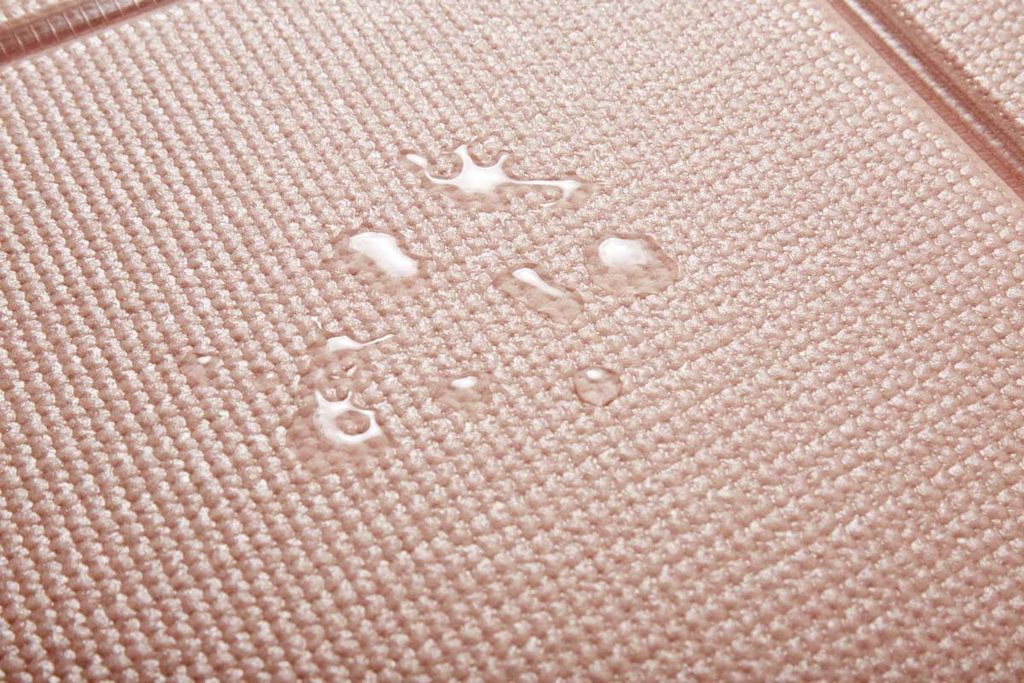
A foam tile can look dry after you wipe up a spill, but water can remain beneath the assembled floor. A laminated play mat may also retain moisture at a damaged edge even when its surface looks dry.
For brands, importers, and facility buyers, water resistance must cover the product as customers use it: its surface, edges, joints, and cleaning routine.
Many closed-cell foam mats resist water uptake. A finished mat also needs checks for water entering through joints or edges, changes after cleaning, and drying before reuse. Water-resistant tile and a watertight assembled floor have different requirements.
This guide covers indoor mats exposed to occasional spills and routine cleaning. Products intended for standing water, pool surrounds, or continuous wet use need an assessment suited to those conditions.
What Does Water Resistance Mean for a Foam Mat?
Start with the requirement behind the word “waterproof.”
| Buyer requirement | What to check |
|---|---|
| Spills should wipe off the surface | The finished face, texture, staining, and residue after the agreed exposure |
| The material should have low water uptake | An absorption test with defined specimens, conditions, and calculation basis |
| Water should stay above the assembled mat | Joints, borders, folds and perimeter openings under the intended exposure |
| Routine cleaning should leave the mat usable | Surface appearance, layer bonding, drying, flatness and relevant functional checks |
A supplier may have evidence for one of these requirements but not the others. Ask which part of the mat was tested and under what conditions. This makes it easier to compare offers and write a care label that matches the finished product.
Do EVA and Other Closed-Cell Foams Absorb Water?
Closed cells limit the connected pathways through which water can enter a foam. The amount taken up still depends on the formulation, cell integrity, cut surfaces, and any attached layers.
Research on an EVA/OBC blend series shows why the material name isn’t enough: changing the blend composition altered cell structure and measured water uptake. The authors associated increased uptake in part of the series with cell merging and rupture.[1] For buyers, the key lesson is to compare proposed constructions rather than assign a single absorption value to all EVA mats.
For PE/XPE, TPE, and PVC mat offers, also identify the foam structure and the surface and backing materials. A textile layer, exposed bond line, or damaged covering may affect drying even when the core absorbs little water. Our closed-cell foam guide explains the structural distinction in more detail.
Do water beads prove a mat is waterproof?
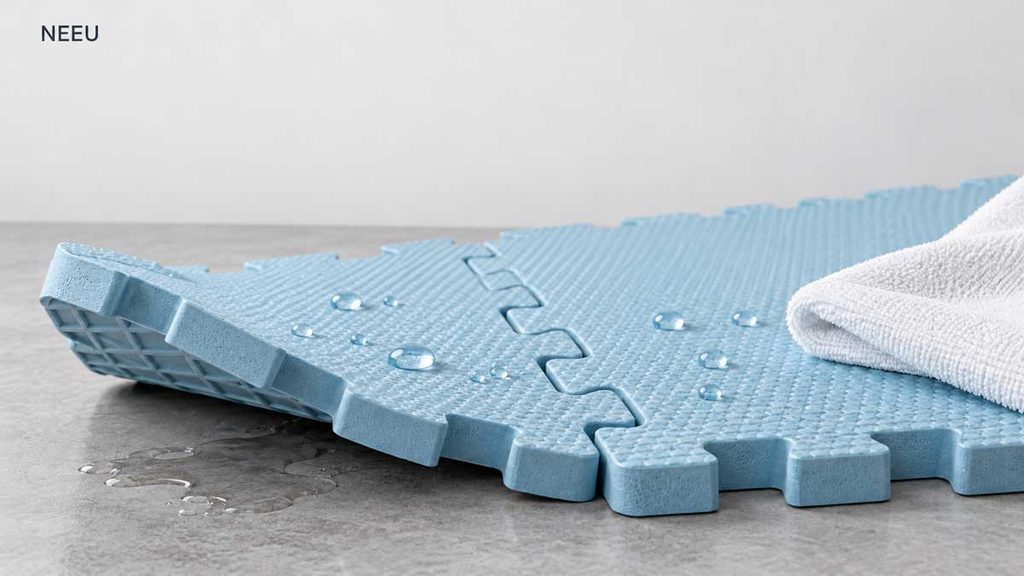
Water beading shows how water interacts with the surface at that moment. To evaluate water resistance, also check measured absorption, exposed edges, joints and the effects of repeated cleaning.
Why Water Can Pass Through Interlocking Mat Seams
Puzzle teeth hold tiles together mechanically. A close fit helps assembly, but the joint needs a sealing design and supporting evidence if it is expected to hold back water.
Liquid may pass between tiles or enter around a border, then spread beneath the assembly. The floor can become wet while the foam core absorbs very little. That distinction matters when investigating a complaint: wet flooring beneath the mat is not, by itself, evidence of high foam absorption.
For interlocking foam mats, check an assembled set with joint intersections and perimeter pieces. Use the intended floor surface and installation arrangement. If customers regularly take the mats apart, include normal assembly and disassembly before repeating the seam check.
Define how you will inspect the underside. The setup should distinguish water passing through a joint from liquid accidentally spilling around the test area. Record where the moisture appears, not just whether the top looks dry.
If sealing is necessary, agree on a suitable joint treatment with the supplier. Tape or sealant can affect removability, floor compatibility and access for cleaning. Ordinary removable tiles are not a substitute for a required building waterproofing system.
Check folds and laminated edges too
A foldable mat may have a continuous cover, separate panels, stitched sections or exposed hinge areas. Inspect the actual design, including the perimeter and openings through the cover.
On laminated products, check for water reaching beneath the film, into a fabric layer, or into the bond line. Include normal folding or flexing where it can affect these areas. An intact face and a damaged edge may behave differently during the same spill.
Read the Absorption Result Before Comparing the Percentage
“Water absorption: 1%” is not enough information to compare two offers. You need to know what the percentage refers to and how the test was carried out.
A mass-based result relates water uptake to the specimen’s starting mass. A volume-based result uses a different reference. These percentages are not interchangeable, especially across foams with different densities.
Request the following details with an absorption result:
- Material, product revision, thickness, and specimen dimensions.
- Bare foam or finished construction, including any surface and backing layers.
- Whether the original skins remain and whether edges are exposed or sealed.
- Conditioning, liquid, exposure time, temperature, and immersion arrangement.
- Any pressure or vacuum step used by the procedure.
- How surface water is removed and when the specimen is weighed or measured.
- Individual results, specimen count, and the agreed acceptance limit.
Water left in a textured surface or recess can affect weighing. Follow the specified handling procedure so that results can be compared meaningfully. Identify a custom screening check as a custom check, rather than reporting it as a standard test.
Which test method fits the mat?
ASTM D3575 covers test methods for flexible closed-cell materials made from olefin polymers and qualifying blends. Ask the laboratory to confirm the relevant procedure and edition for the offered material.
ISO 2896 covers water absorption of rigid cellular plastics. Its scope is different from a flexible finished mat, so selecting a method requires more than matching the words “water absorption” in the title.
Agree on the method and acceptance limit together. Choose them for the product and intended exposure, rather than using one percentage as a universal definition of a waterproof mat.
Check the Finished Mat Under Its Intended Exposure
Material testing answers how a specimen behaves under a defined procedure. A finished-product check answers the next buyer question: what happens when this mat encounters spills, cleaning, and drying?
The following plan is a starting point for a buyer-supplier agreement, not a standardized laboratory protocol.
| Check | Define before testing | Record afterward |
|---|---|---|
| Surface exposure | Liquid, quantity, contact area and contact time | Staining, visible change, wipe-off result and retained liquid |
| Joint or edge entry | Assembly, exposed joints, borders and application area | Where water appears below or inside the construction |
| Drying | Orientation, ventilation, temperature, humidity and inspection times | Moisture on both faces, in folds and at floor-contact areas |
| Cleaning compatibility | Cleaner, dilution, tool, rinsing and number of repetitions | Tackiness, color transfer, film lifting, swelling or finish changes |
| Return to use | Agreed checks after drying | Flatness, tile fit, layer bonding and relevant grip changes |
Use samples with the intended printing, lamination and edge finish. Keep an unexposed sample for comparison and photograph the same areas before and after checking.
Set acceptance criteria before reviewing the results. A project may require low material uptake, no visible water beneath the assembly during a defined exposure, or acceptable appearance and bonding after repeated cleaning. Record each requirement separately so a good result in one area does not hide a problem in another.
How to Clean Foam Mats Without Leaving Moisture Behind
Follow the care instructions for the exact finished mat. The foam, printing, film, adhesive, and fabric may respond differently to the same cleaner.
For a product approved for wipe cleaning, the routine should cover these steps:
- Remove loose dirt using the approved method.
- Wipe with the specified cleaner, dilution, and tool, controlling the amount of liquid applied.
- Remove residue or rinse as directed by the care instructions.
- Check underneath to see whether a spill or cleaning water may have entered the joints.
- Dry the affected mat and floor before reinstalling or returning them to use.
For brands preparing consumer instructions, specify the actual cleaning method. “Easy to clean” leaves customers guessing about detergent, water quantity, and drying.
Soaking, machine washing, steam cleaning, pressure washing, and solvent cleaning need separate approval. A quick spot test may reveal an immediate reaction, but repeated-cleaning checks are needed when the product will undergo that routine throughout use.
Surface pattern also affects where dirt and water collect. When choosing a finish, review foam mat surface texture, cleaning and print compatibility, and water-exposure checks for joints and edges.
If disinfection is required
Cleaning removes dirt; disinfection requires additional products and procedures. Choose a disinfectant suitable for the surface and intended setting, and follow its label, including contact time. CDC guidance for community facilities explains surface suitability and label-based use; healthcare and other regulated settings have their own requirements.
Confirm the finished mat can withstand the entire procedure. If the required wet contact time damages the finish, choose a compatible product or mat construction rather than shortening the procedure. Do not mix cleaning chemicals.
Dry the Underside Before Reinstalling or Packing
When water reaches beneath removable mats, lift the affected pieces and inspect the floor. Allow both faces, joints, and folded areas to dry under the approved conditions. Keep damp mats out of sealed bags, tightly packed stacks, and rolled storage until they are fully dry.
If moisture repeatedly returns from the floor, investigate the source. Covering the area again will not resolve it. The EPA’s moisture-control guidance emphasizes drying wet materials and correcting moisture sources. Dirt and attached layers can trap moisture around a low-absorption core, so surface wiping alone is only part of the maintenance routine.
For use while wet, assess grip at both the top surface and the mat-to-floor interface. That’s separate from handling an occasional spill and drying before use resumes.
Write a Water-Resistance Requirement Buyers and Suppliers Can Use
Replace a vague request for a “waterproof EVA mat” with an exposure, cleaning method, and approval plan.
For an indoor interlocking mat, a buyer brief could read:
Intended use: Indoor flooring exposed to occasional spills and routine cleaning, rather than standing water.
Cleaning: Use the agreed cleaner, dilution and cleaning method. Include instructions for drying the underside after water enters the joints.
Sample approval: Check the finished surface, assembled joints, edges and condition after cleaning and drying. Record the exposure conditions and acceptance criteria before testing.
Evidence: Retain applicable absorption results, finished-product observations and the approved care instructions with the identified sample.
If the project needs water to remain above the assembled floor, add a specific leakage requirement with an agreed exposure and inspection method. That changes what must be demonstrated during approval.
Use the foam mat sample approval checklist to retain these requirements with the approved construction. Changes to the film, backing, adhesive, edge design, or cleaner may require repeating the relevant checks.
Buyer Questions
Many closed-cell EVA mats resist water uptake and suit wipe-clean applications. Check the evidence for the finished product and intended exposure before using a waterproof claim, particularly where joints or layered edges are involved.
Use the product’s approved care method. If damp mopping is permitted, control excess liquid and check underneath when water may have entered the joints. Avoid treating puzzle connections as a seal during cleaning.
Not necessarily. Water can pass between tiles or around the perimeter. Inspect the assembly and record the entry path before deciding whether the problem is absorption, leakage or a wet floor beneath the mat.
Confirm that the product is approved for outdoor use. Sunlight, temperature changes, persistent wetting and installation conditions add requirements beyond an indoor spill check.
Ask for the proposed construction, relevant test results, finished-product exposure checks, care instructions and written acceptance criteria. Keep them with the approved sample so production and later inspection use the same requirements.
Discuss Your Mat’s Water-Resistance Requirements With NEEU
Send NEEU your mat format, surface and backing materials, likely spills, cleaning routine, and installation conditions. Include any waterproof or washable wording planned for the product label so it can be considered during sample approval.
Discuss your sample requirements before approving the construction and care instructions for production.
Research Reference
- Fu, D., Xu, J., Cai, Q., Li, G., Zhong, J., and Wang, G. (2024). Preparation and properties of radiation-crosslinked EVA/OBC foam materials. China Elastomerics, 34(6), 49-54. DOI: 10.16665/j.cnki.issn1005-3174.2024.06.007. This study examined an irradiation-crosslinked, chemically foamed EVA/OBC blend series. Its findings concern that formulation series, not a universal absorption value or the measured performance of NEEU mats. ↩︎