
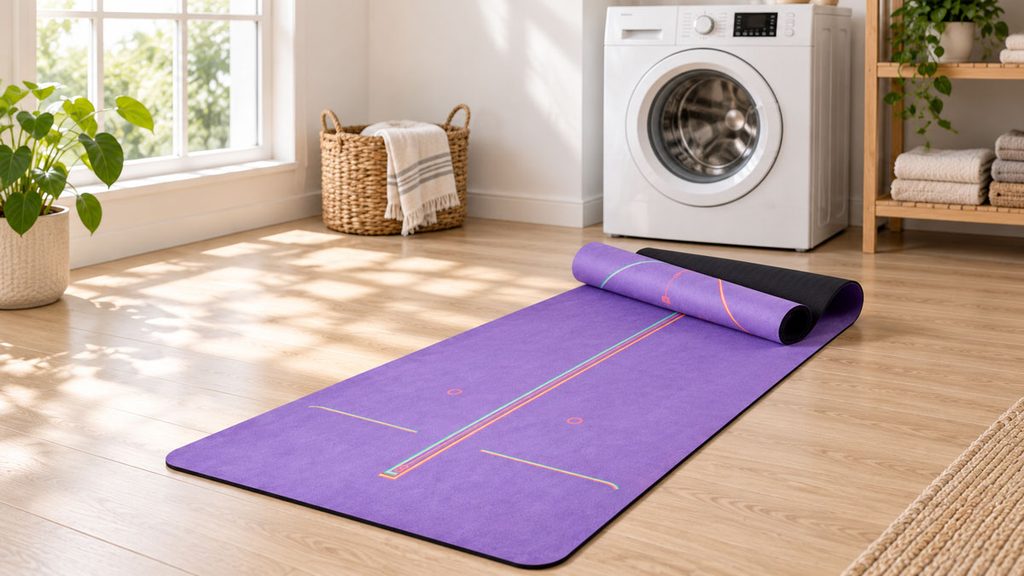
Only machine-wash a yoga mat when the manufacturer explicitly permits it for that exact model. If permission is missing or the instructions prohibit it, keep the mat out of the washer, even on a cold or gentle cycle.
Some purpose-designed mats can be machine washed. Others need surface cleaning even when they tolerate sweat and a damp cloth. Start by identifying your mat and its care method.
Start with the instructions for your exact mat
Find the model on your order confirmation, packaging, or product label, then check its current care page. If you bought it through a marketplace, use the manufacturer’s instructions for the same model rather than a generic seller answer.
| What the instructions say | What to do |
|---|---|
| Machine washing is expressly allowed | Check the permitted washer type, cycle, temperature, cleaner, spinning, and drying method before loading. |
| Do not machine wash; spot clean or wipe clean only | Use the specified surface-cleaning method. A laundry bag does not override this restriction. |
| Washable, easy to clean, or no clear instructions | Ask the maker what those words mean. Do not use a wash cycle to find out. |
Check that the instructions apply to the mat itself. A carrying bag, removable cover, or separate yoga towel may have its own wash label; that label does not cover the foam or rubber underneath. Clean each detachable item separately.
If the label and a current web page disagree, send the maker the model, purchase details, and a label photograph. Get clarification before choosing the more aggressive method.
If your mat is approved for machine washing
Use the cycle, temperature, detergent and drying method specified for your model. Clarify any missing setting before loading; ordinary laundry defaults are not a substitute for a mat-care procedure.
- Check the washer and the mat. Read the appliance’s item restrictions and loading guidance. The mat must fit without being forced into the drum. Check any restriction on a central agitator; a front-loading design alone does not establish compatibility.
- Inspect and prepare the mat. Before loading, look for tears, loose pieces, and separating layers. Set damaged items aside for the maker’s assessment. Remove detachable straps, carriers, or covers as directed.
- Set the permitted wash conditions. Match the named cycle and temperature, and use the specified cleaner and amount. Do not automatically add fabric softener, bleach, scent boosters or household cleaning mixtures.
- Check rinsing and spinning separately. Use the stated rinse procedure to remove cleaner residue and the permitted spin setting. A gentle-wash instruction does not authorize a faster spin. If residue remains, clarify whether another rinse is appropriate; do not simply switch cleaners.
- Disable automatic drying unless it is expressly allowed. Washing permission does not include tumble drying. Use the specified air-drying arrangement, and allow both faces to dry before storage.
If the machine bangs, cannot distribute the load, or displays a fault, stop it according to the appliance’s instructions. Get help from the appliance maker if you cannot remove the load normally and safely.
After drying, inspect the surface, edges, and layers before reuse, even if earlier washes caused no visible change.
If machine washing is prohibited or unconfirmed
For a mat whose instructions permit wipe cleaning, work on the practice face and underside separately:
- Remove loose dirt with a soft cloth or the tool listed in the care instructions.
- Apply the specified cleaner. Where only surface cleaning is allowed, use the stated damp-cloth method rather than soaking the mat.
- Complete the residue-removal step, then leave the mat open to dry.
“Mild soap” is not a universal substitute for a mat cleaner. For example, Manduka’s eKO directions specifically advise against soap. Avoid borrowing a vinegar, alcohol, essential-oil, or detergent recipe from another mat’s care page.
If an intact mat feels slick afterward, check for a missed residue-removal step. Complete that step, then dry the mat again before reassessing; adding more cleaner or scrubbing harder may not fix it.
For cork-topped products, the cork yoga mat cleaning and drying guidance covers the surface, backing and handling after sweaty practice.
Finish drying before rolling or packing
Dry the mat flat, draped or hung with support, as its instructions specify. Avoid using direct sun, a radiator, a hair dryer, an iron, or a tumble dryer as an unapproved shortcut.
Check both faces and any folds or fabric sections before rolling the mat into a bag. A dry-looking top doesn’t mean the whole construction is dry. There is no reliable fixed number of hours for every mat and room.
If you must leave a class with a damp mat, reopen it at the first suitable opportunity to finish drying. Do not keep it sealed while waiting for the next session.
Have you already put your mat through a wash cycle?
Do not immediately run another cycle or tumble dry it in an attempt to correct the result. Note the cycle, temperature, detergent, and spin setting so you can give the maker an accurate account.
Remove the mat using the appliance’s instructions, supporting it without pulling on loose layers. Deal with residue and drying through the model’s care method, then check:
- Shape and fit: has it changed size, developed a persistent curl, or stopped lying flat?
- Surface: are there new splits, sticky patches, continued shedding, or areas where the texture has come away?
- Layers and edges: has the top separated from the backing, or has an existing opening spread?
If it remains intact, compare its feel only after you complete the permitted cleaning and drying. Do not use a difficult pose to test whether a damaged or slippery area will hold.
If you notice damage or persistent performance changes, set the mat aside and contact the seller with photos and product details. Our guide to yoga mat wear signs and replacement explains how to decide whether to replace it. Tape, glue, and a towel over the area won’t undo damage from washing.
Why waterproof does not mean machine washable
Water resistance describes one part of the exposure. A washing cycle adds repeated movement, detergent, rinsing, and possibly spinning; a washer-dryer may add heat afterward. The surface, backing, print, and layer bonds must all tolerate the permitted process.
Water uptake itself is not fixed by a material name. In irradiation-crosslinked EVA/OBC foams, changing the blend composition changed cell structure and measured water uptake.[11] That result applies only to those foam formulations; it does not establish machine-wash compatibility for an EVA yoga mat.
Our guide to foam mat water resistance explains why low absorption, water entering an edge, and cleaning compatibility are separate questions. A droplet beading on the surface doesn’t prove the finished mat can withstand a wash cycle.
The same caution applies to layered products. A textile face may tolerate laundering while the construction underneath has different limits. If you need help identifying the layers, use the yoga mat materials comparison to frame the question for the seller, rather than guessing from the visible face.
Real care instructions show why the model matters
Yoga Design Lab’s Combo Mat FAQ permits machine washing without a central agitator on a gentle cycle with mild detergent. It still recommends handwashing as the preferred approach. The product combines a microfiber surface with a natural-rubber base. That permission belongs to the specified Combo Mat, not every microfiber-topped or rubber-backed mat.
By contrast, Manduka’s mat-care guide says no to machine washing, except for the Shala Yoga Rug. Its eKO instructions also rule out soaking and submerging, so replacing the washer with a bathtub would not solve the care restriction.
Even products from the same brand may need different care. JadeYoga Europe’s care instructions prohibit machine washing and tumble drying its natural-rubber mats, while allowing cold machine or hand washing for its Organic Cotton Mysore Yoga Rugs, with separate-color washing and air drying. A textile rug and a rubber practice mat are different products.
These are published care examples, not cleaning tests performed for this article. Recheck your own model’s instructions.
Read the whole care instruction, not just the water temperature
Where a textile cover or rug uses care symbols, the number in the wash tub gives the maximum washing temperature. Bars beneath it specify reduced mechanical treatment, and drying has its own symbols. GINETEX’s care-symbol guide explains these distinctions.
A maximum temperature does not mean every cycle below it is suitable. You still need the permitted mechanical action and drying method. Likewise, selecting a program called “hand wash” does not mean a mat labeled for manual cleaning can go in a machine.
For a foam or layered mat, look for written instructions that cover the entire construction. A fabric-care symbol on a detachable sleeve doesn’t extend to the mat inside it.
Frequently asked questions
There is no material-wide yes. Check the exact model’s instructions, including any surface coating, printing, or bonded layers. A TPE or PVC label doesn’t mean it’s safe, even if the mat is described as waterproof.
Not automatically. Machine-washable describes an allowed method, not a cleaning schedule. Distinguish routine surface care from deeper washing, using the model’s guidance and the mat’s condition to decide when each is needed. For example, Yoga Design Lab’s Combo Mat guidance still favors handwashing, even though it allows a specified machine process. No universal weekly or monthly machine-washing rule exists.
Do not assume so. A machine program name does not override a product instruction to clean manually. If the maker permits machine washing only under a named procedure, use that procedure; otherwise, keep the mat out of the washer.
Only if the model allows immersion. “Do not machine wash” does not mean “soak instead.” Some products, including Manduka’s eKO range, also prohibit submerging. Surface cleaning is a different exposure from either method.
Only with separate, explicit permission. A mat, its towel, and its carrying bag may have different drying instructions. Do not transfer a low-heat tumble-dry instruction from an accessory to the mat.
Do not assume an ordinary wash cycle is a validated disinfection process. CDC guidance distinguishes cleaning from disinfection and recommends using surface-compatible products as directed on their labels. If disinfection is required, confirm a complete, suitable procedure with the mat supplier; do not improvise with hotter water, steam, or mixed chemicals.
Buying mats for a studio or your own brand?
Choose a care routine your users can actually follow. When comparing NEEU yoga mat options, include the cleaning method and drying arrangement in the product brief alongside grip, cushioning and storage needs.
If machine-washable wording is planned, request evidence for the complete finished construction under the stated washing and drying procedure. Define the repetitions and acceptance checks with the supplier; one wash or a bare-foam result does not establish a repeat-care claim.
Keep the approved instructions and post-care observations with the finished-sample approval record. The label, tested sample, and purchasing requirement should describe the same care routine.
Research reference
- Fu, D., Xu, J., Cai, Q., Li, G., Zhong, J., and Wang, G. (2024). Preparation and properties of cross-linked EVA/OBC foam materials. China Elastomerics, 34(6), 49-54. DOI: 10.16665/j.cnki.issn1005-3174.2024.06.007. This irradiation-crosslinked, chemically foamed blend series was evaluated for water uptake by distilled-water immersion and mass change. It was not a machine-washing test of finished yoga mats and does not establish an approved cleaning cycle. ↩︎