

Choose a yoga mat long enough for the user’s lying positions and forward-to-back movements, and wide enough for the hand, knee, and elbow contact the practice requires.** Height helps shortlist a length; trying the intended movements reveals whether that size works.
For brands, importers and studio buyers, the decision also affects the range they stock and the cartons they ship. NEEU’s listed options include 173 x 61, 183 x 61, 183 x 68 and 183 x 80 cm. The useful comparison is what each change adds for the user, then what it changes in storage, packaging, and bulk-order loading.
What is a standard yoga mat size?
A 68 x 24 inch mat, approximately 173 x 61 cm, is a familiar retail format. However, standard is a product label rather than a single length and width shared by every supplier. Write the dimensions explicitly when comparing products or requesting a quotation.
NEEU yoga mat size options
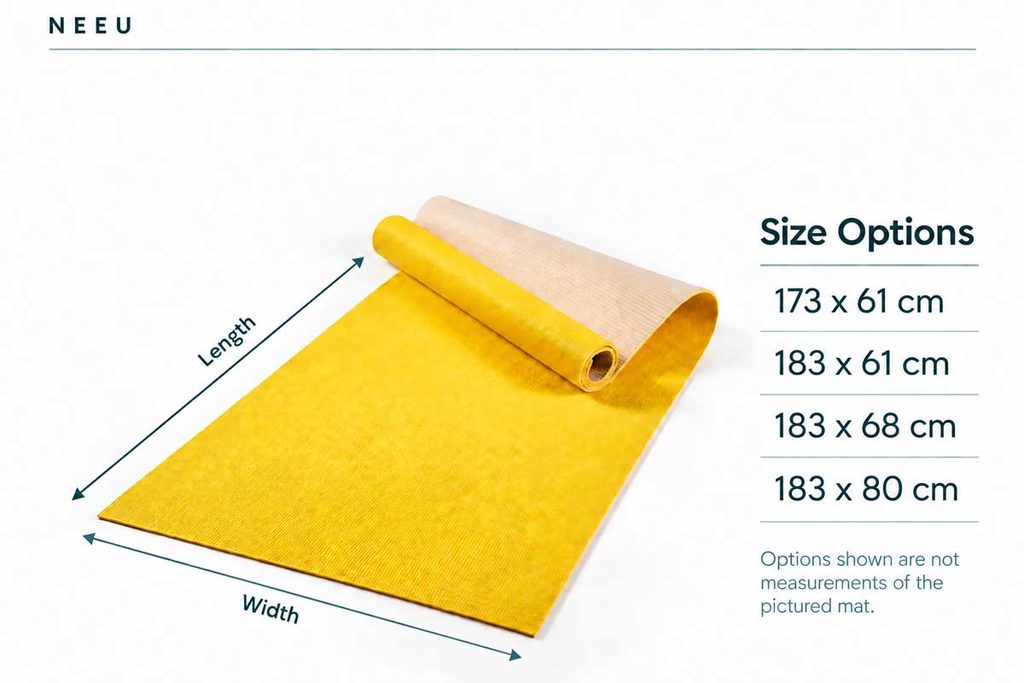
The following sizes appear in NEEU’s yoga mat range. Confirm the selected size, material, thickness, surface, and packaging during sampling.
| Length x width | Approximate inches | What changes |
|---|---|---|
| 173 x 61 cm | 68.1 x 24.0 in | A starting footprint for a general adult range |
| 183 x 61 cm | 72.0 x 24.0 in | Adds 10 cm of length while keeping the same width |
| 183 x 68 cm | 72.0 x 26.8 in | Adds 7 cm of width compared with the 183 x 61 cm option |
| 183 x 80 cm | 72.0 x 31.5 in | Adds 19 cm of width compared with the 61 cm-wide options |
| 150 x 50 cm or 160 x 50 cm | 59.1 x 19.7 in or 63.0 x 19.7 in | Smaller footprints for children’s product programs |
Inch equivalents are rounded. These are listed product options, not a statement of stock availability. Select children’s sizes based on the intended age group and activities; size alone does not establish product suitability or safety.
Keep thickness separate from length and width. A description such as “6 mm yoga mat” tells the buyer nothing about its footprint on the floor. Likewise, large or XL needs actual dimensions.
Other yoga mat dimensions buyers may encounter
Extra-long products extend beyond the 173–183 cm options above. Two published market examples illustrate different ways to add space:
| Market reference size | Approximate equivalent | What the dimensions show |
|---|---|---|
| 210 x 70 cm | 82.7 x 27.6 in | More length and width than an 183 x 61 cm mat |
| 85 x 26 in | 216 x 66 cm | Greater length than the 210 cm example, but a narrower surface |
These dimensions are documented in published XL product specifications and a manufacturer’s size comparison. They illustrate available size combinations, not an industry standard or a product recommendation. Metric and inch equivalents are rounded from the stated source dimensions.
For a taller-user range, compare the length needed before adding width automatically. A longer, narrower mat and a shorter, wider mat address different fit problems and produce different packed shapes. Market examples help define a development brief; they do not establish NEEU stock or manufacturing availability.
For dimensions outside NEEU’s listed options, confirm the proposed material, finished size, and packing arrangement during product development.
How to choose yoga mat length
Start with a simple lying-position check: can the user rest their head and heels on the mat with their legs extended, without repeatedly shifting to find room? Then move through the practice the product is intended for.
A mat that accommodates the body at rest may still feel restrictive during transitions. Some poses deliberately extend beyond the mat, so the aim is to provide the expected contact area rather than contain every movement inside a rectangle.
Use height to shortlist a length
A person 180 cm tall has little nominal end-to-end allowance on a mat listed as 180 cm long. That makes a longer candidate worth trying, but it does not establish a fixed “height plus ten centimeters” rule. Body proportions, foot position, and hand placement also affect the space used.
For a wholesale range, compare candidate lengths with representative users, including those near the taller end of the intended audience. During the trial, record whether:
- the head and heels stay on the intended surface when lying down;
- hands or feet repeatedly approach an end during transitions;
- users keep repositioning themselves to avoid running out of room;
- the longer mat remains practical to carry and store.
A floor outline can help shortlist sizes before samples arrive. Use a finished mat for the final trial so its grip, support and edge behavior are part of the experience.
Add length when length is the problem
Moving from 173 x 61 cm to 183 x 61 cm adds room at the ends without changing the width. This is useful when users find a shorter mat restrictive but are comfortable with its lateral space.
If hands or elbows keep falling off the sides, extra length will not solve that issue. Compare a wider option instead. Describe these differences plainly in the product range: buyers should be able to identify a longer version without assuming it is also wider, thicker, or more supportive.
For users who need more length than the listed options, provide the required dimensions in the custom brief and confirm feasibility before developing packaging or artwork.
How wide should a yoga mat be?
Width affects how much room you have beside your body. Look at resting arm positions, kneeling movements, seated work, and transitions that bring a hand or knee toward the edge.
Compare widths using otherwise similar constructions. If the material, surface and thickness all change at the same time, it becomes difficult to tell whether the extra space improved the experience or the new construction simply felt different.
Compare the extra space on each side
A change from 61 to 68 cm adds 7 cm overall, or 3.5 cm on each side when the user is centered. Moving from 61 to 80 cm adds 9.5 cm per side. These measurements give a clearer picture than the label “extra wide.”
That margin may keep an elbow or knee on the surface during the intended sequence. It may also take up space the user needs for other equipment. Compare the benefit on the floor before selecting the widest version as the default.
Extra width provides more available contact area; grip and support still depend on the finished construction. For the separate choice of under-body cushioning and bulk, see the yoga mat thickness guide.
Decide whether a second width deserves its own SKU
A wider version should solve a recognizable customer need. For a home-practice range, that could be more room for floor-based movements. For a studio fleet, the same width change needs to work within a shared layout.
Before adding it, compare the intended user benefit with the additional bag, carton, and inventory requirements. A regular and a wider size may be enough; offering every length in every width can create combinations with little distinct purpose. Use customer feedback and sample trials to choose which alternatives to carry.
Allow room around the mat
The mat’s outline is only part of a practice area. Home users need space around furniture and doors. Studios also need room for neighboring users, props, instructors, and circulation.
As a planning example, ten mats in a row add 70 cm of combined mat width when each increases from 61 to 68 cm. That calculation excludes the spaces between mats and around the perimeter. Dividing the room’s floor area by mat area alone will therefore overstate what the calculation can tell you about a usable layout.
Lay out several samples or accurate floor outlines before committing to a studio order. Include the props used in class and have the instructor review the arrangement. Premises access and occupancy requirements remain separate from this product-sizing exercise.
| Buying situation | Prioritise | Compare before ordering |
|---|---|---|
| General retail range | A clearly identified core size | Fit across the intended customer group |
| Taller-user option | Additional usable length | Lying positions and forward-to-back transitions |
| Wider practice option | Lateral contact space | Hand, elbow and knee positions on two widths |
| Studio fleet | User fit within the room layout | A full row with props and access included |
| Travel range | Open and packed dimensions | Finished weight, bag fit and carrying convenience |
Check packaging and container loading
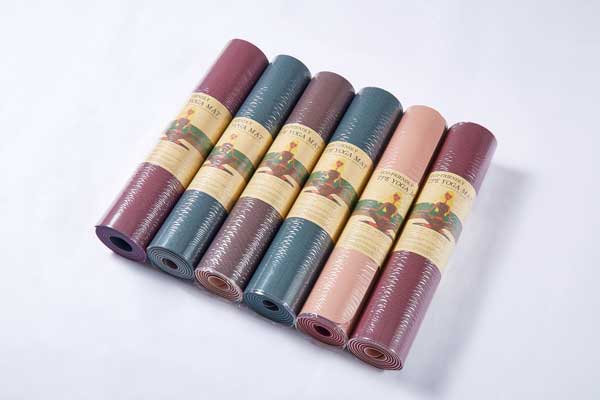
A larger mat changes the packed product and the floor footprint. With the same thickness, density and layer construction, more area means approximately proportionate additional core mass. Measure accessories and packaging separately.
For example, changing from 183 x 61 cm to 183 x 68 cm increases area by approximately 11.5%. That does not imply an identical price or freight increase: manufacturing yield and the packing arrangement also affect cost.
When a mat is rolled from a short end, its width becomes approximately the roll’s axial length. A wider mat may therefore need a longer bag and carton. Increasing mat length instead adds wraps, with the resulting diameter depending on thickness and rolling tightness.
For bulk orders shipped by sea, request four figures for each proposed size: packed roll dimensions, outer carton dimensions, mats per carton, and estimated mats per container. The estimate should identify the container type, floor-loaded or palletized arrangement, and relevant stacking and weight limits.
Dividing carton volume by the number of mats helps compare packed space per unit, but carton orientation and unused space affect the actual loading quantity. Hapag-Lloyd’s container specifications also distinguish internal dimensions, door openings, and payload; confirm the equipment and loading plan with the supplier and forwarder.
For a container carrying one mat specification, divide the comparable shipment cost by the confirmed loading quantity to get a per-mat allocation. Keep the route, container type, and charge scope consistent. For mixed sizes, agree on an allocation basis rather than treating the average cost per piece as each SKU’s true freight cost.
Approve the packing arrangement with the size. Do not use tighter rolling or compression to improve a loading estimate without checking that the unpacked mat recovers acceptably.
Write dimensions that production can measure
The purchase specification should identify the finished length and width, permitted variation, and measurement conditions. “Same size as the sample” leaves room for different interpretations, particularly if one person measures immediately after unrolling and another measures after the mat has rested flat.
| Specification item | What to record |
|---|---|
| Length and width | Nominal dimensions, controlling units and tolerances |
| Measurement state | Flat and unstretched, with agreed conditioning and time after unpacking |
| Measurement locations | Where to measure and how rounded or irregular edges are treated |
| Shape and flatness | Corner design, edge alignment and the agreed assessment of curl |
| Decoration | Logo and alignment-mark positions relative to the finished outline |
| Accessories and pack | Approved bag or strap, packing arrangement and carton quantity |
ISO 1923 covers equipment and procedures for measuring the linear dimensions of cellular materials. Confirm its applicability to the construction; the commercial size and tolerance still need a buyer-supplier agreement.
Choose one controlling unit. A 72-inch length is exactly 182.88 cm, often rounded to 183 cm for a product label. Those should not become two separate exact manufacturing targets. Keep the drawing, inspection record, and packaging copy consistent about the conversion.
Artwork needs a separate check when dimensions change. Stretching a complete graphic can distort a logo or alter the spacing between alignment marks. Retain intentional graphic dimensions and reposition them against the approved mat outline.
Discuss these details through NEEU’s yoga mat customization options, particularly when the new footprint also changes the surface design or packaging.
Record the size approval as a complete product version
Once the trials are complete, identify exactly which dimensions are approved for each SKU. Retain the drawing revision, full-size reference sample, artwork, and matching accessory and carton specifications together.
If the mat is approved but the wider bag is still being revised, record that distinction. Similarly, a size accepted for one construction should not silently become approval for a different material or packing arrangement.
The foam mat sample approval checklist provides a place to record those decisions and any outstanding conditions. This gives production and repeat-order teams a usable reference instead of an email that describes the product only as “large.”
Frequently asked questions
It can be, depending on the user and practice. It is approximately 173 cm long. Compare that length with the full-body lying position and selected movements. For a retail range, a longer alternative can serve customers who find this footprint restrictive.
Six feet is approximately 183 cm. A 72-inch mat has the same nominal length, leaving little additional end-to-end allowance. Compare a longer candidate in the intended poses rather than applying a fixed extra-length rule to everyone.
It may help someone who finds the sides restrictive, but experience level alone does not determine width. Body position, movement, available floor space, and carrying needs are better factors for choosing.
No. Portability also depends on thickness, material weight, and whether the mat rolls or folds. Compare open dimensions with the actual packed sample; reducing length is only one way to reduce what the user carries.
One size simplifies layout and storage. A limited number of longer or wider alternatives may accommodate other users. Decide where those mats will fit in class and where they will be stored before expanding the fleet.
Review Your Yoga Mat Sizes
Send NEEU your target users, proposed length and width, intended practice, material preference, order quantity, and destination market. Include retail-pack requirements and any pallet or container-loading constraints, along with an existing sample or drawing where available.
Request a yoga mat size review to compare candidate dimensions, full-size samples, and packing proposals for your bulk order.