
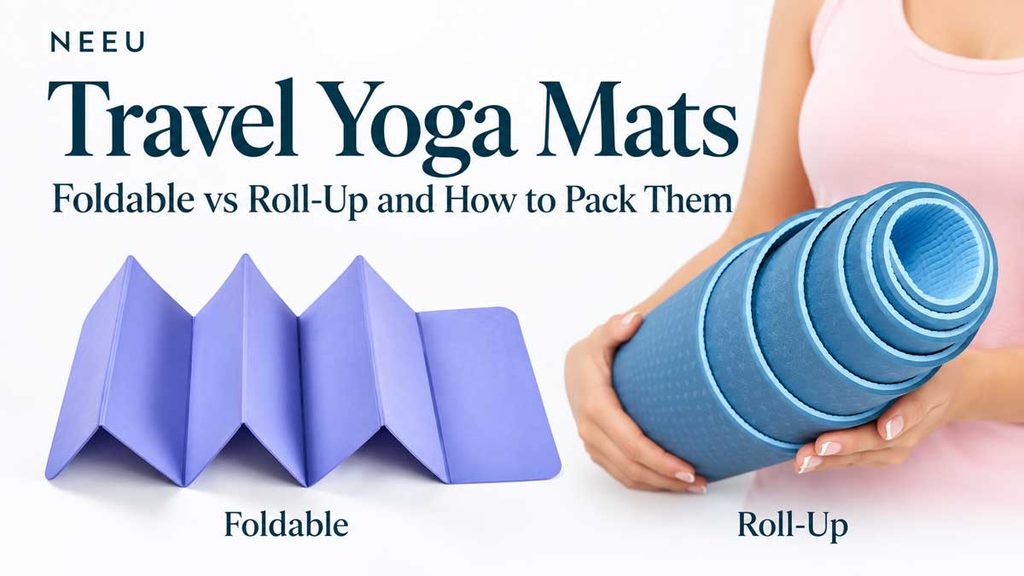
A foldable travel yoga mat fits in a suitcase or backpack as a short, rectangular bundle. A roll-up mat suits a long compartment or a separate mat bag. Choose the shape that fits your luggage, then make sure the mat is comfortable and stable for your planned practice.
If the mat instructions allow folding, start with both sides clean and dry, fold gently, and test the fit with your other luggage. Before choosing a packing method, though, check whether your particular travel mat can fold at all.
First, Check Whether Your Travel Mat Can Fold
Look for an explicit folding instruction for your model. It may describe a sequence, mark fold lines, or allow the flexible mat to fold for transport. A photo of a compact package is less useful than instructions that explain how to make it. If the instructions only describe rolling, ask the supplier before adding folds.
Thickness and the word “travel” don’t answer that question. Manduka’s eKO Superlite instructions allow folding for travel but recommend rolled storage when possible. The Liforme Classic Travel mat’s care instructions say to store it rolled, not folded.
A travel yoga mat can be a flexible sheet that folds, a mat with defined folding sections, or a lighter version of a conventional roll-up mat. Larger panel mats and play mats in the foldable mat range serve different purposes and fold differently. Choose a finished product for yoga rather than selecting based on the folded shape alone.
Foldable vs Roll-Up: What Changes in Your Luggage?
| Packing decision | Foldable travel mat | Roll-up travel mat |
|---|---|---|
| Package shape | A rectangular bundle; measure its thickness too | A cylinder; measure its length and diameter |
| Fitting inside luggage | Can suit a broad, shallow compartment if the bundle fits | Needs a compartment long enough for the roll |
| Carrying separately | Usually a pouch, sleeve or suitable bag | Usually a strap or mat bag |
| What to inspect after packing | Fold marks, raised creases and surface condition | End lift, edge curl and strap marks |
Neither packing format tells you how much grip or cushioning a mat provides; those depend on its surface and construction. Folding also changes the package’s shape without reducing the mat’s weight. Compare the complete mat, bag, and accessories you will carry. A short folded bundle isn’t necessarily less voluminous than a slim roll.
For a suitcase or backpack, measure the usable compartment and its opening, including the space taken up by dividers or internal handle rails. A bundle may fit inside the bag but still be awkward to pull through the zipper opening. Check the bundle’s length, width, and thickness with its pouch on, and leave room for clothing and the items you will add later. The luggage’s advertised outside dimensions do not tell you how much packing space remains inside.
When you roll a mat from a short end without folding it first, the roll’s length is about the mat’s width. For an illustrative 183 × 61 cm (about 72 × 24 in) mat, that means a roll about 61 cm (24 in) long, before allowing for a bag or fasteners. Its diameter depends on the finished thickness and rolling arrangement; measure the actual roll.
For a mat that permits the following sequence, bring the two long edges together to halve the width, then bring the short ends together twice to reduce the length to one quarter. The nominal folded footprint is 45.75 × 30.5 cm (about 18 × 12 in), with eight layers. These are geometry examples, not product specifications or a promise of carry-on fit. Rounded bends, space between layers and the pouch affect the actual packed dimensions. Do not treat eight times the mat’s listed thickness as its measured bundle thickness.
Keep enough open surface for your practice. A full-length travel mat may pack conveniently; you do not automatically need a shorter mat. When choosing yoga mat length and width, allow room for your lying positions and the movements you normally make.
Choose for the Floor You Will Actually Use
A thin travel mat may work as your own practice surface over a studio mat, or as a standalone mat on a suitable floor. Decide which situation you expect before prioritizing the smallest package.
For a studio or retreat, ask whether they provide a base mat and whether bringing a topper is appropriate. Some travel mats are expressly intended for either use: Manduka’s travel packing guide describes its eKO Superlite as suitable alone or over a rental mat. That option is product-specific. Your own top mat still needs cleaning, and both mats must remain stable together.
For hotel-room practice on a hard floor, try kneeling, seated work, and your usual standing movements before traveling. If the compact mat offers too little cushioning, decide whether you can carry a more substantial mat. Our guide to thicker 6, 8, and 10 mm yoga mats covers those options; these thicknesses aren’t a minimum requirement for travel.
Thickness alone cannot tell you how a mat will feel underfoot. Different 6 mm constructions produce different foot-pressure patterns and different front-to-back weight-shift measures during single-leg support.[11] When comparing mats, try a familiar balance pose as well as kneeling and seated positions. The cited results concern those particular samples and a defined task, not an ideal travel thickness or a ranking of travel mats.
Try your mat on the type of surface you expect to use. Check hand and foot grip, whether the underside moves, and whether a folded section rises during ordinary transitions. If you will use it over another mat, repeat the check with that arrangement. A secure top surface does not compensate for the whole assembly sliding underneath you.
How to Fold a Yoga Mat for Travel
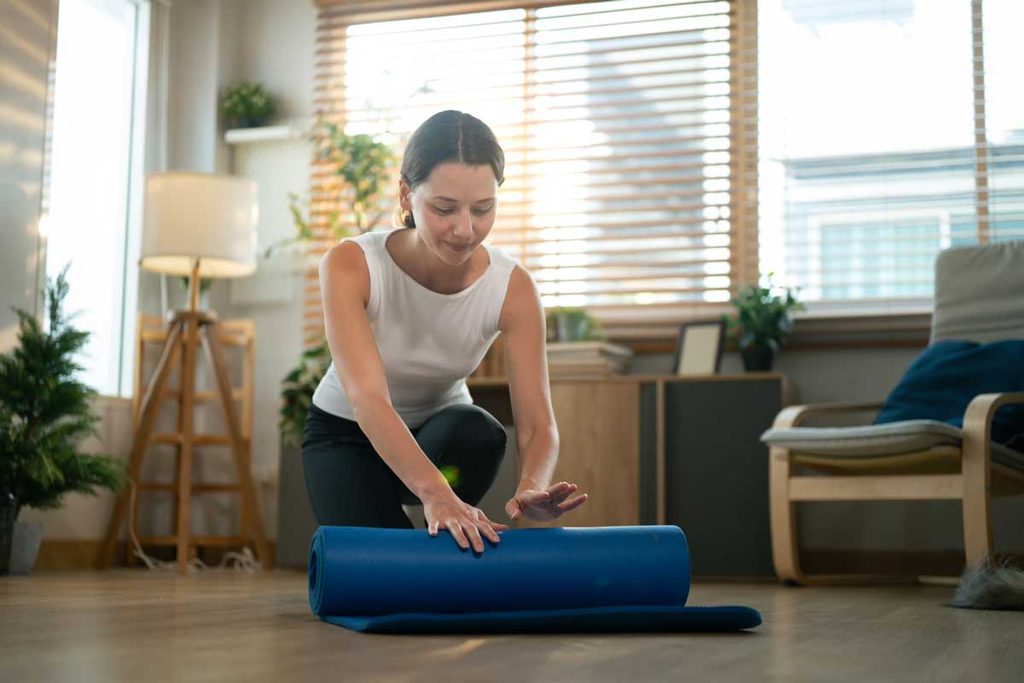
Steps 3 and 4 describe one packing example for a flexible sheet whose maker permits this sequence, including folding the layered bundle. They are not the published folding instructions for the brands mentioned above. If your mat has a specified sequence, scored fold lines, or hinged panels, follow those directions instead, which may produce an accordion stack. The cleaning, packing, and reopening checks still apply.
1. Clean Both Faces and Let Them Dry
Use the cleaner and method recommended for the finished mat. Remove grit from the underside and residue from the practice surface. Let both faces dry before putting them together or sealing the mat in a bag.
Avoid borrowing a cleaning recipe from another material. A method that works for one rubber surface may not work for a printed PVC mat or a layered construction. If you must leave immediately after practice, keep the damp mat away from clothing and reopen it to dry at the first suitable opportunity. A waterproof pouch traps moisture; it doesn’t dry the mat.
2. Lay It Out and Identify the Fold Direction
Place the mat on a clean, flat support. Check the fold lines, layer condition, and any instructions on which face goes inward. Keep straps and closures clear of the folds.
Where the permitted sequence allows it, plan the first fold so the practice surface folds inward onto itself. This reduces contact between the practice and floor-facing surfaces; both faces still need cleaning.
3. Make the First Fold Gently
Bring one long edge toward the other to halve the width. Align the edges and let the bend form naturally.
Do not press a new crease into a mat with your knee or body weight. If the material resists the permitted movement, or a surface layer pulls apart, stop and review the instructions.
4. Shorten the Bundle to Fit the Compartment
Bring the short ends of the folded strip together to halve its length. If the same sequence allows another fold, bring the new short ends together once more. This produces the eight-layer example described above. Stop earlier if the bundle already fits your bag, and do not add extra folds simply to make it smaller.
Keep the layers aligned without pulling them tight.
5. Pack It Without Crushing the Folds
Use the supplied pouch or a clean sleeve that accommodates the finished bundle. Place it where a shoe heel, charger, or other hard item won’t press into the mat. Close the bag with its normal contents inside.
If you have to force the zipper or heavily compress the folds, rearrange or use a roomier bag. Check the total carried weight and how it fits. A towel, bottle, and mat bag can change how a travel kit feels to carry.
6. Reopen It Before the Trip
Try the entire pack-and-unpack routine at home. Lay the mat on the intended floor type and check for raised folds, surface damage, or movement during a short, familiar sequence.
The rehearsal gives you time to change a cramped packing arrangement or address a fold that catches during movement. It doesn’t determine whether prolonged folded storage is suitable; use the product’s storage instructions to decide.
How to Roll and Pack a Travel Yoga Mat
For a mat designed to roll, start with the same cleaning and drying routine. Then:
- Check which face goes outward. Follow the product’s storage instructions for its finished layers.
- Roll evenly from the instructed end. Keep the edges aligned and the roll snug enough to hold its shape without forcing it into a smaller diameter.
- Secure it with a suitable strap or bag. The restraint should hold the roll without leaving deep pressure marks. Keep buckles from pressing into the practice face.
- Check the complete packed roll. Measure it with the bag and closures in place, and try putting it into the compartment or carrying it alongside your other luggage.
Unpack, Check and Practice at Your Destination
Open the mat when you arrive, rather than leaving it compressed until the class starts. Choose a clean, level area with enough space for your movements, and let it rest as its instructions recommend. No single waiting time guarantees every mat will flatten.
Some travel mats retain visible fold marks. JadeYoga’s Voyager care information explains that folding can leave creases and recommends storing it rolled when not traveling. Inspect what those marks mean in use: a visible line differs from a raised fold, split surface or separating layer.
Do not use heat, a hot iron or aggressive reverse rolling to flatten an unfamiliar mat. If an edge or fold keeps lifting or catching during movement, follow the supplier’s remedy or choose another suitable practice surface.
After each session, remove dirt, clean as directed, and dry the mat before repacking. Keep a damp towel separate. At the end of the trip, reopen the mat, inspect both faces, and return it to the recommended storage arrangement.
Frequently Asked Questions
For US security checkpoints, the TSA’s yoga-mat listing allows yoga mats in carry-on and checked bags, subject to the screening officer’s final decision. The airline’s size, weight, and item-count rules still determine how you can carry it. Check your route and fare, including whether a separate mat bag counts as an additional item. Attaching a roll to the outside of a backpack does not exempt it from those rules.
Yes, if it suits your routine, support needs, and floor. Test it for a full, familiar practice rather than only a few standing poses. If you use it as a topper while traveling but directly on a hard floor at home, assess both setups separately.
Developing a Travel Yoga Mat Range?
For brands and distributors choosing from NEEU’s yoga mat range, the carrying bag and instructions deserve as much attention as the mat. Customers need to know how to restore the packed shape, reopen the mat, and care for it between trips. Confirm the construction and permitted packing method on a full-size sample.
Include these details in the brief:
- Open length and width, thickness, mat weight, and total kit weight.
- Permitted fold sequence or rolling direction, packed dimensions, and matching bag.
- Intended floor or topper arrangement, grip and support needs, and destination market.
- Condition after packing and reopening, including fold marks, curl, and layer integrity.
- Cleaning, drying, storage instructions, and the complete retail-pack contents.
When specifying custom yoga mats and accessories, check that the supplied folding or rolling directions produce a bundle that fits the chosen bag. Assemble and use the complete kit, including its closures and retail packaging. Keep the approved dimensions, artwork, instructions, and packing arrangement together in the sample approval record.
Use this brief to review your travel yoga mat requirements with NEEU.
Research Reference
- Liu, X., Yan, H.-J., Dan, L.-F., Lu, Y.-C., and Li, J.-S. (2024). [A Study on the Effects of Different Materials of Yoga Mats on Key Biomechanical Indexes of Mat Exercise in Women]. Zhejiang Sport Science, 46(4), 78–86. The comparison used four 6 mm constructions—EVA, NBR, PU + natural rubber and TPE—with 24 healthy female university students. The findings cited here concern a defined single-leg support task. It did not test folding, luggage packing, thin travel mats or clinical injury outcomes. ↩︎