
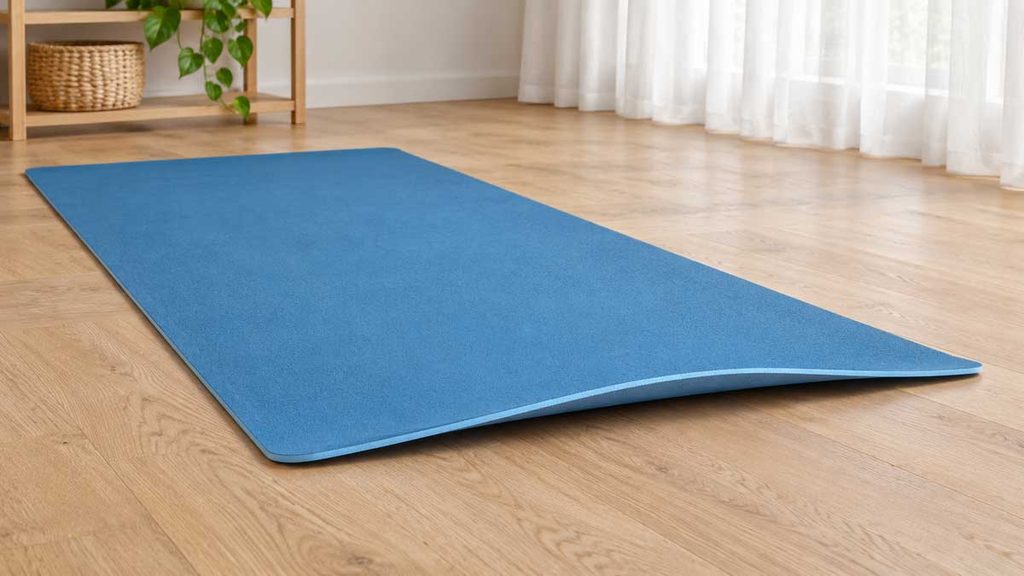
Unstrap your yoga mat and unroll it practice-side up on a clean, dry, level floor. If the end makes a smooth curve and both sides look intact, let it rest without weights and see whether the edge settles on its own.
Try reverse rolling or weighing down the ends only if the maker allows it for your mat. If you find a sharp crease, a crack or a layer peeling away, stop trying to flatten that spot. The aim is for the mat to stay down on its own, not just while something holds it in place.
Start With What’s Lifting
Look along both short ends and down the long edges, then check the underside. You can do this before looking up the care instructions. If the mat has just come out of a hot or cold vehicle, let it come to room temperature rather than forcing a stiff roll open or heating it.
| What you see | What to do |
|---|---|
| A smooth curve at one or both ends | Leave the mat open, away from foot traffic. Check whether the edge comes down without being pressed. |
| A sharp ridge or kink | Look for a matching fold, strap mark or crushed spot in the packaging. Don’t bend the ridge backward to see if it will disappear. |
| A line where a foldable mat is designed to fold | Check that both panels sit evenly. A visible line alone is different from a ridge that catches your foot. |
| A bubble, split or loose surface layer | Set the mat aside. A flat-looking edge does not mean a separated layer has bonded again. |
| A mat that lies flat until you move on it | Check whether the mat slides or bunches on that floor. Start by clearing grit and trying a firm, level surface suitable for the mat. |
| New waves after washing, heat or damp storage | Stop repeating that treatment. Note what changed before you noticed the waves. |
Check what is under the raised area too. A rug edge or a cable under the mat can look like a problem with the mat itself. A bed or deep carpet makes it harder to tell whether the whole mat sits evenly.
Why Does a Yoga Mat Curl Up?
A mat can still follow the curve of the roll when you first open it, especially at an end that was wound tightly. Compare the shape after it has rested with what you saw at unpacking. If the smooth curve is easing, leave it alone rather than adding force. A sharp line that stays in one spot deserves a closer look.
Don’t choose a treatment based only on a label like “rubber,” “TPE” or “cork.” A backing that bends easily can still be bonded to a surface that creases when bent the other way. And pressure is not a reliable way to undo damage: laboratory compression work on closed-cell EVA describes how some deformation can remain after the load comes off. That is a finding about foam under compression, not a test of how to flatten a yoga mat.
Can You Reverse Roll or Weigh Down the Ends?
Look up the exact model on the label, receipt or order page. Use the maker’s unpacking directions first, including any resting time. If there is no guidance for reverse rolling or weighting, stick to the flat-floor check. You do not need instructions to see whether an intact curve is easing, but you do need them before choosing a load or bending direction.
Reverse Rolling
Reverse rolling bends the mat against the curve it already holds. Starting from the other short end while keeping the same face on the outside is not the same thing. And “practice side out” may already be the normal storage direction. For instance, Les Mills specifies top-side-out storage for its yoga mat and warns that rolling the other way can damage the surface.
If your model allows reverse rolling, follow the stated direction, roll size and duration. Keep the bend broad and even. Don’t pinch a lifted corner into a fold or cinch the strap to pull the roll tighter. Stop if the surface starts to whiten, crease, crack or separate.
Weighing Down the Ends
If the instructions specify weighting, use the stated load, placement and duration. Support the whole mat and keep anything with a sharp edge or a small, hard contact point off the surface. A dumbbell end can leave a dent where you were trying to remove a curl.
Take all objects off the mat before checking it. If the end only looks flat under a weight, it has not stayed flat on its own.
Check the Mat After You Let Go
Lay the mat practice-side up again on the same floor. Look at both ends without pressing on them. If the maker specifies a follow-up interval, check again at that point.
- The edges stay down and the mat is intact. Start with a familiar, controlled movement. If the mat catches, shifts or feels uneven, stop rather than testing it with a more demanding pose.
- The curl doesn’t change or comes back. Note whether it lifts as soon as you let go or only after you roll and reopen the mat. That gives the seller more to work with than “it won’t lie flat.” Don’t add more weight or tighter bends.
- You find a new crease, crack or lifted layer. Set the mat aside. Don’t keep treating it or use it for practice.
If It Still Won’t Lie Flat
In an r/yoga discussion about a raised edge, one owner said the problem persisted despite keeping the mat unrolled and trying weights. That’s one person’s experience, not a test result.
If yours is new, take a side-on photo of the raised area without holding it down. Keep the model label, order details and any photos of the original packaging. Tell the seller what you tried and whether the shape changed. If you don’t have the care instructions, ask whether the maker recommends a specific method for that model. Check the return deadline rather than waiting indefinitely for it to settle.
A shallow mark that does not affect use isn’t the same as a ridge that catches or a surface that is splitting. If the mat no longer stays stable and the seller has no suitable remedy, use another mat. For a mat that’s also thinning, shedding or losing grip, check the signs that a yoga mat needs replacing.
What Not to Use to Flatten a Yoga Mat
- An iron, hair dryer, radiator or hot car. Let a cold mat warm up indoors on its own. A mat intended for heated classes isn’t necessarily made to take direct heat from an appliance.
- Water or a wash cycle. Cleaning is a separate job. If the mat needs cleaning, check whether it can be machine washed and follow its drying instructions. Don’t soak it just to take out a curl.
- Tape, glue or scissors. They can change the mat or leave residue without fixing what caused the edge to lift. Ask about a remedy before making a change you can’t undo.
- A new fold or an upside-down practice surface. Don’t fold a mat intended only to roll. Turning a one-sided mat over for practice also puts a different surface under your hands and feet.
How to Keep the Ends From Curling Again
Use the storage direction specified for your mat. Give the roll enough room in its bag so you don’t have to cinch it tighter to make it fit. Keep hard buckles from pressing into the surface, and don’t store heavy objects on top of the roll.
Let the mat dry before packing it away. If it keeps lifting after ordinary storage, check how it was rolled and whether the same end lifts every time. When you’re packing for a trip, check whether your travel mat should fold or roll; a thin mat is not necessarily designed to fold.
For Brands and Studios: Check the Mat as the Customer Receives It
When sourcing yoga mats for a brand or studio, include a packaged sample. A loose sample that has already been lying flat won’t show what a customer sees when they remove the wrap and straps.
Agree on the packing arrangement, storage conditions, how to open the mat and when to check it. Photograph the raised areas from the same angle before and after the specified preparation, with nothing holding the mat down. If the care instructions call for a correction, have someone follow those instructions as written before approval.
Add the observations and any agreed limits to the sample approval record. Recheck if the mat or its packaging changes.
Frequently Asked Questions
There’s no single time for every mat. Use the unpacking interval given for your model. If there isn’t one, see whether the curve eases while the mat rests and contact the seller promptly if the edge still interferes with use.
Only if the maker says you can for that model. Check the rolling direction rather than going by the cork surface alone. If the cork is already cracking or lifting from the backing, don’t bend it back.
Use another suitable mat if yours still catches, bunches or needs weights to stay down. Fixing the curl can wait until after class.