
A yoga mat can last from months to several years, depending on the model, use and care. Consider replacing yours when worn areas keep slipping after correct cleaning, a knee patch stays flattened, or the surface tears or separates.**
A mat used for an occasional home session has a different history from one taken to a sweaty class every morning. Look at the places beneath your hands, feet and knees: these can wear while the border still looks new. A faded print alone tells you less than a change you notice during practice.
Treat a quoted lifespan as guidance for the named model and its stated use and care conditions. A warranty describes what the seller covers; it is not a replacement schedule. Use those details as context, then judge your own mat by its condition after correct cleaning and drying.
When should you replace your yoga mat?
Unroll it on a clean, level floor and look at both faces, the edges and your usual contact areas. Start with what you can see; you don’t need to try a difficult pose or press into discomfort to test a damaged patch.
| What you notice | What to do next |
|---|---|
| A faded logo or shallow scuff, without a split or change in grip | Inspect the area. A cosmetic mark alone is not a reason to replace the mat. |
| Slipping that began after a new cleaner or a sweaty class | Check for residue or moisture, clean as the maker directs and let the mat dry before reassessing. |
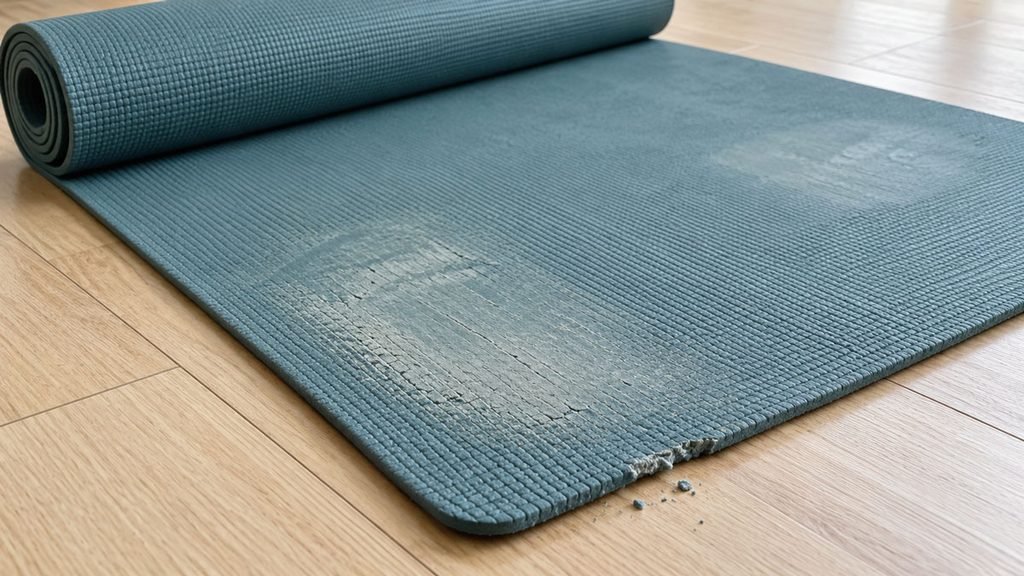
| The same hand or foot patch still slips after correct cleaning and drying | Use another mat for practice. If the worn surface remains slippery, replace it rather than keep adjusting around that patch. |
| A lasting depression where you kneel, with less cushioning than before | Choose another mat if that area stays flattened and no longer cushions your usual floor positions. |
| A tear, lifting layer, continued shedding or an edge that catches during movement | Set the mat aside for replacement or a seller’s assessment before using it again. |
| A persistent unpleasant odour or visible contamination | Set it aside and follow its care guidance. If the problem remains, ask the maker how to proceed; smell alone cannot identify the cause. |
The following checks help separate ordinary marks, cleaning problems and worn material.
Is your hand slipping, or is the whole mat moving?
Watch where the movement starts. Your palm may slide over the surface while the mat stays still. Alternatively, your hand may stay in place while the entire mat shifts across the floor.
For movement underneath, check the floor and backing for grit, moisture or cleaning residue. If a problem appears only on a different floor finish, it may be compatibility rather than the mat’s age.
For slipping on top, consider whether it happens at the start when dry, after sweating, or only on a visibly worn patch. These are different contact conditions; dry and sweaty yoga mat grip needs separate consideration. A mat that has never worked for your practice may be the wrong choice, rather than worn out.
Does a low spot remain after the mat has rested?
A knee patch can lose thickness without an obvious surface tear. Notice whether the low spot remains between sessions and whether that part now feels noticeably less cushioned during familiar floor positions.
Quick bounce-back and recovery after a sustained load are different behaviours. In EVA/nylon-elastomer footwear foams, greater short-impact rebound can coexist with poorer thickness recovery after prolonged compression.[11] That distinction helps explain why pressing a springy, unworn corner cannot answer a question about a flattened knee patch.
A persistent indentation deserves its own check. Let the mat rest as its instructions recommend, then inspect the affected area again. If the depression remains and changes the support beneath your usual contact point, choose another mat. Adding more pressure is not a useful home test.
Are those particles dirt, or pieces of the mat?
Check the surface before scrubbing harder. Dirt resting on a mat and material coming away from it need different responses. Avoid picking at an edge or pulling a loose layer to see how far it will spread.
Some surface wear depends on the model. Manduka’s eKO guidance, for example, describes local rubber wear where hands and feet repeatedly make contact and along the edges. A few particles need context; they don’t all have the same cause.
Continued shedding, a visibly thinning patch, an opening split or a lifting layer is more concerning than a stain. Tape or glue changes the practice surface, and a towel over the area leaves the damaged material underneath.
Check what changed before buying a replacement
If the mat is intact and its feel changed recently, think back to the previous session. Did you try a different cleaner? Use lotion before class? Pack it while damp? Move to a different floor?
Clean using the product’s specified method, remove residue as directed and let the mat dry. Inspect it again before returning to slow, familiar movements. This gives you a better comparison than judging the surface while it is still wet or coated with cleaner.
The cleaning method matters. JadeYoga Europe’s instructions warn against alcohol, petroleum-based solvents and unsuitable essential-oil products on its natural-rubber mats, as well as machine washing, dryers and direct sunlight. A routine intended for another mat may damage it instead of cleaning it.
Cleaning can address dirt and compatible surface residue. It cannot restore missing material, close a tear, or reattach a separating layer. If an unpleasant odour remains after the permitted cleaning and drying routine, set the mat aside and contact the maker. Covering it with fragrance won’t fix the cause.
Why two mats can wear out at different times
The number of sessions is only part of the explanation. Frequent transitions rub the same contact patches. A mat closed damp inside a bag has a different storage history from one opened and dried after class. A tight strap or hard buckle may leave a local mark that has little to do with how often you practice.
The finished material construction also matters. Two TPE mats can differ in foam structure, thickness and surface layers. A cork-topped mat has a backing, a bond between layers, and the visible cork. The first part to wear may be the surface, the cushioning underneath or a layer attachment.
Extra thickness does not promise longer life. It doesn’t indicate how well the foam will recover, whether a surface will retain grip, or how a laminate will withstand use. Compare the finished product rather than assigning a replacement date based on its material name, price, or thickness alone.
Likewise, a seller’s compression-cycle or abrasion result is evidence from a particular durability test. There is no general conversion from those cycles to years of your practice. Ask which construction was tested and what conditions the claimed lifespan assumes.
Care that helps you avoid preventable damage
Choose a care routine you can carry out between classes:
- Clear the underside before packing. Remove grit that could be pressed against the mat inside the roll.
- Use the specified cleaner and method. More scrubbing, soaking, or a stronger mixture isn’t automatically a better clean.
- Dry before closing the bag. If you have to leave with a damp mat, reopen it to finish drying at the first suitable opportunity.
- Follow the storage instructions. Keep the mat away from heat and sunlight where its maker requires that protection.
- Roll or fold it as intended. Keep straps and hard accessories from pressing deeply into the surface.
Some travel yoga mats allow folding for transport but recommend rolling them afterwards. A compact package doesn’t mean the mat can stay folded indefinitely.
Track changes in the same contact areas
Make a brief condition check part of your care routine:
- Compare under similar conditions. After cleaning and fully drying the mat as directed, unroll it on a clean, level floor. Check the same hand, foot and knee areas, as well as the underside and edges.
- Record a change you want to monitor. A dated photo or short note can help you see whether a thin patch, crack or lifting layer is growing. Do not pull at loose material to inspect it. Visible damage still needs the action described in the table above; recording it is not a reason to keep using the mat.
- Separate appearance from function. For an intact mat, notice changes in grip or cushioning during familiar movements. A faded print without those changes is different from a contact patch that stays slippery after cleaning.
Check for changes as soon as you notice them, even if you bought the mat recently. You do not need to wait for an annual replacement date.
Before you throw it away: check the warranty and disposal options
Unexpectedly early damage is worth discussing with the seller before you cut, glue, or otherwise alter the mat. Keep the receipt, model and care history. Photograph the whole mat and the affected area, and ask whether the seller needs the product for assessment.
A lifetime guarantee has its own terms. Manduka’s US PRO Series guarantee, for example, describes approximately ten years of regular use with proper care, subject to its stated conditions and exclusions. That applies to the specified models and US terms—not every PVC mat, every Manduka range or every country of purchase. Warranty coverage is not a reason to keep practising on a damaged mat.
For disposal, ask your local waste service or a current take-back scheme whether it accepts the complete construction. A rubber or cork label does not establish that the whole mat belongs in household recycling or compost. In England and Northern Ireland, Recycle Now’s local collection guidance can help you find the relevant service; elsewhere, check your own local arrangements.
Reuse depends on the mat’s condition and its new purpose. Do not pass a shedding, contaminated or unstable mat to someone else as usable yoga equipment.
Frequently asked questions
Not automatically. Check its condition and any model-specific replacement advice. A purchase anniversary does not make an intact mat unusable, and a damaged mat may need replacing much sooner.
No. First, check for moisture, residue, and movement on the underside. If the same worn contact area still slips after proper cleaning and drying, use another mat instead of practising on it.
An extra layer cannot repair a torn top surface or separating bond. It also adds another surface that may move. A topper designed for that use works differently from trying to cover damage with a second mat.
Storage still matters. Check both faces and the edges when you take it out, especially after heat, sunlight, damp storage, or prolonged folding. Look for cracking, sticking, lifted layers, or folds that catch when you move it.
It is a reason to set the mat aside and investigate. Follow the model’s care guidance; if the odour persists, ask the maker about the next step. Smell alone cannot identify contamination or chemical exposure.
Choose the next mat around what wore out
If hand patches became slippery during sweaty classes, compare grip under those conditions. If a knee area stayed flattened, pay attention to support in your usual floor positions. If drying was always difficult, check the care routine before choosing another model with the same requirements.
When comparing NEEU’s yoga mat options, start with the practice and care routine the mat needs to handle. For a studio or private-label program, record those requirements and acceptable wear in the finished-sample approval so the sample, instructions and purchasing brief agree.
- Huang, G., Gui, Y., Li, Y., et al. Preparation and Characterization of EVA/Nylon Elastomer Microcellular Foaming Materials. China Plastics. 2021;35(9):1–7. The comparison focused on chemically foamed EVA/PEBAX cushioning formulations for footwear. The study measured recovery after compressing to 50% of the original thickness for 72 hours, then resting for 2 hours. Ball rebound was measured separately. These results do not establish yoga-mat service life. ↩︎