
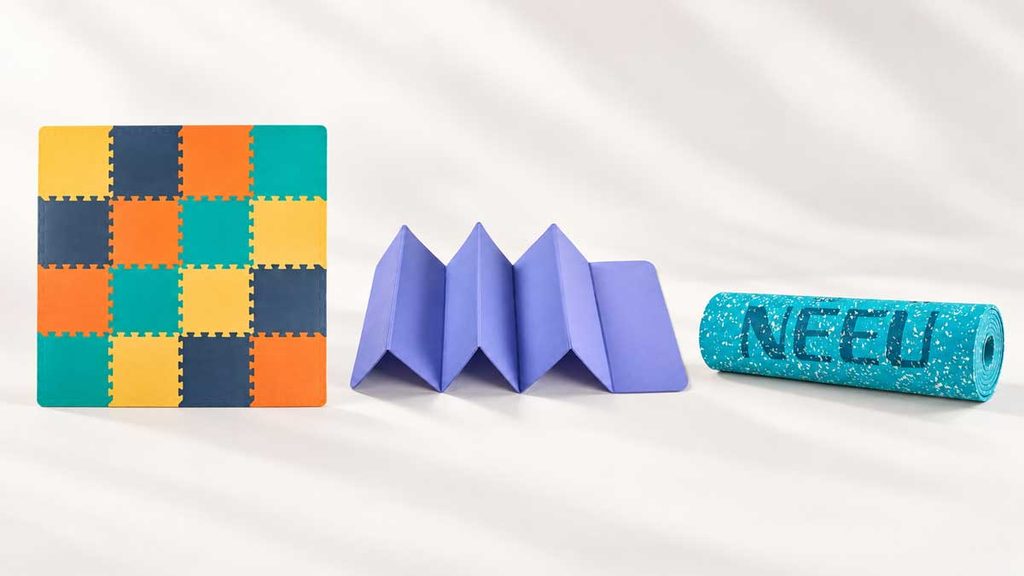
A mat may fit the floor perfectly and still be awkward to store or carry. For brands, importers, and facility buyers, choosing a format means considering the whole routine: delivery, installation, use, cleaning, and putting the mat away.
Choose interlocking mats for adjustable coverage and replaceable sections. Choose foldable mats when a fixed-size mat needs to fit on a shelf, in a cupboard, or in a bag. Choose roll mats when a continuous surface and cylindrical storage suit the application. Cushioning, grip, and durability still depend on the actual construction.
How often the mat moves is a useful place to start. A floor mat left in place for months can justify assembly work that would become inconvenient in a room cleared every evening.
Interlocking vs Foldable vs Roll Mats at a Glance
| Decision | Interlocking mats | Foldable mats | Roll mats |
|---|---|---|---|
| Installation | Connect separate tiles; finish the perimeter | Unfold connected sections | Unroll; join adjacent lengths if the layout requires it |
| Coverage | Adjustable using compatible tiles | Usually a defined open footprint | Defined finished size, or usable width and length for a supply roll |
| Storage | A stack of tiles plus border pieces | A rectangular stack | A cylinder |
| Carrying | Several pieces or bundles to keep together | One connected product; check bulk and handle position | One roll; check length, diameter and restraint |
| Local replacement | A compatible tile can be replaced | Usually the whole mat unless repairable panels are provided | Usually the whole portable mat, or a repairable installed section |
| Detail to inspect | Joints, intersections and border fit | Hinges, creases and panel alignment | Edge curl, winding marks and any backing cuts |
| Main trade-off | Layout flexibility adds assembly work | Compact folding concentrates bending at defined locations | Fewer surface interruptions can mean a long storage package |
Interlocking Mats for Adjustable Layouts and Tile Replacement
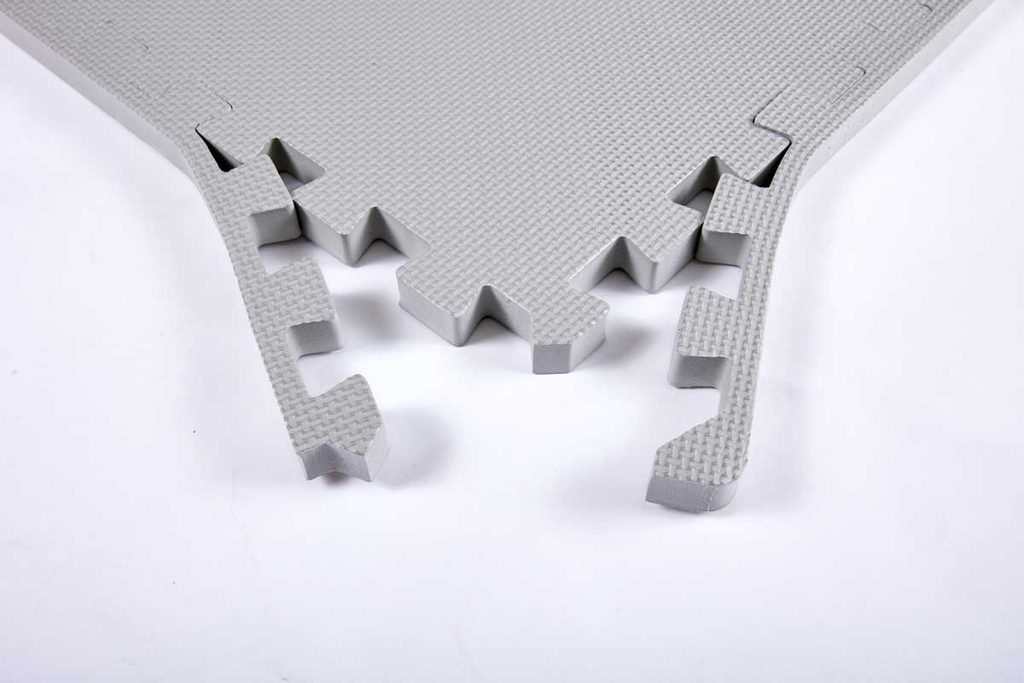
Interlocking foam mats let buyers assemble a floor from smaller units. They suit modular retail sets, spaces with obstacles, and installations where replacing a damaged section matters.
Compatible tiles let you expand the area or remove a section for access. Perimeter tiles can be trimmed where the product’s installation instructions allow, but columns and irregular outlines still require a cutting plan and create offcuts.
The handling work depends on how often you dismantle the floor. Connecting tiles for a long-term installation is different from collecting, counting, and stacking them after every session. A trial with the full set, including border pieces, shows how much time this takes and whether you can store all the pieces together.
Replacement requires a matching connection
Two tiles described as the same size and thickness may have different tooth profiles or spacing. Retain the approved profile, orientation, and thickness in the purchasing record, along with sample pieces for checking replenishment orders. The same product name alone does not establish compatibility.
Fit also depends on dimensional stability and measurement conditions. Compare replacement tiles with retained pieces under the same conditions before approving their use in an existing floor.
If future expansion is part of the selling proposition, agree how profile changes will be communicated and whether spare tiles should be ordered with the initial batch. New pieces may fit mechanically but look different next to worn or faded ones.
Foldable Mats for Shelves, Cupboards and Travel Bags
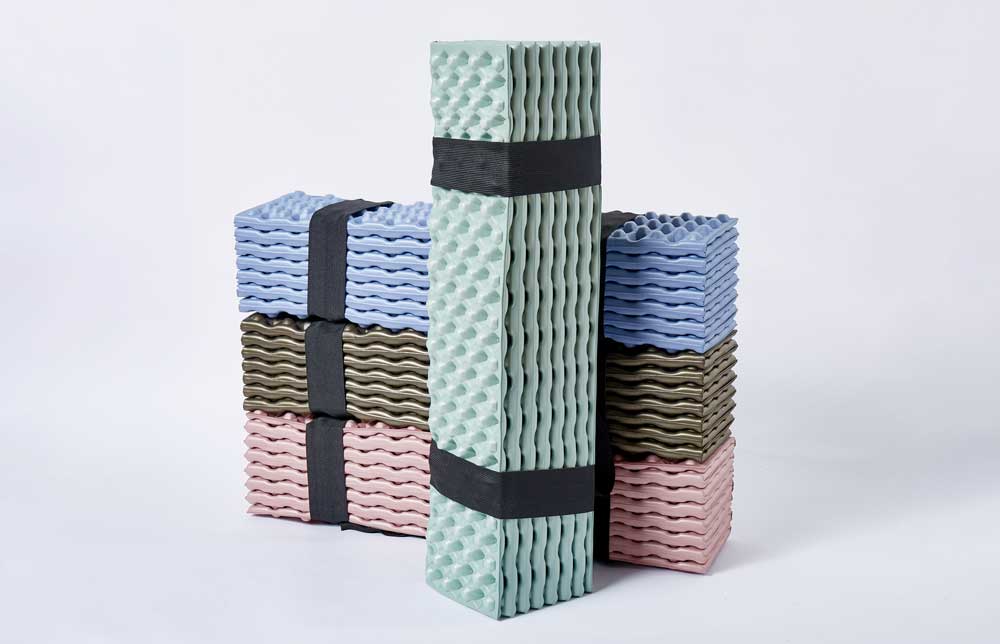
Foldable mats keep connected sections together as the product opens and closes. That can suit a play area cleared each evening, an exercise mat stored on a shelf, or a travel mat designed to fit inside a bag.
The storage opening often sets the limit. A folded mat can have a small footprint but still be too thick for a cupboard. Its finished folded length, width, and height must account for closures or handles, with enough clearance to put it away comfortably.
More folds can shorten a package, but they also add bending locations and steps to the folding sequence. A thin folding yoga mat, a scored foam play mat and a covered panel exercise mat achieve that movement differently. The supplier should identify what forms the hinge and which surface or cover layers cross it.
Follow the mat from use to storage
A full-size sample reveals details that folded dimensions cannot. Open it in the intended sequence and look for raised folds that could interfere with the activity. Folding, fastening, and carrying the complete product to its storage space then shows whether the handle or bag is practical under load.
The folding pattern also determines which faces touch. Some arrangements bring the floor-contact face against the user-contact face; others keep them apart. That affects the care routine and may matter more to the customer than an extra fold.
For printed products, inspect the design both open and folded. Important graphics can land on a crease, disappear inside the stack, or face the wrong way in the retail pack.
Roll Mats Need Space for Their Rolled Length
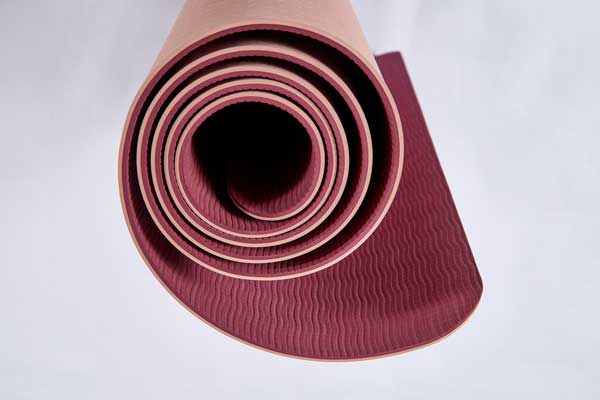
Roll mats include finished portable mats and longer rolls supplied for cutting or installation. Establish which product is being quoted before comparing prices or handling requirements.
A finished roll-up mat can provide an uninterrupted upper face without loose tiles. A wider installation roll can reduce the number of joints in a suitable room layout, although adjacent rolls, doorways and columns may still require seams and cuts.
Some rollable sports mats have cuts in the foam backing to help them bend, as illustrated by Dollamur’s FLEXI-Roll construction. Therefore, inspect both faces and the layer arrangement; the rolled shape alone tells little about how the product is built.
Flatness after storage determines when the mat is ready to use
A sample lying flat does not show what a customer receives after weeks in a roll. If the mat must be usable immediately, assess end lift, edge curl and surface marks as soon as it is unpacked, then again after any agreed rest period.
To make the result useful, record how the sample was stored: winding direction, core or inner diameter (where applicable), restraint, storage conditions, and elapsed time before inspection. These details give the supplier and buyer a common basis for judging flatness.
Any instructions for reverse rolling or changing the roll diameter must suit the finished layers. They should not be prescribed as a universal cure for curl. Carrying and storage need a separate check: a narrow cylinder can still be too long for a cupboard or awkward on stairs and inside a small vehicle.
Compare Usable Coverage on the Same Basis
Net coverage is the area the finished layout actually covers. The purchasing unit may be a tile, a set, one mat or a linear meter, so headline dimensions alone can make offers difficult to compare.
For interlocking sets, confirm the assembled length and width with the supplied borders. A tooth-to-tooth tile measurement is not necessarily the distance each additional tile adds to the grid. For foldable mats, confirm the full open footprint and whether edge or hinge details affect the usable area. For rolls, confirm usable width and length, along with any trimming or joining allowance required by the layout.
A floor installation calls for a comparison at equivalent coverage. A retail range calls for a comparison of complete saleable units, including the accessories customers need. A tile set and a single folding mat can be valid alternatives even when their pack contents differ, provided those differences are visible in the quotation.
Once you shortlist a format, use the intended layout to confirm tile quantities, border requirements, and cutting allowances before placing the order.
Separate Material Performance From Format
A fair format comparison starts with products intended for the same activity. Differences in foam, thickness or surface layers can otherwise be mistaken for an advantage of folding, rolling or interlocking construction.
A springier feel, for example, does not, by itself, indicate greater support. In irradiation-crosslinked EVA blended with an olefin block copolymer, selected blend proportions increased rebound and tear strength while reducing compressive strength relative to the EVA foam control.[11] That is why foam rebound and cushioning need separate assessment: a rebound percentage cannot stand in for impact response or support under load.
For applicable flexible closed-cell olefin foams, ASTM D3575 provides material test procedures whose results apply to the particular test conditions. These material checks should sit alongside inspection of the finished hinge, tile connection or rolled laminate. Where the intended activity involves falls, landings or heavy equipment, the finished system needs evidence for that application; format and thickness alone cannot establish protective performance.
Portability also needs assessment on the complete product. Folding and rolling reduce or rearrange stored dimensions without removing material mass. Finished weight, bulk, grip, and carrying distance determine whether the customer can comfortably move the mat.
Cleaning Access Can Change the Preferred Format
The joints and folds that make a mat convenient to handle also affect cleaning access. Tiles let you lift individual sections, but spills may pass through joints onto the floor. Folding mats need attention at creases and covered edges. A one-piece roll mat may reduce joints while being harder for one person to lift and dry underneath.
Include the underside in the care routine, and let the mat dry as directed before closing or securing it for storage. Instructions must match the actual surface, print, and backing; a closed-cell foam core does not make every finished assembly watertight or suitable for soaking.
For a room cleared daily, cleaning and storing a full-size sample is part of the handling trial. A small swatch cannot show whether one person can manage the complete mat.
Compare Packaging Using the Finished Pack
Open dimensions show the usable area. Stored dimensions show whether the mat fits its cupboard, shelf or bag. External shipping-package dimensions determine how much transport space the packed product occupies. Request all three.
Tiles can stack into rectangular packs but need space for borders. Folding mats may fit in a shorter carton but create a thicker stack. Rolls occupy a cylindrical envelope, plus space for the core, restraint, and protective packaging where used. The finished pack establishes which option uses space most efficiently for the order.
Ask each shortlisted supplier for the same packing information:
- External carton dimensions and gross weight.
- Complete mats or saleable sets per carton.
- Usable coverage per mat or set.
- Included borders, straps, bags and protective packing.
- Pallet arrangement or proposed container loading plan.
For an area-based order, compare packed volume per usable square meter. For retail, compare packed volume and shipping cost per complete saleable unit. Calculate carton volume by multiplying external length × width × height (in meters), then divide by the relevant quantity or coverage.
For parcel delivery, a light but bulky package may be charged by dimensional weight. Confirm the applicable service and rate rules for the route before using carton size to estimate delivery cost.
Container loading also depends on carton orientation, permitted load, stacking, and securing. The IMO/ILO/UNECE CTU Code provides cargo-packing guidance; an agreed loading plan establishes the shipment quantity more reliably than a volume estimate alone.
Reopen a production-equivalent pack before approving the packing arrangement. Any saving from tighter folding, winding, or stacking must leave the mat acceptable after unpacking.
Use Samples to Make the Final Choice
Shortlist formats against the customer’s routine, then compare full-size samples at the required coverage. Record their materials and thicknesses alongside the handling results so that the reasons for choosing a product remain clear.
| Format | Trial to include | What to record |
|---|---|---|
| Interlocking | Assemble, use as intended, separate and restack | Joint fit, movement, damaged teeth, border completeness and handling time |
| Foldable | Open, use, fold, carry, store and reopen | Raised folds, hinge damage, alignment, closure fit and folded dimensions |
| Roll | Unroll, use, reroll, secure, store and reopen | Flatness at stated intervals, curl, surface marks, rolled dimensions and carrying effort |
Agree the conditions, repetitions and acceptance rules before comparing results. These practical trials support product selection; they do not establish a universal durability standard or translate directly into years of service. Where repeated handling is a purchase requirement, specify relevant compression, tear or abrasion tests alongside the opening and storage trials.
Record the selected construction, dimensions, packing arrangement and accepted results in the foam mat sample approval checklist. You can then check subsequent production against the agreed sample and specification.
Frequently Asked Questions
A foldable or roll-up mat is a useful starting point because it remains one connected product. Compare the actual storage opening, packed bulk, and lifting effort. Tiles can still work if several smaller bundles are easier to handle, as long as daily assembly is acceptable.
Only if that construction is designed and approved for folding. A sharp fold may leave a crease or damage a surface layer. For a roll-fold hybrid, check both storage methods and their instructions.
Compare equivalent coverage or complete saleable units, including accessories, packaging, delivery and installation work. Also consider whether you can replace a damaged section. There is no reliable cost ranking based on format alone.
Do not assume so. Matching nominal size and thickness does not establish matching tooth shape, spacing, or border geometry. Confirm compatibility by assembling the actual pieces.
Compare Mat Formats With NEEU
Send your intended use, required open dimensions, storage-space limits, target order quantity and packaging requirements. Include a floor plan if modular coverage matters, or the cupboard, shelf or bag dimensions if the product will be stored after each use.
Compare mat formats with NEEU and request suitable sample options before finalizing your specification.
Reference
- Fu, D., Xu, J., Cai, Q., Li, G., Zhong, J., and Wang, G. (2024). Preparation and properties of cross-linked EVA/OBC foam materials. China Elastomerics, 34(6), 49–54. DOI: 10.16665/j.cnki.issn1005-3174.2024.06.007. The cited comparison concerns chemically foamed, irradiation-crosslinked EVA/OBC specimens; it does not compare finished mat formats. ↩︎