
A foam mat can feel supportive when new, but it may develop a lasting dent after weeks of use under equipment, furniture, or stacked cartons. That does not automatically mean the mat was too soft or too thin. The missing specification may be compression set: the amount of deformation that remains after the foam has been compressed for a defined time and then allowed to recover.
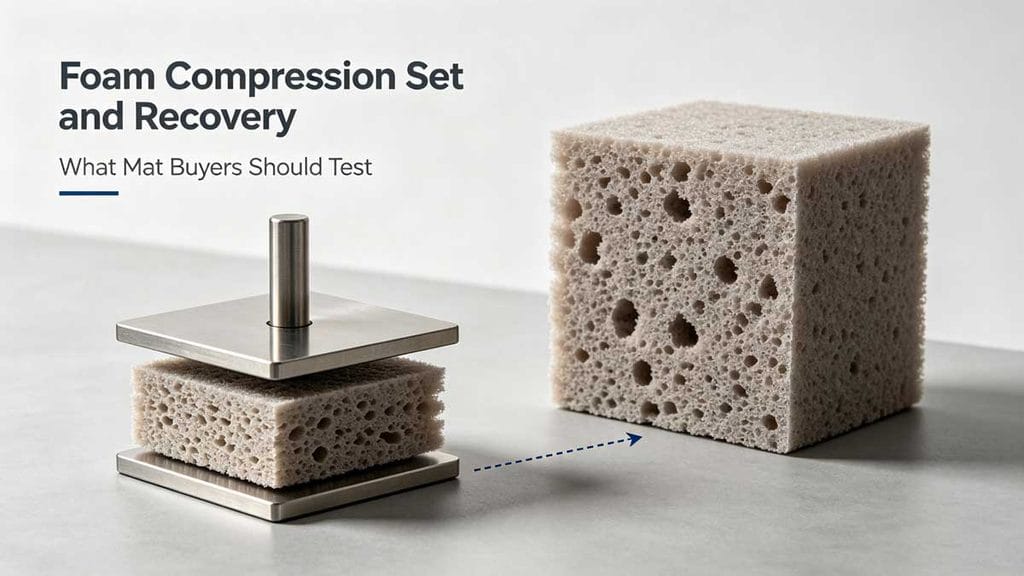
For buyers, the useful question is not simply, “Will this foam bounce back?” It is:
After a stated load or deflection, at a stated temperature and duration, how much thickness does the finished mat recover within a stated recovery period?
That question can be tested. It also creates a requirement that a supplier, a laboratory, and an inspection team can interpret in the same way.
Quick answer: why does a foam mat stay dented?
A persistent indentation develops when part of the foam does not return to its original shape after compression. Polymer chains can rearrange, cell walls can bend or buckle, cells can be damaged, and a laminated construction can restrict or distort recovery. Time, temperature, and concentrated loading make these effects more demanding.
Some impressions are temporary. A mat compressed in a carton may continue recovering after unpacking. Other dents remain because the cellular structure or polymer network has taken an irreversible set. Visual inspection alone cannot reliably distinguish the two. Record the loading history, measure the mat at fixed recovery intervals, and compare the result with an agreed reference sample.
What is foam compression set?
Compression set expresses the deformation that remains after a specimen has been held under compression and released. In a common constant-deflection calculation:
Compression set (%) = (original thickness – recovered thickness) / (original thickness – compressed thickness) x 100
The compressed thickness is typically determined using a spacer or another defined test arrangement. Under the same method and conditions, a lower compression-set result generally indicates that the specimen recovered more of the imposed deflection.
The percentage is meaningless without the test conditions. A result should travel with, at minimum:
- the standard and test-method version;
- specimen construction and dimensions;
- percentage deflection or applied force;
- compression time and temperature;
- recovery time and recovery temperature;
- measurement procedure and number of specimens.
A supplier saying “compression set: 8%” has not provided a comparable specification if those details are missing.
Compression recovery is related, but the formula may differ
Some reports report compression recovery or thickness recovery rather than compression set. One possible calculation is recovered thickness divided by original thickness. Another protocol may report the percentage of imposed deformation recovered. Because the denominators can differ, recovery and compression-set figures are not automatically mathematical opposites.
Write the formula into the test request. A high recovery percentage usually sounds favorable, while a low compression-set percentage usually sounds favorable, but neither can be compared across reports until the methods and conditions match.
Compression set is not rebound, hardness, or density
These measurements describe different parts of foam behavior.
| Property | The question it answers | What it does not prove |
|---|---|---|
| Compression set | How much deformation remains after prolonged compression and a defined recovery period? | Dynamic impact response or lifetime under repeated use |
| Thickness recovery | How much thickness returns after a stated compression history? | A universal pass-or-fail result unless the formula and conditions are defined |
| Rebound resilience | How energetically does the material return energy during a short impact? | Recovery after hours or days under static load |
| Hardness | How strongly does the surface resist indentation under a specified device and procedure? | Long-term resistance to a retained dent |
| Density | How much mass exists per unit volume under a stated basis? | Hardness, recovery, or durability by itself |
| Cyclic compression or fatigue | How does performance change through repeated loading? | The result of a long, uninterrupted static load unless that condition is included |
The distinction matters in product development. A lively ball rebound can coexist with disappointing recovery after prolonged compression. A firm foam can still retain an equipment-foot mark. A thick mat provides the product with more deformation distance, but it does not guarantee that the material will return to its original thickness.
For separate guidance on initial feel and product geometry, see NEEU’s guide to foam mat hardness and thickness.
What material research tells buyers about recovery
Published foam studies help explain why one number cannot stand in for another.
A 2021 study of compression-molded EVA/PEBAX foams measured both ball rebound and recovery after specimens were compressed to 50% of their original thickness for 72 hours and then allowed to recover for 2 hours. In that formulation series, adding PEBAX could increase rebound while reducing compression recovery.[1] The practical lesson is not that PEBAX is unsuitable for mats. It is that short-impact rebound and recovery after a long dwell load can move in different directions.
Research on EVA/POE/EPDM and EVA/EPDM/OBC foam blends also found that formulation, crosslinking conditions, compatibility, and cell-wall structure affected compression-set behavior.[2][33] These are controlled formulation studies, not universal rankings of commercial EVA mats. Their value for a buyer is more modest and more useful: finished recovery must be tested; it cannot be predicted from the word EVA, a density figure, or a hardness reading alone.
The same caution applies to closed-cell language. A predominantly closed-cell construction may support moisture resistance and cushioning, but closed cells do not guarantee low compression set. Polymer choice, blend compatibility, crosslinking, cell size and distribution, skin, lamination, and processing history all contribute to the finished response. NEEU’s foaming process overview shows where the cellular structure forms during production.
Why persistent dents develop
1. The load remains in place for too long
A treadmill foot, storage rack, or furniture leg can hold one area under compression for days or months. Even if the overall equipment weight seems reasonable, a small contact area produces a concentrated local pressure. A broad body-weight load and a narrow equipment foot are not equivalent test conditions.
2. Heat accelerates material change
Compression at elevated temperature is usually more demanding than compression at room temperature. A mat may encounter warm containers, warehouse heat, direct sunlight through a window, or heat from equipment. Test temperature therefore belongs in the specification rather than in a laboratory’s unstated default.
3. The cells or cell walls cannot sustain the imposed strain
During compression, cell walls bend, and the gas-containing structure changes shape. If the imposed strain is too severe, cell walls may buckle, rupture, or fail to return to their original geometry. The visible result can be local thinning, a dish-shaped dent, or a broad flattened area.
4. The polymer network and formulation are not balanced for the use
The base polymer, blend components, crosslinking state, additives, and foaming conditions interact. More crosslinking is not automatically better: insufficient and excessive network formation can both create processing or recovery problems. The right formulation is the one that meets the complete finished-product requirement under controlled production conditions.
5. A surface layer changes the finished-mat response
Films, printed skins, textiles, coatings, adhesives, and laminated backings can constrain recovery or hide core deformation. A foam coupon may pass while the finished mat creases, delaminates, or recovers unevenly. Test the construction of the customer’s unit.
6. Packaging creates a different compression history
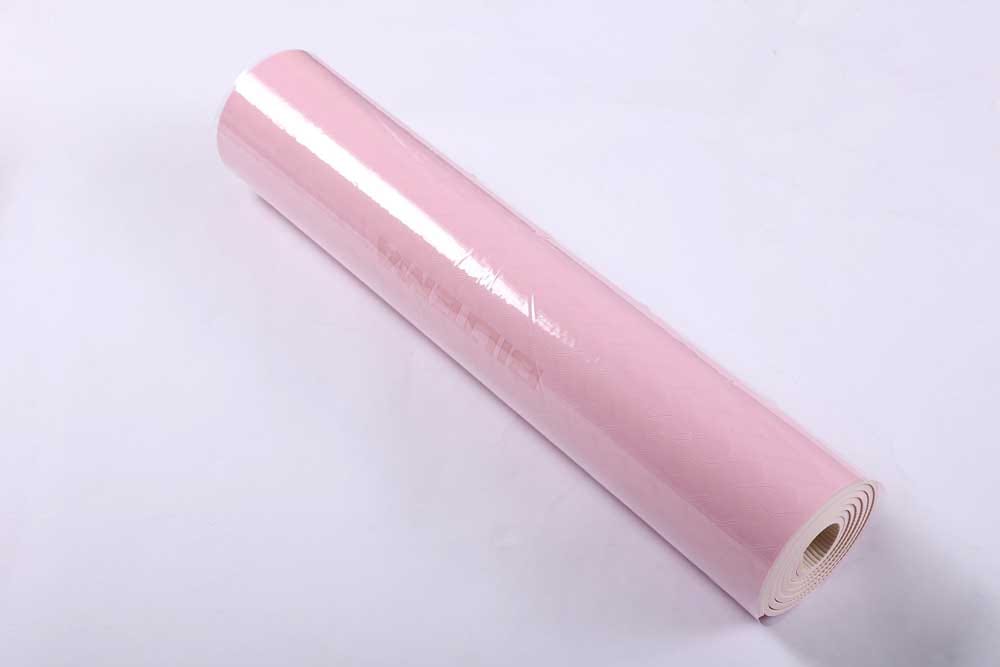
Rolled, folded, strapped, vacuum-packed, or tightly stacked mats can arrive with temporary marks or curl. Packaging recovery should be assessed separately from product-use compression because the contact pattern, duration, and temperature are different.
Select a test method that fits the material and the buyer’s question
There is no single compression-set protocol for every mat construction. The purchaser and supplier should agree on the method before samples are approved.
ASTM D3575 for flexible closed-cell olefin foam
ASTM D3575-20 applies to flexible closed-cell materials made from olefin polymers or olefin-polymer blends. ASTM states that results apply to the conditions of the particular test and may not reproduce behavior in other environments or service conditions. This makes it a relevant starting point for many discussions on EVA and polyethylene foam, but it does not provide a universal limit for mat acceptance.
ASTM D395 or ISO 815-1 for rubber materials
ASTM D395-18(2025) and ISO 815-1:2019 address compression set in rubber materials. They may be relevant to vulcanized rubber or thermoplastic-rubber constructions when their scope matches the product. They should not be assigned to an EVA or XPE mat merely because another supplier used them on a different material.
ISO 1856 has a narrower stated scope
ISO 1856:2018 specifies compression-set methods for flexible cellular materials, but its published scope identifies latex and polyurethane foams thicker than 2 mm. Check material applicability before placing it on an EVA, XPE, or multilayer mat specification.
Compression curves provide complementary information
ASTM D8626/D8626M-25 covers compression properties of open- and closed-cell flexible cellular materials. Loading and unloading curves can show elastic and viscoelastic response and hysteresis. That information can help compare how foams carry and release a load, but it does not replace a long-dwell compression-set test when the buyer’s complaint is a retained indentation.
Build a test around the real failure mode
A standards-based test supports comparison and quality control. An application simulation checks whether the product survives the situation that matters to the buyer. Many projects need both.
Step 1: define the dent scenario
State where the problem occurs and what creates it:
- a gym machine or furniture foot left in place;
- stacked product during warehouse storage;
- roll tension or straps during shipping;
- kneeling and body-weight loading;
- repeated exercise or repeated assembly;
- fold lines in a portable mat.
Record the contact area, approximate force, duration, temperature, floor support, and acceptable visual change. “Heavy use” is not a reproducible condition.
Step 2: Test the finished construction
Identify whether specimens come from the molded foam, the center of a finished tile, an embossed area, a fold panel, or a laminated product. Avoid beveled edges, puzzle teeth, and fold lines unless those features are the subject of the investigation. If the surface and core behave differently, test and report them separately.
When sourcing EVA foam mats, compare the proposed production construction rather than treating all EVA formulations as one grade.
Step 3: Lock the conditioning and measurement procedure
Specify pre-test conditioning, original-thickness measurement, deflection or force, dwell time, temperature, and post-release recovery time. Use the same support plates and measurement pressure across suppliers. Measure at defined intervals if the recovery curve matters, rather than selecting whichever reading looks most favorable.
Step 4: Use enough locations and specimens
A single cut piece cannot show the uniformity of a sheet, roll, or molded tile. Sample multiple positions and, for important programs, more than one production batch. Record individual results as well as the average; a good average can conceal one weak location.
Step 5: Set acceptance criteria before the test
A test method explains how to produce a result. It does not necessarily tell a buyer which result is acceptable for a yoga mat, play mat, interlocking tile, or equipment mat. Establish the limit from the application, a validated incumbent product, retailer requirements, and sample development. Keep the method and limit together in the purchase specification.
A practical compression-recovery test brief
The following format can be used when sending an RFQ or sample request. Replace the brackets with project-specific values.
| Field | Requirement to define |
|---|---|
| Product | [Finished tile, roll mat, foldable panel or laminated mat] |
| Material and construction | [Polymer/blend, skin, film, textile, coating, adhesive and backing] |
| Specimen source | [Finished-product location and cutting orientation] |
| Test method | [Standard, year/version and method designation] |
| Original thickness | [Nominal value, measurement procedure and tolerance] |
| Compression condition | [Constant deflection percentage or stated force/contact area] |
| Dwell condition | [Time and temperature] |
| Recovery condition | [Time, temperature and support condition after release] |
| Calculation | [Compression-set or recovery formula] |
| Sampling | [Specimens per location and production lots] |
| Acceptance rule | [Maximum set, minimum recovery and treatment of individual failures] |
| Appearance after recovery | [Dent, cracking, whitening, delamination, curl or surface change] |
| Change control | [When formula, material, process, or plant changes require retesting] |
Do not fill this table with a copied competitor value. First, establish what loading the mat must withstand and whether the proposed protocol accounts for it.
Diagnose a dent before changing the specification
| Observation | Likely question to investigate | Useful next check |
|---|---|---|
| Marks immediately after unpacking | Was the mat compressed, rolled, or strapped too tightly? | Measure recovery at fixed intervals; repeat a controlled pack-out trial |
| Dent only under a narrow equipment foot | Is the local pressure much higher than the general floor load? | Representative point-load test with the actual contact area |
| Broad loss of thickness | Did time, heat, or excessive deflection affect the cellular structure? | Standardized compression set plus temperature-conditioned comparison |
| Good ball rebound but poor long-dwell recovery | Are short-impact response and static recovery being confused with each other? | Report rebound and compression set as separate properties |
| Uneven recovery across a tile or sheet | Is there a process, thickness, or cell-structure variation? | Multi-location sampling and batch comparison |
| Surface creasing or delamination | Is the finished layer restricting or separating from the core? | Test the laminate and inspect adhesion after compression |
| Gradual change after repeated workouts | Is cyclic fatigue the dominant mechanism? | Cyclic compression or application simulation, not static set alone |
Increasing hardness is not an automatic fix. It may change initial feel without resolving cell damage, formulation compatibility, heat exposure, packaging pressure, or a concentrated load. Start with the failure mode, then decide whether the material, thickness, hardness, surface construction, packaging, or use instructions need to change.
From sample approval to production control
Compression recovery should not exist only on a prototype report. For a repeat order, connect the approved result to the exact material construction, formulation revision, production location, and lot.
A practical control plan can include:
- an approved finished sample and signed specification;
- original thickness and specimen-location rules;
- the agreed compression-set or recovery protocol;
- production-lot identification and test records;
- retesting triggers after material, formulation, process, or construction changes;
- packaging trials when shipping compression is a known risk.
NEEU’s foam mat quality-control overview explains how incoming, in-process, and finished-product checks can be connected to an approved product requirement. A laboratory result does not replace routine inspections of dimensions, appearance, fit, surface, and packaging; it answers one specific performance question.
Frequently asked questions
Under the same test method, specimen construction, and conditions, a lower result generally means less retained deformation. Results from different methods, temperatures, dwell times, deflections, or recovery periods should not be ranked directly.
There is no universal recovery time. Some deformation returns quickly, while viscoelastic recovery continues more slowly. Define measurement intervals that fit the product scenario, and use the same intervals for all comparisons.
No. Density is useful for material identification and production consistency, but compression set also depends on polymer structure, formulation, crosslinking, cells, thickness, temperature, and loading history. Test recovery directly.
No. Rebound measures a short dynamic response. Compression recovery measures the dimensional return after a specified period of compression. A foam can perform well in one and less well in the other.
Use core specimens for material-development work when necessary, but approve the finished construction. Embossing, skins, films, textiles, adhesives, and backings can change recovery and appearance.
No. The closed-cell structure alone does not determine compression-set performance. The polymer system, cell-wall structure, process, product thickness, and test conditions still matter.
Not as the only test. A long static point load and repeated exercise loading are different service conditions. Use a long-dwell set or point-load test for static marks and a cyclic method when repeated loading is also important.
Turn “bounce back” into a measurable requirement
When a mat retains a dent, changing density, hardness, or thickness without diagnosing the cause can create a second problem while leaving the first unresolved. Define the load, contact area, duration, temperature, and acceptable recovery. Then compare the finished samples using a single written method.
Planning an EVA, XPE, or multilayer mat program? Discuss your compression and recovery test brief with NEEU. Include the product format, intended load, dimensions, material preference, packaging method, target market, and any incumbent sample you want to match.
Selected technical references
- Huang, G., Gui, Y., Li, Y., et al. “Preparation and Characterization of EVA/Nylon Elastomer Microcellular Foaming Materials.” China Plastics, 35(9), 2021, 1-7. https://doi.org/10.19491/j.issn.1001-9278.2021.09.001 ↩︎
- Xu, J., Zhao, W., Huang, C., et al. “Preparation and Properties of Radiation Cross-Linked EVA/POE/EPDM Foaming Material.” Plastics, 49(6), 2020, 21-24. ↩︎
- Xing, E., Su, Q., Zou, C., et al. “Crystallization Behavior of EVA/EPDM/OBC Blends and Structure and Properties of Their Foamed Materials.” China Synthetic Resin and Plastics, 42(2), 2025, 66-71. https://doi.org/10.19825/j.issn.1002-1396.2025.02.15 ↩︎
- ASTM International. ASTM D3575-20, Standard Test Methods for Flexible Cellular Materials Made from Olefin Polymers.
- ASTM International. ASTM D395-18(2025), Standard Test Methods for Rubber Property – Compression Set.
- ASTM International. ASTM D8626/D8626M-25, Standard Test Method for Compression Properties of Flexible Cellular Materials.
- International Organization for Standardization. ISO 1856:2018, Flexible Cellular Polymeric Materials – Determination of Compression Set.
- International Organization for Standardization. ISO 815-1:2019, Rubber, Vulcanized or Thermoplastic – Determination of Compression Set – Part 1.