
Yoga Mat Materials Compared: PVC vs TPE vs Rubber vs Cork for B2B Buyers
Choosing a yoga mat material is not a matter of finding one universal “best” option. For a wholesale, private-label, studio, or retail program, it is a specification decision: the material route affects target price, hand feel, cushioning, surface design, finished weight, packaging, care instructions, and the evidence a buyer may need for the destination market.
This guide compares four widely discussed yoga-mat material routes — PVC, TPE, natural rubber, and cork-based constructions — from a B2B sourcing perspective. It helps buyers create a clearer brief before sampling, rather than relying on broad claims such as “eco-friendly,” “non-slip,” or “non-toxic.”
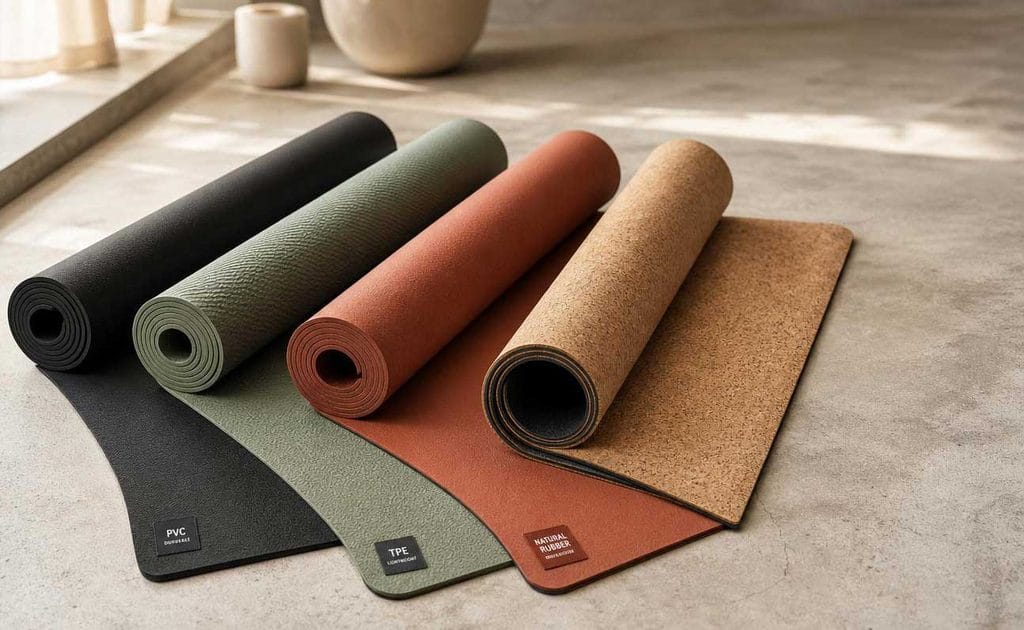
Quick answer: PVC and TPE are widely used routes for volume yoga-mat programs because they can support different price, texture, thickness, and presentation requirements. Natural rubber and cork-based constructions can suit more specific market positions, but their final performance, care requirements, availability, and compliance documentation must be evaluated on the exact finished construction.
Start with the product brief, not the material name
Before comparing material names, define what the finished yoga mat must do. A useful buying brief covers the following questions:
| Decision area | Questions to settle before sampling |
|---|---|
| Product position | Is the range value-led, mid-market, premium, studio-focused, travel-focused, or home-fitness-focused? |
| Intended practice | Will users mainly practice general yoga, stretching, Pilates, heated classes, or a mix of fitness? |
| Grip requirement | Do you need dry grip, moisture management, floor stability, or a combination? |
| Support and feel | What thickness, density, firmness, and compression recovery do you need? |
| Surface direction | Is the surface embossed foam, a laminated layer, a fabric-like top, or another construction? |
| Market and documentation | Which destination market, retailer, age group, chemical requirements, and declarations apply? |
| Commercial format | What are the target price, MOQ, size, rolled diameter, pack format, and carton requirements? |
Material is one input to those decisions. It does not determine every outcome on its own. Top-surface texture affects skin contact and grip; the core affects cushioning and recovery; the underside affects floor stability; and packaging affects freight efficiency and retail presentation.
Yoga mat material comparison at a glance
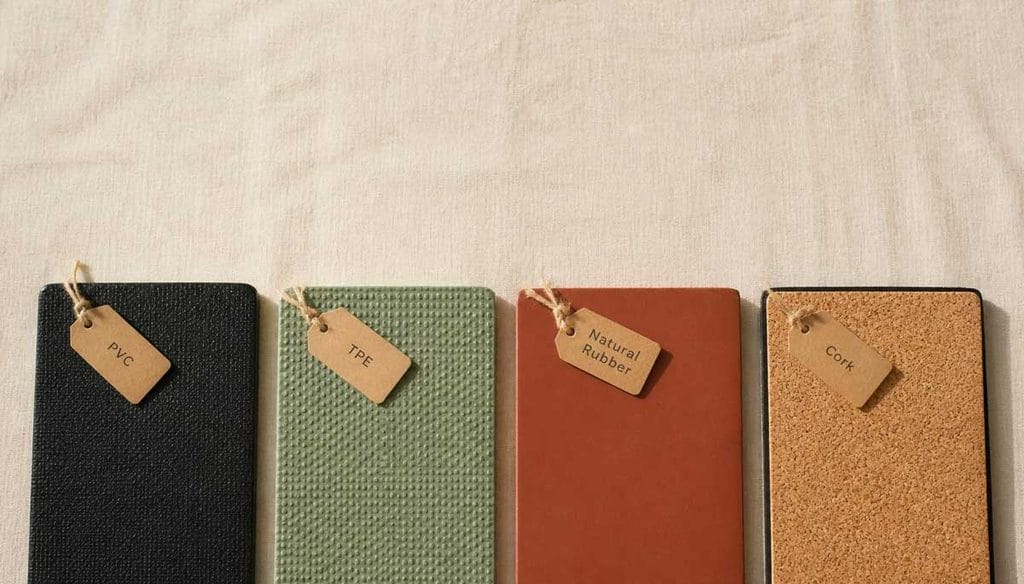
Most yoga mats are made from a few core materials, and knowing how a mat is made tells you almost everything about how it will feel. The most common are PVC (polyvinyl chloride), TPE (thermoplastic elastomer), natural rubber, and cork, sometimes combined with jute, cotton, or a polyurethane top layer. Each material sits somewhere on a spectrum of grip, cushion, durability, weight, and environmental impact.
For buyers, this is where material knowledge pays off. As a manufacturer, HRD Mat produces yoga mats in TPE, PVC, natural-rubber, and cork constructions, so the “right” material becomes a deliberate spec decision—matched to a target price point and use case—rather than whatever a factory happens to stock.
| Material route | Typical B2B position | Potential strengths to assess | Buyer trade-offs to assess |
|---|---|---|---|
| PVC | Value to volume retail, studio, and general-use programs | Durable construction options, broad texture choices, practical cleanability, cost control | Formulation and documentation scope, weight, product positioning, end-of-life story |
| TPE | Mid-market and design-led foam mat programs | Low-bulk constructions, color and texture flexibility, layered or reversible concepts | Exact blend, density, recovery, surface wear, and the evidence behind any recycling claim |
| Natural rubber | Premium or specialized performance positioning | Dense feel and material story for selected constructions | Weight, odor, latex sensitivity, care requirements, and supply consistency |
| Cork-based construction | Niche visual or natural-surface positioning, usually with a separate backing/core | Distinct tactile and visual direction | The underlying layer, bonding durability, moisture response, care instructions, and product-specific performance validation |
This table is a starting point, not a universal ranking. Two yoga mats made from the same named material can feel and perform differently because of thickness, density, hardness, foam structure, surface treatment, layer construction, and quality control.
PVC yoga mats: when a value and durability route fits
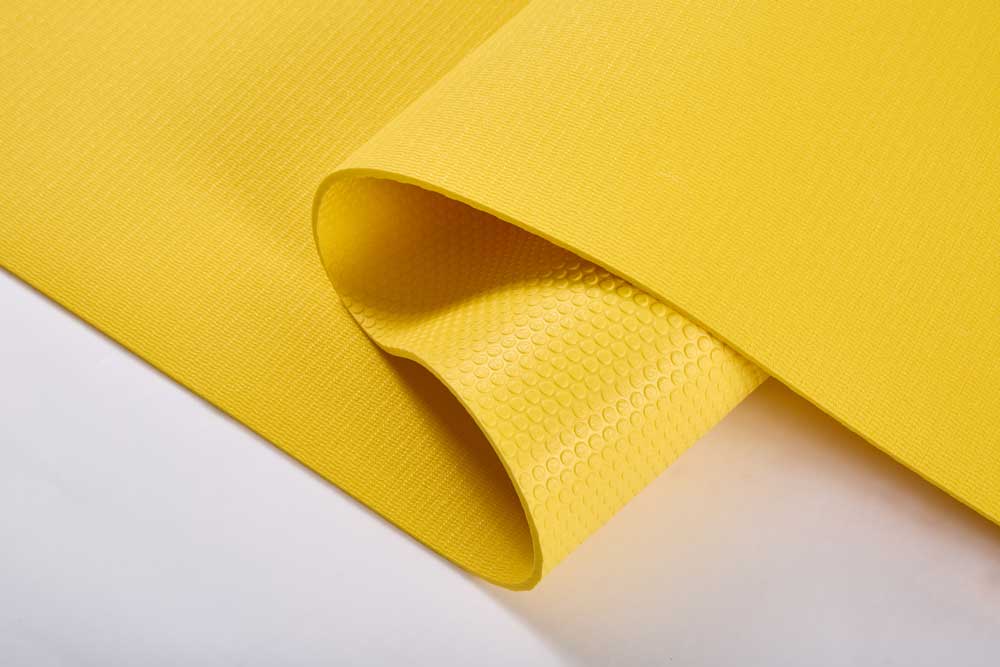
PVC remains a common route for yoga and fitness mats where buyers need practical cost control, repeatable production, and an established material platform. It can support entry-level retail, studio, and broad-use programs when the surface texture, density, thickness, and packaging are developed for the intended use.
For a PVC brief, buyers should define more than the word “PVC.” Confirm the finished thickness and tolerance, surface embossing, underside pattern, density or support target, flat-lay behavior after unrolling, color program, print or logo method, and carton configuration.
PVC should not be described with blanket safety or environmental claims. The appropriate chemical or retailer documentation depends on the finished SKU and destination market. Before production, a buyer should confirm the applicable requirements with the relevant customer, testing provider, or compliance adviser.
Related material route: See PVC Mats for NEEU’s PVC material platform, product directions, and custom-mat considerations.
PVC may be a practical route when:
- The program needs a value-oriented or high-volume commercial position.
- Surface durability and repeatable appearance are important.
- The brand needs a defined texture, color, or printed presentation.
- The brand reviews specifications and documentation for the intended market before bulk approval.
TPE yoga mats: when flexibility and product differentiation matter
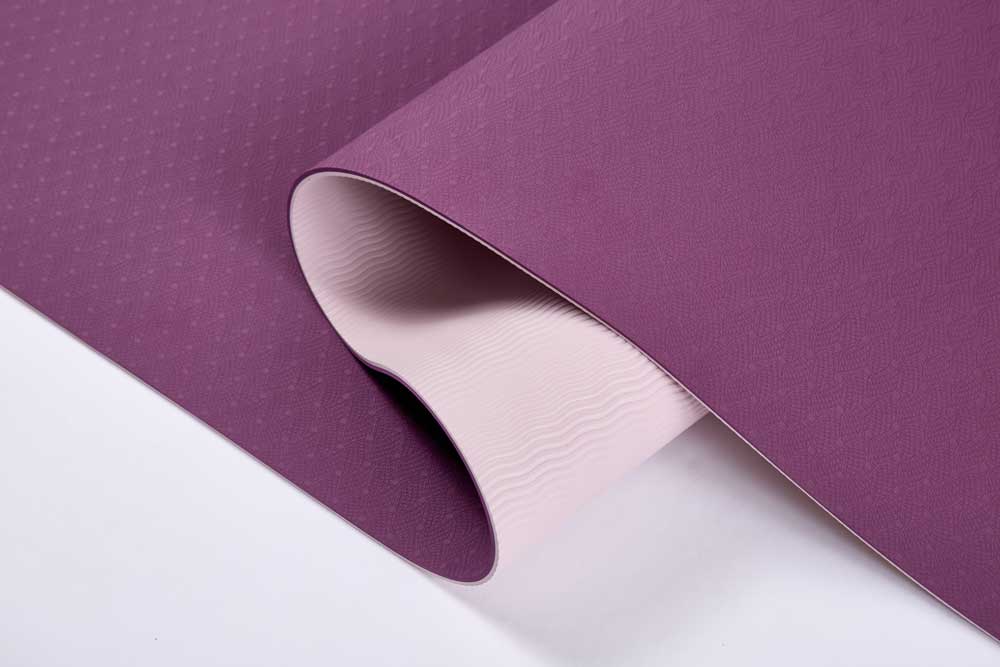
TPE is a broad family of thermoplastic elastomer formulations, not a single universal material. In yoga mats, it can support lightweight-to-mid-weight constructions, varied colors, dual-texture surfaces, and different cushioning directions. The exact result depends on the formula and the whole mat construction.
For B2B buyers, TPE is often considered when the program requires a more design-led or mid-market yoga mat with controlled feel, low bulk, and flexible surface options. It can also support layered or reversible concepts, but sample review remains essential because a TPE mat’s grip, resilience, odor profile, and surface durability vary by formulation and finish.
Avoid treating “recyclable” as an automatic TPE property. Whether a finished product can enter a recycling stream depends on its specific composition, added layers, inks, adhesives, local collection systems, and the evidence supporting the claim. Use only substantiated, product-specific environmental language.
TPE may be a practical route when:
- The project needs controlled options for weight, color, and texture.
- A brand wants to develop a differentiated mid-market foam mat.
- The buyer can approve the exact density, recovery, top surface, and back surface on a production-representative sample.
- Document any material, recycled-content, or end-of-life claim for the actual construction.
Related material route: Explore TPE Foam Material for NEEU’s material-focused range and sourcing considerations.
TPE vs PVC Yoga Mats: How to Choose for Your Practice
Choose between TPE and PVC by the finished mat you will use: how it feels during practice, how it behaves on your floor, and how easily you can carry and clean it. A material label alone cannot answer those questions.
TPE stands for thermoplastic elastomer and covers several material families and blends. Different formulations can vary in hardness, friction, and durability, as Avient’s guide to TPE explains. PVC stands for polyvinyl chloride; a PVC yoga mat is also a formulated product, with its foam structure, texture, and any added layers affecting the result.
| What matters to you | What to check on a TPE mat | What to check on a PVC mat |
|---|---|---|
| Standing and balance work | Whether the foam compresses too much beneath your feet or feels steady during transitions | Whether the selected construction provides the firmness and floor contact you prefer |
| Kneeling and seated practice | Pressure comfort and recovery after loading, alongside thickness | Pressure comfort and recovery on the actual foam construction, rather than assuming PVC is always firm |
| Grip | The exposed top surface with mat’s performance hands and under the moisture conditions you expect | The same dry and moisture checks; surface texture or a coating can matter more than the PVC label |
| Carrying | Finished weight, rolled or folded dimensions, and fit in your bag | Finished weight and roll size; a thinner PVC mat and a thicker PVC mat will affect the weight order you expect |
| Cleaning | Care instructions for both the foam and any laminated, printed, fabric surface | Approved cleaning and drying method for the selected surface and backing |
| Wear | Scuffs, lasting dents and edge condition after normal use | Surface wear, curl, cracking and any print or layer changes after normal use |
| Price and value | The complete mat, accessories and packaging at the required specification | An equivalent final product; PVC does not automatically mean the lowest price |
Match the sample to your main use
For home practice, try both can support short sequences that include kneeling and seated positions. A mat can feel comfortable under a knee yet too yielding for your preferred standing practice. Pressing it with a hand in a shop is only a first impression.
For regular trips to a studio, compare finished weight and packed size before reducing usable floor space. A lightweight TPE foam mat is one candidate worth checking, but its material name doesn’t guarantee the center of pressure or the length and width you need; the yoga mat dimensions guide explains how to assess that fit.
For a studio fleet, compare repeated cleaning, floor contact, and recovery after storage on the proposed samples. For sweaty practice, assess the surface under the intended moisture conditions rather than choosing a material based solely on its dry feel.
Compare like-for-like samples
Start with similar length, width, and thickness on the same floor. Note differences in density, surface layers, or texture, so you know what else changed. Use the same movements, then review both mats after their approved cleaning and packing routines. If one has a fabric or coated top and the other exposes foam, you are comparing two finished constructions—not just TPE against PVC.
For brands selecting a range, keep the preferred sample with its layer description, finished weight, care instructions, and pack dimensions. Those details give the supplier a reproducible brief and give customers more useful information than a material name alone.
Natural rubber yoga mats: a market route to do with careful qualification
Natural rubber is often associated with dense, premium yoga-mat constructions. It can create a distinctive feel and can support brands pursuing a natural-material story. However, it is not a simple substitute for foam mats, and buyers should evaluate it as a complete product route rather than a marketing label.
Buyers should consider finished weight, odor, storage conditions, care guidance, surface wear, and latex sensitivity. A rubber-based product may also use other layers or treatments, which can materially change performance and end-of-life claims.
On, suppliers ask about exact construction, material declarations, care requirements, sample performance, and availability before including a natural-rubber product in a range. Don’t assume every yoga-mat manufacturer offers natural-rubber construction as a standard option.
Cork yoga mats: evaluate the full layered construction
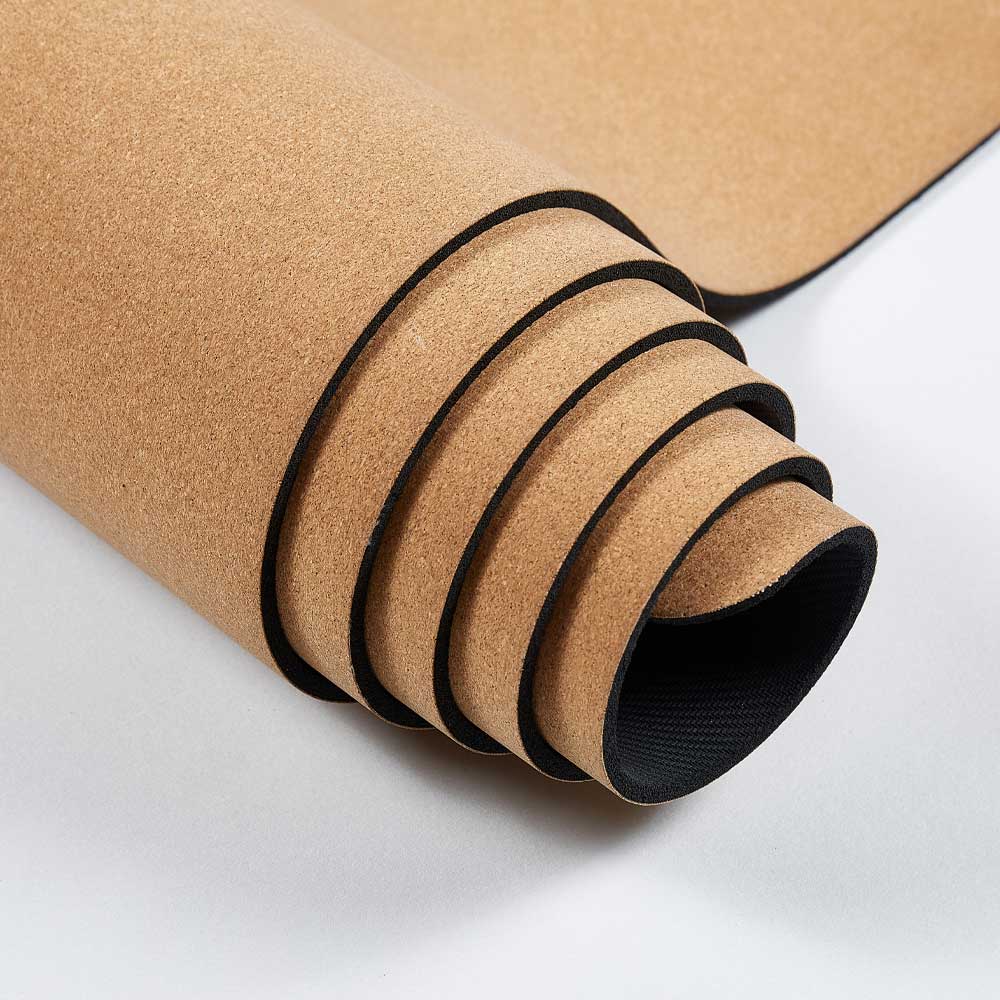
In the market, cork is typically a surface component rather than the entire mat. A cork yoga mat’s performance therefore depends on both the cork surface and the backing or core beneath it. The bond between layers, surface finish, thickness, floor-facing texture, cleaning method, and storage conditions all matter.
Cork can create a clear tactile and visual identity for a yoga range. It may suit a selected premium or natural-material concept, but buyers should validate the surface response under the intended use conditions. Do not make claims about wet grip, antimicrobial performance, or sustainability without evidence for the finished product.
If cork is part of your concept, ask for a physical sample and review the surface after rolling, cleaning, normal use, and storage. Confirm the backing material and the care instructions before finalizing branding or packaging.
Material affects performance, but construction decides the user experience
Material research can support product development, but read it with its limitations in mind. A controlled 2024 study of 24 healthy female university students compared 6 mm EVA, NBR, PU + natural rubber, and TPE yoga mats during specific single-leg landing and support tasks. It refines material-related differences in lower-body mechanics and plantar-pressure measures. In a single-leg support measure, the EVA sample showed the smallest front-to-back center-of-pressure displacement among the four mats tested.[1]
For buyers, the useful lesson is that no single material is universally safer or more stable. All samples were 6 mm; participants and movements were specific, and commercial yoga mats differ in density, hardness, texture, layer structure, and formulation. Use research to compare samples carefully, not as a shortcut to broad product claims.
Separate grip, cushioning, and stability in the specifics. Check a sample
Top-surface grip: Define the intended dry and moist conditions, not just the selected top surface and texture.
- Cushioning and support: Specify thickness, density, firmness, and compression recovery.
- Floor stability: Review the underside texture, mat weight, flat-lay performance, and utilization.
- Durability: Test the finished surface, print, laminate, and edge condition after normal rolling, cleaning, and use.
For sweat-focused surface decisions, read the Non-Slip Yoga Mats for Hot Yoga guide. For thickness selection, see the Thick Yoga Mat Guide.
Do not approve a material claim without defining what it means
Material language is often where a yoga-mat brief becomes unclear. Terms such as “eco-friendly,” “cleaner material,” “low odor,” “skin-friendly,” “recyclable,” or “premium grip” can be useful commercial shorthand, but they are not technical specifications. Without a definition, two buyers may approve the same phrase while expecting different products.
Turn each claim into a question that can be answered with a sample, a document, or a controlled production requirement:
| Marketing phrase | Better B2B question |
|---|---|
| Eco-friendly | What specific material, recycled-content, renewable-content, packaging, or end-of-life claim is intended, and what evidence supports it? |
| Recyclable | Is the finished mat a single-material construction or a multi-layer product? Which collection and recycling route is being refe |
| Low odour | What is the acceptable odor level after unpacking, and how will the buyer assess it during sample approval? |
| Non-slip | Is the request about a dry hand grip, a moisture-conditioned grip, or bottom-side floor stability? |
| Comfortable | Does the target user need knee cushioning, a firm standing feel, or a balance between the two? |
| Safe or non-toxic | Which destination-market requirements, behavioral substances, and product-specific reports are relevant to the exact SKU? |
This approach protects both the buyer and the supplier. It prevents an attractive but vague claim from becoming a quality dispute after delivery. It also gives the marketing team language that reflects what the organized product has actually proven to deliver.
How material choice changes the manufacturing process
The material route affects more than the finished mat. It also changes the questions that must be settled during development.
Foam construction: density, cell structure, and recovery
For PVC, TPE, EVA, NBR, and other foam-based constructions, the material name does not define the level of support. Buyers should describe the intended feel in practical terms—for example, firm and grounded, balanced for daily use, or more cushioned for floor exercise—and then confirm it with a production-representative sample.
The specification should align nominal thickness with density, hardness, resilience, and compression recovery. A mat can meet a thickness target but still feel too soft, too rigid, or inconsistent across the surface. Define tolerances and sample-approval methods before finalizing artwork, packaging, and bulk scheduling.
Surface treatment: touch, appearance, and function
The top surface can be embossed, laminated, printed, coated, fabric-like, or otherwise finished. These choices influence visual differentiation, tactile feel, cleaning behavior, and the mat’s response during use. The bottom surface deserves equal attention because its pattern and material affect how the mat behaves on a studio, wood, tile, or home floor.
When a brand requests a distinctive texture, logo, alignment line, or visual layer, ask whether the selected process changes the mat’s wear behavior or cleaning instructions. Check a sample after normal rolling, unpacking, and cleaning, not only when it first leaves the program.
Related resource: Learn how surface texture, lamination, and visual treatments are developed in Surface Treatment & Lamination.
Packaging: material selection prioritizes freight efficiency
Material thickness and construction affect rolled diameter and product utilization. Low-bulk TPE construction and dense rubber-based construction may need different carry solutions and carton plans even when their face dimensions are similar.
For export orders, approve the product and pack in one system. Confirm whether the mat will be rolled, folded, strapped, sleeved, bagged, or boxed; then verify carton dimensions, quantity per carton, carton marks, label placement, and container-loading expectations. The best material choice on paper can become commercially inefficient if the finished pack doesn’t match the program’s model.
Use a staged sample process instead of choosing from a swatch
A material swatch can help start a conversation, but it cannot validate a yoga mat. The relevant performance comes from the finished construction. A disciplined sourcing process normally moves through three approvals.
1. Material-direction review
At the beginning, compare material routes against the target market, price band, intended activity, and brand story. This stage rules out options that are unsuitable because of weight, care, available documentation, or expected commercial cost. It is not yet the stage to make final claims about grip or comfort.
2. Finished development sample
The development sample should include the intended thickness, density, surface texture, dimensions, color, logo method, and base construction. Colorit for flat-lay behavior, edge quality, hand feel, floor stability, surface appearance, and practical rolling or folding. Where the range is designed for moisture-intensive use, agree a realistic wet-condition review rather than relying on dry feedback alone.
For a branded project, use the How to Customize Yoga Mats guide to organize these decisions before finalizing artwork and retail packaging.
3. Pre-production and packed-product confirmation
Before bulk production, confirm that the approved construction can be repeated at scale. Check the production color standard, logo placement, thickness tolerance, finished size, surface consistency, and packaging completeness. The final inspection standard should match the buyer’s approved sample and documented specification.
Related resource: Read Packaging Preparation & Final Inspection for the export-pack and shipment-release stage.
This sequence makes material choice traceable from a commercial concept to an export-ready product. It is particularly valuable for private-label programs where product, packaging, and retailer documents must be aligned before launch.
Material decision paths for common B2B programs
Value retail or promotional yoga mats
For a price-sensitive retail program, the priority is often a dependable balance of cost, visual consistency, practical cleanability, and carton efficiency. PVC or selected foam constructions may be considered, but the product brief still needs a defined surface, thickness, density, and documentation plan. Avoid positioning a value product as a premium wet-grip or sustainable solution unless its construction and evidence justify that message.
Branded everyday behaviors
For an everyday range, we may develop a TPE or PVC route around color, texture, a reversible color range, ordered support, and clear pack presentation. The objective is not to maximize every property; it is to create a coherent product position that customers can understand and the factory can reproduce consistently.
Studio and repeat-use programs
Studio products may need to prioritize repeat cleaning, floor stability, flat-lay behavior, and durability under regular handling. Assess material selection alongside cleaning guidance and the expected practice environment. A studio’s floor type and storage process can be as relevant as the mat’s top surface.
Premium or natural-material concepts
Natural rubber and cork-based concepts may support a differentiated material story, but the buyer should start with availability, layered construction, care instructions, pack requirements, and evidence for each proposed claim. Premium positioning depends on consistency and clear information, not natural-material wording alone.
Family, children, or multi-use programs
If a yoga-mat-like product is intended for children, family use, or another use category, don’t assume adult yoga-mat documentation applies; identify the intended user and applicable product category early, then create the correct test and compliance plan for that specific program.
For practical guidance on choosing materials and features for a kids’ yoga mat, consider the finished mat’s movement space, comfort, grip, and care requirements alongside its material description.
Build chemical and compliance planning into the product brief
Yoga mats may involve extended skin contact. A risk-factor review of yoga mats identifies categories such as certain phthalate plasticizers, formamide, volatile organic compounds, short-chain chlorinated paraffins, and migratable heavy metals as areas that can require attention in risk management, especially where products are intended for children or family use.[^2]
This does not mean every yoga mat needs the same tests or that a single report covers every color, thickness, or construction. The correct test and documentation plan depends on the finished product, intended user, destination market, retailer requirements, and applicable legal scope.
For example, requirements for a children’s play product may differ from those for an adult yoga mat. Avoid presenting EN71, RoHS, REACH, or any other standard as universal proof for all yoga mats. Instead, confirm which requirements apply to the exact product and market, then retain the corresponding reports, declarations, and production controls.
Industry reporting on China’s yoga-mat standard development also points to measurable concerns such as plasticizer control, slip resistance, shock absorption, and dimensional tolerance.[^33] These are useful quality-management topics, but they do not replace the rules, retailer manuals, or testing requirements in the United States, Europe, or other sales destinations.
Related resource: Review NEEU’s Certifications & Compliance capability, then match the final test plan to the product and destination market.
A B2B sample checklist for yoga mat material selection
Approve the finished sample and its documents, not just a material swatch or product photograph.
- Material and layer declaration: Confirm the actual top surface, core, backing, laminations, and relevant additives or claims.
- Thickness, dimensions, and weight: Measure the finished mat at multiple points and confirm the rolled diameter for packaging.
- Support and recovery: Check compression feel and recovery after repeated loading and rolling.
- Top and bottom surface performance: Review dry grip, intended moisture-condition behavior, and floor stability separately.
- Flat-lay and edge condition: Check curl, lay-flat behavior, cut quality, and edge durability after packing and storage.
- Visual and sensory review: Confirm color, print, odor expectations, cleanliness, and surface consistency on both sides.
- Care and packaging: Approve cleaning guidance, labels, carry accessories, sleeves, cartons, barcodes, and carton marks.
- Market documentation: Match testing and declarations to the exact SKU, destination, target user, and buyer requirements.
Related resource: See how approved specifications are checked at release in NEEU’s Quality Control process.
Choosing a material route by buyer objective
| Buyer objective | Start the discussion with | Do not decide from material name alone |
|---|---|---|
| Value-oriented retail or studio programme | PVC or a selected foam construction | Texture, density, required documentation, and expected service life |
| Design-led mid-market yoga range | TPE construction and surface options | Recovery, surface durability, grip conditions, and any environmental claim |
| Premium natural-material concept | Natural rubber or cork-based market route | Supplier capability, full layered construction, care, weight, and claim support |
| Sweat-focused practice program | The selected top surface and moisture-use test | A broad statement that one material is “best” for hot yoga |
| Comfort-led home or floor-exercise range | Thickness, density, support, and pack size | The assumption that more millimeters automatically mean better support |
Develop the right yoga mat specification with NEEU
NEEU works with B2B buyers on yoga-mat routes based on the finished specification: material selection, texture, layer construction, thickness, dimensions, color and pattern, branding, packaging, and inspection requirements. Start with the target use, market, price position, and required documents so the sample can be assessed against a clear brief
Frequently asked questions
Neither material is universally better. The right choice depends on the target price, surface construction, density, weight, design direction, intended use, and documentation needs. Compare finished samples rather than selecting from a material name alone.
No. Natural rubber can fit selected premium constructions, but buyers should consider weight, odor, care requirements, latex sensitivity, supply availability, and the full layered construction.
No universal claim should be made. Cork is a surface option that must be assessed based on the specific construction and intended use conditions, along with the backing, bonding, texture, and care instructions.
Request a finished sample, full specifications, material and layer information, packaging details, relevant test reports or declarations for the target market, and an agreed approval standard before bulk production.
Hot-yoga suitability is mainly a surface-and-use-condition decision. Define dry grip, moisture-condition grip, floor stability, cleaning needs, and care instructions, then evaluate production-representative samples. See the dedicated Non-Slip Yoga Mats for Hot Yoga guide for the detailed sourcing framework.
Start with the intended user, practice conditions, price target, and sales channel. Compare TPE and PVC samples under consistent specifications before deciding on colors, logos, and packaging. For a rubber or cork concept, confirm the full layer construction, availability, and care requirements with the proposed supplier.
Environmental positioning also needs a specific basis. Recycled content, renewable content, and recyclability describe different attributes. A material can be reprocessed but still lack an accessible recycling route as a finished mat. The FTC’s environmental-claims guidance explains why recycling access and clear qualifications matter. Keep each product claim tied to evidence for the construction you intend to sell.
Material and construction together influence wear and packability. Compare surface abrasion, lasting compression, edge damage, and layer separation after normal use, cleaning, and storage. A broad claim that one material lasts longest cannot replace evidence for the finished product.
For travel, compare usable dimensions, finished weight, packed dimensions, and recovery after unpacking. A thin mat may take less bag space but feel different under load; a larger mat may still be practical if its weight and packing arrangement suit the trip. Confirm that the specific design folds or rolls as intended, and let it dry per the care instructions before packing.
- Liu Xin et al. (2024), A Study on the Effect of Different Materials of Yoga Mats on Key Biomechanical Indexes of Mat Exercise in Women, Zhejiang Sport Science, 46(4), 78-86. The study is a controlled comparison under specific conditions; it is not a universal product ranking. ↩︎
- Hou Guangyue et al. (2018), Risk Factor Analysis and Management Status of Yoga Mats, China Standardization, 2018(20), 152-153. DOI: 10.3969/j.issn.1002-5944.2018.20.094. ↩︎
- Liu Yuan (2025), Industry Standards Safeguard Yoga Mat Safety, Consumer Daily, 5 June 2025. Used as industry-standard context, not as a peer-reviewed performance study. ↩︎