
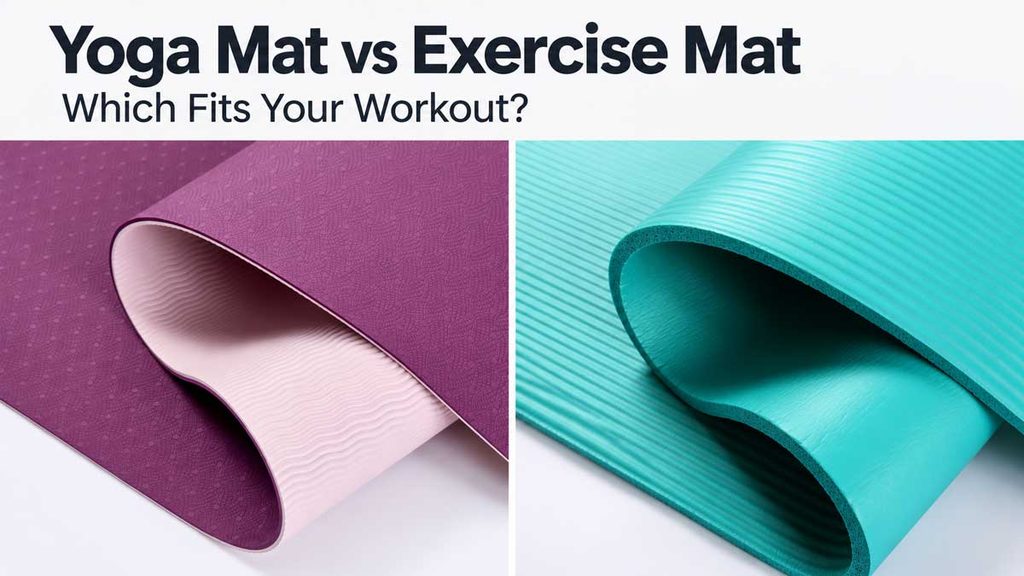
Choose a yoga mat if your routine centers on barefoot poses, standing balance, and controlled transitions. Start with an exercise mat if you spend most of a session sitting, kneeling, or lying on the floor. One mat can cover both, as long as it offers the grip, support, and space your movements need.
The hard choice is often between two specific products, not between the words “yoga” and “exercise.” A soft mat may feel inviting under your back but unsettled under one foot. A compact yoga mat may work for stretching yet leave your elbows off the sides during floor exercises.
Yoga mat vs exercise mat: the useful differences
“Exercise mat” covers a wide range, from portable roll-up mats to folding pads and interlocking tiles. This guide compares personal practice mats, not room-wide gym flooring or gymnastics landing mats.
| Decision | When choosing for yoga | When choosing for floor exercise |
|---|---|---|
| Support | Hands and feet need a settled base during poses and transitions | Check comfort under the back, hips, knees, and elbows during the actual routine |
| Surface | Compare barefoot grip, including sweaty conditions if relevant | Check whether the surface is intended for bare feet, socks, or shoes |
| Space | Allow for standing positions and full-body stretches | Allow for sideways movement, rolling and the position of your arms |
| Movement | Watch for stretching or bunching as you move between poses | Watch for movement under repeated transitions or changes of direction |
| Carrying | Weight and rolled size matter if you attend classes | Packed volume may matter more if the mat stays at home |
These categories overlap in real product ranges. Decathlon’s exercise-mat guide, for example, includes relatively thin fitness mats and a thicker gentle-yoga option. Read the model’s intended use before deciding what its label implies.
What do the material and thickness labels leave out?
Separate the contact surface, cushioning layer, and underside when reading a specification. A layered mat may use different materials for those jobs. Knowing the foam core doesn’t tell you what your hands touch or what meets the floor.
Thickness also leaves questions unanswered: how much the mat compresses during movement, whether it stretches, and whether its surface can handle your footwear and cleaning routine. Ask for those use details alongside the dimensions.
Ball rebound measures how high a test ball bounces back from a specified foam specimen.[1] Even a high result doesn’t guarantee comfort under the knee or support during a standing pose. You need separate checks for the finished mat; our foam rebound vs. cushioning guide explains the difference.
The yoga mat materials comparison covers construction choices in greater depth; the immediate task here is matching the complete mat to your workout.
Which part of your workout makes the decision?
Mostly standing yoga and flowing transitions
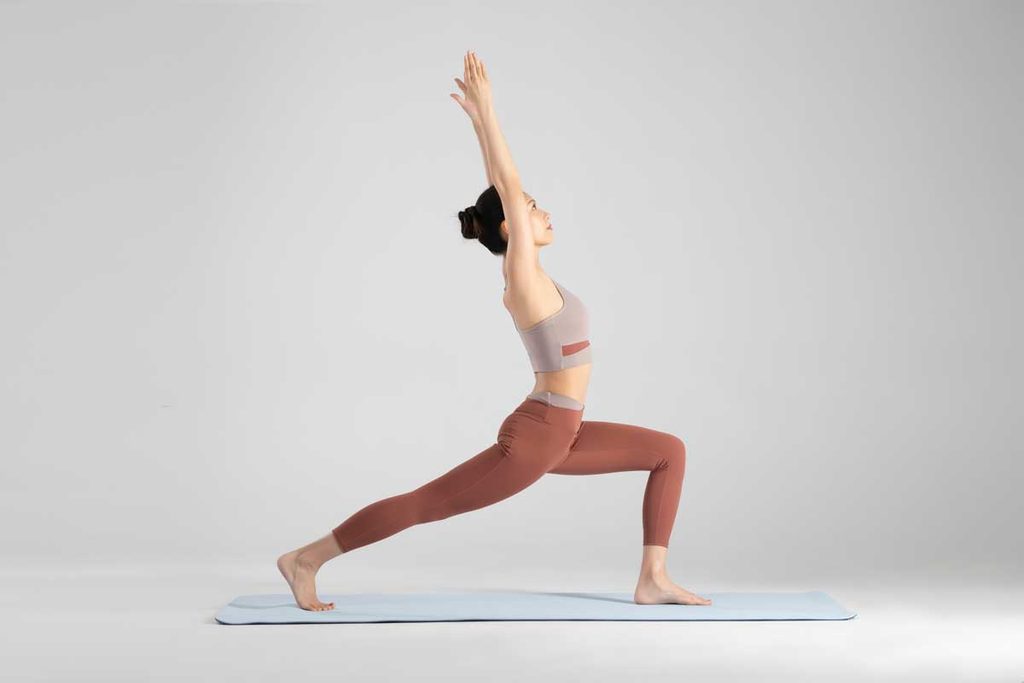
Prioritize footing and hand grip. The mat should stay flat while you move, without stretching noticeably under your hands or gathering beneath your feet. Consider the underside, too: secure hand contact helps little if the whole mat slides across the floor.
Extra softness can become a compromise here. When comparing mats, notice how settled your feet feel in a familiar standing position and whether you can move between positions without the surface shifting. Start slowly, near a stable support, rather than using a difficult balance to test a new mat.
Mostly seated, kneeling or lying exercises
Pay more attention to contact comfort. Your back, elbows, or knees may stay on the same spot for much of the session. Compare mats during those movements, rather than deciding from a quick squeeze of the foam.
Size matters alongside cushioning. A mat that is long enough when you lie still may be too narrow for side-lying work or rolling. Check where your hands and elbows land and how much room the routine needs around the mat.
Can you use a yoga mat for exercise?
Yes, for exercises that suit its surface, dimensions and construction. A yoga mat can be useful for mobility work, stretching, and controlled floor exercises. Before using it for a different routine, check that you stay on the mat and that it stays flat throughout the movements.
Footwear deserves a separate check. Trainers bring tread, grit, and twisting contact that differ from barefoot use. If shoes are part of every session, choose a mat expressly intended for that use. Don’t assume a more expensive yoga mat will handle it better.
If your routine includes repeated jumping or landings, confirm that the product is intended for that activity. Comfort during stretching or kneeling does not prove impact protection. Do not treat a personal practice mat as a gymnastics landing pad.
A personal mat also has limits as floor protection. An exercise-mat label does not mean it’s suitable for heavy equipment or dropped weights. If you are planning an equipment area, use the separate foam versus rubber gym flooring guide.
Can you use an exercise mat for yoga?
An exercise mat can work for stretching and gentle yoga if it stays secure and supports you well. For standing poses, compare how much it compresses under your feet and whether it shifts sideways as you change position.
A mat that feels pleasant while lying down may feel quite different during a standing balance. If it sinks or shifts enough to make footing uncertain, choose a more suitable construction. Adding a second soft mat underneath won’t reliably fix that problem.
For a yoga-focused purchase, our yoga mats page offers a starting point. For predominantly floor-based workouts, compare exercise mat formats with your movements and footwear.
Does a thicker mat solve discomfort on a hard floor?
It may improve contact comfort, but thickness alone does not describe support. The mat’s construction determines how much of that thickness remains beneath an elbow, knee, or foot when loaded.
Foam can become much harder to compress near its compression limit. Tested EVA and cross-linked polyethylene foams show this behavior; the EVA specimens also became stiffer as compression speed increased.[2][33] A hand squeeze is therefore only an initial feel check. It cannot establish how a finished mat supports a held pose or responds during a landing.
Equal thickness can still produce different responses. In barefoot tests with 24 healthy young adult women, four specific 6 mm constructions—EVA, NBR, PU/natural rubber and TPE—produced different foot-pressure and balance measurements during defined single-leg tasks.[44] Those results do not rank all commercial materials, compare different thicknesses, or prove injury prevention.
For shopping, compare a thicker option with a firmer one during the same familiar movements. Notice both floor-contact comfort and standing support. Our thick yoga mat guide explores that choice without making the largest millimeter figure the default answer.
Will you use it on a hard floor or carpet?
Include your home floor in the comparison. A mat that feels right on a shop’s hard display floor still needs to work on the surface where you train. Liforme’s buying guide distinguishes carpet-related sinking and movement from sliding on hardwood. Its product recommendations are brand-specific; the useful general check is how the mat and floor behave together.
On a hard floor, check contact comfort and whether the underside stays in place during a gentle, familiar movement. Prepare both the floor and mat according to their care instructions. Don’t add a loose towel underneath to hide sliding.
On carpet, check whether the mat lies flat, bunches during transitions, or sinks enough to make footing uncertain. A plush carpet with underlay is a different setup from a firm, low-pile carpet. More mat thickness alone doesn’t explain those observations. If the setup shifts, stop and choose a product and location approved for the routine rather than improvising a rigid platform.
If you move between home and a studio, assess both settings. Keep movement and footwear consistent when comparing candidates so you don’t mistake a floor change for a difference between mats.
Check the fit beyond your height
Measure the mat and the space you will use it in. Length is relevant when you lie down; width becomes important when arms, knees or legs move sideways. Keep doorways and walking routes around the practice area clear.
Think through one ordinary session from beginning to end. Can you place your hands where the routine requires them? Do you need to keep repositioning yourself? Does a curled edge get in the way? The yoga mat dimensions guide covers length and width in more detail.
Then consider carrying and storage. Compare actual weight and packed dimensions if you take the mat to class. If it stays at home, check whether it fits the cupboard or shelf you intend to use. Follow the product’s rolling or folding instructions; a roll-up mat isn’t necessarily designed to crease.
One mat or two? Make the choice around your week
List the activities you do most often. If they are standing yoga, stretching, and controlled core work, one suitable mat may be enough. Compare candidates across all three activities, keeping the floor and preparation conditions consistent.
If you combine studio yoga with shoe-wearing circuits at home, separate mats may be more practical. Choose the class mat for carrying and barefoot practice, and the home surface for the fitness routine. You don’t need one product to meet conflicting requirements.
Where a seller permits a trial, begin with a short, gentle session on a clean, dry setup. Notice contact comfort, hand grip, underside movement, and usable space. Stop if the surface shifts unexpectedly. Check the cleaning instructions and return terms before heavy use or alteration.
It’s easier to judge a purchase when you can describe what worked: enough room for your movements, comfortable floor contact, and steady support throughout the routine. Choose the mat that meets those needs most consistently.
Yes, if it provides enough space and comfortable support for your mat-based routine. Check side-lying work and rolling as well as lying still; a narrow mat may leave arms or elbows off the surface. If floor contact is uncomfortable, compare another construction rather than assuming that the yoga or Pilates label settles the choice.
Not automatically. Choose based on the movements you are learning: standing balance needs stable footing, while kneeling or lying exercises may make contact comfort more important. Compare both during simple, familiar movements. Being new to exercise does not, by itself, determine the right thickness.
Look at its condition and performance rather than relying on a fixed replacement calendar. Stop using it if tears, peeling layers, persistent raised edges, or loss of grip make the surface unreliable. If slipping remains after the approved cleaning and setup checks, contact the maker about replacement instead of continuing to use it for demanding movements.
References
- Wang W., Gong W., Zheng B. Improving viscoelasticity and rebound resilience of crosslinked low-density polyethylene foam by blending with ethylene vinyl acetate and polyethylene-octene elastomer. Journal of Vinyl and Additive Technology. 2016;22:61–71. Ball-rebound testing of LDPE/EVA/POE foam specimens, not a comparison of finished yoga and exercise mats. ↩︎
- Penta F. et al. Low-Velocity Impacts on a Polymeric Foam for the Passive Safety Improvement of Sports Fields: Meshless Approach and Experimental Validation. Applied Sciences. 2018;8(7):1174. Compression and impact testing of EVA protective foam; not a consumer yoga-mat thickness trial. ↩︎
- Kmetty Á., Tomin M., Bárány T., Czigány T. Static and dynamic mechanical characterization of cross-linked polyethylene foams: The effect of density. eXPRESS Polymer Letters. 2020;14(5):503–509. Cross-linked PE specimens under specified compression and impact conditions; not a material-wide ranking. ↩︎
- Liu X. et al. [Effects of different yoga-mat materials on key biomechanical indicators during women’s mat exercise; translated title]. Zhejiang Sport Science. 2024;46(4):78–86. Four specific 6 mm constructions and defined barefoot single-leg tasks; not injury rates or a comparison of mat thicknesses. ↩︎