
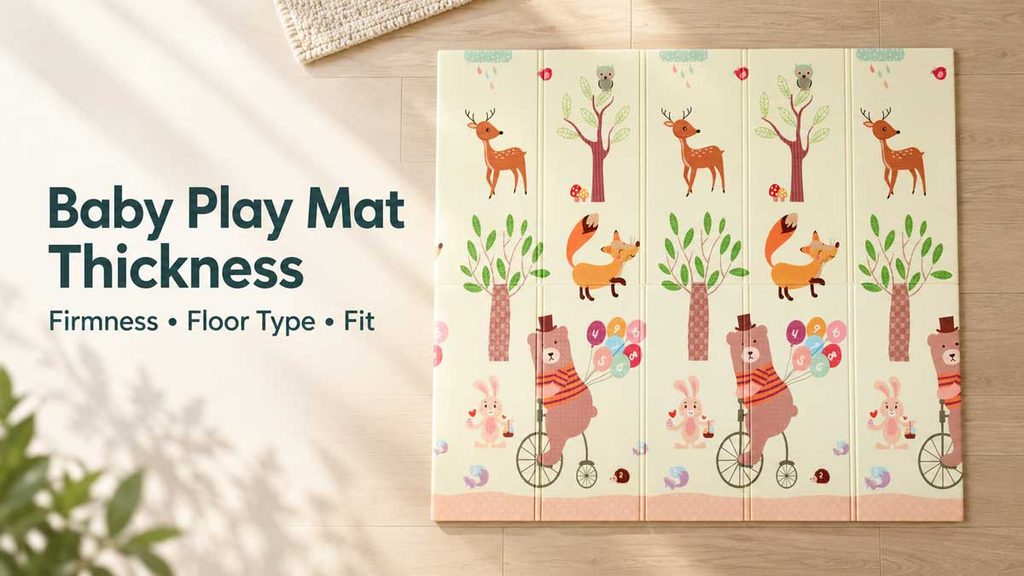
Choose a baby play mat by matching its intended use to your floor, then compare thickness and firmness. On tile or wood, focus on how the foam compresses against the hard base and whether its backing grips. On carpet, focus on whether the whole mat stays flat and stable. Finally, check its edges, components, and usable area.
If your shortlist includes 10 mm and 20 mm mats, compare the same construction where possible. The thicker version provides more material between the user and the floor, but neither number is a universal safety threshold. A different foam or backing can also change how the mat feels and behaves.
This guide covers supervised, awake floor play. The American Academy of Pediatrics’ tummy-time guidance says babies should be awake and closely supervised during tummy time. A regular floor play mat isn’t a surface for infant sleep.
What Changes Between a 10 mm and a 20 mm Mat?
A 10 mm mat is 1 cm thick; a 20 mm mat is 2 cm thick. For products with the same foam formulation, surface layers, and construction, the main differences are depth, available compression distance, and storage bulk.
| What you are comparing | What the thickness difference means |
|---|---|
| Material above the floor | The 20 mm version has twice the nominal depth. |
| Compression distance | At the same percentage compression, the 20 mm version compresses twice as far. This is geometry, not a claim of twice the protection. |
| Feel under pressure | Firmness and the complete construction still determine how readily the mat yields. |
| Storage | The thinner version generally takes up less space when the mat area and packing method are otherwise the same. |
When comparing different brands or materials, look beyond this table. A thicker, softer mat and a thinner, firmer mat differ in more than their height. Compare their descriptions and samples as complete products.
Also check how the advertised thickness is measured. The main panel may be thicker than a fold groove, embossed recess, or edge. For a layered mat, confirm whether the stated measurement includes the complete product or only the foam core.
Firmness, Bounce, and Recovery Describe Different Things
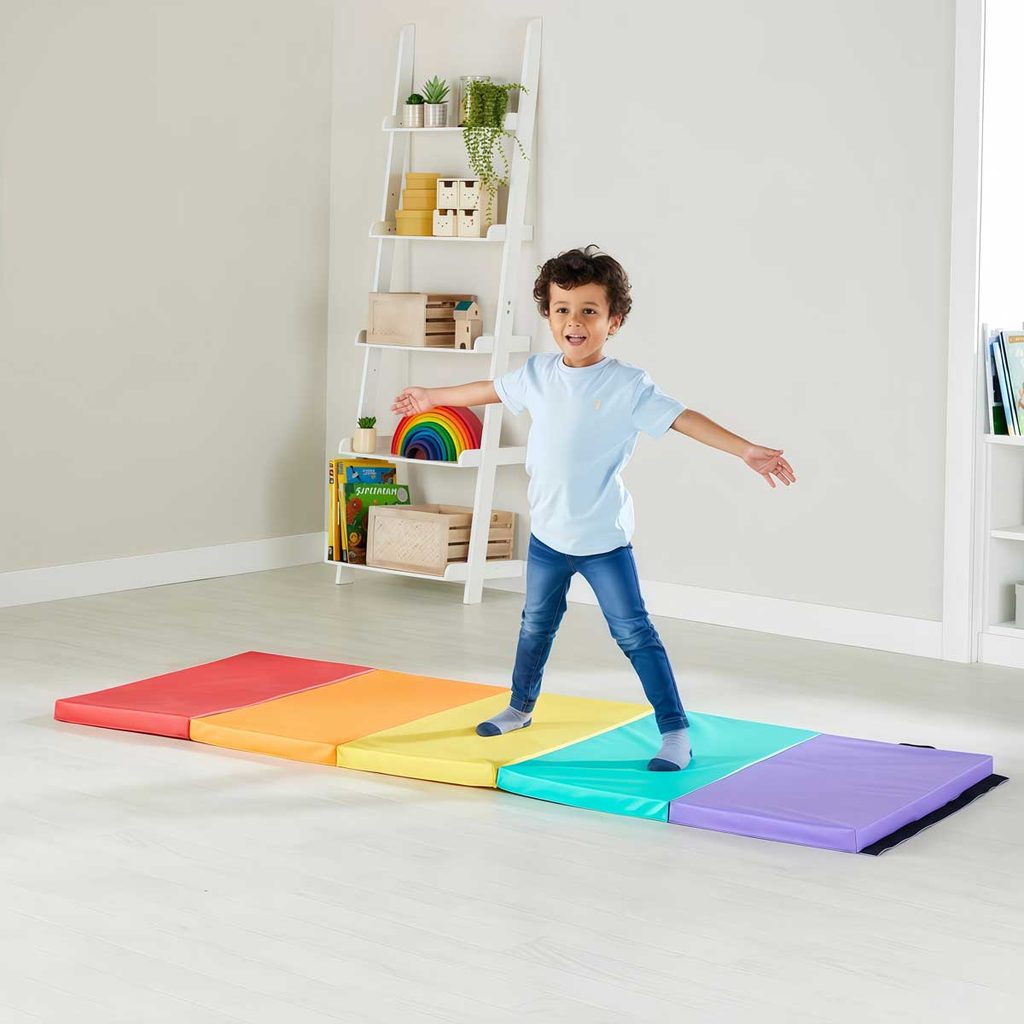
Firmness is resistance to being pressed. Recovery describes how the foam regains its shape after compression. A quick squeeze gives you an impression of initial feel, but tells you little about how the mat will recover after a longer load.
These properties can change in different directions. In tested EVA/PEBAX foam formulations, lower hardness and greater ball rebound occurred alongside poorer recovery after prolonged compression.¹ That finding is useful for understanding why a soft, bouncy feel is not a complete performance description; it is not evidence for a particular baby-mat thickness.
Density is another separate measurement: mass per unit volume. A density label is not a direct softness score. For a fuller explanation of the specifications, see foam mat hardness versus thickness.
You can use hand pressure to notice differences between samples, provided you treat this as a comparison of feel. An adult’s hand or knee doesn’t replicate an infant’s loading conditions. Impact and destructive testing belong with a qualified laboratory, not a household trial. Our guide to rebound versus cushioning explains what those measurements tell you.
Match the Mat to Your Floor
Evaluate a mat on the type of floor where it will be used. The same product can behave differently when moved from a rigid base to a soft carpet.
Tile, hardwood, laminate, and vinyl
These floors provide a relatively rigid base. Compare the mat’s compression on that surface, rather than while holding it in the air or pressing it against a sofa. If one candidate feels too close to the hard floor, compare a thicker version or a different foam construction.
The backing needs attention as well. A textured top surface won’t grip polished flooring. Start with a clean, dry floor and follow the manufacturer’s compatibility instructions. For wood and vinyl, check any restrictions concerning backing materials, trapped moisture, and floor finishes.
Firm, low-pile carpet
Carpet and underlay add another compressible layer. If the manufacturer permits carpet use, check the assembled mat on a similar carpet: its panels should rest evenly, and puzzle joints should remain connected during normal handling.
A sample that felt stable on a hard showroom floor may feel different here. Compare the complete mat-and-carpet setup before paying for extra thickness.
Deep-pile carpet, soft rugs and uneven surfaces
If a mat rocks, wrinkles, or bridges uneven areas, move it to a location that meets its installation instructions. Extra foam depth is not a reliable way to correct an unstable base.
Avoid adding loose mats or rugs underneath to fix poor fit or grip. Additional layers change how the assembly moves and compresses; use them only if the manufacturer explicitly allows that setup.
Check the Edges, Parts and Play Area
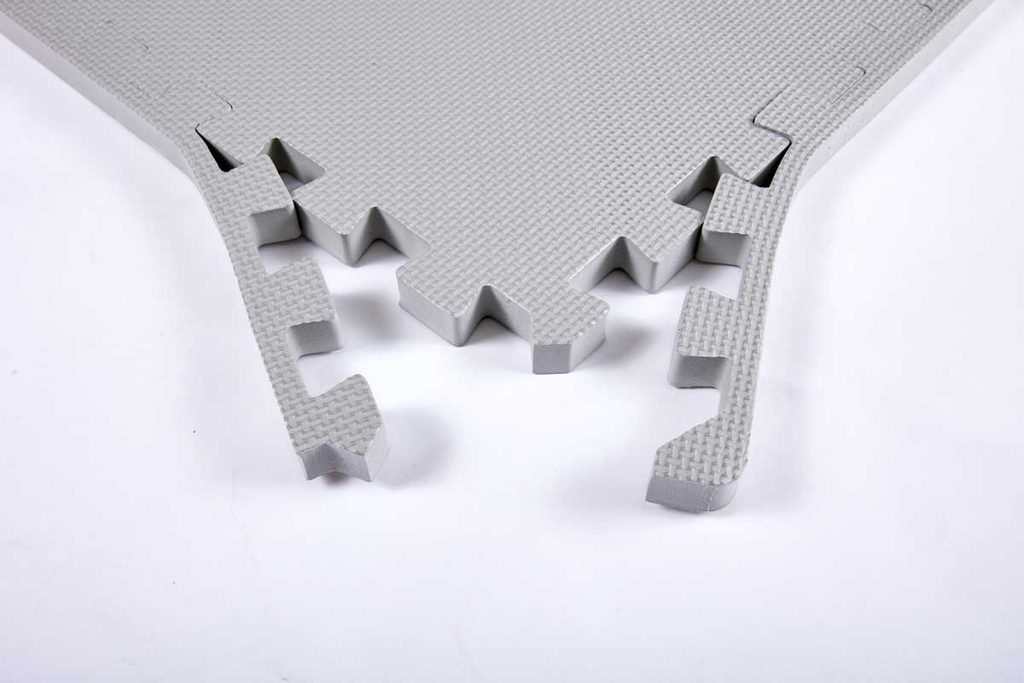
A thickness measurement describes the mat’s depth. It omits details a child may grasp: puzzle teeth, border strips, removable letters or numbers, and any lifted surface film.
Pay attention to both components that are removable when new and fragments that could detach after damage. The CPSC’s small-parts guidance includes separate components and pieces that break off during simulated use or abuse testing. If foam tears, a layer peels, or pieces come loose, stop using the mat and contact the supplier.
The perimeter matters as children move across it. A thicker mat creates a taller change in floor level unless its edge provides a transition. Keep the boundary visible, and check that it doesn’t curl into a walking route.
Measure the usable play area, not just the tile or panel dimensions. A small patch of padding leaves nearby flooring exposed as a child moves. Position the play area away from stairs, furniture edges, and other hazards, and supervise its use.
Use the product’s age labeling and instructions alongside these checks. As a child’s activities change, reassess the space and the mat’s condition rather than choosing a new thickness based solely on age. For an individual positioning or therapy requirement, ask the child’s clinician.
Five Checks Before First Use
With no child on the mat, work through this sequence. It is a household inspection, not a safety certification.
- Read the label and instructions. Confirm the intended age, awake-play use, and permitted floor surfaces.
- Check the product details. Compare finished thickness, usable area, and layers with what you ordered, including any thinner fold sections.
- Unpack and assemble it as instructed. Allow for any specified flattening period, then inspect joints, edges, inserts, and surface condition.
- Assess the setup on your floor. Look for sliding, rocking, gaps, or lifted edges during normal handling. Compare firmness separately from installation stability.
- Plan cleaning and storage. Make sure you can lift the mat, inspect underneath, and dry it as directed. Recheck its condition after cleaning and repeated folding or rolling.
Spills can reach the floor through edges or joints even when the foam resists water. See our guide to foam mat water resistance, cleaning, and drying for care of the underside and visible surface.
For Brands: What to Specify and Verify
Start a sample request with the intended floor, user age, finished construction, and storage format. Compare two thicknesses in the same construction before changing material or surface finish. Record thickness measurement locations, the firmness method where used, and agreed recovery requirements.
For puzzle mats, ask which finished parts were assessed for mechanical safety. A material tensile result does not establish the integrity of a puzzle tooth or removable insert. Mat-specific pull-test results depend on the fixture, grip location, and pulling direction, so include those details with the result.²
Assess a sample after its normal retail packing, too: flat-delivered samples may not show packing-related creases or curl. Include unpacking and handling in the finished-mat sample approval checks.
For an impact-reduction claim, check that the report identifies:
- the tested construction and thickness;
- the supporting surface beneath the mat;
- the impact conditions and measured outcome;
- the comparison baseline for any percentage reduction.
Playground-surfacing tests can relate head-impact measurements to drop height and determine a critical fall height for the tested surface.³ Those results should not be transferred to an untested household baby mat. Chemical compliance, mechanical integrity, and cushioning also need their own relevant evidence.
To discuss a product range, explore NEEU’s Baby & Kids Play Mat options and include your floor type, unfolded area, storage format, and candidate thicknesses in the sample request.
Frequently Asked Questions
Treat 10 mm as a product dimension, not an approval for infant use. Confirm the intended use and floor compatibility, then compare the finished mat’s firmness and stability with your other options. The same thickness can feel different across constructions.
Not simply because it is thicker. Extra depth does not establish a particular impact reduction or lower injury risk; those claims need relevant finished-product evidence.
Not automatically. Carpet adds its own compressible layer. Follow the manufacturer’s floor guidance, and make sure the mat rests evenly and stays in place.
Do not use an ordinary floor play mat as an infant sleep surface. If your baby falls asleep during play, move them to an appropriate infant sleep space and place them on their back. The AAP guidance linked above recommends a firm, flat sleep surface that meets applicable safety standards.
Do not add a floor play mat as improvised play-yard padding. Follow the enclosure manufacturer’s instructions. Health Canada’s playpen guidance warns against adding an extra mattress or soft items because of suffocation risk.
Research References
Huang, G., et al. (2021). Preparation and Characterization of EVA/Nylon Elastomer Microcellular Foaming Materials (publisher PDF). China Plastics, 35(9), 1–7. DOI: 10.19491/j.issn.1001-9278.2021.09.001. EVA/PEBAX formulation evidence; not an infant-use study.
2. Luo Junheng, Li Junqi, Li Shili and Du Fengjuan (2020). [Discussion of tensile abuse testing methods for children’s floor mats; translated title]. Light Industry Standards and Quality, issue 2, 69–72. DOI: 10.19541/j.cnki.issn1004-4108.2020.02.008. Method-development discussion; not a universal requirement for all markets.
3. Xu Bin et al. (2015). Study of Test Method of Assessing Impact Attenuation Property of Children Playground Surface. Machine Building & Automation, 44(2), 65–67. DOI: 10.19344/j.cnki.issn1671-5276.2015.02.019. Playground impact-test equipment and data processing.