
An interlocking mat can match its drawing at the cutting station yet still arrive with gaps, tight joints, or corners that no longer align. The cause is not always inaccurate cutting. Foam may continue to change as it cools, relax during conditioning, distort under packaging pressure, or respond to heat differently than a laminated surface.
For buyers, the practical question is not simply, “Is the tile 600 x 600 mm?” It is:
What dimensions must the finished tile meet, when will it be measured, and will randomly selected tiles still fit after packing and transport?
A reliable specification needs all three parts. Nominal size alone cannot control post-production shrinkage, squareness, curl, or interlocking fit.
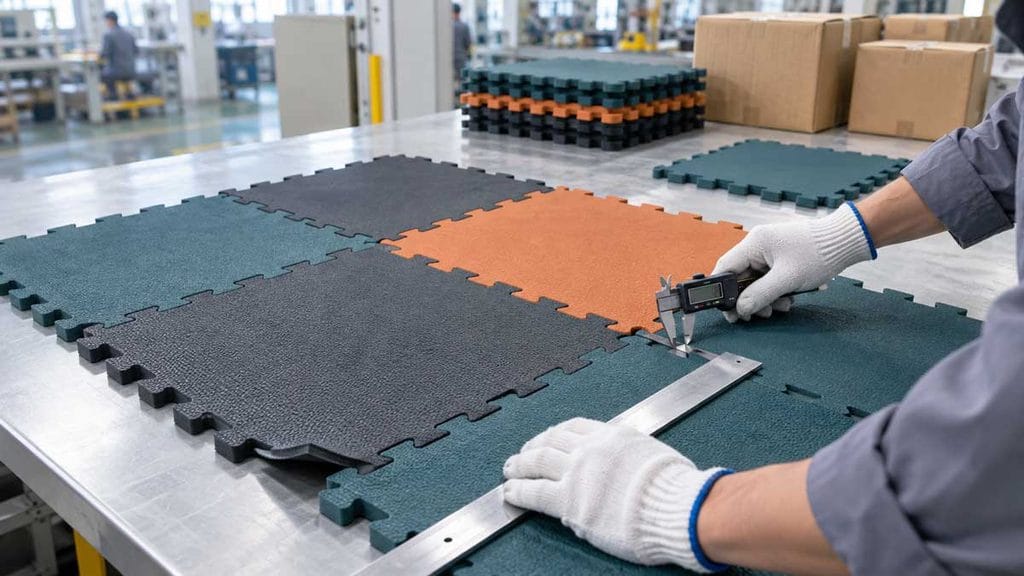
Quick answer: Why do foam mats change size or fail to align?
Foam mat dimensions can be affected by:
- expansion, crosslinking, cooling and conditioning during foam production;
- cutting direction, die condition and deformation during cutting;
- heat used for embossing, printing or lamination;
- different movement between a foam core and its surface layer;
- tight straps, stacking pressure, roll tension and transport temperature;
- measuring the product too early or while it is stretched, compressed or curled;
- mixing tooling revisions, production lots or incompatible product generations.
Interlocking tiles expose these differences quickly. A small change in tile pitch or tooth geometry may look insignificant on a single tile but become visible across a ten-tile row. That is why dimensional stability and assembled fit should be approved together.
Size tolerance is not the same as dimensional stability
These terms answer different questions:
| Term | What it tells the buyer |
|---|---|
| Nominal size | The intended product dimension shown on the drawing or product specification |
| Size tolerance | The permitted deviation from nominal size at a defined inspection point |
| Dimensional stability | How much the product changes after a defined time, temperature, packing, or other exposure |
| Squareness | Whether sides and diagonals form the intended geometry |
| Flatness | Whether the mat lies flat without curl, bowing, or lifted corners |
| Interlocking fit | Whether the tile body, teeth, corners and borders assemble as intended |
A tile can pass its initial size tolerance and still shrink later. It can remain dimensionally stable but be cut incorrectly from the beginning. It can also pass length and width checks but fail because the diagonals or puzzle teeth are incorrect.
For interlocking foam mats, buyers install a complete floor, not one isolated tile. Testing a single square cannot show how dimensional differences accumulate throughout the installation.
Where dimensional changes enter the production process
Dimensional complaints are often assigned to the last visible operation. A joint does not fit, so the cutting die is blamed. That may be correct, but it is only one possibility.
Foaming and cooling establish the starting geometry
During foaming, gas expands within a polymer matrix as the material develops sufficient strength to retain its cellular structure. Formulation, crosslinking, temperature, pressure, and time must work together. After forming, the foam cools and continues to move toward a more stable state.
Published EVA research illustrates this relationship. In one chemical compression-foaming study, the authors reported shrinkage when molding time became excessive in their tested formulation and connected the result to the balance between crosslinking and blowing reactions.[1] This does not prove that every undersized mat was over-processed. It shows why a dimensional investigation should begin before the cutting stage.
If a foamed blank is cut while it is still changing, the cutting equipment may reproduce the requested geometry accurately at that moment, but the finished part can move afterward. A defined conditioning period helps ensure that sample approval and production inspection are comparing the same product state.
NEEU’s foam mat foaming process explains where density, thickness, and cellular structure are established before downstream conversion.
Cutting determines body size and edge geometry
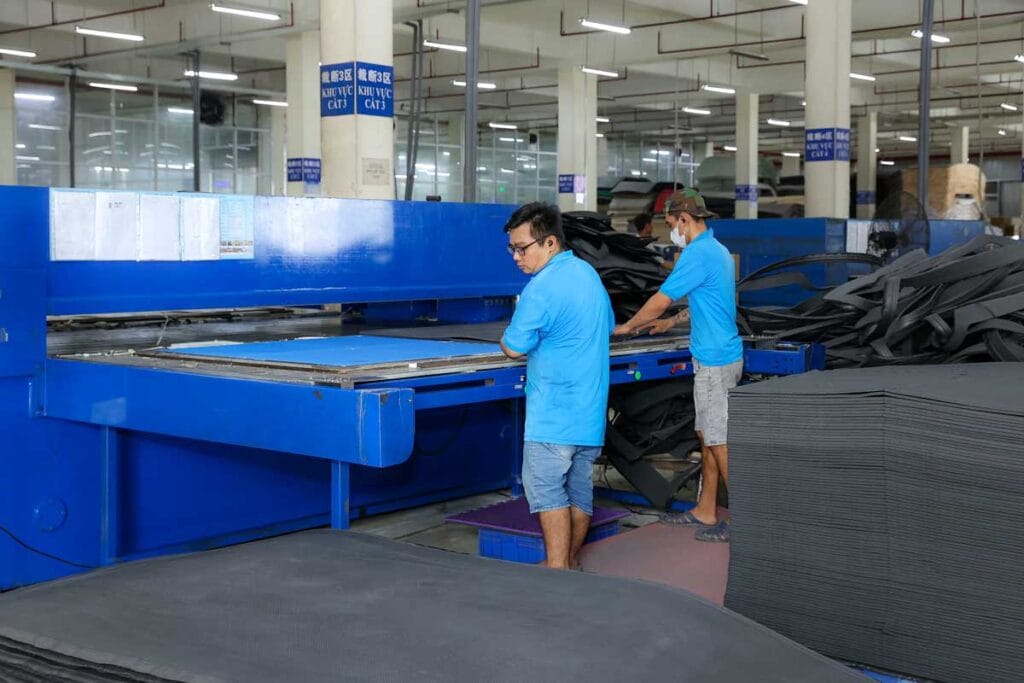
Once the foam has reached the agreed condition, cutting defines the length, width, corners, and interlocking profile. Variation may come from:
- die wear or damage;
- foam movement under the cutting equipment;
- incorrect material orientation;
- incomplete removal of scrap from the teeth;
- different dies or tooling revisions used in one program;
- measurement pressure that stretches or compresses a flexible edge.
The body dimension and the tooth profile should be treated as separate inspection features. A correct square with an incorrect tooth pitch can still fail. NEEU’s cutting, shaping and finishing process provides the production context for these geometry checks.
Surface processing and lamination can add another source of movement
Embossing and thermal lamination expose the product to heat after foaming. Films, fabrics, coatings, andin adhesivthe same way es may not respond exactly as the foam core does. Uneven layer tension or differential thermal expansion can cause curl even when length and width remain within tolerance.
For a laminated mat, testing the unlaminated foam alone is not enough. Approve the construction the customer will receive.
Packing and transport can reveal or create distortion
Tight cartons, straps, rolled packing, heavy stacking, and warm containers can affect shape. Some mats recover after being unpacked and laid flat. Other changes remain.
Do not classify every arrival complaint as permanent shrinkage. Record dimensions:
- before packing;
- immediately after unpacking;
- after one or more agreed recovery periods.
These measurements show whether the product was already out of tolerance, temporarily distorted by packing, or unable to recover within the agreed time.
Why interlocking mats need an assembled-fit test
Individual length and width measurements do not fully predict how puzzle tiles will behave across a floor.
Four geometries work together:
- the tile body;
- tooth and slot pitch;
- corner transitions;
- borders or ramps, where supplied.
A small difference in effective pitch can accumulate across several pieces. Flexible foam may also allow an installer to force one joint together while transferring the error to the next joint. The first pair appears acceptable, but later rows develop gaps, buckling, or drift.
Test a random grid, not a selected pair
During sample approval and production inspection, randomly select tiles from different cartons and production positions. Assemble a defined grid on a flat surface without stretching the parts.
Check and record:
- visible gaps between joints;
- excessive force required for assembly;
- lifted edges or buckling;
- alignment of rows and corners;
- total assembled length and width;
- compatibility of border pieces;
- damage after disassembly.
If customers may add or replace tiles later, test new production batches against the retained approved set. Tiles made years apart, with different tooling or altered formulations, should not be assumed compatible merely because they share the same nominal size.
Density and hardness may affect how easily a joint deforms, but neither defines the edge geometry. Dimensional inspection and fit testing remain separate requirements.
A practical dimensional stability test for buyers
The test does not need to become a research project. It only needs to reproduce how the mats will be conditioned, packed, shipped and inspected for this order.
1. Define the finished construction
Identify the material or blend, nominal thickness, surface texture, laminated layers, edge style, and border pieces. State whether the requirement applies to an individual tile, an assembled set or both.
2. Establish a conditioned baseline
Agree on the minimum time between final production and measurement. Store the mats flat, unstressed, and under stated environmental conditions before recording:
- length and width;
- both diagonals;
- thickness at defined locations;
- flatness or corner lift;
- critical tooth and slot dimensions.
ISO 1923:1981 addresses equipment and procedures for measuring the linear dimensions of flexible and rigid cellular sheets, blocks, and specimens.[2] It is a useful measurement reference, but it does not provide a universal tolerance for a finished puzzle mat.
3. Perform the grid-fit check
Use the agreed number of randomly selected tiles and the same assembly surface and procedure for every comparison. Record individual joint observations and overall grid dimensions. Photographs should identify the lot and sample positions.
4. Validate the intended packaging
Pack the approved product quantity using the intended bag, carton, strap, insert, and pallet arrangement. After a documented storage or transport simulation, repeat the dimensional and fit checks immediately after unpacking and after the agreed recovery time.
This separates temporary packing effects from persistent dimensional change.
5. Add temperature or humidity exposure only when relevant
A hot-container or warehouse simulation may be appropriate for a demanding distribution route. The temperature, duration, specimen orientation, and recovery period must be written into the protocol.
A 2022 EVA composite study, for example, reported heat shrinkage only under its stated test temperature and exposure time.[3] Its shoe-material formulation and numerical results are not acceptance limits for foam mats. A shrinkage result is meaningful only when the report states the temperature, exposure time, and recovery conditions.
ASTM D3575-20 applies to flexible closed-cell olefin foams and olefin-polymer blends. ASTM also cautions that results under a particular test condition may differ from behavior in another environment or use condition.[44] Confirm that any selected method fits the material and buyer’s question.
6. Calculate and report directional change
One common calculation is:
Dimensional change (%) = (dimension after exposure – initial dimension) / initial dimension x 100
Under this convention, a negative result indicates shrinkage and a positive result indicates expansion. Report length and width separately. Do not mix linear change with area change, volume change, or foaming expansion ratio.
Keep individual readings as well as the average. A satisfactory average can hide one unacceptable tile or one weak position within a sheet or mold.
Diagnose the complaint before changing the specification
The same visible problem can have several causes. Retain factory samples and, where possible, obtain returned products with carton and lot information.
| Buyer observation | Questions to investigate | Useful next check |
|---|---|---|
| All tiles arrive smaller than the approved sample | Were they undersized before packing, measured at a different conditioning time, or changed during transport? | Compare retained pre-pack samples, arrival dimensions, and timed recovery |
| Tiles fit at final inspection but not after shipment | Did packing pressure, heat, or insufficient conditioning affect the finished product? | Controlled pack-out trial followed by grid-fit testing |
| Gaps increase across a large floor | Is effective tile pitch drifting even though individual pieces appear close to nominal? | Random multi-tile grid and total assembled dimensions |
| Only some teeth fail to engage | Is there local tool wear, debris, incomplete cutting or mixed tooling? | Edge-profile measurement and tooling traceability |
| Rows curve or corners drift | Are tiles out of square? | Compare both diagonals and inspect grid squareness |
| Corners lift while length and width pass | Is the problem curl from packaging or differential layer stress? | Flatness readings at fixed recovery intervals |
| Replacement tiles do not match existing flooring | Have tooling, formulation, or product generation changed? | Cross-batch fit test against the retained reference |
Increasing the nominal tile size is not an automatic correction. If the real cause is post-cut shrinkage, local tool wear, or packaging distortion, changing the drawing can introduce a second problem.
What to include in the purchase specification
“Tile size: 600 x 600 mm” leaves too much open to interpretation. A useful specification identifies:
| Field | Requirement to define |
|---|---|
| Product state | Finished mat, including texture, print, laminate and edge profile |
| Nominal dimensions | Length, width, thickness and measurement reference points |
| Size tolerance | Permitted deviation and whether it applies to each piece, the average, or both |
| Measurement timing | Minimum time after production and after unpacking |
| Conditioning | Temperature, humidity, orientation, and duration |
| Geometry | Diagonals, squareness, flatness and relevant tooth dimensions |
| Stability exposure | Packing, time, temperature or humidity condition and recovery period |
| Grid fit | Grid size, random-sampling rule, acceptable gaps, force, lift and alignment |
| Sampling | Number of lots, cartons, positions and specimens |
| Change control | Material, formulation, process, tooling and packaging changes requiring reapproval |
| Records | Raw readings, photographs, lot identity and disposition |
Do not copy a competitor’s tolerance without its measurement procedure. A tighter number does not produce a better product if the material, test state, and production capability are undefined.
Connect the result to production records
When a lot fails, compare material and formulation identity, foaming records, conditioning time, pre-cut dimensions, tooling records, pre-pack inspection, and arrival measurements. This sequence helps locate when the change occurred.
NEEU’s foam mat quality-control process shows how incoming, in-process, and finished-product checks can be connected to an approved requirement. Visual inspection remains useful, but dimensional stability needs measured, traceable results and an assembled-fit decision.
Frequently asked questions
Nominal length and width do not describe tooth pitch, slot depth, corners, squareness, or the way foam deforms during assembly. Test randomly selected tiles in a multi-piece grid.
They can change during packing, storage, or transport, but a smaller arrival measurement does not prove one cause. Compare dimensions before packing, immediately after unpacking, and after a stated recovery period
There is no universal period for every EVA, XPE, TPE, PVC, or laminated mat. Validate a conditioning period for the finished construction and use it consistently for samples and production lots.
No. Cutting controls geometry at one production stage. Later heat treatment, lamination, packaging, and transport can still affect the finished mat.
No. Dimensional stability tracks changes in length, width, thickness, or shape after a defined exposure. Compression set measures deformation remaining after a defined compressive condition and recovery period.
Make dimensional fit part of sample approval
A drawing dimension is only the starting point. Reliable interlocking performance requires a conditioned baseline, a realistic exposure, a random-grid fit test, and clear rules for repeat orders.
Send NEEU your target tile size, edge drawing, packaging method, and destination market. We can review the dimensional and fit checks that should be confirmed before mass production. Discuss your dimensional stability and fit requirements with NEEU.
- Feng, S., Liu, Z., Zuo, J., Zeng, J., and Hao, J. “EVA Crosslinking Foaming Technology and Application.” Plastics Science and Technology, 2003(2), 9-11. ↩︎
- International Organization for Standardization. ISO 1923:1981, Cellular plastics and rubbers – Determination of linear dimensions. ↩︎
- Wang, Y., Liu, X., Lu, X., et al. “Preparation and Properties of Cork-Based EVA Foams.” China Leather, 51(3), 2022, 10-14. ↩︎
- ASTM International. ASTM D3575-20, Standard Test Methods for Flexible Cellular Materials Made from Olefin Polymers. ↩︎