
When a buyer asks for a foam mat that is “softer,” “more supportive,” or “better for impact,” the answer is rarely a single number. Thickness and hardness both shape the result, but they do different jobs. Thickness determines how much material sits between the user or equipment and the floor. Hardness describes how strongly the surface resists indentation under a defined test. You can’t select either property properly without the other.
This is especially true for foam mats. A thick mat can still feel unstable if it’s too soft or compresses unevenly. A thin mat can feel firm and controlled while offering limited protection from a hard floor. A dense-looking mat can permanently set under load, whereas a lighter construction may recover well because of its polymer system and cell structure.
For B2B development, the useful question is not “Which hardness is best?” or “How thick should a mat be?” It is: what combination of material, hardness, thickness, compression response, surface design, and verification method is appropriate for the finished product and its intended use?
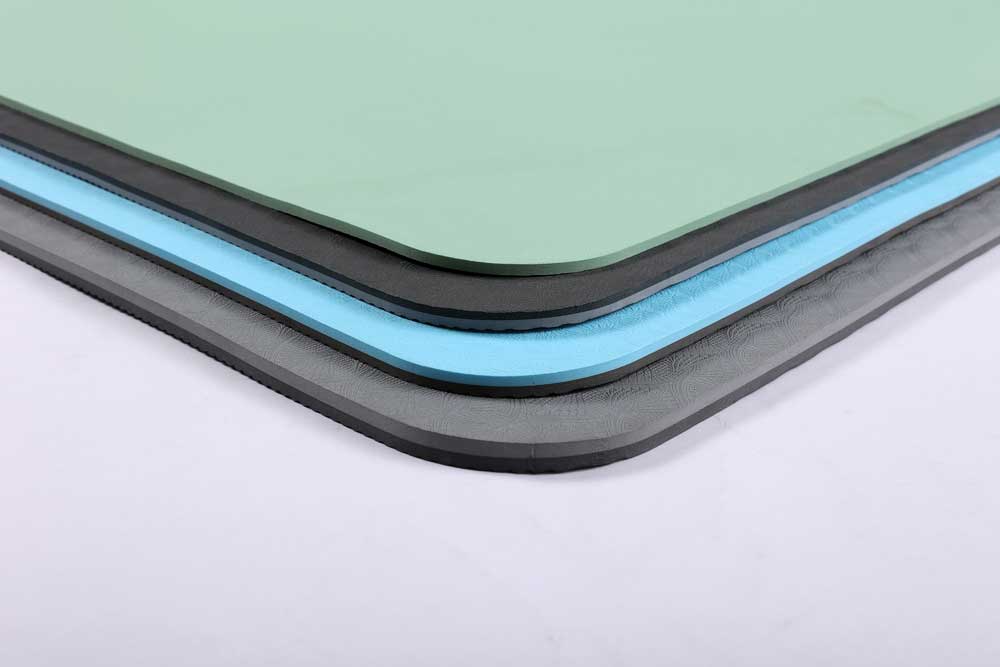
Quick answer: Thickness provides distance and potential cushioning. Hardness describes indentation resistance under a stated method. Specify them together with material, density basis, compression recovery, surface grip, dimensions, intended load, and an approved finished sample. Do not use a Shore or thickness figure as a shortcut for total product quality.
Hardness and Thickness Are Different Controls
What foam mat hardness means
Hardness is usually an indentation measurement. A test device presses an indenter into the material under defined conditions, then records the penetration depth or converts it into a scale value. The test is useful for production control and comparison when the same method is used consistently.
For elastomeric and cellular materials, buyers may encounter Shore A, Shore C, Asker C, or another specified hardness method. These scales are not interchangeable. For example, ASTM D2240 covers several durometer types and explains that indentation hardness depends on indenter geometry, applied force, elastic modulus, and viscoelastic behavior. Do not treat a value from one durometer as a simple conversion of a value from another instrument.
This has a practical consequence: “40 Shore” is not a complete purchasing requirement. A usable requirement identifies the scale, the test method, sample thickness, conditioning, test position, number of readings, and permitted tolerance. It should also say whether the reading is taken on the foam core or on the finished product with a skin, film, textile, coating, or laminated backing.
A hardness value should include its scale, method, specimen thickness, and measurement conditions. See how to interpret foam hardness test results before comparing supplier reports.
What foam mat thickness means
Thickness is the distance from the top surface to the underside of the finished mat. It affects how much material can deform under a load, how high the body or equipment sits off the floor, product weight, roll diameter, carton volume, edge profile, and visual presence.
Thickness is typically expressed in millimeters, but the nominal value is only a starting point. Buyers should define where they measure thickness, the measurement force used, how many positions they check, and the applicable tolerance. Embossing, textured surfaces, beveled edges, fold lines, and layered products can make a single thickness reading misleading.
The simple distinction
Think of thickness as the amount of foam available to work with, and hardness as one measure of how that foam resists being pressed. A thicker product has more potential travel before the user reaches the hard floor. A firmer product resists the initial indentation more strongly. The final experience depends on the entire compression curve, not just its first moment of contact.
For a similar material and construction:
- Increasing thickness can increase cushioning distance, but it can also add bulk, weight, and instability if the foam is too soft.
- Increasing hardness can create a more controlled, supportive initial feel, but it can reduce comfort for kneeling or floor-contact movements if the product is too thin.
- Changing the formulation, cell structure, crosslinking, or surface skin can alter both feel and durability without changing nominal thickness.
Why the Same Thickness Can Feel Completely Different
Two 10 mm mats are not automatically comparable. They may use different polymers, foam densities, cell structures, surface layers, backing materials, and production routes. One may be closed-cell EVA, another multilayer TPE, and another a PVC composite mat. Their thickness labels may match, but their user experience may not.
Material system
EVA, XPE, TPE, PVC, natural rubber, and multilayer combinations respond differently to load. The polymer base affects resilience, creep, tear resistance, surface behavior, odor control, and processability. It should be named before a hardness or thickness figure is compared.
EVA is widely used where a closed-cell structure, cushioning, color flexibility, and efficient conversion into tiles, rolls, or pads are needed. XPE is often chosen for lightweight, closed-cell, foldable constructions. TPE and PVC systems can be designed for yoga and exercise products, each with different priorities for surface and support. Start with the foam material overview and the EVA Foam Mats material page before selecting a number.
Foam density and cell structure
Density and hardness are not the same property. Density is mass per unit volume. In comparable constructions, it can affect weight and certain compression-related behavior, but it doesn’t predict hardness on its own. Read the Foam Density Guide for the measurement basis, overall-versus-core density, and purchasing implications.
Cell structure is equally important. Research in the NEEU content library on foam microstructure and mechanical performance describes how cell size, cell shape, cell density, anisotropy, and open- or closed-cell character affect compression, tensile, and shear behavior. A foam with a finer, more uniform cell structure may behave differently under repeated loading than one with larger or less uniform cells, even when the basic product dimensions look similar.
For mat buyers, that does not mean a cell-size number should replace finished-product testing. It means you must evaluate hardness and thickness alongside foam structure, material route, and actual loading conditions.
Crosslinking, formulation, and surface layers
Formulation and process choices, not thickness alone, create hardness. Crosslinking can alter the polymer network and influence resilience, compressive response, thermal behavior, and dimensional stability. Blending EVA with elastomers or other polymers can change the balance among hardness, rebound, tensile strength, tear strength, and water uptake.
Two EVA studies illustrate the trade-off. Fu Dongliang et al. (2024) found that varying the OBC proportion in radiation-crosslinked EVA/OBC foam affected elongation, rebound, tear strength, compressive strength, and Shore hardness. Hao Qi et al. (2026) found that crosslinker and blowing-agent levels changed expansion ratio, hardness, elasticity, and toughness. These are formulation studies, not off-the-shelf mat recipes. The useful lesson is that a thickness or hardness figure doesn’t describe the whole construction.
Surface layers matter too. An embossed skin can change initial hand feel and grip. A laminated film can affect top-surface durability and cleanability. A textile or non-woven backing can change a composite mat’s assembly, tensile behavior, and floor contact. The library study of PVC composite mats likewise shows that processing conditions and layer bonding affect final mechanical properties. Review surface treatment and lamination options as part of the construction process, rather than treating the foam core as the entire product. Therefore, test the finished mat as a complete construction.
The Four Common Hardness and Thickness Combinations
The following matrix is a decision aid, not a set of universal grades. Each direction still needs sampling and application-specific testing.
| Construction direction | Typical experience | Where it can fit | What to watch |
|---|---|---|---|
| Thinner and softer | Close-to-floor, flexible, light; limited material under load | Light exercise and travel-oriented mat formats | Bottoming out, point-load marks, limited cushioning |
| Thinner and firmer | Controlled, stable, compact | Some yoga, exercise, or low-profile floor-protection uses | Kneeling comfort, edge feel, limited impact distance |
| Thicker and softer | Plush and cushioning-led | Floor exercise, home comfort, selected children’s products | Uneven compression, balance stability, rolled size, permanent indentations |
| Thicker and firmer | More substantial with controlled support | Interlocking flooring, selected gym, play, and project mats | Weight, freight, installation fit, whether firmness is excessive for the intended user |
The desired quadrant depends on the product’s job. A thick, firm gym tile and a thick, soft floor-exercise mat may both be technically sound, but they don’t serve the same buyer need.
How to Choose Hardness and Thickness by Application
EVA interlocking foam mats
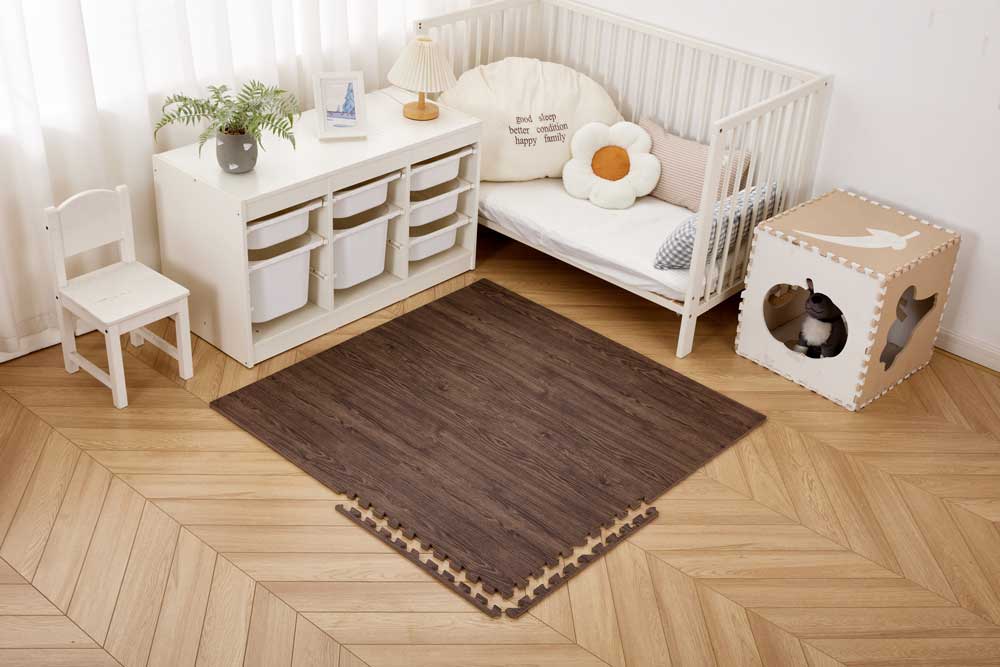
Interlocking EVA mats are floor systems, not just foam sheets. Tile thickness, edge geometry, interlock fit, compression response, flatness, surface texture, and dimensional tolerance all affect the finished floor.
For home gyms, martial arts spaces, workshops, and play areas, start with the expected load. Barefoot exercise, children’s play, dropped items, light equipment, and static-machine feet impose different demands. Thicker tile can increase separation from the floor; firmer construction can better resist indentation and help keep edges aligned. On the approved interlocking foam mat sample, check center and edge thickness, tile-to-tile fit, recovery after representative point loads, and edge condition after repeated assembly.
Baby and children’s play mats
For a children’s mat, softness is only one part of the decision. Buyers also need stable dimensions, easy cleaning, surface durability, seam or interlock integrity, odor control, and relevant chemical and product safety documentation.
Thickness creates distance from the floor during crawling, sitting, and ordinary play. Hardness affects how readily the surface compresses beneath hands, knees, and toys. For baby and kids play mats, choose the format first: puzzle tile, one-piece mat, foldable product, or multilayer printed mat. Then evaluate the full-size article after cleaning, folding, or assembly, and normal handling. This matters because seams, print, backing, and film layers can change the real product experience.
For a practical comparison on hard floors and carpet, see our guide to baby play mat thickness, firmness and floor type.
XPE foldable mats
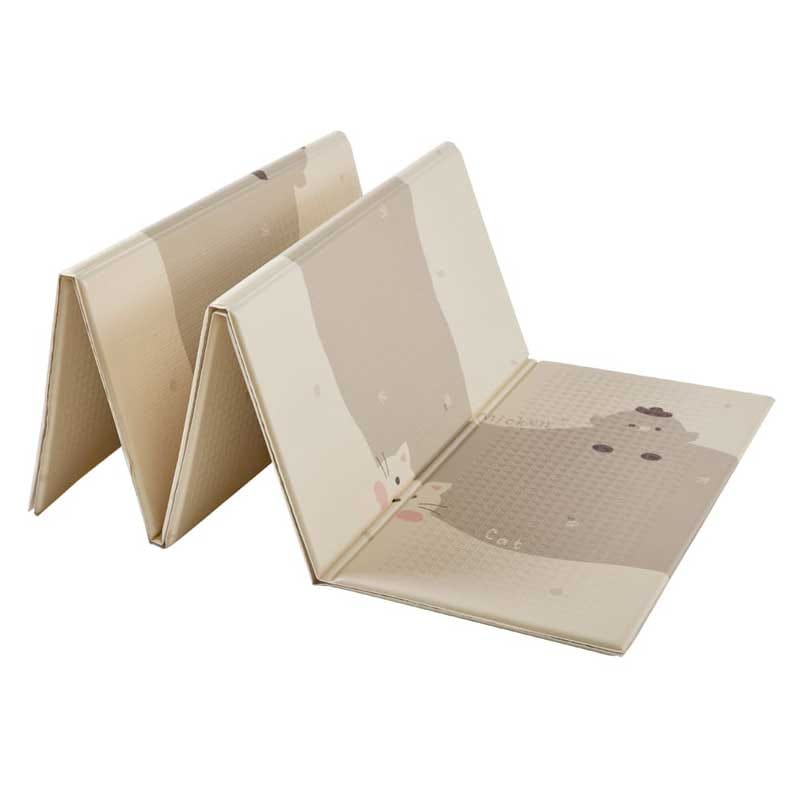
Foldable mats have a different design problem. Thickness affects panel bulk, storage, fold geometry, and whether the mat sits flat after unpacking. Hardness and compression response determine how the body feels the panel and how fold zones age under repeated use.
Assess XPE foam mats used in foldable formats as panel systems rather than as central foam coupons. Key checks include thickness at and away from fold lines, recovery after folding and compression, lay-flat behavior, cover integrity, and the relationship between the core and the film or printed surface.
Yoga and exercise mats
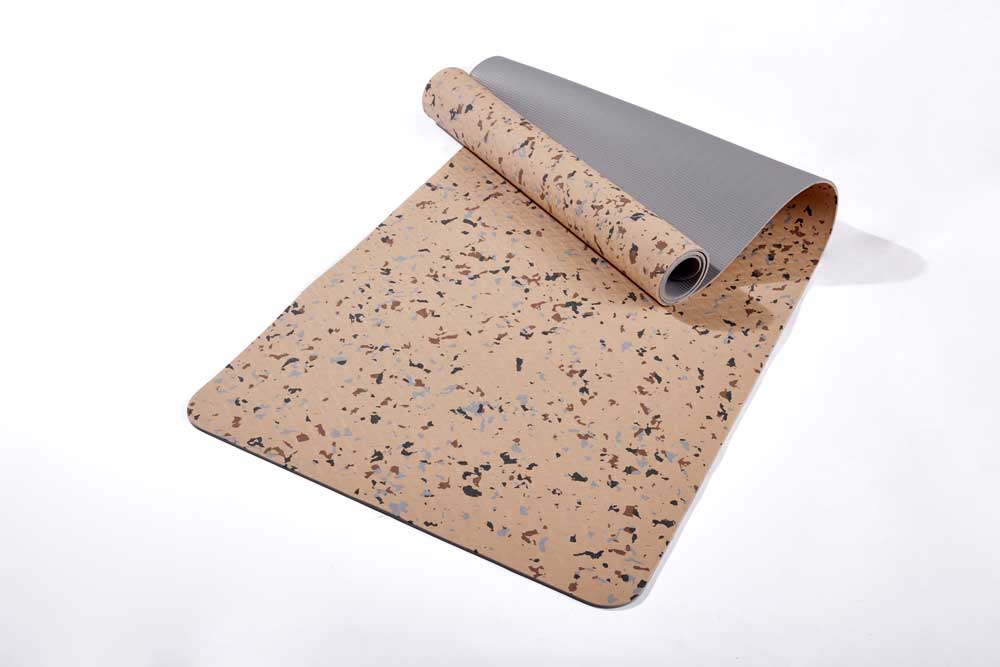
Yoga and exercise products sit at the intersection of cushioning and stability. A mat that is too thin for kneeling or floor work may feel harsh; one that is too soft or too thick for balance-focused movement can feel less controlled. Surface grip and underside stability are separate requirements, but they strongly shape how users perceive the mat.
For the application choice, see when a yoga mat or exercise mat better fits the workout, including standing poses, kneeling, and lying exercises.
A 2024 biomechanical study by Liu Xin et al. compared EVA, NBR, PU-plus-natural-rubber, and TPE yoga mats from a single manufacturer. The samples were all 6 mm thick and used the same foaming route and surface pattern. The study recorded material-related differences in selected landing, lower-limb, and plantar-pressure measures. Since density and hardness were not isolated, the study cannot rank a universal “best” hardness or thickness. It supports a practical development rule: compare finished samples under the intended use conditions.
For yoga mat product positioning, including 6 mm, 8 mm, and 10 mm options, see the dedicated Thick Yoga Mat Guide. This article focuses on broader specification decisions: support, cushioning, grip, roll diameter, weight, and recovery.
Gym equipment and protective floor mats
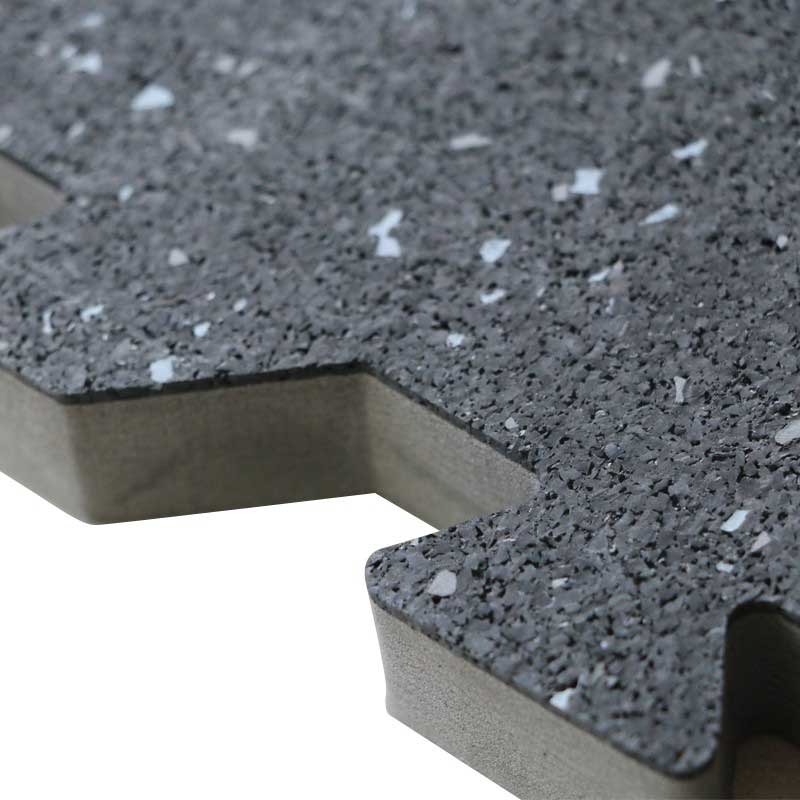
Equipment mats should be specified by load type. The foot of a treadmill, rack, bench, or machine creates a concentrated static load; moving equipment adds shear and abrasion. A mat can appear firm initially yet still retain an indentation after prolonged loading.
Build a representative loading plan by defining the contact area, load duration, floor type, and whether the equipment moves. Then inspect compression, recovery, slip, tear resistance, edge stability, and any risk of transfer or marking on that floor surface.
For home gyms, compare foam and rubber gym flooring for your planned activities. Hardness and thickness alone don’t determine suitability for equipment loads or dropped weights.
Hardness Is Not the Same as Compression Performance
Hardness provides a quick measure of indentation at a specific location and time. Real-world use depends on force level, load area, duration, repetition, temperature, and rate of movement. These differences explain why a product can meet a hardness target yet disappoint in use.
Compression force and stress-strain behavior
Compression testing describes how a foam responds when compressed. The response is often non-linear: the material may feel compliant at first, then become progressively firmer as the cellular structure compresses. At higher compression, it can reach a dense state where support rises sharply. The exact curve depends on the material, density, cell structure, thickness, and sample geometry.
Research on low-density polyethylene foam models this non-linear compression behavior for cushioning use. That work concerns packaging, not floor mats, but it explains why a foam response under load cannot always be approximated as a simple linear spring. You still need to test the mat’s relevant loading range.
For a mat buyer, a useful question is: under the expected load, how much does the finished product compress, and how consistently does it recover? That question is usually more revealing than asking only for a maximum hardness value.
Compression set and recovery
Compression set measures the permanent deformation remaining after a specimen has been compressed under specified time, temperature, and deformation conditions. You can also check recovery through product-specific tests after loading, rolling, folding, or installation.
Don’t assume a hard foam will always recover better, or that a soft foam will always take a set. Formulation, crosslinking, cell architecture, temperature, and use severity all matter. For B2B projects, specify the recovery test you need, especially when equipment will handle the product, it will be folded repeatedly, or it will be packed under compression during long transport periods.
Recovering its original thickness after compression does not tell you how a foam responds to impact. When comparing samples, distinguish foam rebound from cushioning performance rather than judging cushioning by a springy feel alone.
Impact and vibration are separate questions
Impact attenuation, vibration isolation, and static comfort are related but distinct. A construction designed to absorb a dynamic drop may not be the best for a person standing still, and a stable exercise surface may not be intended to protect a floor from a heavy dropped object. Define the event as one of the following: bodyweight movement, a kneeling load, a dropped item, a machine foot, a rolling cart, or long-term static storage.
This distinction is why performance claims should name the test and the use case. Do not use automotive, packaging, or sports-equipment foam research to make blanket promises for a consumer mat without validating the finished mat under its own conditions.
What adjacent foam industries can and cannot add
Research from packaging, automotive energy absorption, footwear, and sports equipment can still be useful when it explains mechanisms such as non-linear compression, repeated loading, cell morphology, abrasion, or crosslinking. It does not supply a ready-made specification for a foam mat. A packaging cushion is tuned for a specific impact event, whereas footwear and automotive foams operate under different geometries, surfaces, and duty cycles. Use adjacent-industry research to frame better development questions, then confirm the answer with the finished mat, its intended load, and its real handling conditions.
How to Build a Hardness and Thickness Specification
A good specification is short enough to use and detailed enough to prevent a disagreement. It should define the finished product before it defines its numbers.
| Specification item | What the buyer should state |
|---|---|
| Product and use | Mat format, intended user, floor type, expected loading, and key use condition |
| Material construction | EVA, XPE, TPE, PVC, or defined multilayer build, including cover or backing where relevant |
| Thickness | Nominal finished thickness, measurement locations, method, and tolerance |
| Hardness | Scale and method, sample condition, test locations, number of readings, and tolerance |
| Density | State whether it is core or finished-product density; link it to the density specification guide |
| Compression and recovery | Required test condition or product-specific load scenario and acceptance rule |
| Surface performance | Top texture, underside grip, abrasion or cleaning expectation, and visual standard |
| Dimensions and weight | Length, width, tile fit, edge shape, unit weight, roll diameter, and packing requirements |
| Acceptance | Golden sample, batch sampling plan, required reports, defect criteria, and lot traceability |
RFQ wording example
Use the following as a project template, not as a substitute for a mutually agreed test method:
Supply a finished
for [intended application], using [material and construction]. Nominal finished thickness: [value] mm, measured at [defined locations] after [conditioning]. Hardness: [scale and method], measured on [foam core or finished product] at [defined positions], with an agreed tolerance of [value]. Confirm density basis, finished unit weight, compression and recovery requirement, dimensions, surface condition, and packing format. Bulk production must match the approved golden sample and agreed acceptance criteria.
3D Kids Stickers
$2.29 Select options This product has multiple variants. The options may be chosen on the product page

This wording prevents three common failures: quoting a hardness scale without a method, measuring a foam core while approving a laminated product, and treating thickness as a substitute for application testing.
Add these physical requirements to a complete foam mat RFQ, together with order quantities, packaging, and delivery terms.
For a custom project, the design and customization process is the right place to align the construction, sample, and acceptance plan before bulk production.
Do not specify a number before agreeing on how it is measured
There is no value in setting a very tight tolerance if the buyer and supplier measure different samples, use different equipment, or apply different thickness force. ASTM D2240 describes durometer hardness as an empirical control test, while ASTM D3575 provides test procedures for flexible closed-cell materials made from olefin polymers. In both cases, the product-specific agreement remains decisive.
For a buyer, the sensible sequence is:
- Define the intended use and the finished construction.
- Approve samples that show the desired balance of cushioning, stability, surface behavior, and recovery.
- Record the measurement basis and the approved values from that sample.
- Agree production tolerances only after confirming the factory can measure and control them consistently.
- Use lot checks and finished-product inspection to verify that bulk goods remain aligned with the approved sample.
A Practical Sample and Inspection Plan
Laboratory numbers guide the development process. The finished sample determines whether the product suits its channel.
During sample development
- Compare at least two or three constructions that differ in a controlled way. Do not change material, thickness, hardness, texture, and backing all at once if you need to understand the result.
- Test on the actual floor surface or user condition where possible.
- Record the finished weight,nd pack dimensions, and physical properties. A thicker product may meet technical requirements but fail to meet retail freight or storage needs.
- Evaluate after realistic handling: rolling, folding, interlocking, cleaning, or loading.
- Keep a signed or clearly identified golden sample with the specification and test record.
During production and final inspection
- Check thickness across representative positions, not only the easiest central point.
- Confirm hardness using the agreed instrument and conditioning procedure.
- Verify density or unit weight against the defined basis.
- Inspect surface pattern, color, lamination, fold areas, interlock fit, flatness, and visible defects.
- Run the agreed compression, recovery, or functional test when the product use requires it.
- Review packaging compression, carton count, marks, and traceability alongside the mat itself.
The quality control process should connect these checks. A single passing hardness value does not compensate for incorrect thickness, poor tile fit, a damaged surface, or an unapproved construction change.
Common Mistakes When Selecting Foam Mat Hardness and Thickness
Copying a competitor’s number without a sample
Competitor listings may use a different scale, material, test basis, or finished construction. Use them to understand market positioning, not as a complete specification.
Treating a thickness label as a cushioning claim
More millimeters do not automatically mean better cushioning or protection. Consider thickness alongside hardness, density, compression response, and the actual load.
Treating hardness as a durability claim
A harder surface may resist initial indentation, but durability also depends on tear resistance, abrasion, fatigue, cell structure, backing, surface treatment, and use conditions.
Measuring only the foam core of a layered product
Core data can be useful, but a customer buys the finished mat. Film, textile, backing, adhesive, embossing, and edge construction can change how the product feels and behaves.
Combining unrelated test results
Do not take a dynamic impact result, a static hardness value, and a packaging compression test and present them as evidence of one universal performance benefit. Each test answers a different question.
Frequently Asked Questions
No. A thicker mat has more material between you and the floor, but a firm construction can still feel controlled and supportive. A thinner mat may feel soft initially but bottom out under a concentrated load. Select thickness and hardness together.
Not by itself. Hardness measures indentation resistance under a stated method. Durability also depends on tear resistance, abrasion, fatigue, compression set, surface construction, and conditions of use. Test the finished mat against the relevant use case.
Use the scale already appropriate to the material and factory test method, but specify it clearly. Shore and Asker results should not be treated as direct substitutes. Confirm the instrument, sample thickness, conditioning, measurement points, and tolerance before comparing supplier quotations.
Agree on the measurement locations and method before sampling. A patterned top surface, beveled edge, or fold line can create different readings. Use multiple points across the finished product and state whether the value is a center reading, an average, or a defined minimum.
No. Density is mass per unit volume, while hardness measures resistance to indentation. They can influence each other in comparable materials, but neither replaces thickness, compression recovery, or finished-product testing.
Start with the intended practice and product position. Decide whether the range needs closer floor feedback, extra cushioning for floor work, compact travel handling, or home-use comfort. Then sample the appropriate material, thickness, surface grip, and support balance together. For yoga-specific thickness positioning, use the Thick Yoga Mat Guide.
Make the Specification Match the Use
Hardness and thickness are powerful controls when they are treated as part of a complete foam-mat system. Thickness sets the available material and product format. Hardness helps describe initial indentation resistance. Density, cell structure, crosslinking, surface design, compression behavior, and loading conditions determine the finished product’s performance.
For custom EVA, XPE, TPE, PVC, or multilayer foam mats, start with the intended use, then develop a sample plan to test the final construction. The result is a clearer RFQ, fewer false comparisons between suppliers, and a specification you can check from development through bulk inspection. Where the result depends on the manufacturing route as much as a nominal number, review the relevant production process and equipment before locking the acceptance criteria.
Selected Research References
The following published research informs the technical context of this article:
- Liu Xin et al. (2024), A Study on the Effect of Different Materials of Yoga Mats on Key Biomechanical Indexes of Mat Exercise in Women. The four samples were all 6 mm thick and shared a foaming route and surface pattern. Its findings support a finished-mat comparison, not a universal ranking of material, hardness, or thickness.
- Ma Zhonglei and Zhang Guangcheng, Microstructure and Properties of Foam Plastics. Used for the relationship between cellular structure and macroscopic mechanical behavior.
- Fu Dongliang et al. (2024), Preparation and Properties of Radiation-Crosslinked EVA/OBC Foamed Materials. Used to show that formulation can simultaneously change rebound, strength, compression performance, and hardness.
- Hao Qi et al. (2026), Effects of Different Additives and Contents on the Foaming Process and Crystallization Behavior of EVA Foams. Used to show that crosslinker and blowing-agent levels influence expansion, hardness, elasticity, and toughness together.
- Zhang Dianbo et al. (2026), Effect of TPU on Cell Structure and Properties of EVA/POE/TPU Foamed Materials. Used for the limited point that cell refinement and formulation influence mechanical performance.
This research on packaging, automotive energy absorption, footwear, and other foam applications explains mechanisms, not automatic performance claims for NEEU mats. Relevant properties must be confirmed for the finished product using the agreed method and intended application. For density terminology, see ISO 845; for durometer-hardness context, see ASTM D2240; and for flexible closed-cell olefin testing context, see ASTM D3575.