
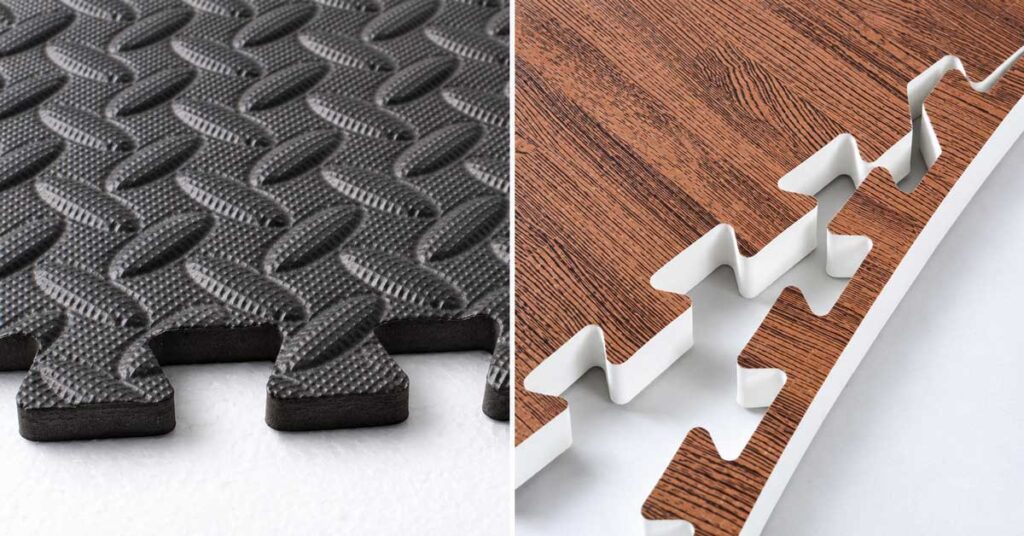
On a plain EVA mat, your hand touches the foam itself. On a film-laminated mat, you touch a thin layer bonded to the foam. The two interlocking floor tiles below show what that difference looks like at a cut edge. It tells you where to look for wear, but not which tile will last longer or take less work to clean.
First, identify the face you are buying
Look at the top, then at a factory-cut edge or puzzle tooth in good light. On a molded plain tile, the raised pattern is formed in the foam. “Plain” need not mean smooth: a solid-color tile can have pronounced ridges. On a film-faced tile, a thin skin may be visible where the design meets the cut edge. A flush, well-bonded film can be hard to see. Don’t pick at a corner to find it.
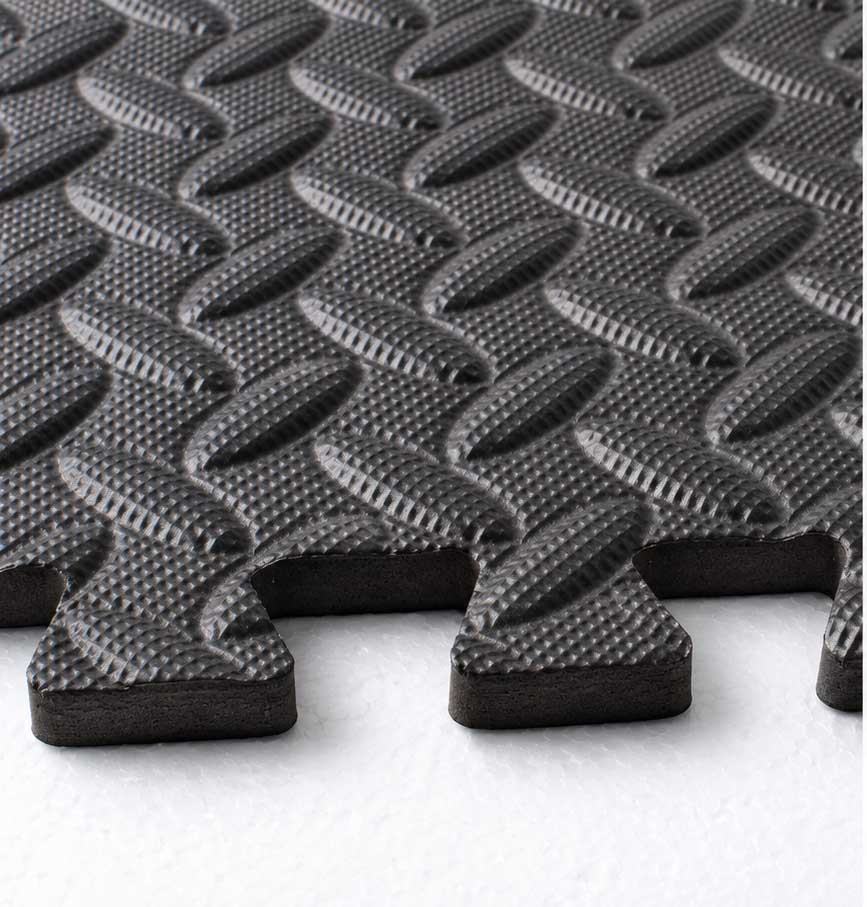
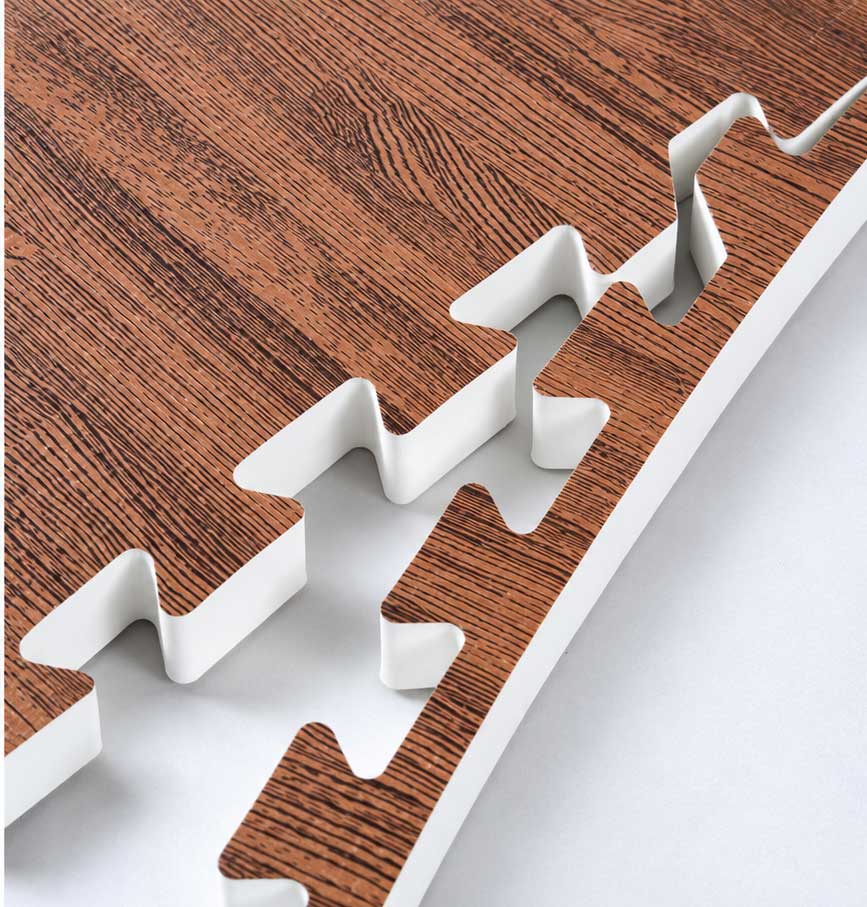
For an online purchase, ask one question: “From the top down, what layers are in this exact color and design?” A photo of the edge helps, but the seller’s construction description matters. Wood grain can be a molded texture, an image on film, or both. A printed logo can be applied directly to foam. And two colors visible at an edge may be two layers of foam, neither of them a surface film. The EVA surface-finishing options illustrate why “printed” and “laminated” are not interchangeable.
What changes under your hands and across the room?
Put both tiles on the same floor and press a palm or bare knee against each. Does the raised pattern press into your skin? Can you feel the grain you see? Either face can be textured, and the foam underneath also affects how the tile feels.
| What to compare | Plain, exposed EVA face | Film-laminated EVA face |
|---|---|---|
| Appearance across a joint | Directional ribs can change shade when one tile is turned. | A print can break at a seam even when the teeth fit perfectly. Check whether the design is meant to align. |
| Visible wear | Look at the tops of ridges for flattening, cuts or a change in sheen. | Look separately for a scuffed finish, a break in the image and a film edge lifting from the foam. |
| Replacing one tile | Match the connector, thickness, shade and texture direction. | Match those features plus print version and orientation. Ask whether individual pieces are interchangeable. |
A road that a child follows across four tiles needs the right pieces in the right positions; a scattered star print need not line up. For a wood-look floor, ask to see two tiles joined. Stand in the doorway: does the change in grain direction at the seam catch your eye?
If grip is your concern, distinguish a foot sliding on the tile from the whole tile shifting on the floor. The face is only one of those contact surfaces. The foam mat surface texture guide explains what to check beyond the pattern’s look.
Cleaning: compare the grooves as well as the finish
If the nuisance in your home is crumbs, inspect the narrowest groove and the joint. If it is muddy footprints, look at how readily a damp cloth reaches the low spots. A smooth film and a deeply embossed film need not clean alike. Likewise, a plain tile with shallow relief can be less work to wipe than its photo suggests.
Remove loose grit first so the cloth does not drag it across the face. Use the method listed for the finished mat. If the instructions allow damp wiping, wring out the cloth and try an inconspicuous spot before cleaning the whole layout. Let it dry before judging the result: a wet patch, dried residue and a permanent change in sheen can look similar at first. Don’t escalate to a scrub pad, solvent, steam or soaking just because a mark remains.
SGS tested a sample of the black leaf-textured model shown above. On a five-point scale, with 5 indicating the least staining, the test cloth received a staining grade of 4 after dry rubbing and 4–5 after wet rubbing.
A wipeable face does not seal an interlocking floor. After a spill reaches a joint, lift the affected pieces and check underneath. Let the mat and floor dry before reassembly. The guide to water at foam mat seams covers that problem; buying a laminated face is not a substitute for checking underneath.
Wear: distinguish a surface mark from a loose layer
A pale line across a dark tile might be residue, a scuff in the finish or a cut. Clean only as directed, let the area dry, then look across it in low-angle light. Does the line merely change the look, or is there a flap, opening or loose piece? On plain foam there is no top film to separate, but the foam can still tear at a tooth. On a laminated tile, a mark does not automatically mean the bond has failed: inspect the boundary between film and foam.
If the mark is flat and the surface remains intact, photograph it so you can see whether it changes. If a film edge stands up, a tooth has torn loose, or a damaged patch sheds pieces, take that tile out of use, especially in a child’s play area. Photograph the face and edge and ask about a matching replacement. Don’t pull back the film to see how far it lifts.
A side-by-side check before you commit
Choose samples of similar thickness and note any difference in the foam underneath. Even within EVA-based footwear foams, changing the formulation can change wear and compression behavior. That doesn’t predict a floor tile’s lifespan; it explains why differences between finished tiles aren’t necessarily due to the film.
Use the same clean, dry floor and lighting for the checks below. To compare ease of cleaning, use spare samples and the same amount of the same everyday soil on each. Wiping two clean tiles can reveal a change in appearance, but it won’t tell you how readily dirt comes off.
| Check | What to do on both samples | What to record for each |
|---|---|---|
| Surface and edge | Inspect one face and one factory-cut tooth; check the stated layer order. | Product code, stated face, photograph of the edge; note anything unconfirmed. |
| Joined appearance | Assemble two tiles in their intended orientation and view from standing height. | Visible gap, raised lip, direction change or print mismatch. Record which one you see. |
| Everyday contact | With the tile supported, press a hand or knee where you normally use it. | Whether ridges bother you or the tile shifts. This is a use observation, not a slip rating. |
| Routine wipe | If both labels allow it, use equivalent clean cloths, the same dampness and the same number of passes. Let both dry. | Residue in grooves, change in sheen, color on the cloth or a change at an edge. If care methods differ, record that instead. |
| Later wear | Photograph the same high-contact area again after comparable use. | Date, use and change since the first photo. A single wipe is not a durability test. |
If you expect to replace one tile at a time, ask whether matching singles are sold and whether the design calls for a particular piece in each position. A spare that fits the teeth but interrupts the road on a play mat isn’t quite a match. For a child’s play area, also check the age and use information for the exact product; the presence or absence of a film doesn’t settle that question.
For a retail order, request the two finished EVA mat options you are actually pricing. Keep the chosen tile, a photo of the joined layout and its care instructions together under the same product code. That gives purchasing, customer service and the factory a shared reference when a later shipment looks or feels different.