
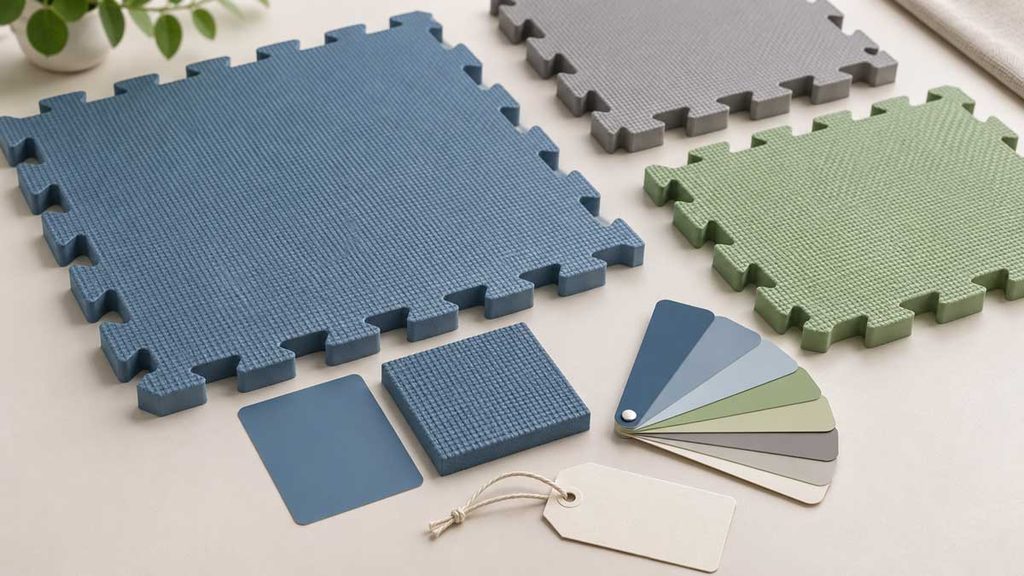
A color code gives a supplier a starting reference. To approve an EVA foam mat, you also need to identify the finished surface, compare physical samples under agreed conditions, and record which version you accept.
A useful color approval connects the reference, the finished sample, and the acceptance method. This guide explains what to send, how to review a submission, and how to resolve differences before signing off.
Define Which Surface You Are Matching
An EVA foam mat may show the foam’s own color, a printed design, or an attached surface layer. Identify the visible component before asking for a match.
| Color location | What to submit for approval |
|---|---|
| Solid-color foam face | A sample with the intended foam construction and final texture |
| Printed logo or pattern | The printed face on the intended substrate, with the artwork revision identified |
| Decorative film | The finished laminated surface, including its gloss or texture |
| Two-layer mat or contrasting edge | Each visible color and the assembled construction |
| Multi-color puzzle set | Individual colors, their quantities, and the full assembled arrangement |
Give separate identifiers to the top face, backing, border pieces, and printed elements where they have separate targets. “Match the blue” is ambiguous if the blue foam, printed logo, and retail box are produced on different materials.
Use the surface texture and print compatibility guide when selecting the finish. Confirm that finish before signing off its color.
Send a Reference Both Parties Can Identify
Include the complete color designation, reference system, suffix where applicable, and the physical reference used. A cropped screenshot of a swatch name leaves too much uncertain.
| Starting reference | Useful information to send | Decision still needed |
|---|---|---|
| Named color standard | Full designation, system, reference edition where relevant, and physical swatch identification | How it will be represented on the finished mat |
| Existing product sample | Sample ID, the exact area to match, its condition, and whether it is new or used | Whether the target is that sample’s current appearance or an earlier approved color |
| Brand artwork | Original file, color specifications, and the intended printed element | Approval on the actual substrate and finish |
| Photograph or screen color | Original image and an explanation of the intended shade | A physical reference or agreed finished sample before final approval |
Photographs are useful for communicating layout, marked areas and revision history. Camera processing, lighting and display settings make them a poor sole reference for a close physical match. Keep image-based feedback provisional until the sample has been assessed under the agreed conditions.
Where the starting reference and final material differ, make the approval target explicit. The buyer may accept the closest feasible finished-mat sample, request another iteration, or reconsider the finish. Record that decision rather than quietly replacing the original target.
Review the Final Texture and Construction
A smooth sample can help narrow a color direction, but it should not automatically approve an embossed tile. Gloss and surface condition change appearance; measurements that include specular reflection and those that exclude it also answer different questions. Konica Minolta’s explanation of SCI and SCE describes this distinction.
For final sign-off, identify the texture, print, film, and visible layers on the submitted sample. If any of those are still provisional, state exactly what the color approval covers and what needs another review. An approved foam color does not automatically approve a later printed or laminated face.
Review patterned mats both by individual color area and as a complete design. A small coupon cannot show whether repeated tiles create a visibly uneven layout or whether border pieces sit well beside the main tiles.
Agree How the Samples Will Be Viewed
Choose a defined primary viewing condition and, where relevant, an additional light source representative of the intended display or use. Keep the reference and trial sample side by side, with consistent orientation and surroundings. Record the viewing setup so the next reviewer can reproduce it.
When two samples match under one light but differ under another, the mismatch is called metamerism. Compare the reference and trial sample together under each agreed light. Looking at one sample in the office and another beside a window does not provide the same comparison.
Specify which lighting condition governs acceptance and whether an additional condition must also pass. If the pair matches in the primary condition but differs under the second, record the difference and refer it to the designated buyer for a decision. Do not treat the first match as approval under every light.
The Atlas guide to color measurement explains why illuminant, observer, and specimen conditions belong with the result. For a mat approval, use those principles to define a repeatable comparison rather than judging samples under changing office lights.
Ask reviewers to describe the difference they see: lighter, darker, redder, greener, yellower, or bluer, and under which condition. “Not quite right” gives the supplier little direction. Mark the relevant sample ID in every response.
Specify More Than a Delta E Limit
Delta E summarizes a calculated color difference, but “Delta E below 2” is an incomplete specification. Name the formula, measurement setup, reference, and acceptance rule. CIELAB ΔE*ab and CIEDE2000 ΔE00 are different calculations; their numerical limits should not be substituted for one another.
Ask for the formula to appear on the report alongside the result. If your team calculates CIEDE2000 independently, validate the implementation against the published reference test data before using it for acceptance.
Agree the following with the supplier or color laboratory:
- The instrument, calibration/check procedure and measurement geometry.
- Whether the specular component is included or excluded, where applicable.
- Illuminant, standard observer and color-difference formula, including relevant settings.
- Aperture, sample support or backing, orientation and a repeatable way to present the foam without inconsistent compression.
- Measurement locations, repeat readings, and how the results will be summarized.
- The numerical limit, visual criteria, and the action to take if those assessments disagree.
Decide whether the rule applies to each measured location, an average, the maximum difference, or another agreed result. Keep local variation visible: an average alone may not describe a noticeably different patch or tile.
No single ΔE limit is established here for every EVA color, texture, or application. Set the requirement using representative finished samples and the buyer’s needs. If the first trial cannot meet it consistently, resolve the target or process before production approval.
Mark the areas to measure
For a multi-color mat, mark the intended measurement areas on a diagram or sample photograph. Confirm that the selected aperture measures the intended color without including a neighboring print, border or exposed edge. If a feature is too small for the available instrument, agree an appropriate method with the laboratory rather than reporting a mixed-area reading as that feature’s color.
Use the same orientation, support, and sample presentation for the reference and trial. Record any backing used and avoid changing how firmly the foam is held between readings. Specify representative locations across the face instead of choosing only the best-looking spot.
Inspect the whole mat separately for streaks, patches, contrasting specks, and differences between adjacent same-color tiles. Record those observations as appearance findings; a passing average color difference does not close them automatically.
Resolve different results before requesting another sample
Different instruments can produce different results because of their design, calibration, and sample presentation. Inter-instrument agreement needs checking when buyer and supplier measurements are used together.
If the reports disagree:
- Confirm that both parties measured the same sample revision against the same reference.
- Compare the formula, illuminant, observer, geometry, and relevant instrument settings.
- Check the marked locations, orientation, backing, and presentation method.
- Arrange a comparison using the same physical specimens to help separate specimen differences from method differences.
- If the disagreement remains, use the reviewer or laboratory named in the approval plan. Keep the decision pending until the agreed acceptance process is complete.
Do not average conflicting reports or change settings simply to obtain a pass.
Move From Trial Samples to One Approved Version
Keep each sampling round identifiable
Assign an ID to every submitted version and keep its construction details with it. Feedback should identify the reference, sample, viewing condition, and requested change. When a sample is rejected, retain the decision so it cannot later be mistaken for the approved master.
Approve the whole retail color assortment
For a multi-color set, record each color and its quantity. Review the intended arrangement, including borders and any same-color pieces that must sit next to one another. Matching a tile to its reference and matching adjacent tiles within a set are related but separate checks.
Do not approve a complete assortment from a photograph of one top tile. Confirm the actual colors represented in the submitted set and identify any still awaiting approval.
Record what the approval does—and does not—cover
An appearance approval does not establish resistance to rubbing, cleaning, sweat, or sunlight. Those are separate requirements for the finished construction. Keep the relevant test plan with the complete foam mat sample approval record; do not turn “color approved” into approval of every product characteristic.
Separate Color Direction from Final Approval
An early color chip can narrow the shade without representing the finished mat. Record whether a submission is a trial coupon, a finished prototype, or a production-representative sample, and identify any differences in construction or manufacturing conditions that still need confirmation.
Use explicit approval states so that a favorable comment does not become an unintended production release:
| Status | Meaning and next action |
|---|---|
| Revision required | Record the rejected sample ID, reason, and requested change; submit a new identified version |
| Color direction accepted | Use the shade as a development target; review it again on the specified finished construction |
| Conditional approval | List the unresolved items, responsible person, and permitted next step; do not assume this authorizes production |
| Final color approval | Identify the accepted finished sample, method and scope, with authorized sign-off; manage any production release separately |
For example, in an illustrative two-color puzzle set, a buyer might accept the shade of a smooth gray trial while the blue embossed tile is ready for approval. The gray still needs review on the specified texture, followed by a comparison of both colors and the borders in the assembled set. The record should show which item remains open rather than marking the whole set “approved.”
Color Approval Sheet
Use one record for each color and connect the records to the complete SKU or assortment. Empty fields are items to resolve before final color approval.
| Field | Information to record |
|---|---|
| Product identity | SKU, construction revision, dimensions and intended use |
| Color location | Foam face, backing, border, printed area or film; diagram if needed |
| Starting reference | Full designation, system, physical reference ID and condition |
| Trial sample | Sample ID, date, finish, construction, sampling revision, and whether the sample represents production |
| Visual comparison | Lighting, surroundings, orientation, reviewer and result |
| Instrumental method, if used | Instrument, geometry, SCI/SCE where applicable, aperture, backing/support, illuminant and observer |
| Calculation and acceptance | Formula/settings, locations, summary rule, agreed limit and visual acceptance criteria |
| Assortment | Colors, quantities, border assignments and assembled-set review |
| Approval status | Revision required, color direction accepted, conditional or final; permitted next step and unresolved actions |
| Dispute resolution | Common specimens, method comparison and designated reviewer or laboratory |
| Final master | Approved finished sample IDs, governing reference, decision date and authorized signatories |
| Remaining limitations | Unapproved components, excluded performance claims and outstanding actions |
| Retention and changes | Who holds each reference, storage instructions, revision control and reapproval triggers |
If the retained physical master differs from the initial color standard by an accepted amount, document which reference governs routine acceptance and which remains the design target. Avoid leaving the supplier and buyer with different interpretations of “approved.”
Keep the Approved Color Connected to Production
Protect reference samples from contamination and unintended exposure, and follow a documented storage and replacement procedure. A worn or changed reference should not quietly become the standard for a new order.
Before a repeat order, review changes to the material, finish, artwork, or reference itself. Where new stock must sit beside older stock, state that requirement explicitly. The batch consistency guide covers production checks and repeat-order control; the color approval file supplies the reference those checks depend on.
Frequently Asked Questions
A Pantone reference can start the sampling discussion. Provide its complete designation and the intended mat surface, then approve the result on the finished construction. Do not assume that a reference on another substrate guarantees an identical appearance on foam.
Use photographs to identify samples and discuss changes. For a close physical match, approve the actual sample under agreed conditions rather than relying solely on a screen image.
Agree it for the finished product, with the formula and measurement conditions stated. This guide does not prescribe a universal limit. Representative samples help both parties understand what the numerical rule accepts and rejects.
Hold the decision and check the reference, viewing conditions, instrument settings and sample presentation. Apply the agreed visual and instrumental acceptance rules. Do not keep changing settings until one result passes.
No. Initial color matching and color retention after use or exposure are different evaluations. Specify the relevant exposure and assessment separately if that performance matters to the application.
Prepare Your Color Brief
For a NEEU project, send the reference identification, intended color location, finish, color assortment and any customer-specified evaluation method. Include physical references where available and identify any requirements still open. Discuss your color and sample requirements with NEEU before treating a screen mock-up as the final approval.