
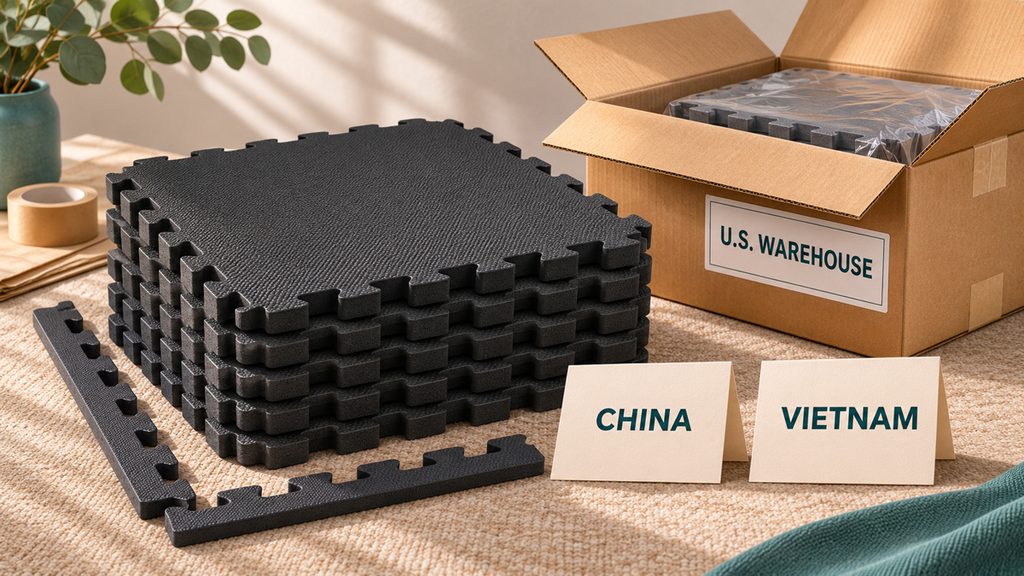
For a U.S. foam mat order, compare the cost of delivering one approved retail set to the same warehouse. A six-tile pack that costs less at the factory can cost more on arrival if fewer packs fit in each carton. A quote shipped from Vietnam is not, by itself, evidence of Vietnamese origin. Resolve those two questions before choosing a production site.
Which NEEU site should quote your order first?
Start with China for a small trial or a technically demanding mat. If you need a few dozen sets to test a retail range, tell our sales team the quantity, the number of designs and whether an existing die will work. Our China team can review small runs and arrange less-than-container-load (LCL) quotes through its freight network. A few dozen sets is an inquiry example, not a minimum we promise for every design. A custom die or several print changes can make a short run uneconomical even when space on a vessel is available.
If your cartons would fill roughly a third of a container, send their outside dimensions, count and U.S. delivery ZIP code. Ask for both a consolidated shipment and a full-container quote to the same destination. Compare the total including consolidation, destination handling and final delivery, not just the ocean rate. In our sales team’s experience, small consolidated orders are often easier to price competitively from China than from our Vietnam site.
Include Vietnam for a large repeat order with a settled specification. A long run of the same tile, finish and retail pack is the kind of order our Vietnam team prefers to quote. If your current order is a pilot but you expect regular replenishment, give us both quantities: quote the pilot from China and assess Vietnam separately for the repeat run. Confirm the die, approved sample and carton layout at the proposed site before treating the two quotes as interchangeable.
For a standardized order where the goods and logistics quotes come back close, U.S. duty can decide the result. For a small shipment, freight and handling per set can settle the question first. Freight is what it costs to move the cartons; duty is a separate customs charge. Compare the two lines separately rather than assuming either country always wins.
Start with one mat, not two price lists
Suppose you need six black interlocking EVA tiles per retail pack. “Six black tiles” leaves room for two factories to quote different products: one might include border strips, the other might not. Even a small change in finished thickness can change carton depth across a stack. Fix the tile dimensions, assembled coverage, thickness tolerance, face texture, connector profile, border count and pack contents before you compare prices.
Send the same drawing revision, quantity, delivery address and required arrival date to both sites. Use the foam mat RFQ template if you need a specification sheet. Ask for the named port or delivery point, Incoterm and quote expiry. An FOB price from one factory and a delivered price from another are not two entries in the same price column.
Find out what each factory actually makes
Ask each site to return the following information for the quoted SKU. A site that can make the tile but cannot yet reproduce the required connector is not a qualified alternative for a replacement-tile program.
| Ask for | What to check |
|---|---|
| Incoming materials | Does the site receive resin and additives, foam sheets, surfaced blanks or finished tiles? Where are they made? |
| Manufacturing steps | Record where compounding, foaming, lamination or printing, die-cutting and packing take place. Identify any subcontracted step. |
| Tooling and finished sample | Is the correct die at the proposed site? Will its teeth mate with a retained tile from your current stock? Who approves the first sample? |
| Packed shipment | Get retail sets per carton, measured outside carton dimensions, gross weight and a loading plan for the actual shipping mode. |
| First order versus reorder | Separate sample approval, tooling, and first-production lead time from repeat-order lead time. Identify the last date to release the purchase order. |
Two factory addresses can still share a bottleneck. Production disruptions can travel through supplier networks beyond the location initially affected. For mats, the practical question is specific: if both sites need the same printed film or the only approved die, what can the second site ship while that input is unavailable?
Verify U.S. classification and origin before pricing the duty
Classification: Give your U.S. customs broker the material and layer description, photographs, dimensions, intended use and contents of the imported pack. Don’t copy a tariff code from a competing listing or assume a yoga roll, a puzzle floor tile and a printed play set share one classification because all three contain foam. Ask for the proposed U.S. HTS provision and the reasoning for this particular article.
For an interlocking EVA floor tile, one tariff line to review with your broker is HTSUS 3918.90.10.00, for floor coverings of other plastics. The 2026 HTS Revision 23 lists a 5.3% Column 1 general rate for that provision. This is not a total duty estimate for either production route. Confirm the classification of the finished tile, then check any additional duties applicable to its origin and entry date.
Origin: The shipping port tells you where the cargo leaves, not necessarily where the article originates for the measure in question. If foam sheets are made in one country and cut, finished or packed in another, disclose both stages. Do not assume that cutting establishes origin, or that it never can. Have the broker assess the applicable rule against the actual inputs and operations. A packing list or a country name on the invoice is not a substitute for those facts.
Duty estimate: Check the current U.S. Harmonized Tariff Schedule for the expected entry date. Ask the broker to record the classification, origin basis, customs value, ordinary duty and any applicable Chapter 99 provisions, exclusions or other trade remedies. Confirm the effective dates. If there is material uncertainty, review comparable decisions in CBP’s customs rulings database and consider seeking a binding ruling on the proposed transaction before committing to production. Another importer’s ruling is not a decision on your SKU.
Keep duty separate on the quote sheet. During the 2018 U.S. tariff increases, import prices inclusive of duty rose rather than foreign suppliers generally cutting prices enough to absorb the charge. That historical evidence on tariff pass-through is a reason to budget the charge explicitly, not a prediction of today’s rate or of how your supplier will negotiate.
Worked example: how much duty savings would change the order?

Assume 2,400 identical six-tile sets, one U.S. warehouse and the same delivery window. Both options are quoted FOB at their respective named ports. All figures below are invented for comparison, not NEEU prices, actual factory packing capabilities or current tariff rates. Assume all sets arrive saleable. The logistics estimates cover freight, insurance, handling, brokerage, other entry fees and delivery, but exclude customs duties.
| First-order input, USD unless noted | China quote A | Vietnam quote B |
|---|---|---|
| FOB price per retail set | $8.00 | $8.30 |
| Goods total for 2,400 sets | $19,200 | $19,920 |
| Sets per export carton | 8 | 6 |
| Cartons required | 300 | 400 |
| Outside volume per carton | 0.10 m³ | 0.09 m³ |
| Total packed volume | 30 m³ | 36 m³ |
| Quoted logistics to the warehouse | $3,000 | $3,600 |
| One-time setup paid separately | $0 | $480 |
| Total before duty | $22,200 | $24,000 |
| Cost per set before duty | $9.25 | $10.00 |
Decision: B needs more than $1,800 less in total duty than A to win the first order on landed cost alone. Exactly $1,800 less is a tie. If the broker’s two estimates differ by just $1,200 in B’s favor, B still costs $600 more, or $0.25 per set. On a repeat order with no further setup charge and all other figures unchanged, the break-even duty difference falls to $1,320.
Use actual duty dollars for each route, not a rate difference multiplied by one common invoice value. Ask the broker whether separately paid tooling or other items affect customs valuation. The setup payment belongs in your commercial cost calculation once; its treatment for duty is a separate question. Likewise, don’t add freight twice if it is already included in a delivered quote.
The carton figures explain why the freight quotes merit a second look; they are not a freight tariff. Confirm the carrier’s actual basis, minimum charges and loading constraints. For the details to request from the packer, see the retail-pack and carton specification guide.
Decide when to stay, switch or qualify a backup
Keep the current site when the alternative’s apparent savings depend on an unconfirmed origin decision, an unapproved sample, or an untested loading plan. Mark those fields as open rather than entering zero. A slightly cheaper estimate is of little use if the goods miss a retailer’s delivery appointment.
Move the order when the second site’s sample is approved, its route is documented, and the landed-cost or delivery advantage survives updated freight and duty estimates. If these are replacement tiles, check one new tile against existing stock, not just against another tile from the new run.
Qualify a backup without moving the whole order when supply continuity matters more than the immediate unit saving. Establish which materials, dies and artwork the backup can access independently. Check the manufacturing address and product description against the factory and product documentation your customer requires. Agree in writing on what must be reapproved if the site, formulation, film or packing method changes.
For a two-site NEEU quote, send the SKU drawing, pack count, order quantity, U.S. delivery point and required arrival date. Ask first which steps each site can perform for that exact mat. Then request a packed-carton quote and a dated duty estimate from your broker. Those are the numbers that decide the route, not the country names at the top of the quotations.