
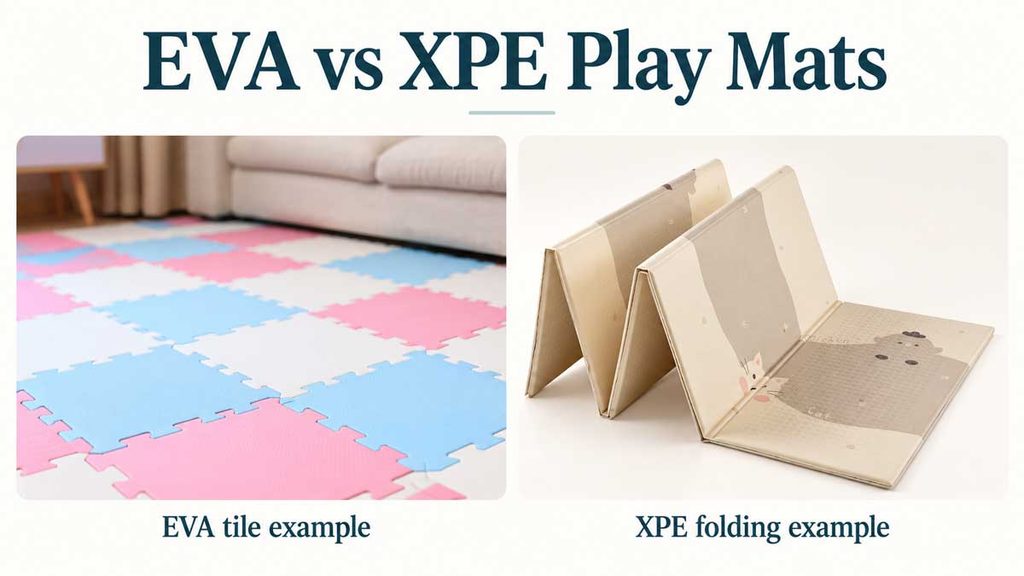
EVA and XPE play mats can both work for supervised floor play, as long as the finished product suits your child’s age and intended use. The useful comparison is between the mats you would bring home: their surface, firmness, edges, cleaning needs, and fit in your room. Neither foam name alone establishes safety, comfort or service life.
This guide uses EVA interlocking tiles and an XPE folding mat as familiar product examples. Those combinations are not definitions of the materials. Folding, rolling, and puzzle connections describe the product’s design; EVA and XPE describe its foam.
If you need to clear the room every evening, start with a connected folding mat that fits your storage space and lays flat. If you need to adjust the play area’s shape, consider an age-appropriate tile system with well-fitting joints and available replacements.
This guide covers supervised, awake floor play. Tummy time should happen while a baby is awake and closely supervised; a regular floor play mat is not an infant sleep surface. Follow the American Academy of Pediatrics’ guidance on awake play and safe sleep.
What EVA and XPE Actually Tell You
EVA stands for ethylene-vinyl acetate, a copolymer used to make foam. XPE means cross-linked polyethene. EVA foam can also be cross-linked: the names describe the materials differently, rather than dividing mats into “cross-linked” and “not cross-linked.”
A finished mat may have a foam core, printed film, coating, bonded layers or separate backing. An exposed foam face and a laminated face put different surfaces in contact with your child, even when the core carries the same material name. Ask for the complete layer description.
Use the model’s specification to identify the material. Color, smell, bounce and folding ability are not reliable ways to identify EVA or XPE at home. If a listing uses EPE, IXPE or several foam names, ask the seller to clarify the core and each added layer; similar abbreviations are not interchangeable product specifications.
Which Differences Are You Actually Comparing?
An EVA tile set and an XPE folding mat may differ in several ways. Use the following distinctions to make sense of what you see:
| Difference you notice | What may explain it | How it affects your choice |
|---|---|---|
| One mat is a tile set; the other folds as one piece | Product format and joint or hinge design | Tiles allow layout changes; a connected folding mat keeps the sections together during storage |
| One face is bare foam; the other has a printed film | Surface construction, not just the core material | Compare what the child touches, care restrictions and the condition of the edges |
| One feels softer under pressure | Foam formulation, density, thickness and surface layers | Compare similar constructions on the intended floor before attributing the feel to EVA or XPE |
| One has deeper grooves or visible joints | Embossing, folds or puzzle connections | Consider contact comfort, cleaning access and whether the assembled surface rests evenly |
| One is heavier to carry | Area, thickness, foam density and added layers | Use the complete product’s weight; compare similar usable areas |
Start With the Room and Your Daily Routine
Measure the space available for the mat with doors, drawers and cupboards in use. Include the finished borders or perimeter, rather than relying on a tile count or a photograph of an empty room. Keep the play area away from stairs and other hazards; a mat is not a barrier.
For a folding mat, measure where the closed stack will go. For tiles, allow room for the complete stack and border pieces. Check the carrying weight if you will move the set between rooms.
A Shared Living Room Cleared Every Evening
A connected folding mat can simplify setup because there are fewer separate pieces to collect. Compare the actual folded size, carrying weight and opening routine. Check that the panels lay flat as instructed and that the folds don’t leave raised ridges in the play area.
A connected folding model has a defined open footprint, so check the whole rectangle against the room. You cannot reduce it by leaving out a panel, as you could with a tile.

A Play Area That Stays in Place
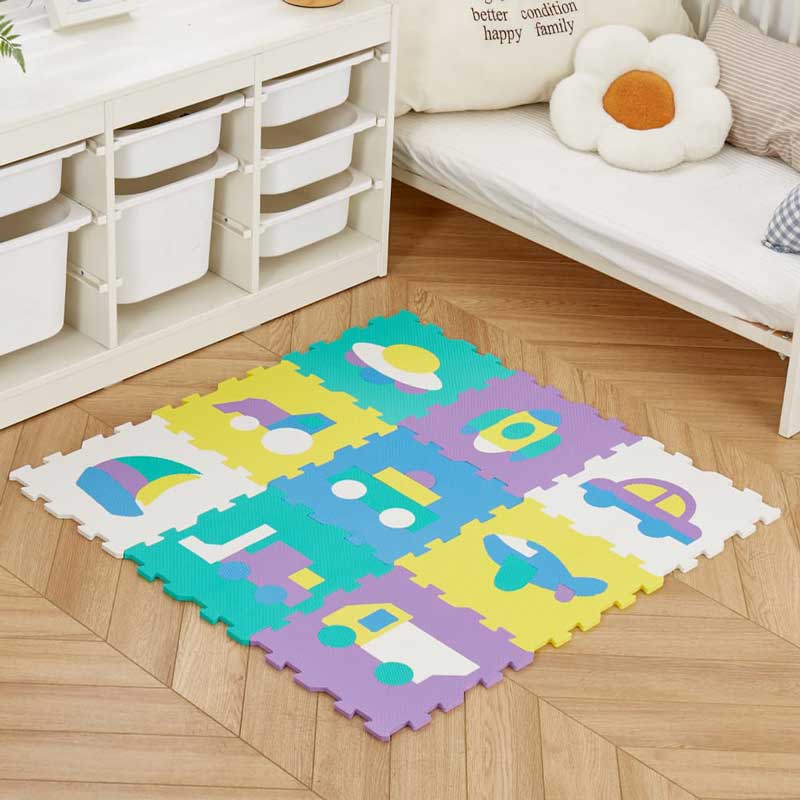
Interlocking tiles can help when the layout needs adjusting, or an individual damaged piece needs replacing. Ask whether matching replacement tiles will remain available. The same nominal tile size does not guarantee matching puzzle teeth or thickness.
Separating tiles gives access underneath, but reassembling a large area takes time. Our comparison of interlocking, foldable and roll-up mat formats follows each design from setup to storage.
A Space With Frequent Spills
A continuous surface avoids open tile joints, which may make wiping up easier. Still inspect fold grooves, the perimeter and any damaged surface layers. A folding mat isn’t automatically leakproof, and a water-resistant foam core won’t keep every spill off the floor.
Choose a size you can lift and leave exposed to dry when needed, not just one you can wipe down.
A Worked Choice: EVA Tiles or an XPE Folding Mat?
This is a hypothetical buying example, not a test or comparison of named products. Assume both candidates have suitable age guidance, permit use on the family’s hard floor, and include relevant product information the buyer has checked.
The family uses the living room for play during the day and clears it every evening. Both options fit the open play area and the designated storage space.
- Option A: EVA interlocking tiles. The layout can be adjusted around a recess. Matching replacement tiles are available, but the family would need to separate and stack the pieces each evening.
- Option B: an XPE folding mat. It opens to a fixed rectangle and folds into a connected stack. Its complete folded size fits the cupboard, but a damaged fold or surface could mean replacing the whole mat.
For this family, choose Option B if its contact feel and cleaning routine are acceptable. Daily packing is the main task; adjustable coverage provides little benefit in their rectangular play area. They accept less flexibility and whole-mat replacement in return for simpler handling.
Change the room, and the choice can change. If the folding mat blocks a doorway, exclude that size. A compatible tile layout that keeps the doorway clear may be a better purchase, especially if the area will stay assembled.
Compare the Surface, Edges and Joints
Look closely at the finished surface. When buying online, ask for photos of the edges, underside, and fold areas, as well as the decorated top.
For either material, check:
- Surface condition: no loose film, lifting layers, exposed adhesive, cracks or damaged printing.
- Texture: how raised patterns or recessed grooves feel during normal contact, and whether you can clean them.
- Perimeter: edges that lie as intended, without loose trim or damaged corners.
- Product identification: an age range and intended use that match your child, rather than a generic exercise-floor description.
For puzzle mats, examine the assembled joints and any removable letters, numbers or border pieces. A large main tile doesn’t indicate whether its detachable components suit a younger child. Check the stated age restrictions and warnings for all included pieces; small-parts suitability requires product-specific assessment.
For folding mats, inspect the hinge areas as the mat is opened and closed normally. Look for splitting, lifting film, or a fold that prevents the panels from lying flat. Follow the designed folding direction instead of forcing a new crease.
Check Grip at Both Contact Surfaces
The top surface and the underside have different jobs. On top, check contact with hands, knees, and the clothes or socks used during normal play. Look for unexpected slipping or an uncomfortable texture; a decorative embossed pattern doesn’t prove good grip.
Underneath, check that the mat stays in its intended position on a clean, dry, compatible floor. Look for a moving panel, a lifting perimeter or a joint that opens. A rough-feeling top doesn’t indicate how the backing grips your floor.
Check the setup before the child uses the area, then watch for movement during supervised, age-appropriate play. Stop using an unstable setup and consult the seller. These normal-use observations help you spot a problem; they do not establish a slip-resistance or fall-protection rating.
Compare Firmness on the Floor You Will Use
A thumb press can help you notice how readily two samples compress. It cannot tell you how much protection they provide during a fall, or how either will feel to a child under different loading.
Foam yields as its cells deform. As it approaches densification, it has little compression travel left, and the force needed to compress it further rises sharply. That is why a soft first touch does not tell you how a mat will cushion under a different load. In cross-linked PE foam specimens, density affects compression and impact response under defined loading conditions. This evidence helps explain the compression behaviour; it does not compare finished EVA and XPE baby mats or establish a baby-mat fall-protection rating.
If possible, compare samples with similar thickness and surface construction. Otherwise, you may be judging a thick laminated mat against a thin bare-foam tile and attributing every difference to the base material.
On a hard floor, consider the complete mat’s feel and whether its underside stays in place. On carpet, first confirm that the manufacturer permits that installation. Carpet and underlay change the support beneath the mat, so a setup that looked stable in a showroom may behave differently at home.
Do not stack unrelated mats to create an assumed safer surface. For detailed thickness decisions, use our guide to baby play mat thickness, firmness, and floor type.
Which Is Safer: EVA or XPE?
Both candidates should have safety information that matches the finished mat and intended age group. Review detachable parts, edges and surface construction alongside chemical information. Resolve these checks before using softness, print or price to make the final choice.
Ask What the Report Actually Covers
For a household purchase, start with three questions: does the information identify the model and size you are buying, does it cover the intended age group, and can the seller explain what was tested? Photographs and a layer description help connect a report to the offered mat. A report for an unprinted foam sheet leaves questions about a printed, laminated product.
Our guide to foam mat reports and certifications explains the document types. You don’t need to do a lab review yourself, but the seller should be able to answer basic questions about identity, age suitability, and care.
If those details are missing, ask before ordering. Keep a product out of the final shortlist while essential questions remain unanswered. Missing public information is a reason to seek clarification, not proof that the mat is toxic or unlawful.
Treat “Free From” Claims as Specific Claims
“BPA-free” answers a specific substance question. A formamide claim answers a different one, and neither replaces checks on removable parts or surface condition. Ask which product and substances the evidence covers. Formamide and formaldehyde are different substances; a result for one should not be presented as a result for the other.
Finished products with the same foam label can have different volatile chemical profiles. Read the method as well as the result: a heated laboratory screen identifies substances under that procedure, rather than directly measuring what a child breathes in a room.
Smell is not a substitute for that information. An absence of noticeable odor does not demonstrate that every relevant chemical requirement has been met. If a new mat has an unexpected persistent odor, set it aside and ask the seller about the exact product, care instructions and return options. Airing it for a fixed number of days is not a substitute for resolving the concern.
Cleaning and Storage Should Fit Your Household
Read the care instructions before purchasing. “Wipe clean” is not permission to soak, machine-wash, steam-clean or disinfect the mat with any household product. The surface, printing and bonded layers can impose restrictions beyond those of the foam core.
Choose a mat whose approved routine you can maintain. Check access to grooves, joints and the underside; dry affected surfaces and the floor before putting the mat back or packing it away. Our foam mat water-resistance and cleaning guide explains why a dry-looking top can leave moisture underneath.
Allow drying space as well as storage space. Keep straps, storage bags and packaging away from the child’s play area.
Look at the Parts That Will Be Handled Repeatedly
For tiles, ask to see the puzzle teeth and perimeter pieces up close. If a joint tears, a compatible replacement tile may restore the set, provided the remaining pieces are sound. For a folding mat, check the fold lines and any film or bonded edges: damage there can affect a connected section and may require replacing the whole mat.
Inspect those areas during routine cleaning. Peeling film, loose pieces, split folds or joints that no longer stay together are reasons to stop using the affected mat and seek replacement advice. Follow the manufacturer’s replacement or approved repair instructions. These details give you a practical way to compare upkeep without assuming a fixed lifespan for either foam.
Compare Cost Over the Same Usable Area
Compare the price of the complete setup you need, including necessary borders and any storage accessories, rather than the lowest advertised price per piece. Confirm whether the quoted dimensions describe a single tile, the assembled set or the entire folding mat. For a tile option, calculate the tile and pack quantities for your finished layout before comparing it with the price of a complete folding mat.
Include the likely replacement unit in the comparison: a compatible tile, a repairable component where offered, or the whole mat. Check spare-part availability and return conditions for an opened product before ordering.
A Checklist for Your Two Final Choices
Use the same questions for both products. Record missing information as missing rather than filling it in from a general description of EVA or XPE.
| Detail to record | What a useful answer looks like |
|---|---|
| Product identity | Exact model, size variant, intended age and use |
| Complete construction | Foam type plus surface, printing, backing and bonded layers |
| Open footprint | Finished length and width, including the chosen perimeter |
| Thickness | What is included in the measurement and whether folds or recesses differ |
| Floor compatibility | Instructions for your floor type, with any installation restrictions |
| Edges and components | Joint or fold details; detachable parts and relevant warnings |
| Cleaning | Approved method, cleaner restrictions and drying instructions |
| Storage | Actual packed dimensions, weight and folding or rolling instructions |
| Supporting evidence | Documentation that can be matched to the offered product |
| Replacement and return | Matching spare-part availability and conditions for opened products |
Resolve age suitability, floor fit and essential product information first. Then choose the better everyday fit among the remaining candidates: one you can lay flat, maintain and store properly.
For Brands Comparing EVA and XPE Samples
Request finished retail-representative samples, including the intended print, surface layers, edges and packaging. A small plain foam swatch cannot show joint fit, folding behaviour, or the cleaning access of the complete mat.
Record which variables differ. To compare two foam options, keep the other relevant specifications as close as practical. To compare two saleable products, evaluate the complete designs and avoid presenting their differences as a controlled material experiment.
For the US market, identify the applicable children’s product rules and testing or certification requirements, including relevant exceptions. The CPSC’s Children’s Product Certificate guidance explains who is responsible for the certificate and what information is required. A CPC is not a government-issued material recommendation.
For the EU, first confirm the product’s intended use and classification. If it is a toy, use the European Commission’s toy-safety guidance to check the applicable conformity assessment, documentation and marking requirements. A play-mat name alone does not settle that classification. Match the documentation, labels and responsible business to the actual product and target market; one chemical test does not cover every physical or chemical requirement.
Agree on applicable testing, care instructions, acceptance criteria, and changes that require reapproval. Use the foam mat sample approval checklist to retain those decisions. For substance claims, include the method and reporting limit in the review. NEEU’s baby and kids play mat range is a starting point for discussing formats and requesting information for the proposed construction.
Common Questions
Either finished product can feel softer. Formulation, foam density, thickness and surface layers all affect the feel. Compare similar thicknesses on the intended floor, then consider flatness and support as well as initial softness.
A tile system can allow local replacement if a matching tile is available and the rest of the set is sound. A connected folding mat may need to be replaced as a whole if a fold or bonded surface fails. Check the seller’s replacement options before choosing; the foam name does not specify the replacement unit.
No. Carrying weight also depends on area, thickness, foam density and added layers. Compare the actual weight of the complete mats you would buy. A smaller mat being lighter does not establish a material advantage.
Only where the exact product’s instructions permit it. Portability does not establish resistance to sunlight, outdoor wear or prolonged heat. For a heated floor, check both the mat instructions and the flooring or heating-system requirements instead of choosing by EVA or XPE alone.
Not without a specific, supported claim. Ask whether the seller means verified recycled content, a documented production measure, longer usable life or a collection route for the finished product. Do not assume either mat belongs in household recycling because of its foam name. Check local acceptance for the actual layered product, and avoid buying unnecessary area or accessories.