
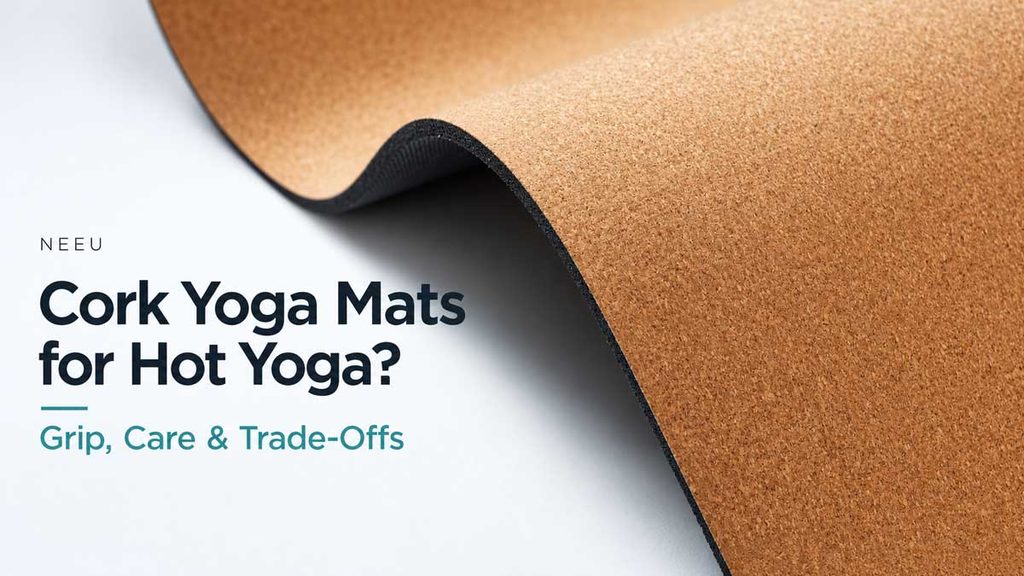
Yes, a cork yoga mat can be a good choice for hot yoga if it grips well throughout your class, the backing supports you, and you can clean and dry it properly afterward. Check the dry opening poses and the sweaty part of practice. A surface that feels secure with damp hands may feel different at first.
Cork is a practice-surface choice, not a complete description of the mat. The layer underneath affects cushioning, floor movement, and weight-bearing. The bond between layers and the care instructions also matter.
Use the whole routine to decide: preparing the mat, practicing, cleaning it, taking it home, and storing it for the next session.
When is a cork mat a good fit for hot yoga?
Shortlist a cork mat if you like the feel of its surface, the finished model is intended for heated practice, and its prep and drying requirements fit your routine. You should be able to move through familiar poses without the surface bunching or either contact point slipping.
Another construction may suit you better if dry-start grip remains unreliable, carrying the mat is awkward, or you have nowhere to dry it between classes. Those are useful reasons to choose differently, even when you like the appearance of cork.
| Your priority | What to check on a cork mat |
|---|---|
| Secure contact before warming up | How your dry hands and feet feel on the prepared surface |
| Grip during a sweaty class | Contact as perspiration increases, including any towel you use |
| Comfortable floor contact | Support beneath the knees, hands and feet during familiar movements |
| Walking or commuting to class | The complete mat’s weight, rolled dimensions and bag fit |
| Frequent classes or shared use | Cleaning compatibility, drying space and signs of wear |
A suitable mat doesn’t make every heated class suitable for everyone. The NIH’s yoga safety guidance notes the additional risks of overheating and dehydration in hot yoga. Choose the practice with your instructor and, where relevant, your healthcare professional.
Why dry and sweaty grip need separate checks
Some cork-mat descriptions promote grip that improves with moisture. That is useful information to investigate, but it doesn’t show how every cork surface will feel against your skin or behave throughout a class.
Friction depends on the contact conditions. Measurements of cork against glass and steel changed with loading and cork surface orientation.[11] These are material-contact results, not a sweaty-hand test of a finished yoga mat. There is no single value from that work that tells you which cork mat to buy.
At the dry start
Follow the product’s preparation instructions, then begin with slow, familiar movements. Notice whether your hands stay where you place them, your feet feel settled, and the mat lies flat during transitions.
If a model calls for a light application of water, follow that instruction for that product. Do not assume every cork mat needs wetting, or wet the floor underneath it. If you prefer to start without preparation, choose a mat with an approved dry-use setup that works for you.
Do not wait through repeated slipping in the hope that sweat will eventually fix it. Pause and reassess the mat, its preparation, and the floor before continuing.
As perspiration increases
Lightly damp hands and accumulated sweat are different conditions to assess. Notice any change in contact as the session progresses. A brief touch of a dry display sample won’t tell you how the mat will feel later.
Watch the underside too. Keep your hands on the cork while the full mat moves across the floor. Surface grip and floor grip need separate checks; our hot-yoga grip guide explains the distinction.
When comparing two candidates, use the same familiar movements and the same type of floor. Keep preparation consistent with each product’s instructions. You are checking ordinary usability, not trying to provoke a slip or measure friction at home.
Do you need a towel on a cork yoga mat?
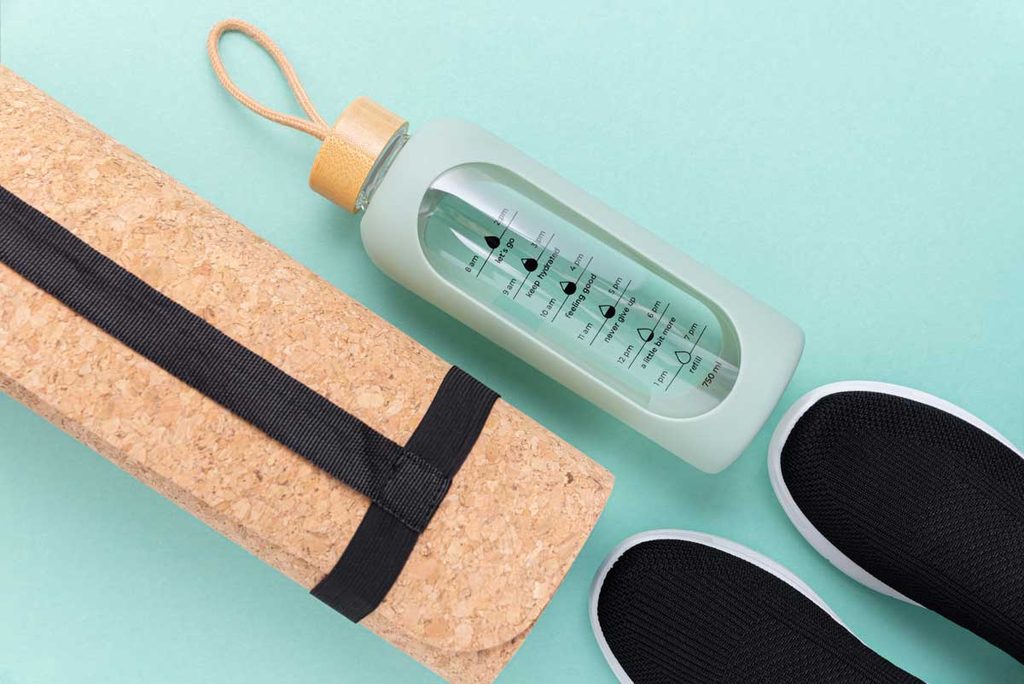
A towel may help if your hands and feet get very wet or you prefer a washable contact layer. It is an option to assess with the mat, not an accessory every cork user needs or should avoid.
A towel introduces another contact surface. Check that it fits, stays flat, and remains in place during transitions. Follow its own preparation instructions too. If it wrinkles, shifts, or leaves you uncertain about footing, pause and adjust the setup.
Identify what is moving before changing anything:
| What moves | What to check |
|---|---|
| Hands or feet on the cork | Surface condition, approved preparation and suitability for the practice |
| The towel on the mat | Towel fit, condition and intended application |
| The whole mat across the floor | Underside condition, floor preparation and floor compatibility |
| A soft area beneath the feet | Backing support, compression and the underlying floor |
A towel won’t fix backing that slides across the room. Adding a second soft mat underneath also changes the support setup. Choose a combination intended for the activity, and stop if it remains unreliable.
Look beneath the cork before choosing thickness
A cork surface may be combined with a rubber or foam backing. When assessing a product such as NEEU’s cork yoga mat, ask for the complete construction rather than assuming the visible brown layer is the whole product.
The surface affects how it feels to the touch. The backing contributes to under-body comfort, standing support, and how the underside behaves on the floor. Bonding joins those layers into a usable mat. Also inspect printed areas and surface finishes where your hands and feet will rest.

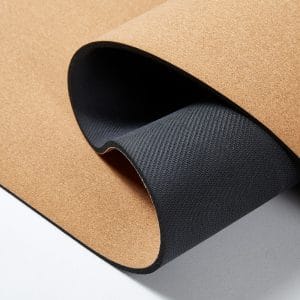
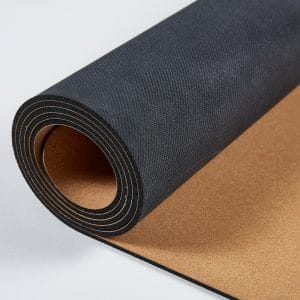
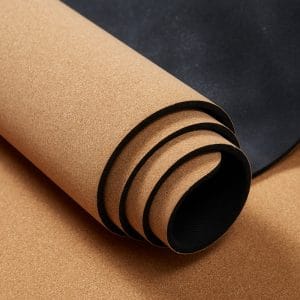


Cork Yoga Mat
Our Cork Yoga Mat features a non-slip, eco-friendly surface for stability and comfort. Lightweight, easy to clean, and sustainable.
Compare support during the movements you actually use
A mat can feel comfortable under the knees yet too yielding beneath one standing foot. Another may feel settled during standing work but uncomfortable during longer floor-contact positions.
Compare both during a short sequence of familiar movements. Notice whether you repeatedly reposition yourself to avoid an uncomfortable area, whether hands or feet sink awkwardly, and whether transitions stretch or bunch the mat.
Total thickness includes all layers; it is not the thickness of cork alone. A larger millimeter figure does not describe how the backing compresses or recovers. The yoga mat thickness guide covers those general trade-offs without assigning one thickness to every practice.
Check length, width, and carrying weight
Start with enough room for your usual contact points. Check lying positions, hand placement, and transitions that bring a knee or elbow toward an edge. If size is the limiting factor, use the yoga mat dimensions guide to compare length and width.
Ask for the weight of the complete selected mat and its rolled dimensions. Include the bag and towel when judging the load you will carry. A lighter product that doesn’t provide suitable support isn’t a useful saving; neither is extra weight that makes you reluctant to take it to class.
If you are comparing cork with another surface, the yoga mat materials comparison offers a broader discussion. Keep the immediate decision focused on the finished mat you will use.
How to clean a cork yoga mat after hot yoga
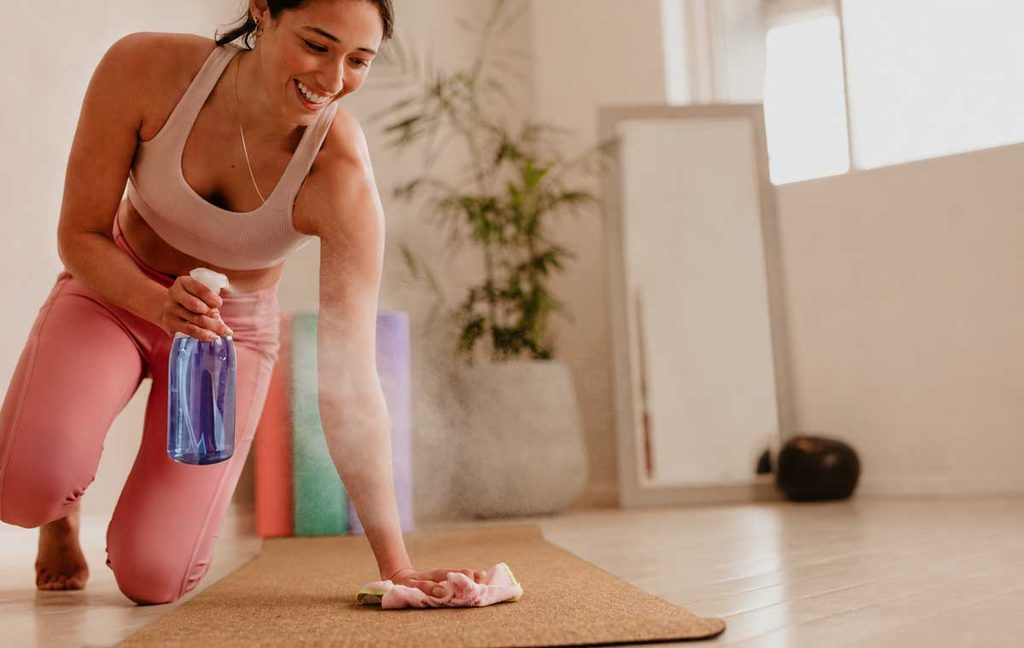
Read the care instructions before buying, especially if you practice several times a week. Confirm the cleaner, application method, drying position, and storage method permitted for the complete construction.
A practical routine is:
- Open and inspect the mat. Check the practice surface and underside for sweat, visible dirt, or damage.
- Clean using the permitted method. Use the specified cloth, cleaner, and amount of moisture. Avoid soaking the mat when the instructions only allow wiping.
- Remove residue as directed. Follow any requirement for a further wipe, rinsing or other finishing step.
- Dry the permitted surfaces in the recommended position. Allow access to the underside where the instructions require it.
- Pack only after checking the mat’s condition. Use the approved rolling direction and reopen it after transport if drying is incomplete.
Do not choose a homemade vinegar or essential-oil mixture just because the ingredients sound natural. Compatibility depends on the complete surface, bond, and backing. The same applies to alcohol, bleach, abrasive scrubbing, steam, and machine washing: use them only where the mat manufacturer expressly permits them.
Cleaning and disinfection are different tasks
Removing sweat and dirt is routine care. A shared studio may also require disinfection under its facility policy. The CDC’s guidance for gyms and other community facilities distinguishes cleaning from disinfection and calls for suitable products and label directions.
If disinfection is required, confirm that the mat tolerates the product and the full required contact time. A quick wipe may not meet the disinfectant’s directions. A process suitable for a hard studio floor is not automatically suitable for a layered cork mat.
Ask how any antibacterial or antimicrobial claim was tested on the finished product. Such wording does not remove the need for cleaning or establish that a used mat protects its user from infection. For a shared set, agree on the cleaning process before approving the mats.
Drying, rolling and the trip home
No single drying time fits every session. Moisture, room conditions, construction and the drying method all vary. Check the surface and underside instead of relying only on how long the mat has been open.
If you must roll the mat for the journey, follow its transport instructions and reopen it at the next suitable opportunity. A tightly packed bag should not become the mat’s usual drying location. Plan where the mat can lie or hang as its instructions allow.
Follow the specified rolling direction. Do not prescribe cork-in or cork-out for every product, and do not fold a roll-up model unless folding is expressly permitted. Check whether the mat should be stored loosely rolled, suspended, or in another arrangement.
Keep storage conditions within the maker’s guidance. Approval for a heated class does not approve a hot parked car, a heater, or prolonged direct sun. Do not use extra heat to force drying or flattening.
For back-to-back classes, check whether there is time and space to complete the care routine. A second mat may be more practical than repeatedly packing one before it is ready.
Wear, cracking and changes in grip
Inspect the mat when you lay it out and put it away. Focus on changes that affect contact or the integrity of the layers.
| Observation | Useful next step |
|---|---|
| The surface feels slippery or sticky after cleaning | Recheck the approved cleaner, residue-removal method, and drying process |
| Edges remain raised after the instructed unpacking routine | Check storage and ask the supplier about the persistent change |
| Cork particles, cracks or peeling appear | Record the affected areas and ask the seller to assess their significance |
| Layers lift apart or the backing tears | Put the mat aside and contact the seller before further use |
Natural color variation differs from a lifting layer or a tear. Appearance alone does not settle whether a change is acceptable; describe where it occurs, whether it is progressing, and whether it changes footing.
Photograph the problem and keep the product information. Avoid sanding the surface, gluing a loose layer, or treating it with oils to restore grip unless the manufacturer provides an approved repair method. Those alterations can change the contact surface and complicate assessment.
There is no useful universal lifespan in years without the construction, frequency of use, and care conditions. Replace a mat when damage or persistent performance changes make it unreliable, rather than trying to reach a promised calendar age.
Is a cork yoga mat automatically eco-friendly?
Evaluate the full product. The visible cork layer doesn’t describe the backing, binder, adhesive, printing, or packaging, or how the finished mat will be collected at the end of use.
Ask what a claim covers:
- Renewable content: which material, what share of the product, and how it is measured.
- Recycled content: whether it refers to the mat, one component, or the packaging.
- Recyclability: whether a local collection or take-back route accepts the complete bonded mat.
- Biodegradability or compostability: the conditions, timescale, and finished components covered.
The FTC’s guidance on environmental claims explains why specific claims and local disposal options matter. A recyclable cork component does not establish a recycling route for the assembled mat.
Durability belongs in the decision too. Choose a product whose care requirements you can maintain, and confirm how to handle it when it eventually needs replacement. A broad green label gives you less useful information than a clear explanation of construction and disposal.
Before buying: ask about the complete routine
Look for answers you can use:
- How should the mat be prepared for dry-start and sweaty practice?
- What materials make up the surface and backing?
- What are the selected model’s finished dimensions, weight, and packed size?
- Which cleaning method is allowed, and how should it dry?
- Are there restrictions on floors, footwear, storage, or outdoor use?
- What should you do if the surface changes, and what return terms apply?
Where a trial is permitted, check those points before heavy use or alteration. Photos can show texture and edges, but they don’t show how a mat grips your hands or behaves on your studio floor.
For a studio set, trial the actual cleaning, drying, and storage process as well as the practice surface. A sample that works for one person at home may need a different operational assessment before sharing it between classes.
Frequently asked questions
Yes, if the finished mat gives you suitable dry grip and support for that routine. Pay particular attention to the start of practice if you rarely sweat. Choose based on how the approved setup works for you, rather than assuming a hot-yoga label requires heat or moisture.
A cork top doesn’t mean the whole mat is latex-free; the backing may contain natural rubber. Ask for product-specific material information. The American College of Allergy, Asthma and Immunology advises people with latex allergy to avoid exposure to latex products. Follow your clinician’s advice rather than testing a suspected trigger during practice.
Follow any preparation or break-in instructions for the model, but do not treat recurring slipping as something you must practice through. Ask the seller what usable condition to expect after preparation. Avoid salt scrubs, abrasive treatment or homemade coatings unless they are explicitly part of the approved instructions.
Compare the surfaces and finished constructions. Some cork mats already have rubber backing, so the labels do not describe mutually exclusive products. Check dry and sweaty contact, underside stability, support, care, and carrying weight. The better fit is the mat that works consistently for your routine.
Developing a cork yoga mat range
For a brand or studio project, start with the intended practice, surface, backing, cleaning process, and claim support. Review the proposed construction within NEEU’s yoga mat range, then compare custom yoga mat specifications against a finished sample.
- Vaz M. F., Fortes M. A. Friction properties of cork. Journal of Materials Science. 1998;33:2087-2093. DOI: 10.1023/A:1004315118535. Publisher abstract reviewed; mainly cork/glass and cork/steel contacts under specified loading and sliding conditions. It does not measure skin contact, sweat, or performance on a finished yoga mat. ↩︎