
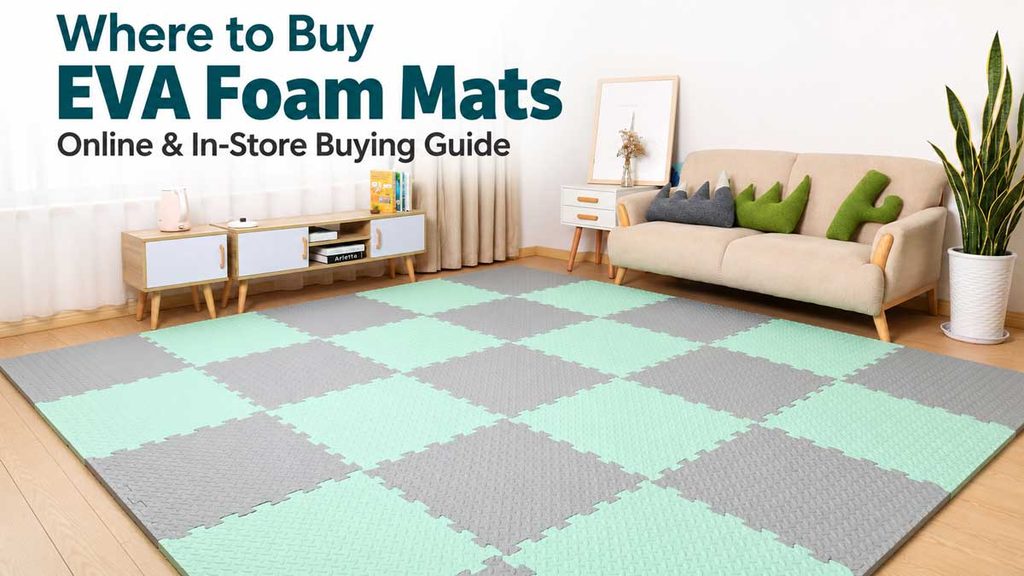
You can buy EVA foam mats through online marketplaces, sports and home-improvement retailers, specialist mat shops, and brand websites. Local stores are useful if you want to inspect a product or pick it up nearby; online shopping lets you compare listings without visiting each shop. For replacement tiles, start with the original seller and product code.
These routes apply across Europe and North America, but stock, delivery options and purchase terms depend on your country, location and the actual seller. Choose the channel that fits the job: a small exercise area, a room-sized layout, a child’s play space, or an extension to a set you already own.
Where should you start looking?
| Buying channel | When it may suit you | What to establish first |
|---|---|---|
| Online marketplaces and multi-seller retail sites | Comparing several brands, pack sizes and delivered prices | Who sells and fulfills the order, where it ships from, and who handles returns |
| Sports, home-improvement and general retailers, online or in store | Finding a standard pack locally or checking collection options | Whether the selected item is stocked in your chosen store, supplied online only, or sold by a third party |
| Specialist mat retailers and brand websites | Asking about installation, compatible replacements, or a particular application | Whether the seller can answer questions about the exact system and supply the pieces you need |
| Manufacturers or project distributors | Custom constructions, private-label ranges or planned bulk orders | Order quantities, samples, delivery terms and the scope of the quotation |
A retailer can operate more than one of these channels. Buying from its own stock and buying from a partner on its website may involve different contacts and terms. Check the selected listing rather than relying on the shop’s name alone.
Country-specific places to start
These official category pages provide practical browsing routes, not a ranking of the best sellers or approval of every product displayed. Pages were checked on October 18, 2026; set your delivery location and inspect the selected listing before relying on stock or collection information.

| Shopping location | Official browsing examples | What to do next |
|---|---|---|
| United States | Walmart EVA foam listings and Target EVA floor-mat listings | Select the seller, variant, and delivery or collection option for your address |
| United Kingdom | Decathlon UK foam-floor-mat range | Check whether the item is supplied by Decathlon or a named partner, and whether local collection is offered |
| France | Decathlon France floor-tile category | Read the material and seller details; a floor-tile category is not limited to EVA |
| Germany | Decathlon Germany fitness floor-protection range | Look for the stated EVA construction and distinguish online-only partner items from store stock |
For other European or North American markets, start with the retailer’s own country selector or a local specialist rather than assuming one of these sites delivers internationally. Search by the job as well as the material: “EVA interlocking floor tiles” for a tiled area, or the exact brand and product code for replacements. For a child’s space, add the intended age and use, then verify the product’s actual age recommendation. A matching search phrase is not a suitability check.
Buying EVA foam mats online
Check the seller before comparing the pack
Open the listing’s seller, delivery, and return information. Confirm which business is responsible for the order, the country it ships from, and whether delivery is available to your address. The website’s language or currency does not, by itself, tell you where the stock is held.
Save the product code, selected variant, and seller details. A single page may offer different thicknesses, tile quantities or surface constructions. Reviews or photographs of one variant may not describe the pack in your basket.
When comparing listings, look for a stated material, usable coverage, included borders and installation instructions. Ask about contradictions before paying. For a replacement order, send photographs of the old edge profile and ask whether the current version will connect with it.
Use specialist shops for system-specific questions
Check a specialist retailer or brand website when you need more than a standard pack. Questions about border pieces, changes to an older product line, or an unusual floor surface require an answer about the exact tiles.
Useful support is specific: an installation document, confirmation of compatible pieces, or a clear explanation of what the mat is intended to do. A broad claim like “suitable for every room” is less helpful than instructions that match your floor and activity.
If you’re buying a custom range rather than a household pack, start with the options on our EVA foam mats page and the manufacturer selection guide. Factory sourcing is a separate route; don’t assume it offers single packs, retail returns, or faster delivery.
Buying in a physical store or collecting an online order
Choose a local sports, flooring, home-improvement, or general retail store to inspect a sample or collect nearby. Check the selected product’s local availability before traveling. A chain’s website may list items that aren’t on its shelves.
Use the retailer’s store finder or collection checker with the exact product code. If the website is unclear, ask the branch whether it has a display sample, a sealed pack, or only an online ordering service before you go.
If a display sample is available, use it to assess the surface feel, thickness, and edge profile. Ask permission before handling or connecting pieces. A sample on a shop floor cannot establish how the complete layout will behave in your room.
Before taking a pack home, inspect:
- The exact product and quantity: tile code, pack count, stated dimensions, and coverage.
- Included parts: borders, corners, or other pieces shown as part of the selected set.
- Packaging and labels: intended use, age limits, care instructions, and seller or manufacturer identification.
- Visible condition: damaged corners, torn packaging, crushed teeth, or peeling layers.
Keep the receipt and product labels. If you’re collecting an online order, confirm where to send a return or product complaint; don’t assume every branch handles every seller’s goods.
Compare the total cost in the same units
Listings may use millimeters and centimeters, inches and feet, or different units for coverage. Put each offer into one consistent set of units before comparing it. Also distinguish a nominal tile size, which may include interlocking teeth, from the area covered after assembly.
Sketch the rows and columns you need. A pack can contain enough total area yet still require extra pieces to achieve the right shape. Include permitted trimming, spare tiles, and required edging in the purchase quantity.
Use this comparison:
Delivered cost per usable unit of area = total cost of the required tiles, edging, and delivery, including any applicable charges, divided by the area your planned layout will cover.
Use square meters for every offer or square feet for every offer, and compare costs in one currency. Keep unused spares in the cost, but do not count them as installed area.
For a hypothetical layout, suppose the seller confirms an installed tile size of 60 × 60 cm, and you want a 1.8 × 2.4 m area. Three rows by four tiles require 12 tiles and cover 4.32 m². If six-tile packs cost €30 each and the complete order, including delivery, required borders, and applicable charges, totals €70, the delivered cost is about €16.20/m². These are illustrative figures, not a current offer. Rework the layout if the advertised 60 cm includes teeth rather than the installed spacing, or if trimming and perimeter clearance change the usable shape.
For a cross-border purchase, check whether the checkout total includes all charges payable on delivery, where a return would be sent, and who pays the return transport. A low listed price can be difficult to evaluate until those details are clear. Confirm the arrangements for your destination and seller rather than assuming terms from another country apply.
Choose a mat for the intended activity
Read the material and construction description
“Foam mat” does not establish that a product is EVA. Look for the stated polymer or blend and identify any printed film, rubber top, or other laminated surface. Craft foam sheets, fitness tiles and age-specific play mats are not interchangeable simply because they contain the same material.
Keep rebound and lasting support as separate questions. In chemically foamed EVA/nylon-elastomer footwear formulations, increased ball rebound accompanied reduced recovery after prolonged compression.[1] That result does not rate retail floor mats. It explains why a springy hand feel cannot establish how a mat recovers from sustained loading. Our rebound-versus-cushioning guide explains the distinction.
Check the floor and activity restrictions
Confirm suitability for your actual base, especially carpet, delicate finishes, heated floors, or damp areas. Check footwear and activity limits too. A tile intended for light floor exercise isn’t automatically suitable under heavy equipment or dropped weights; the foam versus rubber gym flooring guide covers that separate choice.
For puzzle tiles, matching color, thickness, and nominal size doesn’t guarantee compatible teeth. Ask about the exact system before extending an existing layout. The interlocking foam mats overview explains the format and its applications.
Consider cleaning access. Water-resistant foam does not make the joints watertight, and spills can reach underneath. Follow the product’s lifting, cleaning, and drying instructions; see the water-resistance guide for the difference between the foam and the assembled floor.
Read age limits and warnings for the intended user
A playroom photograph is not an age recommendation. Choose a product expressly intended for the child’s age and use, and read its damage and small-part warnings.
Children’s mat testing distinguishes a joint staying connected from a tooth or corner tearing off under pulling or biting.[2] A neat connection does not settle both questions. Do not conduct improvised laboratory pull or bite tests at home, or treat “EVA” as a safety certification.
The same care applies to broad advertising terms such as “non-toxic” or “safe.” Ask what information supports the claim for the exact product and intended use. Smell alone cannot identify a chemical or establish safety.
If a seller supplies test information, check which product or variant it covers and which substances were assessed. A formamide result does not establish results for every volatile compound. Also check what was measured: material content, emissions under stated test conditions, and exposure during use are not interchangeable. Heated headspace screening can identify compounds for further investigation without establishing room exposure.[3] Ask the seller to explain what an unspecified “tested” label actually covers before relying on it.
Check the purchase terms before opening or cutting
For online and in-store purchases, confirm what happens if the mat is unsuitable, arrives damaged, or doesn’t match the description. Read the terms that apply to the selected seller and your location, including return arrangements, costs and any restrictions on opened, cleaned, used or cut packs.
An online-only seller, a marketplace partner, and a local shop may not handle these situations the same way. Clarify uncertainty before purchase, especially when a return would cross a border.
Also distinguish a change-of-mind return from a complaint about faulty or misdescribed goods. A shop’s voluntary return offer doesn’t reflect the full range of applicable consumer rights. For EU purchases, Your Europe’s shopping guidance explains why buying from a trader rather than a private individual matters. Use the relevant official consumer guidance for your destination; EU rules are not a single rulebook for all of Europe or North America.
Once the mats arrive, compare labels and quantities with the order confirmation. Assemble a small section as instructed before cutting or installing the whole order. Look for flatness, intact layers, borders that fit, and joints that close without force.
Photograph any problem before making alterations, and keep the packaging and batch information while the seller assesses it. If you put the tiles away daily, check their stacked size, handling requirements, and installed footprint.
Before paying, you should be able to identify the exact product, the supplier, the delivered cost, and a contact for issues. Keep those details with the product code so a future replacement order starts with the right system.
Frequently asked questions
Some ranges offer individual pieces; others sell only in packs. Ask the original seller and provide your product code, batch information, and photos of the edge profile. Confirm compatibility with your existing set before ordering, including whether the replacement has the same brand name and advertised dimensions.
A sample can help you compare surface feel, color, and construction before a larger purchase. Ask what the sample represents and whether it includes a usable interlocking edge; a small swatch cannot demonstrate assembled fit. It also cannot establish chemical safety or long-term performance. Check sample availability and delivery to your country rather than assuming every seller offers it.
Consider compatible spares for planned cuts, likely replacement needs, or a layout you expect to extend. Work out rows, columns, and pack quantities first; there is no single spare percentage that fits every room. Ask whether the current batch can supply the whole project, and keep the product information for later orders. Future versions may not match.
That wording alone does not establish the composition. Look for an explicit polymer or blend description, and distinguish the foam core from any surface layer. If EVA is a requirement, ask the seller to confirm it for the selected item rather than relying on a category name, photograph or customer review.
References
- Huang G. et al. Preparation and Characterization of EVA/Nylon Elastomer Microcellular Foaming Materials. China Plastics. 2021;35(9):1–7. Footwear-oriented EVA/PEBAX formulations; rebound and prolonged-compression recovery were separate tests, not finished floor-mat ratings. ↩︎
- Luo J., Li J., Li S., Du F. [Discussion of tensile abuse testing methods for children’s mats; translated title]. Light Industry Standards and Quality. 2020;(2):69–72. DOI: 10.19541/j.cnki.issn1004-4108.2020.02.008. Method-development context for the distinction between joint fit and tearing/detachment; not a current market-access rule or a home-test procedure. ↩︎
- Liang S., Shi H., Yang Y., Zhang Q., Wang Z., Lv Q. Evaluation of volatile safety in children’s play mats based on non-targeted screening and risk prioritization. Ecotoxicology and Environmental Safety. 2025;290:117565. DOI: 10.1016/j.ecoenv.2024.117565. Heated headspace screening of children’s play-mat samples; not a room-temperature emission or exposure assessment, or a safety verdict on the retail listings in this guide. ↩︎