
Foam Blowing Agents Explained: Types, Processes, and Mat Quality
Two mats can use the same material label and thickness yet perform differently. One recovers after compression; another stays dented. One has a consistent core, while another contains large voids or uneven areas.
The blowing agent contributes to these differences by supplying the gas that forms cells within the polymer. Its effect depends on the rest of the formulation and on when, where, and how the gas expands. Polymer viscosity, temperature, pressure, and crosslinking all influence the final result.
For a B2B buyer, the practical issue is the finished mat. Blowing-agent information is useful when it helps define density, hardness, recovery, dimensions, odor requirements, and applicable chemical testing. The ingredient name alone is never a complete product specification.
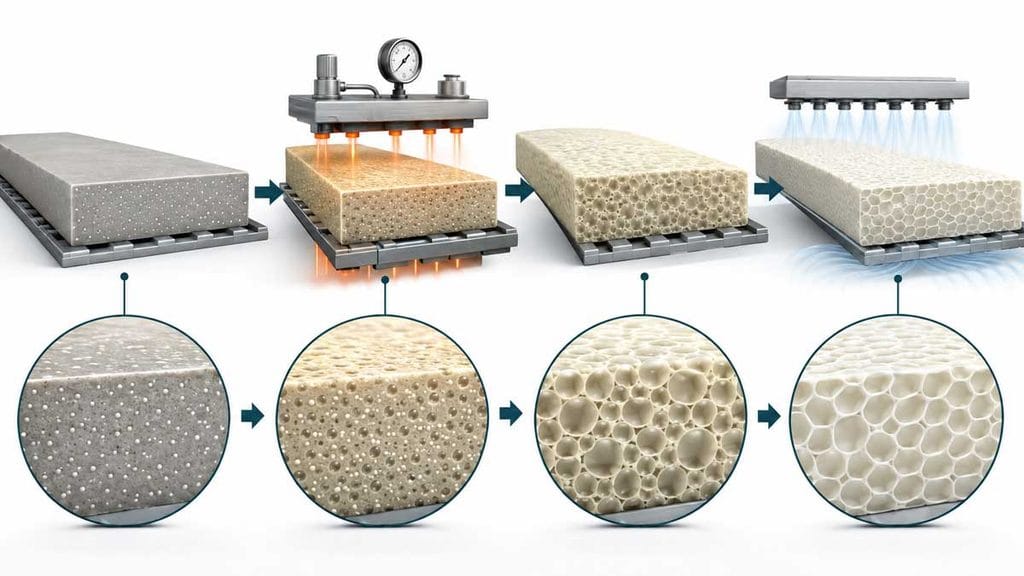
A foam blowing agent is a substance that releases gas during polymer processing. The gas forms bubbles within the material. When the surrounding polymer stabilizes those bubbles, the result is a cellular structure rather than a solid, unfoamed mass.
Polymer processors generally distinguish between two main routes:
- Physical blowing agents are gases or volatile fluids that expand as pressure or temperature changes.
- Chemical blowing agents generate gas through decomposition or reaction during processing.
A 2024 review by He and colleagues describes both routes in polypropylene and shows why the material and processing method must be considered together.[1]
The term “foaming agent” can mean something different outside polymer processing. In an aqueous foam, for example, it may refer to a surfactant that helps create or stabilize bubbles in a liquid. Mechanically frothed latex, detergent foam, and chemically expanded EVA are separate systems. Research on foam drainage in water addresses a different system from an EVA puzzle mat.
Physical, Chemical and Mechanical Foaming Compared
| Route | How cells are created | Common examples | Main process concern |
|---|---|---|---|
| Physical blowing | Dissolved or introduced gas expands, or a volatile fluid changes phase | Carbon dioxide, nitrogen, and selected volatile blowing fluids | Gas uptake, retention, pressure, and temperature must suit the polymer |
| Chemical blowing | An ingredient decomposes or reacts to release gas inside the material | Azodicarbonamide, OBSH, and bicarbonate-based systems | Gas generation must occur while the polymer can expand and hold the cells |
| Mechanical frothing | Mixing incorporates gas into a liquid or dispersion before it sets | Air introduced into suitable latex or other liquid systems | Bubble stabilization and setting determine whether the structure survives |
These routes describe how gas enters the material. They do not rank finished-product quality. Manufacturers may also combine mechanisms or use additives that assist nucleation in a gas-blown process.
Physical blowing depends on gas uptake and retention
In a physical foaming process, the polymer must absorb or contain sufficient gas to expand. It must also retain that gas until the selected pressure and temperature conditions allow cells to form.
Li and colleagues tested carbon dioxide, carbon dioxide/water, and carbon dioxide/ethanol systems in TPU particles. The three systems differed in gas uptake, gas loss, and resulting cell structure.[2] The experiment covered batch-foamed TPU particles rather than a commercial TPE yoga mat. Its results show how gas behavior varies across polymer systems.
A label such as “CO2-blown” identifies part of the processing route. Mat durability, emissions, and user suitability still require product-specific evidence.
Chemical blowing depends on timing
A chemical blowing agent releases gas when it decomposes or reacts. The polymer needs enough mobility to expand at that point, along with enough strength to retain the growing cells.
Early gas release can lead to gas loss, merged cells, or surface defects. Late release may limit expansion. Activators are sometimes used to adjust the temperature range or rate of decomposition, but their effects remain formulation-specific.
This timing issue explains why a recommended processing condition for one resin or blowing-agent grade is not a universal recipe. The agent, activator, polymer, and manufacturing sequence have to work together.
Common Blowing Agents in Polymer Foams
Azodicarbonamide: AC, ADC or ADCA
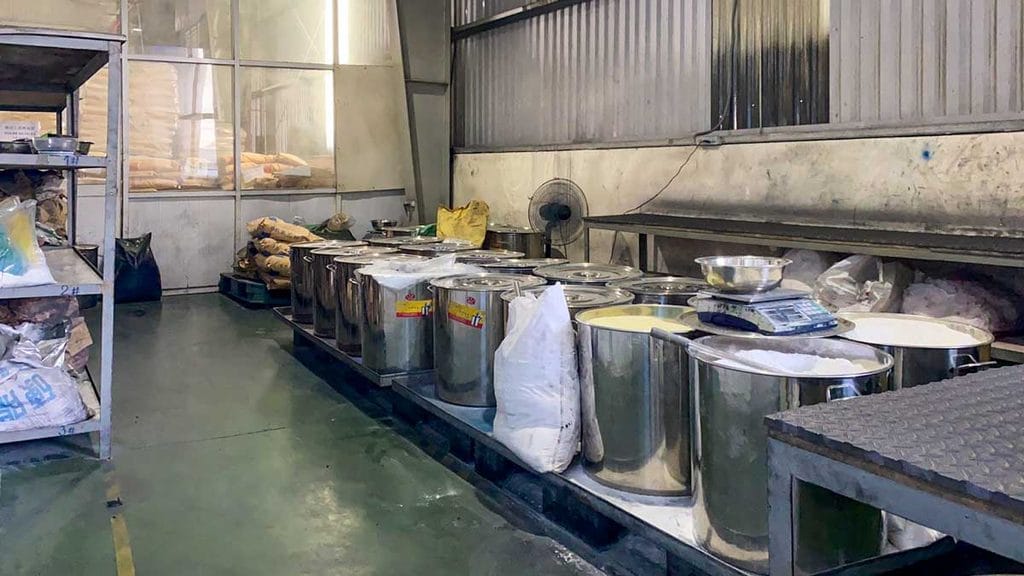
Azodicarbonamide appears in technical literature as AC, ADC, or ADCA. It is a chemical blowing agent used in several polymer-foam systems, including formulations relevant to EVA and other foam products.
Grade, particle characteristics, activators, and the surrounding formulation all affect its behavior. A declaration that a product “uses AC” gives no information about the complete additive package, processing conditions, or finished-product test results.
OBSH and activated systems
OBSH is found in rubber and related foam research. Zhang and colleagues studied OBSH with a urea-based additive in NBR/PVC sponge rubber. Changing the combination altered the decomposition profile and its coordination with vulcanization. Cell uniformity and surface condition also changed.[3]
The study provides a useful example of process matching, not an EVA mat formula. NBR/PVC sponge rubber has its own curing behavior, ingredients, and processing conditions.
Bicarbonates, carbon dioxide, nitrogen, and water
These familiar names can play very different roles:
- Bicarbonate-based ingredients are used in chemical blowing systems, often as part of a formulated package designed for a particular activation range.
- Carbon dioxide and nitrogen are physical blowing gases. Their solubility, diffusion, and expansion behavior vary by polymer and process.
- Water can generate carbon dioxide through reaction with isocyanate groups in polyurethane chemistry. Liu and colleagues describe this mechanism in a study of polyester polyurethane.[4]
Water in reactive polyurethane differs from water used as a physical foaming medium in another polymer. Changing from a chemical blowing powder to a gas-based process requires a new assessment of the equipment, polymer, and target cell structure.
Endothermic and Exothermic Chemical Blowing Agents
Chemical blowing systems are also described by their heat behavior. An endothermic system absorbs heat during gas generation. An exothermic system releases heat. Commercial blends combine components to adjust gas release and processing behavior, as shown in Bergen International’s processing guidance.
These labels are process descriptions rather than quality grades. A lower activation temperature can be helpful if it falls within the polymer’s processing window. The same change can create premature gas release in another formulation. Product trials remain necessary.
Crosslinking and Foaming Are Separate Processes
Crosslinking connects polymer chains. Foaming creates the cellular structure. The two processes often interact because the developing network helps the polymer retain expanding cells, but one does not automatically identify the other.
For example, a Toray patent describes irradiation crosslinking and chemical blowing as distinct steps in a polypropylene foam manufacturing process. The material is irradiated to create a crosslinked structure, then heated to activate a chemical blowing agent. See the published manufacturing method.
This distinction matters when sourcing PE or XPE foam. Ask how the polymer is crosslinked and how the expansion gas is supplied. “XPE” describes a crosslinked polyethylene foam category; the complete formulation and any substance-specific claim require separate evidence.
How Blowing Agents Influence Foam Mat Quality
Density and cell stability
More blowing agent can increase gas generation, but useful expansion depends on cell stability. Insufficient polymer strength allows cells to merge, rupture, or collapse.
Zhang and Cui observed this non-linear behavior in a molded PVC experiment. As the tested AC/ZnO addition increased, density first decreased and later increased. The authors associated the reversal with cell merging, rupture, and shrinkage.[5] Their formulation and dosage should not be used as a recommendation for EVA or yoga mats. The transferable lesson is narrower: maximum gas generation is not the same as controlled density reduction.
A purchase specification should pair the target density range with the performance that must be retained. Otherwise, a lighter sample may pass one measurement while losing support, recovery, or edge strength.
More information about foam density: Foam Density Explained
Hardness, cushioning, and recovery
Density measures mass per unit volume. Hardness measures resistance to indentation under a defined test. Thickness is a dimension. Each describes a different part of mat performance.
Cell structure affects how a foam feels and responds to load, but so do the polymer blend, fillers, crosslinking, and surface construction. Two mats with the same nominal density can behave differently under compression.
Compare candidate samples at the same thickness and under consistent conditions. Hardness values should specify the scale and method; a value like “40 degrees” is incomplete. For applications where repeated loading matters, include an agreed recovery or compression assessment.
Learn more about foam hardness and thickness
Cell structure and consistency
Commercial foam contains a distribution of cell sizes. Large voids, collapsed regions, or uneven areas can produce local differences in support and appearance.
Evaluation should reflect the finished product. A puzzle mat needs a consistent core, intact edges, and reliable assembly fit. A yoga mat combines foam, a grip surface, and any laminated layers. A foldable mat must also maintain panel alignment and fold performance.
Closed-cell construction can reduce water uptake, although cut edges, seams, and surface layers still affect the finished article. Waterproof performance has to be checked on the complete construction.
Dimensions after conditioning
Measurements taken immediately after production may differ from measurements taken after conditioning or packing. Define when thickness, length, and width will be checked, along with the storage conditions before measurement.
This is particularly important for puzzle-tooth fit, roll-flat behavior, and fold alignment. A representative finished sample provides better evidence than a small unprinted foam coupon. NEEU’s foam mat foaming process explains where expansion sits within the wider manufacturing sequence.
Material Differences: EVA, PE/XPE, TPE and PVC
The same blowing agent can behave differently in different polymers. Research conclusions should remain within the scope of the materials and processes tested.
| Material family | What buyers need to clarify | Useful sample checks |
|---|---|---|
| EVA foam | Resin blend, additive package and coordination between expansion and crosslinking | Support, recovery, dimensions, edge strength and surface condition at the agreed thickness |
| PE/XPE foam | Crosslinking method and blowing route | Construction details, density consistency, recovery and any relevant chemical declarations |
| TPE foam | Specific thermoplastic elastomer system and foaming method | Material identification and samples of the proposed commercial construction |
| PVC foam | Flexible formulation, additives and processing route | Finished-product performance and chemical requirements rather than data from rigid PVC insulation foam |
A TPU particle study can help explain gas uptake; its scope is limited to TPU particles rather than every TPE yoga mat. A rigid PVC experiment may illustrate cell formation while remaining unsuitable as evidence for a flexible exercise mat.
For an EVA foam mat project, start with the application and finished construction. The formulation and foaming route should then be developed against those requirements.
Odor, Residues and Formaldehyde
Raw-material documentation and finished-product testing answer different questions. A safety data sheet describes an input, while a finished-product report identifies the tested mat construction and test conditions.
Odor is a useful quality observation. Determining chemical identity and concentration requires an appropriate analytical method, and low odor alone is not a chemical test result.
Formamide illustrates why buyers need precise language. The European Commission’s 2015 directive on formamide in certain foam toy materials distinguishes between material content and emissions. Its scope is specific to certain toy materials. It is neither a universal yoga-mat rule nor a complete checklist of current imports. Learn more about formamide in foam mats.
Testing requirements should be agreed upon based on product classification, destination market, and intended user. Reports should identify the construction and method tested. Where a claim is based on a non-detect result, record the substance, method, and reporting limit instead of converting the result into an absolute “zero” claim.
A blowing-agent name cannot establish the finished mat’s emission profile. See how buyers can specify finished-mat VOC testing.
What B2B Buyers Should Ask Before Ordering
You do not need a supplier’s proprietary formula to define acceptance criteria. You do need enough information to evaluate the proposed construction, compare samples, and control unapproved changes.
| Buyer question | Evidence to request |
|---|---|
| What is the proposed foam construction? | Material family, layers, surface treatment, and relevant formulation declarations |
| What performance range is offered? | Density, thickness, and hardness specifications, including tolerances and methods |
| How is consistency assessed? | Results from representative samples or positions rather than one selected reading |
| How does the mat recover after loading? | An agreed recovery or compression assessment suited to the application |
| When are dimensions measured? | Conditioning time, measurement method, and acceptance limits |
| Which chemical requirements apply? | A product-specific test plan and reports linked to the relevant construction |
| Does the approval sample match production? | The same color, print, laminate, thickness, and packaging where these affect evaluation |
| How are formulation changes controlled? | Written notification and an agreed requalification process |
Use an approved reference sample together with written tolerances. The sample records appearance and feel; the specification records what must be measured. NEEU’s quality-control overview provides a starting point for selecting project-specific checks.
Investigating a Foam Defect
A large void does not reveal its cause by appearance alone. Excess gas generation is one possibility, but uneven dispersion, temperature variation, or weak cell stabilization may produce similar defects. Unexpected softness, shrinkage, and odor also have more than one possible source.
Record the defect, sample position, and batch identification. The supplier can then investigate the material and process history before proposing a correction. Verify any change against the full specification so that solving one problem does not create another.
Start With the Mat Specification
The buyer’s job is to define the required product outcome. The manufacturer then selects and controls the formulation and process needed to reach it.
Begin with the application, target market, dimensions, intended feel, and loading conditions. Add the required surface, packaging, and test plan. This creates a clear basis for comparing material routes and approving samples.
Planning a custom foam mat? Discuss your specifications with NEEU. Include the intended use, preferred material, dimensions, and target market. Order quantity and retailer-specific testing requirements can follow in the same project brief.
Frequently Asked Questions
No. A blowing agent supplies or generates gas for expansion. A crosslinking agent connects polymer chains. The two functions can interact during processing, but they remain distinct.
Neither route is universally better. Suitability depends on the polymer, equipment, and finished-product requirements. Compare the resulting mat through specifications and relevant testing.
There is no fixed relationship. Blowing-agent level can change expansion and cell structure, while hardness also depends on the polymer formulation and construction. Excessive expansion may damage cells rather than improve cushioning.
No. Record odor as a quality concern and use an appropriate analytical method to identify a substance or measure its concentration.
Such studies can explain mechanisms and suggest questions for sample evaluation. An EVA recipe and claims about finished-mat performance or compliance require evidence from the relevant formulation and product.
References
- He, Y., Pan, X., Xu, S., Liu, Y., and He, M. (2024). Research Progress of the Blowing Agent Applications in Polypropylene. China Plastics Industry, 52(9), 19-25. DOI: 10.3969/j.issn.1005-5770.2024.09.003. Chinese-language review; used for classification and process context, not as evidence of EVA mat performance. ↩︎
- Li, H., Yang, W., Qin, L., and Yu, H. (2016). Preparation of TPU Microporous Foaming Material by Compound Foaming Agent. Plastics, 45(6), 59-61; references continued on p. 72. Chinese-language experimental study of TPU particles. ↩︎
- Zhang, S., Hu, X., He, B., et al. (2023). Activation mechanism of combined OBSH and BK and their effects on NBR/PVC material properties [translated title]. China Elastomerics, 33(3), 58-63. DOI: 10.16665/j.cnki.issn1005-3174.2023.03.001. NBR/PVC sponge-rubber study; not a test of EVA mats. ↩︎
- Liu, H., Zhang, X., and Ma, F. (2019). Effect of Foaming Agent and Chain Extender / Cross Linker Agent on Polyester Polyurethane Foam. Synthetic Materials Aging and Application, 48(1). DOI: 10.16584/j.cnki.issn1671-5381.2019.01.007. Used to explain water’s gas-generating role in reactive PU, not as an EVA processing recommendation. ↩︎
- Zhang, X., and Cui, Y. (2016). Effect of AC Foaming Agent and Plasticizer on Properties of PVC Foamed Materials. Plastics, 45(1), 32-34; references continued on p. 44. Chinese-language study of a specific molded PVC formulation. ↩︎