
Crosslinked Foam: A Buyer’s Guide to EVA, XPE and IXPE Mats
Crosslinked foam contains polymer chains joined into a network. In EVA and polyethylene foam, this network helps the material retain gas during expansion and influences how the finished foam responds to loading and heat.
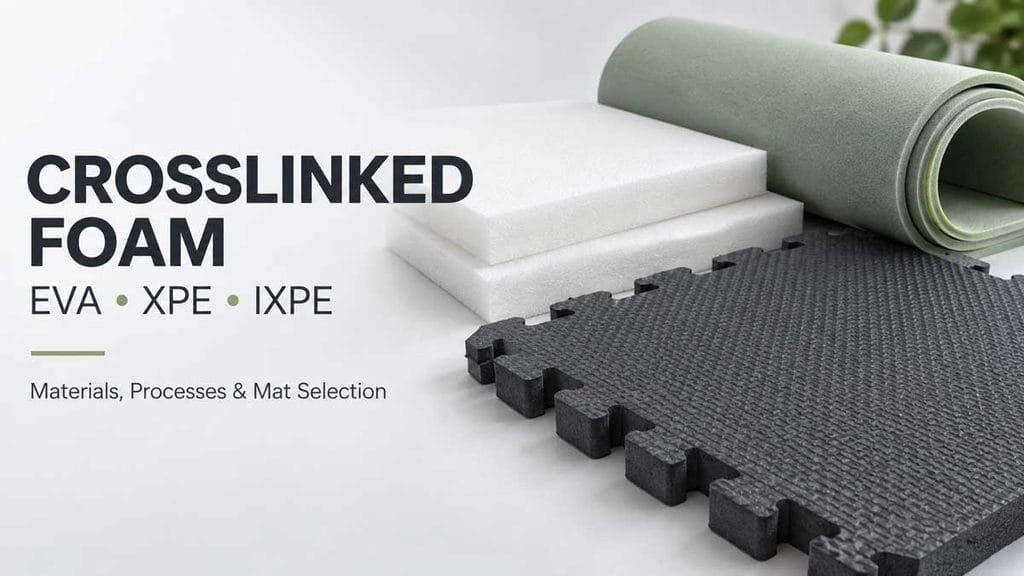
When comparing mat quotations, you may see chemically crosslinked EVA, XPE, and IXPE offered for similar applications. The names help identify a production route, but they do not tell you how two finished mats will compare. A roll that lies flat after unpacking, a puzzle tile with a reliable fit, and a pad that recovers after loading each need a different set of checks.
The essential distinction: Crosslinking connects polymer chains; foaming creates the cells. Chemical crosslinking commonly uses a peroxide, while irradiation crosslinking uses ionizing energy, often an electron beam. These are distinct mechanisms, even when crosslinking and expansion develop during the same heating cycle. For a useful quote, specify the material, both process routes,s and the finished material requirements.
What Is Crosslinked Foam?
Most thermoplastic polymers consist of long molecular chains that can slide past one another when the material is heated. Crosslinking creates bonds between selected chains, producing a three-dimensional network. The network changes how the polymer flows, stretches, and responds to heat or solvent exposure.
In foam manufacturing, this network matters because a polymer must expand around gas and hold the developing cells long enough for the structure to set. A melt with insufficient strength may allow gas to escape or cause cells to merge and collapse. A network that becomes too restrictive can limit expansion and reduce the material’s ability to stretch during cell growth.
Before comparing two crosslinked foams, establish:
- Which polymer or polymer blend is being crosslinked?
- How is crosslinking initiated?
- When does it occur relative to gas generation and expansion?
- How is the result checked during development or production?
- Does the finished foam meet the required density, dimensions, and physical performance?
EVA foam properties depend on the cell structure, crosslinking, blowing ingredients, and processing conditions.[1] Changing the resin or formulation can therefore change the result even when a supplier keeps the same process name.
Crosslinking and Foaming Are Different Processes
The two terms are often used together because they need to be coordinated, but they answer different questions.
| Process | What it does | Typical routes | What a buyer can observe |
|---|---|---|---|
| Crosslinking | Connects polymer chains into a network | Peroxide or other chemical initiation; electron-beam or other irradiation routes | Its effects may appear in expansion behavior, recovery, dimensional stability, and other tested properties |
| Foaming | Introduces or generates gas and expands the polymer into a cellular structure | Chemical gas generation, dissolved physical gas, or mechanical gas incorporation | Density, cell structure, thickness, surface condition, and local defects |
| Forming | Gives the material or part its production shape | Compression molding, extrusion, sheet foaming, casting, or other conversion routes | Sheet profile, tile geometry, roll format, edges and dimensions |
A product may be chemically crosslinked and chemically blown. It may also be irradiation-crosslinked and later expanded using a chemical blowing agent. A physical gas such as carbon dioxide can be used with a crosslinked polymer.[10] These descriptions are not contradictory because each identifies a different part of the production process.
The distinction between mechanical, physical, and chemical gas introduction is covered in foaming methods. Keep that description separate from the crosslinking route on the specification sheet.
Chemical Crosslinking in EVA and Polyethylene Foam
Chemical crosslinking uses an ingredient that generates reactive species under selected processing conditions. In many EVA foam formulations, organic peroxides are used to initiate reactions that connect polymer chains. The exact chemistry, ingredient level, and processing window depend on the resin, blend, additives, and production route.
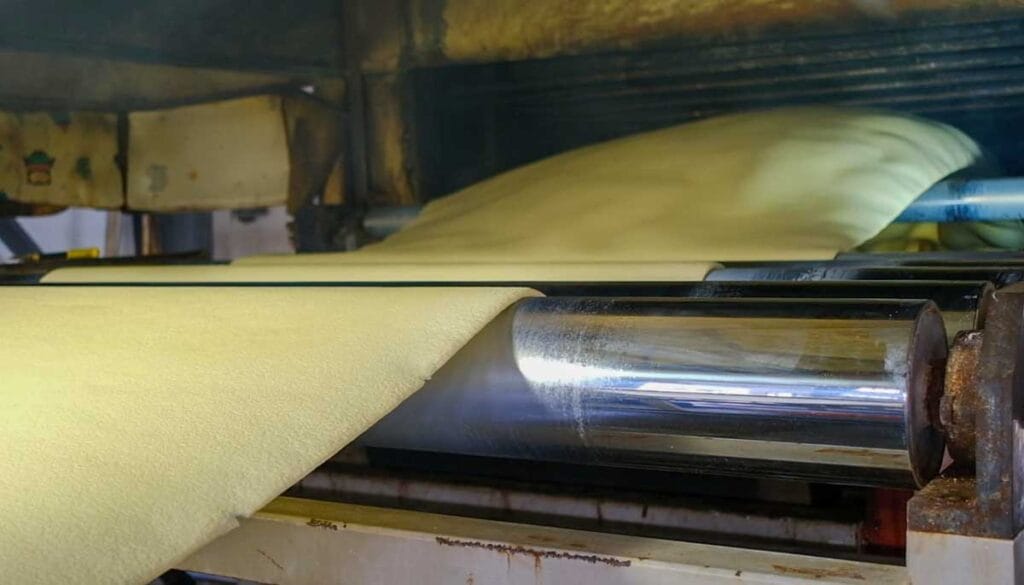
In compression-molded EVA foam, crosslinking and chemical blowing can develop during the same heating cycle. They still have to progress at compatible rates. The polymer needs sufficient network strength to retain gas, but it must still be able to expand.
If the network develops too early, it can restrict cell growth before the blowing agent has released enough gas. In peroxide-crosslinked EVA, this mismatch can contribute to surface cracking or wrinkling as pressure is released.[2] Insufficient network strength poses a different problem: the expanding material may fail to retain its cells. The workable balance depends on the formulation, rather than a universal peroxide dosage.
Crosslinking and gas release must be matched within the same processing window. A change in blowing agent may also require changes to the heating cycle or crosslinking system. Our foam blowing-agent guide explains the role of the gas-generating ingredient.
For purchasing, record the route without treating it as a quality score. The acceptance specification should describe the finished product; the crosslinking description helps control how that product is made.
Irradiation Crosslinking and IXPE
Irradiation crosslinking exposes a polymer to ionizing energy, commonly an electron beam in industrial processing. The energy creates reactive sites, allowing reactions between chains to form a network. Closed-cell foam production is one application of this technology.[3]
The process is sometimes called physical crosslinking in commercial foam terminology because the network is initiated by an external energy source rather than a compounded peroxide. That phrase can be misleading: the final links between polymer chains are still chemical bonds. “Irradiation crosslinking” is the clearer description.
One production sequence is to form a sheet, irradiate it, and then heat it for expansion. Electron-beam crosslinking followed by chemical foaming is used in EVA/POE/EPDM and EVA/OBC experimental formulations.[4][5] The irradiation builds the network; a separate blowing agent supplies the gas.
Irradiation can also break polymer chains, a process called chain scission. The balance between chain scission and crosslinking depends on the polymer and treatment conditions.[3] Dose selection must account for the material and sheet thickness; increasing it is not a general shortcut to better foam.
Does irradiation make the foam radioactive?
Irradiation-crosslinked foam should not be confused with a radioactive material. Electron-beam processing uses an external energy source rather than a radioactive ingredient mixed into the foam. Industrial processing must use appropriate beam energies and validated conditions; the term “irradiation” alone is insufficient to classify the mat as radioactive.[5] It also does not establish that a mat is sterile or meets every chemical requirement.
XPE vs IXPE: Understand the Naming Before Comparing Products
Industry naming is not perfectly consistent. In many foam supply chains:
- XPE refers to chemically crosslinked polyethylene foam.
- IXPE refers to irradiation-crosslinked polyethylene foam, commonly produced with electron-beam crosslinking.
- XLPE may be used as a broader abbreviation for crosslinked polyethylene.
Because suppliers do not always use XPE and IXPE consistently, define both the crosslinking route and the foaming or gas-generation route in the product specification or purchase order rather than relying on the abbreviations alone.
| Buyer question | XPE commonly means | IXPE commonly means |
|---|---|---|
| Base polymer | Polyethylene or a defined PE-based blend | Polyethylene or a defined PE-based blend |
| Crosslinking route | Chemically initiated crosslinking | Irradiation-initiated crosslinking |
| Foaming route | Must be stated separately | Must be stated separately |
| Form supplied | May include sheets, rolls, blocks or converted parts | Often associated with sheet or roll constructions, but must be confirmed |
| Decision evidence | Finished density, thickness, recovery, dimensions, surface and chemical requirements | The same finished-product checks are still required |
Do not assume that IXPE is always thinner, smoother, safer, or better than every chemically crosslinked XPE product. The process route can influence what a manufacturer can produce, but resin selection, formulation, expansion ratio, cell structure, skin, lamination, and conversion also affect the finished result.
For products such as roll and foldable play mats, NEEU’s XPE foam mat overview shows the available product formats. The specific crosslinking and foaming route should be confirmed for the proposed construction during the quotation and sample development phases.
How Crosslinking Applies to EVA Foam Mats
EVA is not the same material as polyethylene foam, even though both may use crosslinking. EVA contains ethylene and vinyl acetate units, and commercial foam may also contain other polymers, fillers, colorants, and processing additives. The selected resin grade and blend affect the response to crosslinking and expansion.
Crosslinking can help an EVA formulation develop enough melt strength to hold growing cells. It can also contribute to the network that supports the finished foam. But the final density, hardness, resilience, tensile behavior, and compressive response do not move in a single guaranteed direction as crosslinking increases.
In EVA/POE/EPDM formulations, changes in irradiation dose can affect hardness, rebound, and tensile behavior differently.[4] Blend composition matters too: changing the EVA/OBC balance under fixed irradiation conditions can alter several properties without yielding continuous improvement.[6] For a mat project, decide which response matters most, then test that response on the proposed construction.
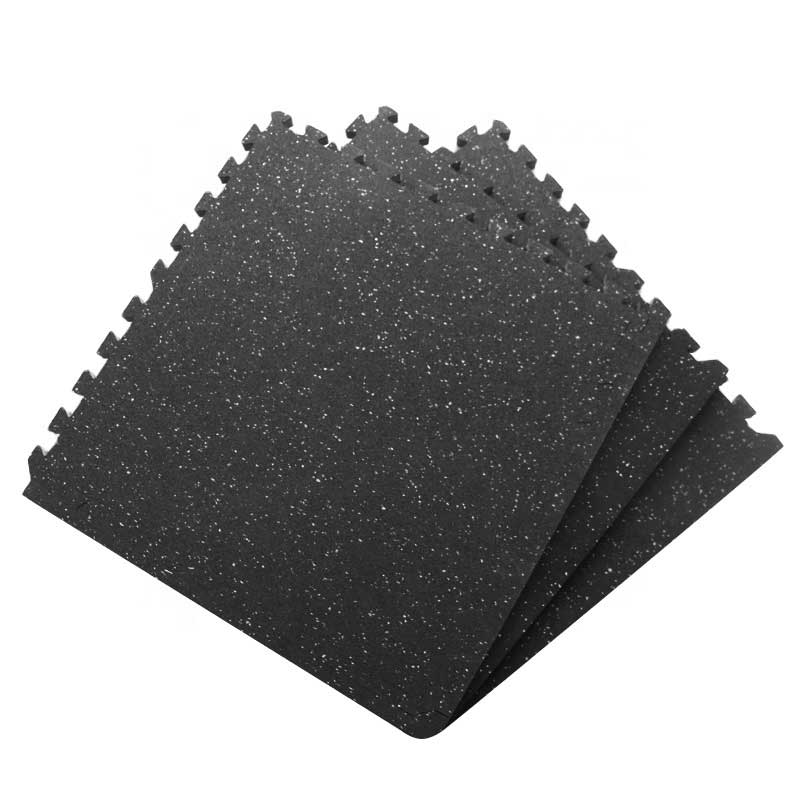
When sourcing EVA foam mats, treat the crosslinking route as process information. Approve the finished mat against the intended application, including its thickness, density, surface, edge design, loading, and target-market requirements.
Under-Crosslinking and Over-Crosslinking
The idea of a “correct” degree of crosslinking is application- and formulation-specific. Still, the two failure directions help buyers understand why production control matters.
If the network develops too slowly or remains insufficient
Depending on the material and process, possible outcomes include:
- gas loss before cells become stable;
- cell merging, rupture or collapse;
- sticking during release;
- uneven expansion;
- weak dimensional recovery;
- local differences in density or feel.
These observations are not exclusive proof of under-crosslinking. Similar defects can result from dispersion, temperature, pressure, gas generation, or forming problems. Root cause analysis requires the batch and process record.
If the network becomes too restrictive
Possible outcomes can include:
- limited cell growth or lower-than-planned expansion;
- higher resistance to stretching during foaming;
- reduced elongation in some formulations;
- surface wrinkling, cracking or shrinkage under unsuitable processing conditions;
Difficulty remelting is generally characteristic of permanent crosslinked networks; it is not, by itself, evidence of excessive crosslinking.
Again, appearance alone cannot establish over-crosslinking. A supplier should compare the defect with process data and relevant material checks before changing the formulation.
What Crosslinking Can Influence in a Foam Mat
Start with the problem the mat needs to solve. A specification for comfortable standing differs from one for close-fitting puzzle tiles or for a roll that must recover after storage.
Cell retention and foam structure
The developing network affects the polymer’s ability to retain gas as cells grow. Cell uniformity also depends on dispersion, nucleation, gas-generation behavior, temperature, and pressure. A crosslinked foam can still contain large voids or uneven areas if other parts of the process are not controlled.
Density, hardness and expansion
Crosslinking can change expansion and therefore affect apparent density. It can also change resistance to deformation. However, foam density measures mass per unit volume, while hardness measures resistance to indentation under a specified method. Neither is a direct measure of crosslinking.
When a buyer asks for a firmer mat, first establish whether the concern is surface feel or support under load. Keep the hardness scale and specimen conditions consistent when comparing samples, and consider hardness together with thickness before changing the specification.
Recovery and compression behavior
A network can contribute to shape retention after loading. For a mat that will sit beneath equipment, specify the load or compression condition, the duration of application, and the recovery interval before measurement. A brief hand press does not reproduce prolonged loading. Polymer type, cell structure, density, thickness, and surface skin all affect the response.
Dimensions and downstream conversion
The foam must remain suitable for cutting, interlocking, folding, embossing, or lamination. Check the length, width, and thickness after the agreed conditioning period. For puzzle tiles, include tooth fit and edge alignment. For foldable or roll products, inspect flatness, panel alignment, and recovery after packing.
Odor, emissions, and compliance
The crosslinking route does not establish a finished-product chemical profile. Irradiation crosslinking may avoid the need for a peroxide crosslinker, but the foam can still contain other ingredients and may use a separate chemical blowing agent. Chemical crosslinking likewise does not prove that a finished product will fail an emissions or restricted-substance requirement.
Test the relevant substance or emission on the proposed finished construction. Do not use “IXPE,” “XPE,” or “crosslinked EVA” as a substitute for a product-specific report.
How Can Buyers Verify Crosslinked Foam?
Buyers rarely need a supplier’s proprietary formula. They do need a clear construction description and measurable acceptance criteria.
1. Confirm the terminology
Ask the supplier to state:
- base polymer or polymer family;
- chemical or irradiation crosslinking route;
- chemical, physical or combined foaming route;
- sheet, roll, molded or laminated construction;
- whether the submitted sample represents production materials and processes.
This prevents an XPE/IXPE naming difference from becoming a purchasing dispute.
2. Approve the finished-product specification
Depending on the mat and application, the specification may include:
- nominal density and tolerance;
- thickness, length and width tolerances;
- hardness scale, method and measurement locations;
- compression, recovery, tensile or tear requirements;
- surface texture, print and lamination construction;
- color and appearance standard;
- conditioning and measurement timing;
- chemical or emissions test plan for the target market.
The crosslinking route can be recorded as a controlled construction characteristic, but it should sit alongside finished-product criteria.
3. Use gel content carefully
Gel-content testing measures the fraction that remains insoluble after a defined solvent-extraction method and can serve as a process-control indicator for certain crosslinked ethylene plastics. ASTM D2765-16(2024) covers gel content and swell ratio for crosslinked ethylene plastics and explains that filler content and specimen preparation affect interpretation.[7]
A gel-content number is not automatically comparable between different materials, test methods, or filled formulations. It is also not a direct prediction of cushioning, durability or safety. If gel content is included in a project specification, the material, method, sample location, conditioning, and acceptance range must be agreed.
ISO 10147 also addresses gel-content determination, but its stated scope is PE-X pipes and fittings.[88] Do not place that standard on a foam mat report until you have confirmed that the method and product specification are appropriate.
4. Compare a representative sample
A small foam coupon may be useful for material screening, but final approval should, where practical, be based on the intended product construction. Films, adhesives, prints, embossed skins, folds and cut edges can all change how the product looks and performs.
Use a signed reference sample with written tolerances. The physical sample records appearance and feel; the specification records what must be measured.
5. Control unapproved changes
Agree that changes to the base resin, crosslinking route, blowing system, critical formulation, or production location require notification and, where relevant, sample reapproval or retesting. NEEU’s foam mat quality-control overview provides a broader framework for connecting material approval with in-process and final checks.
A Practical Crosslinked-Foam RFQ Checklist
| RFQ item | Information to provide or request | Why it matters |
|---|---|---|
| Intended use | Play mat, yoga or exercise mat, interlocking floor tile, equipment mat or other format | Establishes loading, surface and handling priorities |
| Target user and market | Intended age group, sales destination and retailer requirements | Defines the applicable testing plan |
| Material route | EVA, PE-based XPE/IXPE or a named blend | Prevents vague “foam” substitutions |
| Crosslinking description | Chemical or irradiation route, using mutually agreed terminology | Controls a construction characteristic without requesting the full formula |
| Foaming description | Chemical, physical or combined route | Separates gas generation from network formation |
| Dimensions | Finished size, thickness and tolerances | Supports fit, packaging and assembly |
| Physical performance | Density, hardness, recovery and any application-specific tests | Converts material language into measurable acceptance criteria |
| Surface construction | Embossing, film, printing, lamination, backing and edges | Ensures the approved sample represents the saleable item |
| Compliance plan | Product classification, market and required substances or methods | Prevents generic certificate claims |
| Change control | Notification and reapproval triggers | Protects consistency after the initial sample |
Is Crosslinked Foam Recyclable?
Permanent crosslinks restrict the chain mobility needed for conventional remelting. This makes many crosslinked EVA and polyethylene foams more difficult to reprocess through standard thermoplastic recycling routes than their uncrosslinked counterparts.
Recovery routes include mechanical size reduction and use of suitable recovered material in new formulations. Chemical approaches and dynamic-network technologies are also being investigated, but they should not be presented as routine collection or recycling options for every finished mat. Crosslinked EVA waste can require specialized processing to obtain a useful new foam.[10]
For a current purchasing program, ask a narrower set of questions: Is recycled content proposed? What source and percentage are controlled? Does it affect appearance, odor, physical performance, or testing? Can production scrap be recovered in the supplier’s actual process? Environmental claims should describe the verified program rather than the theoretical recyclability of the polymer name.
Choosing Between EVA, XPE and IXPE for a Mat Project
There is no universal crosslinking route for every foam mat. Start with the finished product.
| Product decision | Questions that matter more than the label alone |
|---|---|
| EVA interlocking mat | Tile fit, thickness, density, hardness or compression response, edge strength, surface and intended loading |
| EVA roll or converted mat | Sheet consistency, recovery, surface construction, dimensions and packing behavior |
| XPE or IXPE play mat | Core and surface construction, fold or roll format, panel consistency, recovery, print or film adhesion and target-market testing |
| Multilayer mat | Which layer provides cushioning, grip, decoration, and dimensional support; how the layers are bonded and tested |
Ask the manufacturer to recommend a route after receiving the application, dimensions, desired feel, loading, surface, and compliance brief. Then compare representative constructions under the same acceptance plan.
Discuss a Crosslinked Foam Mat Specification
Planning an EVA, XPE or IXPE mat project? Include the intended application, product format, dimensions, preferred material, target market, and the performance issues you want the sample to resolve.
Frequently Asked Questions
Crosslinking connects polymer chains into a network. Foaming introduces or generates gas, expanding the material into a cellular structure. They can occur within a single production sequence but remain distinct processes.
XPE commonly refers to chemically crosslinked polyethylene foam, while IXPE commonly refers to irradiation-crosslinked polyethylene foam. Naming varies, so buyers should request a written description of both the crosslinking and foaming routes.
No. The “I” in IXPE refers to irradiation crosslinking. The gas used for expansion is a separate question. An irradiation-crosslinked material may still use a chemical blowing agent or another foaming route.
It is often called physical crosslinking in industry because external energy initiates the process. The resulting links between polymer chains are chemical bonds, so “irradiation crosslinking” is the less ambiguous term.
The term describes a processing treatment, not a radioactive ingredient. With appropriate industrial beam energies and validated processing conditions, irradiation crosslinking is not a basis for describing a mat as radioactive.[6] Chemical safety and suitability for the intended use remain separate checks.
Not necessarily. Crosslinking may contribute to shape retention, but recovery also depends on the polymer, density, cell structure, thickness, skin, and loading conditions. Request a relevant finished-product test.
Only when the material, filler correction, specimen preparation, extraction method, and reporting basis are comparable. Even then, gel content should be evaluated alongside finished-product performance rather than used as a stand-alone ranking metric.
No. The crosslinking route does not identify the gas source or complete formulation. A substance-specific claim needs a report for the proposed finished construction using an appropriate analytical method and reporting limit.
References
- Kundlas, L. K. “Ethylene-Vinyl Acetate Foam.” In Polymeric Foams: Fundamentals and Types of Foams, ACS Symposium Series 1439, 2023, pp. 205-221. https://doi.org/10.1021/bk-2023-1439.ch010 ↩︎
- Feng, S., Liu, Z., Zuo, J., Zeng, J. and Hao, J. “EVA Crosslinking Foaming Technology and Application.” Plastics Science and Technology, 2003(2), pp. 9-11. ↩︎
- International Atomic Energy Agency. “Developments in Electron Beam Processing in Polymer and Petroleum Industries.” In Emerging Applications of Radiation Processing, IAEA proceedings. IAEA PDF ↩︎
- Xu, J., Zhao, W., Huang, C., Li, C., Zhong, J. and Bao, J. “Preparation and Properties of Radiation Cross-Linked EVA/POE/EPDM Foaming Material.” Plastics, 2020, 49(6), pp. 21-24, 29. ↩︎
- International Atomic Energy Agency. “E-Beam and X-Ray.” Directory of Industrial Irradiation Facilities. https://nucleus.iaea.org/sites/diif/Pages/EBeam%20and%20XrayRT.aspx ↩︎
- Fu, D., Xu, J., Cai, Q., Li, G., Zhong, J. and Wang, G. “Preparation and Properties of Radiation-Crosslinked EVA/OBC Foam Materials.” China Elastomerics, 2024, 34(6), pp. 49-54. https://doi.org/10.16665/j.cnki.issn1005-3174.2024.06.007 ↩︎
- ASTM International. ASTM D2765-16(2024), Standard Test Methods for Determination of Gel Content and Swell Ratio of Crosslinked Ethylene Plastics. https://doi.org/10.1520/D2765-16R24 ↩︎
- International Organization for Standardization. ISO 10147:2011, Pipes and Fittings Made of Crosslinked Polyethylene (PE-X) – Estimation of the Degree of Crosslinking by Determination of the Gel Content. https://www.iso.org/standard/54759.html ↩︎
- Wu, T. et al. “Fabrication of Sustainable Composite Foam from Ethylene Vinyl Acetate-Based Sole Waste via Solid-State Shear Milling and Supercritical Carbon Dioxide Foaming Technologies.” ACS Sustainable Chemistry & Engineering, 2023. https://doi.org/10.1021/acssuschemeng.3c02390 ↩︎