
Foaming Methods Explained: Mechanical, Physical, and Chemical Foaming
A foam mat begins with a material that can expand around gas bubbles and then hold its new shape. How the gas gets there is the main distinction between mechanical, physical, and chemical foaming.
For a mat buyer, the next question is what happens during and after that expansion. Cells may remain small and well distributed, merge into larger voids, or collapse before the material sets. Those differences help explain why two mats with the same material label can differ in uniformity, dimensions, and response to loading.
Mechanical foaming mixes gas into a liquid or dispersion. Physical foaming uses gas expansion or a physical change, such as vaporization, without a gas-generating chemical reaction. Chemical foaming generates gas through decomposition or reaction within the formulation. All three require a way to preserve the cellular structure long enough for the material to set.
Mechanical frothing is discussed separately here, although it can be grouped under physical gas introduction in a broader classification. Some production routes also combine mechanisms. For purchasing, record the gas source, the method of stabilizing the structure, and the forming process separately; together, they provide a more useful description than a single process label.
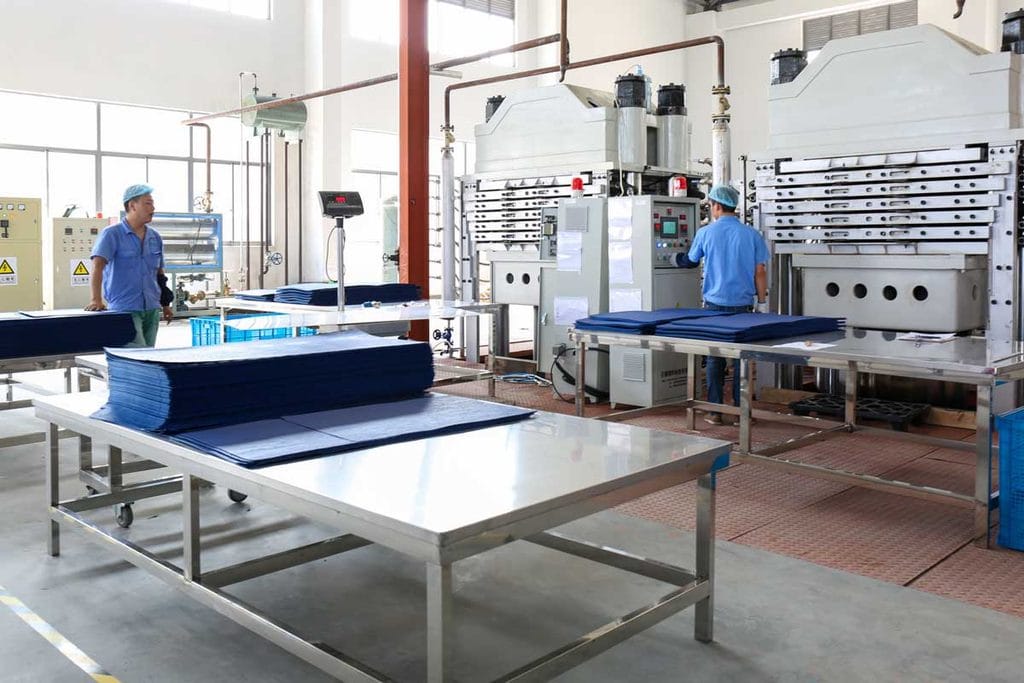
First, separate the Method, the agent, and the Forming Process
A description such as “chemically blown, irradiation-crosslinked sheet foam” covers three aspects of production: gas generation, polymer network formation, and product shape. Each term answers a different question.
| Term | The question it answers | Examples |
|---|---|---|
| Base material | What forms the solid framework? | EVA, polyethylene, polyurethane, rubber, or a polymer blend |
| Blowing agent or gas source | What supplies the gas? | A decomposing ingredient, a reactive ingredient, dissolved gas, or entrained air |
| Foaming method | How is gas introduced or generated? | Mechanical frothing, physical expansion, or chemical gas generation |
| Stabilization or crosslinking | How does the structure resist collapse and become fixed? | Cooling, crystallization, gelation, curing, or crosslinking, depending on the system |
| Forming process | How is the material given its production shape? | Extrusion, compression molding, casting, or bead molding |
| Cell structure | What cellular arrangement results? | Open cells, closed cells, mixed structures, skins and density gradients |
For example, “extruded foam” identifies a forming route but does not identify the gas source. “Crosslinked foam” describes the polymer network but does not tell you whether a chemical agent supplied the gas. Likewise, “closed-cell” describes the resulting structure rather than a single production method.
Individual ingredients, including decomposing powders and physical blowing media, are covered in the foam blowing agents guide. Selecting an ingredient is only one step; its gas must become part of a structure that survives the forming, cooling, and finishing processes.
What Must Happen for a Foam to Keep Its Shape?
Creating bubbles is only the start. A process can produce plenty of gas and still leave a dense, collapsed, or uneven product. The useful expansion is the volume retained after the material has stabilized, not simply the largest volume reached while it is hot.
Introduce gas or make it inside the material
Mechanical frothing disperses existing gas into a suitable liquid. In dissolved-gas physical foaming, gas is loaded into the polymer before expansion. In chemical foaming, gas is generated as an ingredient decomposes or reacts.
A mechanically frothed liquid already contains bubbles when it moves to the next operation. A gas-saturated polymer must first develop a separate gas phase. That difference determines whether the early process control focuses on preserving an existing froth or initiating cell formation.
Form and grow the cells
In dissolved-gas systems, a change in pressure or temperature can cause the polymer-gas mixture to become supersaturated. Gas then forms a separate phase, and small cells can develop through nucleation. Interfaces, particles, and existing microscopic cavities can influence where this happens.
Cells grow as gas enters them and their internal pressure works against the surrounding material. Gas availability matters, but so does the polymer’s resistance to stretching. A compound that is too resistant may expand poorly; one with insufficient strength may allow cell walls to thin and rupture.
In rubber-foam processing, viscosity, gas content, and temperature therefore need to be considered together. The same gas supply can produce different expansions when the surrounding medium has different resistance to flow and stretching. Cell growth must also be coordinated with the stage at which the structure becomes fixed. [1]
Stop growth before it collapses
The structure must become stable at the right stage. Thermoplastics may gain stability as they cool or crystallize. Reactive systems gain strength through curing, while latex froths can require gelation followed by vulcanization. Crosslinking can also help a polymer resist deformation during expansion.
Several changes can compete before the foam sets:
- Coalescence: neighboring bubbles merge when the separating wall fails.
- Gas loss: gas leaves the material before it can contribute to retained expansion.
- Drainage: in a wet froth, liquid moves out of the films between bubbles.
- Coarsening: gas redistribution can enlarge some bubbles at the expense of others.
- Collapse: the surrounding material cannot preserve the expanded structure.
These processes do not contribute equally across all polymer systems. A wet latex froth, a pressurized thermoplastic melt, and a curing rubber compound need different controls.
Mechanical Foaming: Mixing Gas Into a Liquid System
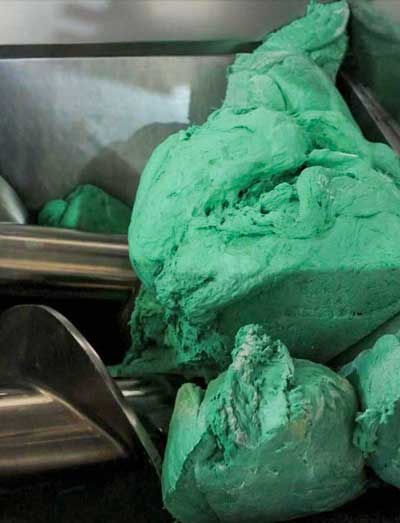
Mechanical foaming, also called mechanical frothing, involves introducing air or another suitable gas by mixing or beating. The starting material must be able to disperse the gas and hold bubbles until it gels, cures, or otherwise sets. Suitable systems include latex dispersions and certain liquid resins.
Mixing creates the wet froth. Gas dispersion, stabilizing ingredients, and viscosity help it survive until the setting step. The production target is a repeatable froth that can be transferred and fixed, rather than the greatest volume obtainable in the mixer.
From wet latex froth to solid rubber foam
In a conventional Dunlop sequence for natural-rubber latex, the compounded liquid is mechanically beaten to incorporate air. Gelling ingredients are added, the froth is placed in a mold, and gelation holds its shape before vulcanization. Washing and drying follow. [2]
The bubbles come from air incorporation; the gelling and curing ingredients act later to establish the solid structure. A mechanically frothed material can therefore undergo chemical setting without becoming a chemically blown foam. This sequence applies to the latex system described here.
What to check in a mechanically frothed product
Ask how long the wet froth remains workable and how it reaches the mold or substrate. Its stability must last through that transfer and the setting step. Include drying and any later curing when reviewing the production sequence.
For a foam backing or cushioning layer, inspect uniformity and bonding to the substrate, then assess recovery after the agreed conditioning. Measure density on the final dry layer using a defined sample basis. A smooth wet coating is an intermediate process observation, not a substitute for those finished-layer checks.
A mixer on an EVA or PE production line may instead be dispersing additives into a polymer compound. In that case, the gas can be generated or introduced at another stage. The presence of mixing equipment does not establish that the foam itself is mechanically frothed.
Physical Foaming: Loading Gas, Then Controlling Expansion
Physical foaming relies on a physical change in the blowing medium rather than a reaction that generates the expansion gas. Routes include gas dissolution under pressure and expansion of a volatile medium as conditions change. Carbon dioxide and nitrogen are gases used in polymer foaming research and production.
A representative dissolved-gas sequence is:
- Bring the polymer and gas together under controlled conditions.
- Allow enough gas uptake or mixing for the intended expansion.
- Change pressure or temperature to initiate cell formation and growth.
- Stabilize the expanded structure through the material’s cooling or setting sequence.
The required loading time and expansion conditions depend on gas solubility, diffusion, polymer grade, specimen dimensions, and the equipment. These are the details to resolve when moving from a route description to a production trial.
Gas loading and gas retention are different jobs
Getting gas into a polymer does not guarantee that enough will remain when expansion begins. A delay between saturation and heating, for example, can matter in a batch process. In continuous equipment, pressure, residence time, and the point at which expansion begins need to be controlled.
In batch-foamed TPU particles, CO2 alone and CO2-containing systems with water or ethanol can differ in gas uptake, gas loss, and the cellular structure produced during subsequent expansion. Desorption behavior can also change over the holding period. [3] For such a route, record the time between gas loading and expansion when comparing samples. A gas choice established for those TPU particles still needs to be qualified for a different grade or mat construction.
Physical foaming is not limited to an injection nozzle
Gas may be introduced into a melt during processing or absorbed into a polymer in a separate pressure vessel. Some routes separate gas loading from later expansion. A volatile medium may instead supply expansion through vaporization.
“Supercritical foaming” refers to the state and use of a fluid within a physical foaming route. It belongs within this process description rather than alongside mechanical, physical, and chemical foaming as a fourth equivalent category.
In polypropylene systems, physical foaming can be combined with different processing approaches, including foam injection molding with a physical blowing medium and pressure-based gas loading. The medium, polymer modification, and forming conditions are selected together. [4] When a supplier proposes a similar change, ask what must change in the material and equipment as well as in the gas supply.
Chemical Foaming: Matching Gas Generation to the Material
Chemical foaming generates gas within the formulation. Two mechanisms need to be distinguished: thermal decomposition of a blowing ingredient and gas-generating reactions between ingredients.
Thermal decomposition
In a decomposition-based system, an ingredient releases gas when activated under the processing conditions. The compound must remain processable long enough to expand, yet develop enough strength to hold the cells.
Gas generation that starts too early can cause the loss of useful gas during preparation. If it occurs after the material has become too resistant to expansion, the intended foam volume may not develop. An activator can change decomposition behavior, so the blowing-agent name alone does not define the processing window.
In an AC/ZnO system for molded PVC, zinc oxide can shift the thermal decomposition behavior of the blowing system toward the material’s processing window. [5] The practical objective is to keep the compound workable during preparation and release useful gas when it can expand. The activator package must be selected for the particular polymer and process; a PVC package is not a ready-made formulation for EVA.
Reaction-generated gas
Chemical foaming does not always mean adding a decomposing powder. In reactive polyurethane systems, water can react with isocyanate groups, generating CO2. The gas-forming reaction takes place within a system that is also developing its polymer structure.
In a water-blown polyester-PU prepolymer system, water supplies the gas-generating reaction while chain-extending and crosslinking ingredients help determine the developing polymer structure. Changing the balance can affect both density and mechanical response. [6] This differs from loading CO2 into an existing polymer: the gas may be the same species, but its source and the surrounding chemistry are different.
Classify water by its function in the formula. Water participating in reactive PU chemistry serves a different role than water used with CO2 as a blowing medium for TPU particles.
Expansion and curing must work together
In crosslinked foam systems, gas generation and network development influence each other. Too little resistance during expansion can leave cell walls weak; excessive resistance at the wrong stage can restrict growth. The useful balance depends on the formulation and thermal history.
An EPDM molding formulation can, for example, use AC as a gas and DCP as a crosslinking agent. The compound is mixed, shaped, processed in the mold, and cooled. [1] Treat gas generation and network formation as separate controls that must be coordinated, rather than assuming a single additive performs both functions.
Mechanical, Physical, and Chemical Foaming Compared
| Decision point | Mechanical frothing | Physical foaming | Chemical foaming |
|---|---|---|---|
| Gas source | Gas dispersed into a liquid or dispersion | Loaded gas or a volatile medium | Decomposition or reaction within the formula |
| Main early-stage control | Bubble incorporation and froth stability | Gas uptake, distribution and retention | Ingredient dispersion and gas-generation timing |
| Expansion control | Mixing, transfer and setting sequence | Pressure, temperature and polymer response | Reaction or decomposition rate matched to material response |
| Structure fixation | Gelation, curing, drying or other setting steps, as appropriate | Cooling, crystallization or another compatible stabilization step | Cooling and/or network development, depending on the polymer |
| Typical questions for the supplier | Does the froth remain stable before it sets? | Where and when is gas loaded and released? | How is gas generation coordinated with forming and curing? |
| Main difficulty to resolve | Preserving the wet bubble structure through transfer and setting | Keeping enough gas in the polymer until controlled expansion begins | Releasing gas while the compound can both expand and support the cells |
Compare cost at the finished-product level. Include line throughput, tooling, material yield, conditioning, finishing, and rejected production. A lower blowing-medium cost may offer little saving if the proposed route requires additional processing or produces fewer acceptable mats. Performance and relevant chemical testing remain part of approval for all three routes.
Crosslinking and Forming Need Their Own Description
Irradiation crosslinking is not proof of physical blowing
Crosslinking connects polymer chains. Irradiation is one way to create that network; by its name alone, it does not indicate how the gas is supplied.
One route for irradiation-crosslinked polypropylene incorporates a chemical blowing agent before extrusion. The extruded precursor is then irradiated to form the network and heated to activate the blowing agent. [7] Irradiation crosslinking and chemical gas generation therefore occur at different stages of the same route.
When reviewing XPE foam mat options, record the crosslinking method and blowing route separately. Neither XPE nor IXPE is sufficient evidence for a substance-specific absence claim.
Extrusion, molding, and casting describe another part of the process
An extrusion line can shape material continuously, but the extruder may produce either expanding foam or a precursor that is foamed later. Ask where expansion actually occurs.
Compression molding uses a mold and a controlled processing cycle. Expansion may be constrained during part of the cycle and may continue as pressure changes. The mold dimensions alone do not establish the dimensions of the conditioned finished part.
Casting places a liquid or reactive mixture into a form before it sets. Bead molding assembles expanded particles into a larger article; the particles’ expansion and their subsequent bonding are separate concerns.
For a roll, ask whether the foam expands continuously or is converted from previously foamed stock. For cut tiles, identify the sheet or block from which they are produced. For molded parts, confirm when dimensions are checked after release from the mold. These questions establish which operations can affect the product you are comparing.
The foam mat production process connects this stage with compounding, cutting, and finishing. Include those later operations in the sample plan, particularly when a mat will be laminated or printed after expansion.
What the Method Means for a Foam Mat
Density and cell uniformity
Density reflects mass per unit volume. A useful reduction requires expansion that remains stable through cooling, conditioning, and conversion. A sample with a low average density can still contain large voids or dense regions.
Ask where density samples are taken and whether they include the skin, film or other layers. A core-only value and a complete laminated-mat value are different measurement bases. Define the basis, conditioning, and tolerance when specifying foam density, so both suppliers are assessed against the same requirement.
Hardness, support and recovery
The route influences cell formation, but the mat’s response also depends on its polymer, additives, crosslinking, thickness, and surface layers. A fine-looking cell structure does not establish resistance to permanent indentation, and a soft hand feel does not measure impact protection.
For EVA foam mats, agree on the dimensions and expected loading before requesting a process adjustment. If a sample feels too soft, establish whether the concern is surface indentation, excessive compression under load, or slow recovery afterward. Those observations lead to different tests. Use hardness and thickness together, with consistent sample conditions and an application-relevant compression or recovery assessment.
Open cells, closed cells and the finished surface
Open cells communicate through openings; closed cells are separated by walls. Actual foams can contain a mixture, and the surface may differ from the core. The three method names alone do not guarantee a particular open-cell fraction.
A closed-cell foam core is only part of a layered mat. Film, cut edges, seams, and bonded layers affect the finished article, so water-related tests should cover the construction being sold. An intact surface and an exposed cut edge may present different conditions to the test.
Dimensions after conversion and packing
Define when length, width, and thickness will be measured. A result taken immediately after expansion is not necessarily comparable with one taken after conditioning, lamination or packed storage.
For puzzle tiles, check assembly fit. For foldable panels, check alignment and folds. For roll mats, check thickness across the width and the agreed flatness after unpacking. Testing should include the processing and packing steps that the production order will receive.
Lessons From Packaging, Insulation and Footwear
The same processing questions appear in other foam applications, but the required outcome changes. A packaging insert, an insulation panel and a shoe sole are selected for different loads and service conditions.
Packaging starts with the object being protected. Consider a foam insert supporting a piece of equipment: its dimensions and loading conditions should be included in the evaluation alongside foam density and thickness. For a mat supporting equipment, the corresponding purchasing questions concern contact areas, loading, and the acceptable deformation. A package-drop result, however, cannot establish protection for a person using a mat.
Insulation asks a different question of the cells. The concern is heat transfer through the foam and its behavior over the intended service conditions. Cell structure and the gas phase therefore matter for reasons beyond reducing weight. If thermal performance is part of a mat brief, specify it separately from traction, support, and recovery; none of those measurements stands in for the others.
Footwear separates first-touch softness from repeated-use behavior. A cushioning material can be evaluated for how it compresses and recovers, rather than only how it feels when pressed once. The same distinction applies to exercise and standing mats, but the specimen’s shape, thickness, and loading must match the mat application. A sole or bead-foam result cannot simply be assigned to a larger floor product.
These comparisons help identify what to measure without forcing every application into the same density, hardness, or cell-size target.
Does Physical Foaming Mean Cleaner or Safer Foam?
A route that does not use a particular decomposing blowing ingredient avoids that ingredient’s decomposition pathway. That is narrower than proving the absence of all residues or emissions from the finished product.
Other additives, polymer processing, printing, films, and adhesives remain part of the construction. Mechanical frothing also uses a formulated system and may involve curing and post-treatment. Define the chemical test scope for those inputs and layers, then link the report to the finished sample.
Environmental comparisons need a wider accounting as well. Consider the polymer network, mixed layers, process inputs, expected service life, and available recovery route before making claims about recyclability or overall environmental burden. Replacing a single blowing medium addresses only part of that assessment.
For example, formamide content and emissions are different measurements. A claim based on either needs to identify the sample, method, and reporting limit. Agree on which result the customer requires for the product and sales market before commissioning the test.
How to Compare Two Proposed Production Routes
Suppose a supplier offers two routes for the same mat. Before comparing prices, make sure the samples answer the same brief: intended use, material construction, dimensions, surface, packaging, and acceptance tests.
Then request the following information:
| What to establish | What to record |
|---|---|
| The process being compared | Gas source, crosslinking or setting method, forming route and point of expansion |
| Sample identity | Material grade or agreed designation, layers, color, thickness, and production reference |
| Retained physical properties | Density, hardness, dimensions and application-relevant compression or recovery results |
| Uniformity | Agreed sampling positions across a sheet, roll or molded part |
| Conditioning history | Production date, conditioning, conversion, packing and time of measurement |
| Chemical evidence | Product-specific test scope and reports covering the relevant construction |
| Scale-up and later changes | Trial-production checks and changes requiring notification or requalification |
The supplier can document this scope without disclosing a proprietary recipe. A clear material designation, process description, and sample reference allow the buyer to track what was approved and what must remain consistent.
For a proposed process change, retain the approved sample and written tolerances. Build the comparison into the quality-control plan: assess trial-production material after the agreed conditioning and finishing, record any differences, and resolve them before approving the change. A lighter trial sample is useful only if it also meets the performance and dimensional requirements.
Frequently Asked Questions
Yes, in a broad classification that groups methods by physical gas introduction versus chemical gas generation. It is also useful to distinguish mechanical frothing because its wet-froth handling and setting controls differ from those of dissolved-gas expansion.
Yes. A formulation can use more than one gas source, and expansion may occur alongside curing or other reactions. Describe the role of each mechanism instead of forcing the whole process into a single word.
No. The heating medium and the source of the expansion gas are different questions. Steam used to heat or mold a material does not, on its own, identify how its cells were originally created.
No. Cell size is one part of the structure. Uniformity, wall integrity, density, polymer properties, and the finished layers also affect performance. Choose based on the intended loading, dimensions, and surface requirements rather than a cell photograph alone.
Not as a like-for-like ingredient substitution. The gas-loading system, pressure control, polymer response, expansion sequence, and stabilization may all need redevelopment. The new route needs its own sample and production qualification.
These categories cover the gas-incorporation and gas-generation routes discussed here. Broader porous-material manufacturing also includes methods such as incorporating hollow particles or removing a temporary phase. They should not be treated as identical to expanding gas bubbles within a mat compound.
Discuss the Product Before Choosing the Route
Start the project brief with the mat’s intended use and the properties that must be maintained after finishing and packing. If the customer requires a particular blowing route, include that requirement before sample development begins.
To discuss a foam-mat project with NEEU, provide the preferred material, dimensions, target feel, loading conditions, surface layers, order quantity, and sales market. Include any customer test protocol and identify which details are still open, such as the final laminate or packaging. The sample plan can then cover the proposed product rather than an unfinished version.
Selected References
- Bian, C. (2015). Preparation and Properties of EPDM/SBR Foams. Master’s thesis, Shaanxi University of Science and Technology. In Chinese. ↩︎
- Sukkaneewat, B., and Utara, S. (2022). Ultrasonic-assisted Dunlop method for natural rubber latex foam production: Effects of irradiation time on morphology and physico-mechanical properties of the foam. Ultrasonics Sonochemistry, 82, 105873. DOI: 10.1016/j.ultsonch.2021.105873. ↩︎
- Li, H., Yang, W., Qin, L., and Yu, H. (2016). Preparation of TPU Microporous Foaming Material by Compound Foaming Agent. Plastics, 45(6), 59-61; references continued on p. 72. In Chinese. ↩︎
- He, Y., Pan, X., Xu, S., Liu, Y., and He, M. (2024). Research Progress of the Blowing Agent Applications in Polypropylene. China Plastics Industry, 52(9), 19-25. DOI: 10.3969/j.issn.1005-5770.2024.09.003. In Chinese. ↩︎
- Zhang, X., and Cui, Y. (2016). Effect of AC Foaming Agent and Plasticizer on Properties of PVC Foamed Materials. Plastics, 45(1), 32-34; references continued on p. 44. In Chinese. ↩︎
- Liu, H., Zhang, X., and Ma, F. (2019). Effect of Foaming Agent and Chain Extender / Cross Linker Agent on Polyester Polyurethane Foam. Synthetic Materials Aging and Application, 48(1). DOI: 10.16584/j.cnki.issn1671-5381.2019.01.007. In Chinese. ↩︎
- Baldwin, J., Sieradzki, P., and Geibler, P. (2015). Method for the production of irradiation crosslinked polypropylene foam. Patent publication WO2015103134A1. ↩︎