
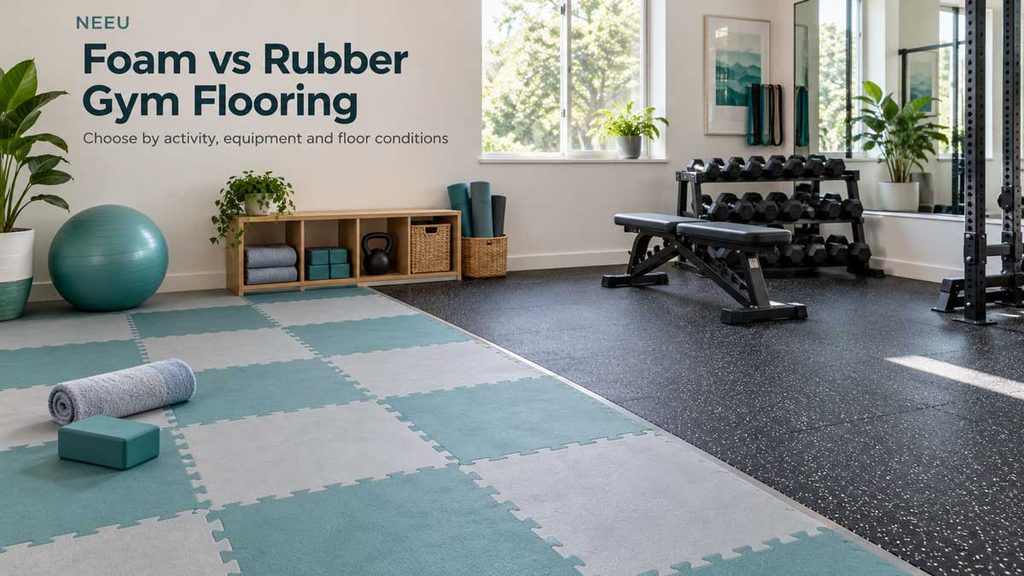
Foam gym flooring suits many home workout areas, especially for stretching, mobility, and bodyweight exercises on the floor. For a permanent strength-training area, start with rubber gym flooring designed for equipment and free weights. If you drop weights, look for a lifting floor or platform approved for that use—not just a thicker mat.
A mixed home gym may need both: a firm equipment zone and a separate, cushioned area for floor work. The choice depends less on which material feels softest in your hand than on what will happen on it every day.
Foam vs Rubber Gym Flooring at a Glance
Here, “foam” mainly means EVA foam exercise tiles. “Rubber” means gym flooring sold for training and equipment areas, including solid or rubber-granule products—not a thin natural-rubber yoga mat. Product construction matters: a rubber-faced tile with an EVA foam core is a hybrid, not the same thing as a full-depth rubber tile.
| Your main use | Where to start | What to check before buying |
|---|---|---|
| Stretching, kneeling and bodyweight floor exercises | Foam exercise mats | Comfortable support without bottoming out; surface texture against skin |
| A temporary workout area you put away afterward | Removable foam tiles or exercise mats | Packed size, handling weight, edge fit and storage space |
| Standing circuits, lunges and frequent changes of direction | A firm training surface; compare suitable foam and rubber products | Foot stability, grip, floor movement and joints opening under use |
| A treadmill, exercise bike or weight bench | Equipment-approved flooring or a dedicated equipment mat; compare load-suitable rubber options | The machine’s installation instructions, foot contact areas and long-term indentation |
| Dumbbells set down under control | Rubber flooring specified for free-weight use | Weight, contact shape, surface wear and protection of the floor beneath |
| Repeated barbell drops | A purpose-built lifting floor or platform | Documented drop conditions, supporting floor and noise requirements |
This is a shortlist by activity, not a load rating for every product in either category.
When Foam Mats Make Sense
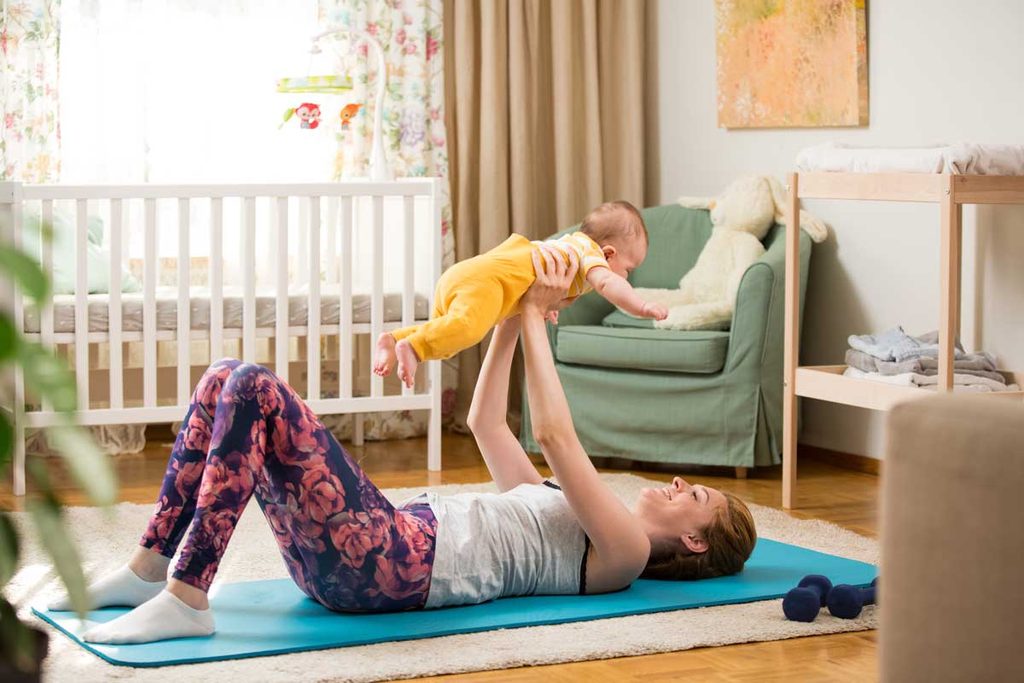
For a living room that becomes a workout space for half an hour, removable foam tiles can be convenient. They create a cushioned area for hands, elbows, and knees, then come apart for storage. You do not necessarily need permanent, room-wide gym flooring for that routine.
Try the movements you actually perform when assessing a sample. A mat that feels comfortable when you sit on it may feel too yielding under one foot during a lunge. A surface that suits shoes may feel rough against bare knees. Look for enough cushioning for floor contact without making standing movements feel unstable.
Exercise mat options for home workouts provide a starting point for this kind of space. If you need a modular area, interlocking foam mats let you assemble a layout from individual tiles. Interlocking edges describe how the pieces join; they don’t indicate suitability for a treadmill or dropped weights.
Foam flooring also should not be treated as a gymnastics landing mat. Tumbling, falls from apparatus, and similar activities require their own equipment and supervision.
When Rubber Flooring Is the Better Starting Point
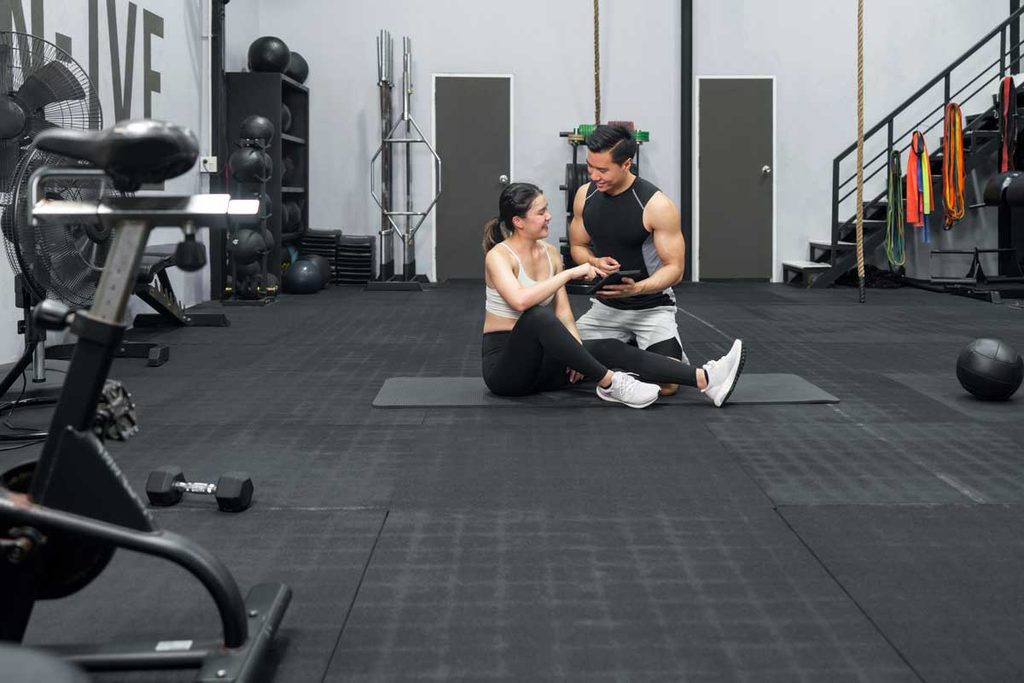
A permanent bench, rack, weight-storage stand, and free-weight area place different demands on the floor. Start with rubber products specified for those uses: the priorities are stable support, resistance to repeated contact and protection of the underlying surface, rather than softness for kneeling.
“Rubber gym flooring” still covers different systems. Equipment areas, general training areas, and lifting zones are not interchangeable applications.
If you also stretch in the room, a removable exercise mat on the designated floor-work area may be simpler than making the entire room softer. Keep transitions between zones secure and out of movement paths.
Placing Weights Is Different from Dropping Them
A dumbbell resting on a floor applies a sustained load. Dropping it adds an impact, influenced by its mass, drop height, and the shape that contacts the surface. A narrow edge can load a much smaller area than a broad, flat base.
For weights set down under control, check the flooring’s stated free-weight use and any restrictions. For repeated drops, ask for the complete approved system: surface, underlayers, installation and supporting floor. Rubber-coated dumbbells and bumper plates alone do not prove the floor beneath them is protected.
Do not use an improvised drop test to decide whether a domestic floor is safe. Flooring cannot establish the structural capacity of an upstairs room; that is a separate building question.
Equipment Needs Support, Not Just Cushioning
A machine’s total weight is only part of the decision. Its feet concentrate that load into small areas, and the user adds load during exercise. A soft layer beneath those feet can compress unevenly, leave persistent dents, or allow movement.
Can You Put Foam Mats Under a Treadmill?
Only when the particular mat and treadmill installation requirements are compatible. A generic EVA puzzle mat should not be assumed suitable because its packaging says “gym mat.” Start with the machine manual, then choose an equipment mat or flooring product intended for that installation.
Horizon Fitness’s treadmill placement guidance calls for a level, stable surface and unobstructed air openings. Its instructions also specify operating conditions and clearances; follow those for your model rather than copying another treadmill’s dimensions.
Before ordering, give the flooring supplier the equipment model, machine weight, user load, foot dimensions, and existing floor type. For a bench or rack, include the stored or lifted weights and any anchoring requirements. Do not substitute extra cushioning for the equipment manufacturer’s installation instructions.
Quick Rebound Does Not Prove Long-Term Recovery
A springy feel does not prove a mat will recover after a machine has stood on it for months. Ball rebound and recovery after prolonged compression measure different behavior. In chemically foamed EVA/nylon-elastomer blends, higher rebound has occurred alongside lower compression recovery under sustained laboratory loading. The practical point is to assess these properties separately, not to assign those experimental results to every EVA mat. Material data and test conditions.
For an equipment area, ask about indentation and recovery under relevant sustained loads. Our guide to foam compression set and recovery explains what those results can—and cannot—tell you about a finished mat.
Thickness, Firmness and Grip: Compare the Finished Product
No single thickness makes every foam or rubber floor suitable for a home gym. Two products of equal thickness can behave differently because of their formulation, density, cell structure, and layers.
A thicker soft foam may feel comfortable for floor exercises while still being unsuitable under equipment feet. A thinner, firm rubber product may be intended for machines but not repeated weight drops. Select the intended use first, then compare thickness within suitable product systems. For foam specifications, hardness and thickness need to be considered together.
Grip also involves more than the top texture. Consider the shoe-to-mat contact, the mat-to-floor contact, and the joints between pieces. During an ordinary, controlled sample trial, look for sliding, edge lift, gaps, and excessive sinking. Do this without heavy equipment or dropped loads; it is a usability check, not a substitute for performance testing.
Check the Floor Underneath Before Installation
The same mat can behave differently over flat concrete, finished wood, vinyl or carpet. Check both the gym-flooring instructions and the existing floor’s requirements.
- Flatness and stability: A cushioned surface does not correct an uneven base. Carpet and underlay can add movement; use a system that explicitly allows carpet installation.
- Moisture: Resolve dampness or leaks before covering a basement or garage floor. Follow any specified moisture testing and preparation requirements.
- Surface compatibility: Confirm that the backing, adhesive, and any proposed separator are compatible with the existing finish.
- Edges and clearance: Allow for doors, equipment access, and specified perimeter gaps. Finish exposed edges as the system requires.
Compatibility is not theoretical. Mannington’s ADURA Rigid care instructions prohibit rubber-backed mats because they can stain or damage that flooring. This is a product-specific restriction, not a rule that every rubber floor damages every vinyl floor. Check your own floor’s instructions before buying.
Avoid adding an unapproved plastic sheet, carpet layer, or foam underlay as a workaround. It changes the assembly you are relying on for stability and moisture management.
Will Foam or Rubber Make an Upstairs Gym Quiet?
Neither material name is a soundproofing specification. Noise includes sound heard in the room and vibration transmitted into the building. Reducing the sharp sound of a weight landing does not establish how much noise reaches the room below.
Additional high-density NBR rubber padding reduced measured impact noise and floor acceleration in controlled barbell-drop trials on an existing hard-rubber gym floor. That result supports using an appropriate cushioning system for a defined impact; it does not establish the performance of an EVA puzzle mat or predict sound isolation in a home. Impact-noise and vibration measurements.
In an apartment, first consider whether the activity suits the building. Controlled weight placement and lower-impact exercise reduce the problem at its source. If you plan heavy lifting or repeated impacts, ask about a tested acoustic flooring assembly and get advice from the building. Room finishes, floor structure, and installation all affect the result.
Cleaning, Wear and the Cost of Living with the Floor
Sweat, dust and small spills are routine in a home gym. Use the cleaning method specified for the finished surface; a cleaner suitable for rubber may not suit a foam coating, adhesive or the floor underneath.
A wipe-clean tile does not make its joints watertight. Remove spills promptly, and make sure removable mats and the floor beneath them are dry before reassembly. The distinction between material absorption and water passing through joints is covered in our foam mat water-resistance guide.
Look beyond surface scuffs when checking wear. Persistent dents, loose joints, damaged edges, or a separating top layer can affect how the area functions. Replace damaged pieces with the same compatible system; a similar-looking puzzle edge may not fit.
When comparing costs, price the completed area, including flooring, delivery, edging, installation materials, preparation, and any dedicated lifting platform. If the room must be cleared regularly, also compare the actual packed weight and storage volume. A low tile price isn’t a saving if you have to replace the installation when you add equipment.
Planning a Mixed Home Gym
Consider a room with an exercise bike, a dumbbell stand, and an open area for stretching. The bike and stand need suitable equipment support; the open area can use a removable foam mat. Keeping the mat outside the equipment footprint lets you lift it for cleaning or put it away without moving the machines.
Mark the equipment footprint, exercise space, and access routes before ordering. If you plan to add barbell training later, reserve space for a suitable lifting system rather than assuming the original floor can take the new impacts.
Frequently Asked Questions
What About the Smell of New Gym Flooring?
Assess the particular product, not “foam” or “rubber” as a whole. Odor alone isn’t a reliable measure of indoor air quality, as the EPA’s indoor-odor guidance explains. Ask for finished-product emissions information relevant to indoor use and follow installation and ventilation instructions. A smell fading after unpacking does not, on its own, establish product safety.
Can I Stack Foam Tiles to Get More Protection?
Do not assume stacking improves the installation. Loose layers can move against each other and make equipment support less stable. Use additional layers only when they are part of the manufacturer’s specified system.
Can I Keep Foam Flooring If I Add Dumbbells Later?
Possibly for the floor-exercise area, but reassess where you’ll use and store the weights. A separate free-weight zone may let you keep the foam without placing equipment or impacts on a surface chosen only for cushioning.
Should I Cover the Whole Room?
Not necessarily. Cover the area needed for the activity, equipment, and safe access, following the relevant installation instructions. A smaller, correctly specified zone can be more useful than room-wide flooring that does not suit the main workout.
Choosing Foam Mats for a Home-Workout Product Range?
For brands, distributors, and gym buyers evaluating foam mats, specify the workout before choosing colors or thickness. Include whether the area is temporary or permanent, the existing floor, equipment details, and any expected weight impacts.
Review mats for your workout area with NEEU. Use that brief to discuss a foam-mat specification and the sample checks needed for the intended use. If the application calls for dedicated heavy-lifting flooring, make that requirement explicit rather than treating a general exercise mat as an equivalent.