
EVA Foam Explained: Copolymer Structure, VA Content, and Foam Mat Applications
EVA foam starts with a resin made from two building blocks: ethylene and vinyl acetate. Combining them in one polymer chain gives manufacturers a broad working range between polyethylene-like stiffness and a softer, more flexible material. That range is one reason EVA appears in interlocking floor tiles, play mats, exercise products, protective pads and many other foamed goods.
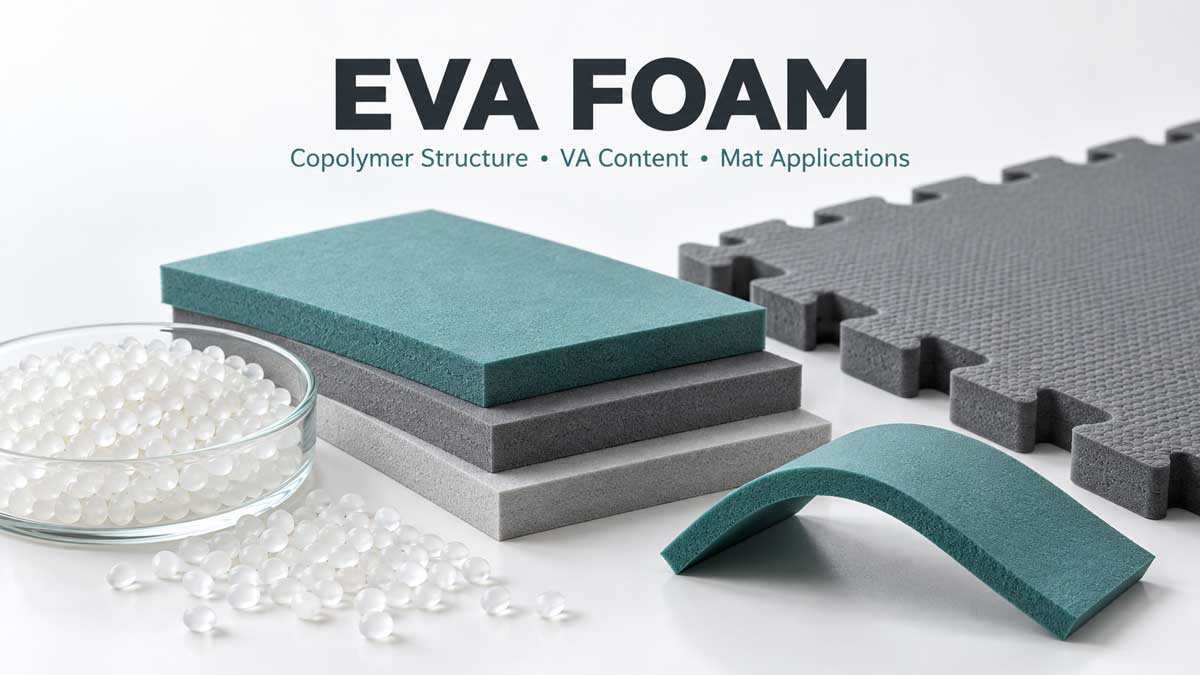
For a buyer, however, the letters EVA do not define a complete material specification. Vinyl acetate (VA) content matters, but so do melt flow rate, molecular structure, blending, fillers, crosslinking, gas generation, and the cell structure created during foaming. A finished mat must still be assessed at its intended density, hardness, thickness, and construction.
The short answer: EVA is an ethylene-vinyl acetate copolymer. Increasing VA content generally reduces crystallinity and shifts the resin toward greater flexibility and a lower softening temperature. It does not, by itself, tell you how soft, dense, resilient, durable, or chemically compliant a finished foam mat will be. Use VA content as one resin-selection input, then validate the actual compound and finished product.
What Does EVA Mean?
EVA stands for ethylene-vinyl acetate. It is produced by copolymerizing ethylene with vinyl acetate (VA). Ethylene also forms the backbone of polyethylene. Adding vinyl acetate units changes how regularly those chains can pack together.
Polyethylene chains can form ordered crystalline regions. Vinyl acetate units interrupt that regularity. As the proportion of VA rises, crystallinity generally falls, and the resin becomes more flexible. Celanese’s EVA processing guide describes the broad commercial trend as increasing flexibility, resilience, and transparency alongside a decreasing softening point as VA content increases.[1]
Those are resin-level tendencies, not a ready-made performance table for mats. Once the resin is compounded and expanded into foam, several additional variables enter the result.
What Is a Copolymer?
A polymer is a large molecule built from repeating chemical units. A homopolymer uses one type of monomer; a copolymer uses two or more. EVA contains units derived from both ethylene and vinyl acetate within the same molecular chains.
This is different from physically mixing two finished polymers. The distinction is useful when reading supplier documents:
| Term | What it describes | EVA example |
|---|---|---|
| Copolymer | Different monomer units joined within polymer chains | Ethylene and vinyl acetate units in EVA resin |
| Polymer blend | Two or more polymers physically mixed | EVA blended with PE, POE, EPDM, or another compatible material |
| Compound | Resin or resin blend mixed with functional ingredients | EVA plus fillers, pigments, crosslinking ingredients, blowing agents and processing aids |
| Foam | A cellular material created by expanding the compound | Closed-cell EVA sheet, tile, roll or molded part |
| Crosslinked foam | Foam whose polymer chains have been connected into a network | Chemically crosslinked EVA foam |
Calling a product “EVA foam” therefore identifies the main material family, but it does not disclose the complete formulation. Two products may both be sold as EVA while using different resin grades, blend ratios, expansion levels, and surface constructions.
How Ethylene and Vinyl Acetate Shape EVA
The ethylene-rich part of EVA contributes the polyolefin character associated with toughness and processability. Vinyl acetate introduces a bulkier, polar side group that disturbs chain packing. This structural change helps explain why EVA can be softer and more flexible than polyethylene while remaining thermoplastic before permanent crosslinking.
VA content is usually reported as a percentage by weight. Commercial suppliers offer EVA across a broad range of applications because film, adhesive, cable, molding, and foam applications do not require the same balance of properties. Celanese, for example, lists EVA families with multiple VA contents and a wide span of melt indexes.[2] SABIC lists a foaming grade with 18 wt% VA and an MFR of 2.5 g/10 min, illustrating that a commercial grade is identified by more than VA percentage alone.[33]
For foam mat sourcing, the most useful interpretation is directional:
- At lower VA content, EVA generally retains more polyethylene-like crystallinity and stiffness.
- As VA content increases, flexibility and low-temperature behavior generally improve while the softening point falls.
- Higher-VA grades can tolerate substantial loadings of suitable fillers in some formulations, but the outcome still depends on the resin, filler, and processing route.[1]
- A resin’s suitability for foaming also depends on melt strength, rheology, molecular architecture, and the selected process.
These trends should guide resin screening. They should not be converted into universal claims such as “higher VA always means a better mat.”
VA Content Is Not a Finished-Mat Hardness Setting
It is tempting to treat VA content as a softness dial. The chemistry is more complicated.
Changing the base resin can alter a compound’s initial flexibility. The hardness measured on a finished mat is then influenced by its expansion ratio, apparent density, cell size and uniformity, crosslink density, filler loading, blend components, surface skin, and test method. Thickness affects the user’s experience without being a measure of hardness.
This is why two mats made with EVA grades of similar VA content can feel different. One may have a lower apparent density and a softer initial compression response. Another may use more filler, a different crosslinking window, or a denser surface skin. A third may be laminated or embossed, changing what the hand or foot feels first.
When the purchasing question concerns cushioning, support, or indentation resistance, use the foam mat hardness and thickness guide to determine the finished-product measurements. VA content belongs in the material record; it does not replace those acceptance criteria.
VA Content and Melt Flow Rate Are Separate Grade Variables
Alongside VA content, resin data sheets commonly report melt index or melt flow rate (MI or MFR). The test measures how much molten polymer flows under stated temperature, load, and time conditions. It is a processing indicator, not a direct measurement of foam softness or product quality.
VA content and MFR can influence each other during polymer production, but they remain separate specifications. A Celanese grade table, for example, includes products with the same nominal 28% VA content and very different melt indexes for different uses.[4] That alone shows why an RFQ that requests only “high-VA EVA” is incomplete.
The selected MFR affects how the resin behaves during mixing and shaping. A formulation also needs enough melt strength to retain growing gas cells. If the material flows too readily under the actual foaming conditions, cells may merge or collapse. If the network becomes too restrictive too early, expansion may be limited. The useful processing window comes from the interaction of resin, formulation, crosslinking, and heat history.
For purchasing purposes, ask the supplier to identify the approved resin grade or an agreed equivalent, then control the finished-product specification. A brand name or resin number is useful for traceability, but it still does not replace sample testing.
From EVA Resin to EVA Foam
The pellets arriving at a factory are only the starting material. Turning them into a stable foam mat involves a connected production sequence.
1. Resin and formulation selection
The manufacturer selects an EVA grade, or a defined blend, that suits the forming route and the intended product. This decision considers more than softness. Processing temperature, flow behavior, filler acceptance, color, required expansion, and the target physical properties all matter.
2. Compounding and dispersion
Resin is mixed with the ingredients needed for the selected foam system. Depending on the formulation, these may include a blowing agent, a crosslinking agent, a filler, a pigment, an activator, and a processing aid. Distribution matters: local differences in ingredient concentration can become visible differences in color, cell structure, density, or surface quality.
NEEU’s compounding and mixing process explains where weighing, recipe control, and homogeneous mixing fit into foam mat manufacturing.
3. Crosslinking
Crosslinking joins portions of the polymer chains into a network. In many molded EVA foam systems, the network helps the material retain gas during expansion. Crosslinking and foaming may develop in the same heating cycle, but they are distinct mechanisms: one builds the polymer network; the other creates gas and cells.
NEEU’s overview of the foaming process shows where network formation and expansion sit within EVA mat production. A process label such as “chemically crosslinked” describes the route, not a guaranteed level of resilience or durability.
4. Gas generation and expansion
Foaming creates the cellular structure. Chemical blowing agents release gas through a temperature-dependent reaction; other foam systems may introduce gas by physical means. The gas must be generated while the polymer has a suitable resistance to flow and stretching.
The foam blowing-agent guide separates gas generation from crosslinking and explains why a blowing-agent name alone cannot predict finished mat quality.
5. Forming, cooling and conversion
The expanded material is formed into sheets, blocks, or molded parts, then cooled and converted into the required mat. Cutting, embossing, printing, lamination, edge treatment, and packaging can all affect the final construction. The complete foam mat production process shows how these stages connect.
Why the Cell Structure Matters
Once EVA becomes foam, much of its volume is occupied by gas trapped within cells. The solid copolymer remains essential, but the cellular architecture strongly affects how the product responds to load.
Buyers may hear terms such as closed-cell, cell size, cell density, and cell uniformity. These describe different features:
- Closed-cell structure means most cells are enclosed rather than openly connected.
- Cell size refers to the dimensions of individual cells, typically assessed microscopically.
- Cell density counts cells within a defined volume; it is not the same as the foam’s apparent density.
- Uniformity concerns the distribution of cells and defects across the material.
Research reviews of EVA foam emphasize that physical and mechanical properties can vary with cell structure, crosslinking and blowing agents, processing conditions, and polymer blending.[5] That is why the resin’s VA percentage should never be used as a shortcut for the complete foam structure.
In commercial evaluation, microscopic analysis may support development or the investigation of defects. Routine buying decisions usually begin with finished density, dimensions, hardness, compression response, recovery, tensile or tear behavior where relevant, and visual consistency.
EVA Copolymer, EVA Compound and EVA Blend
These terms often blur together in quotations. Separating them prevents costly assumptions.
EVA copolymer
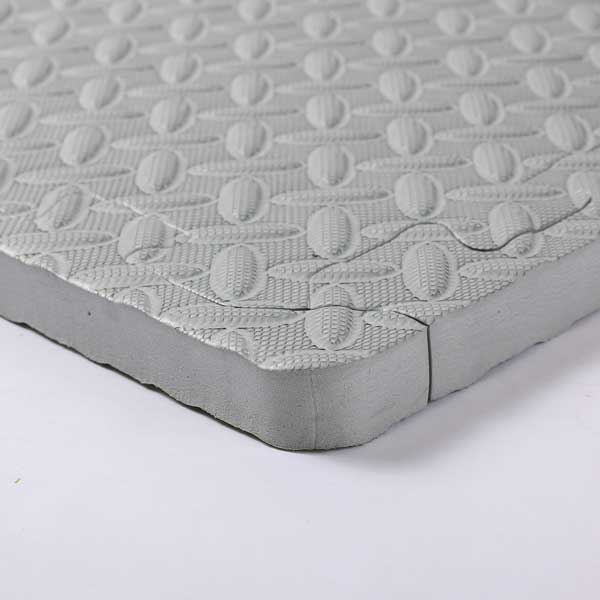
This is the base resin produced from ethylene and vinyl acetate. Its grade normally includes at least a VA content and MFR, along with other supplier data.
EVA compound
A compound is the production mixture prepared for processing. It may contain one or more EVA grades, along with other polymers and functional ingredients. Compound formulation is usually proprietary, but the buyer can still define restricted substances, color, density, hardness, odor expectations, and finished performance.
EVA blend
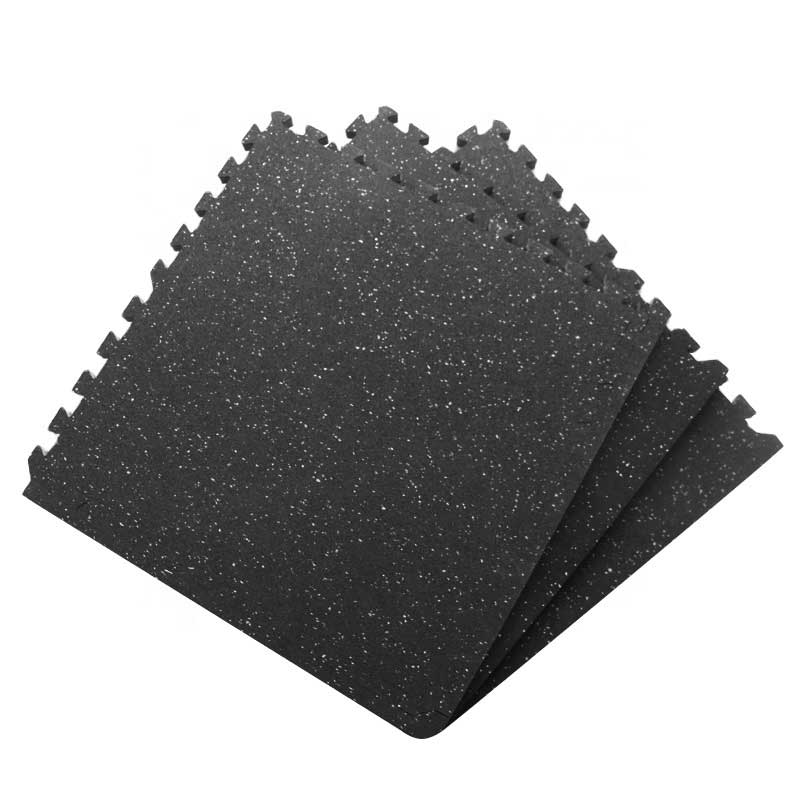
A blend combines EVA with another polymer. PE/EVA, EVA/POE and EVA/EPDM systems are examples found in research and industry. Blending may be used to adjust processing, flexibility, recovery, strength, cost, or another target. Results depend on compatibility, ratios, and processing conditions.
A review of PE/EVA blends found that blend composition and mixing conditions affected compatibility, rheology, and mechanical behavior, with different PE types producing different results.[6] Those findings explain why “contains PE” or “modified EVA” is not enough information to rank a mat. They do not provide a universal recipe for commercial EVA tiles.
Does More EVA Mean Better EVA Foam?
There is no single percentage that proves quality. “100% EVA” can be ambiguous: it may refer to the polymer portion, the main resin family, or a marketing claim that excludes additives required for foaming and color.
A workable foam compound typically contains ingredients in addition to the base polymer. The relevant questions are whether the material declaration is accurate, whether restricted substances are controlled, whether the batch matches the approved construction, and whether the finished mat meets its specification.
If a buyer needs a composition statement, the request should define its basis. Ask whether percentages refer to total compound mass, total polymer content, or the finished product. Confidential formulas can be protected while still supplying the declarations and test evidence required for a target market.
Matching EVA Foam to Mat Applications
EVA serves different roles across a product range. The material direction should begin with the use case rather than a preferred VA number.
| Application | What the construction must balance | What to verify on the finished sample |
|---|---|---|
| Interlocking floor tiles | Support, cushioning, tile fit, edge strength and dimensional stability | Thickness, hardness method, density basis, interlock fit, recovery and flatness |
| Baby and children’s play mats | Comfortable floor separation, cleanable surface, stable assembly and target-market safety | Finished construction, seams or teeth, surface durability, odor protocol and applicable chemical/mechanical tests |
| Exercise and multipurpose mats | Cushioning, controlled support, surface grip and handling | Compression feel, recovery, thickness, surface and underside stability |
| Gym and equipment mats | Resistance to concentrated loads, abrasion and movement | Load-recovery plan, indentation, tear or abrasion where relevant, edge stability and floor compatibility |
| Protective pads and converted foam parts | Fit, impact management, repeatable geometry and packing efficiency | Dimensions, density, compression response, cutting tolerance and recovery after storage |
For interlocking and roll formats, the EVA foam mats material page shows the product family that this resin-and-foam knowledge supports. Product selection still requires an approved sample and an application-specific acceptance plan.
What VA Content Cannot Tell You?
Several questions sit outside the scope of a VA percentage.
It does not establish apparent density
Foam density depends heavily on expansion and formulation. A resin can be processed into multiple densities, subject to the practical limits of the process and required performance.
It does not establish hardness
Base-resin flexibility contributes to the result, but expansion, fillers, crosslinking, and test conditions all affect the reading.
It does not identify the blowing agent
VA is a comonomer incorporated into EVA. A blowing agent is a separate formulation component or gas source used to create cells.
It does not identify the crosslinking route
EVA may be processed through different crosslinking and forming systems. The resin name alone does not tell you which one was used.
It does not prove chemical compliance
VA content is not a test for residual chemicals, emissions, formamide, restricted substances, or market access. Those questions need the relevant material controls and finished-product test methods. For one commonly discussed issue, see formamide in foam mats.
It does not prove recyclability or environmental impact
The base polymer name is only one part of an environmental assessment. Crosslinking, additives, contamination, collection systems, transport, and available recycling routes all matter. Avoid broad “eco-friendly” claims based solely on EVA chemistry.
How B2B Buyers Should Specify EVA Foam
A useful specification connects the resin record to the finished product without trying to reverse-engineer a proprietary recipe.
Include the following information in the RFQ or development brief:
- Product format: puzzle tile, roll, molded pad, exercise mat, or another construction.
- Intended use: user group, floor type, load, cleaning method, installation, and expected service conditions.
- Material declaration: EVA-based construction, permitted blends, and any composition disclosure required by your company or market.
- Approved resin control: grade, agreed equivalent or documented change-control process where this is commercially necessary.
- Finished dimensions: length, width, thickness, edge or tooth geometry and tolerances.
- Physical targets: apparent density basis, hardness scale and method, compression or recovery requirement, tensile or tear checks where relevant.
- Surface construction: embossing, skin, print, film, lamination, backing and color standard.
- Chemical requirements: destination market, product category, restricted-substance list and test protocol.
- Sample plan: laboratory sample, appearance sample, functional sample, and pre-production sample as needed.
- Production controls: inspection points, permitted tolerances, traceability, and approval rules for material or process changes.
NEEU’s design and customization capabilities can be used to organize these decisions into a product brief before sampling.
A Practical Sample Approval Plan
Start with the decisions that can be compared directly. If VA content is commercially important, record it alongside the resin grade and MFR rather than placing it alone at the top of the specification.
On the finished sample:
- confirm dimensions and thickness at agreed positions;
- measure hardness using the stated scale and conditions;
- confirm apparent density or unit weight using an agreed basis;
- assess compression and recovery under a representative load;
- inspect cell and surface consistency at cut edges where appropriate;
- check interlock fit, roll recovery or fold behavior for the selected format;
- evaluate odor using an agreed conditioning and assessment protocol;
- complete the applicable chemical and mechanical tests for the destination market;
- retain the approved sample and its material record for production comparison.
During production, compare batch data and finished goods with the agreed tolerances. A supplier substitution may be technically workable, but it should not silently change the approved feel, dimensions, surface, test status, or processing behavior.
Common EVA Foam Misunderstandings
“EVA is a rubber”
EVA is a thermoplastic copolymer, although flexible grades and foamed products can feel rubber-like. Crosslinking can create a permanent network, but that does not change EVA into natural rubber.
“EVA and PE foam are the same”
They are related polyolefin-based material systems, not identical polymers. EVA contains vinyl acetate units; polyethylene does not. XPE and IXPE commonly refer to crosslinked polyethylene foam routes, while EVA foam begins with an EVA resin or blend.
“Higher VA always gives better cushioning”
Higher VA generally moves the base resin toward greater flexibility, but cushioning depends on the finished foam’s thickness, density, cellular structure, and compression response. “Better” also depends on whether the application requires plush comfort, controlled support, or resistance to concentrated loads.
“The VA percentage tells me whether the mat is safe”
It does not. Chemical safety and market access depend on the product category, formulation, manufacturing control, and applicable testing. VA content is a resin specification, not a compliance certificate.
“One resin data sheet is enough to approve production”
A data sheet describes a resin under specified tests. The buyer receives a compounded, foamed, and converted product. Approval should therefore include the finished mat and its intended use.
Frequently Asked Questions
Its polymer base is ethylene-vinyl acetate copolymer. A commercial foam compound may also contain other polymers, blowing and crosslinking ingredients, fillers, pigments and processing aids. The precise formulation depends on the product and manufacturing route.
It is the weight percentage of vinyl acetate incorporated into the EVA copolymer. It helps characterize the resin and influences crystallinity, flexibility, softening behavior, and compatibility. It is only one part of a usable grade specification.
There is no universal best value. The manufacturer selects a grade or blend around the processing route and the required finished properties. Buyers should approve the mat against use-specific requirements for density, hardness, thickness, recovery, surface, and safety.
Not necessarily. Higher VA generally makes the unfoamed resin more flexible, but the finished foam also reflects expansion, fillers, crosslinking, cell structure, surface skin and measurement conditions.
No. VA content describes comonomer incorporated into the polymer. Emissions or residual chemicals are separate analytical questions requiring defined test methods and conditions.
Many EVA foam mats use a predominantly closed-cell construction. The actual cellular structure depends on formulation and processing, so it should be confirmed for the proposed product rather than inferred only from the material name.
Yes. EVA is used in blends with PE, POE, EPDM, and other materials in research and commercial compounding. A blend should be evaluated as its own formulation because compatibility, ratio, and processing affect the result.
Foaming and crosslinking are different mechanisms. Many EVA mat processes use crosslinking to provide network strength during expansion, but the exact route depends on the product and equipment. Confirm both the crosslinking route and the gas-generation method when they matter to the specification.
Choose the Finished Mat, Not a Single Chemistry Number
VA content explains why EVA covers such a wide range of flexible products. It helps distinguish resin grades and provides useful clues about processing and base-material behavior. It cannot describe a finished foam mat on its own.
The better sourcing sequence is straightforward: define the application, select a workable material and process route, approve the finished construction, then control the measurements that matter in production. This connects polymer knowledge to a product that can actually be quoted, sampled, and inspected.
Developing an EVA foam mat? Send NEEU the intended application, format, dimensions, thickness, feel, surface, target market, and annual volume. Our team can review the brief and prepare a sample development route based on the finished-product requirements.
Selected References
- Celanese. General Extrusion Guide: Celanese EVA Polymers. https://www.celanese.com/-/media/EVA%20Polymers/Files/Product%20Technical%20Guides/EVA-015-GeneralExtrusionGuide-TG-EN-1115.pdf ↩︎
- Celanese. Ethylene Vinyl Acetate (EVA) Polymers: Ateva and VitalDose. https://www.celanese.com/products/ateva_eva_polymers ↩︎
- SABIC. SABIC EVA 2518DF. https://www.sabic.com/en/products/polymers/ethylene-vinyl-acetate-eva/sabic-eva ↩︎
- Celanese. Ateva Standard Grades: Ethylene Vinyl Acetate Copolymers. https://www.celanese.com/-/media/EVA-Polymers/Files/Brochures/Celanese_EVA_Product_Brochure.pdf ↩︎
- Swathy, K. K., Verma, R., and Kumar, L. “Ethylene-Vinyl Acetate Foam.” In Polymeric Foams: Fundamentals and Types of Foams, ACS Symposium Series 1439, 2023, pp. 205-221. https://doi.org/10.1021/bk-2023-1439.ch010 ↩︎
- Ding, Y., Zhang, H., Liu, Q., et al. “Research Progress of PE/EVA Blending Modification.” Chemical Industry Times, 2020, 34(10). https://doi.org/10.16597/j.cnki.issn.1002-154x.2020.10.007 ↩︎